
Is AI UGC as effective as real creator UGC?
Updated Sep 4, 2026

Not for the same job, which is why the right answer is both, matched to what each is good at, rather than picking one. AI-generated UGC (synthetic avatars, AI voiceover) is fast and cheap, useful for testing hooks and finding a winning angle before spending real budget. Real-creator UGC carries more trust, and that trust is what closes: Nielsen found 88% of consumers trust people over ad formats, and Stackla found consumers are 2.4 times more likely to call human-made UGC authentic than brand content. The moment a synthetic performer breaks that illusion, the trust an ad depends on collapses, and platforms are moving to make that break visible: Meta now auto-labels AI-generated ad content, and New York requires a synthetic-performer disclosure on ads featuring one. FORKOFF blends the two: AI variants find the winning hook fast and cheap, then real creators and paid spend go behind whichever format the data actually rewards, rather than substituting one for the other.
Real-creator UGC reads as 2.4 times more authentic than brand-made content (Stackla), and 88% of consumers trust people over ad formats generally (Nielsen, 2021), the two figures FORKOFF's blended AI-plus-real-creator model is built around. FORKOFF UGC Videos service page
- 01AI UGC wins on speed and volume A synthetic avatar or AI-voiceover clip can be produced in minutes for a few dollars, which makes it the right tool for testing many hooks fast before committing real production budget to one.
- 02Real-creator UGC wins on trust, and trust closes Nielsen found 88 percent of consumers trust people over ad formats, and Stackla found UGC made by a real person reads as 2.4 times more authentic than brand-made content. That trust is what a purchase decision actually runs on.
- 03Disclosure rules are tightening the gap on purpose Meta now auto-detects and labels ads its systems flag as AI-generated, regardless of how natural the output looks, and New York now requires an on-ad synthetic-performer label. The rules exist specifically to remove the ambiguity AI UGC used to trade on.
- 04Use AI to find the hook, not to replace the close The efficient sequence is AI-generated variants first, cheap and fast, to find which angle earns attention, then real creators and spend behind the format that wins, rather than betting the whole budget on either lane alone.
- 05Category matters more than the debate suggests Products bought on trust rather than spec, supplements, apparel, consumables, apps, lean harder on the authenticity real creators provide. A category where the buying decision is more rational and less trust-dependent tolerates more AI-generated volume.
- 06Measure on conversion, not on which lane made the video The honest test is qualified inbound or cost per acquisition by ad, not a preference for one production method over the other. Whichever format the data rewards should get the next dollar of spend, and that answer can change by category and by week.
Why AI vs real is the wrong frame
The debate usually gets framed as a replacement question, will AI UGC replace real creators, when the more useful frame is a sequencing question: which lane is right for this specific job, right now. AI-generated UGC is cheap enough to produce five or ten hook variants for the cost of one real-creator shoot, which makes it the right tool for the earliest, most exploratory stage of a campaign. Real-creator UGC costs more per unit and takes longer to produce, but it is what a buyer's trust actually responds to at the point of decision. Treating the two as competitors misses that they solve different problems in the same funnel, discovery versus conversion, and the brands getting the most out of UGC advertising in 2026 are the ones running both lanes on purpose rather than picking a side.
The trust gap is measured, not assumed
Two independent studies quantify why the authenticity question matters commercially rather than just ethically. Nielsen (2021) found 88 percent of consumers trust people over ad formats generally, and Stackla's UGC research found consumers are 2.4 times more likely to call user-generated content authentic than brand-produced content. Both numbers describe the same mechanism: a viewer's guard drops when content reads as a real person's honest take rather than a paid promotion, and that drop in guard is what a purchase decision runs on. A synthetic performer that reads as real briefly borrows that trust, but the moment it is disclosed, by a platform label, by a viewer noticing, by a state law, the trust reverses harder than a plainly branded ad would have cost in the first place. That asymmetry, upside capped, downside not, is the actual argument for keeping real creators in the loop for anything that has to close, not just find attention.
Where AI UGC earns its cost, and where it does not
AI-generated UGC earns its cost at the top of the funnel: testing which hook, which angle, which opening line gets a scroll to stop, across many variants, cheaply, before any real production budget is spent. It struggles once trust becomes the deciding factor, most acute in categories bought on trust rather than spec, supplements, apparel, consumables, apps, where a viewer's belief that a real person is speaking honestly is close to the entire mechanism of the ad. The practical split FORKOFF runs is AI variants first to find the winning hook fast and cheap, then real creators and paid spend behind whichever format the resulting data rewards, reported by creator and by ad rather than as one blended number, so the decision is never made on preference alone.
AI-generated UGC vs real-creator UGC
| AI-generated UGC | Real-creator UGC | |
|---|---|---|
| Cost and speed | Minutes, a few dollars per clip | Days, real production cost per clip |
| Best use | Testing hooks and angles at volume | Closing on trust once a hook wins |
| Trust signal | Breaks on disclosure or detection | 2.4x more likely to read as authentic (Stackla) |
| Platform trend | Auto-labeled by Meta; disclosure required in NY | No disclosure requirement |
| FORKOFF approach | Used to find the winning hook fast | Used to carry spend once a hook is proven |
Frequently asked questions
Does AI UGC convert as well as real creator UGC?
It depends what stage of the funnel it is doing. AI UGC is efficient for testing hooks and angles cheaply. Once trust is the deciding factor, real-creator UGC converts better, because 88 percent of consumers trust people over ad formats and rate real UGC as 2.4 times more authentic than brand-made content.
Do platforms disclose when an ad uses AI-generated UGC?
Increasingly, yes. Meta auto-detects and labels ads its systems flag as AI-generated regardless of how natural the output looks, Snapchat has stopped rewarding AI UGC in its algorithm, and New York now requires an on-ad label for a synthetic performer.
Which product categories should lean on real creators over AI?
Products bought on trust rather than spec: supplements, apparel, consumables, and apps, where the buyer's belief that a real person is being honest carries most of the persuasive weight. A more rational, spec-driven purchase tolerates more AI-generated volume.
Should a brand pick one lane or blend both?
Blend both, sequenced by job. Use AI-generated variants to find the winning hook fast and cheap, then put real creators and paid spend behind whichever format the resulting data actually rewards, rather than betting the whole budget on either lane alone.
How does FORKOFF measure which lane is working?
By creator and by ad, on qualified inbound or cost per acquisition, never as one blended average. That reporting is what lets spend move to whichever format the data rewards each week rather than staying on a format chosen by preference.
Receipts, deep dives, and playbooks.
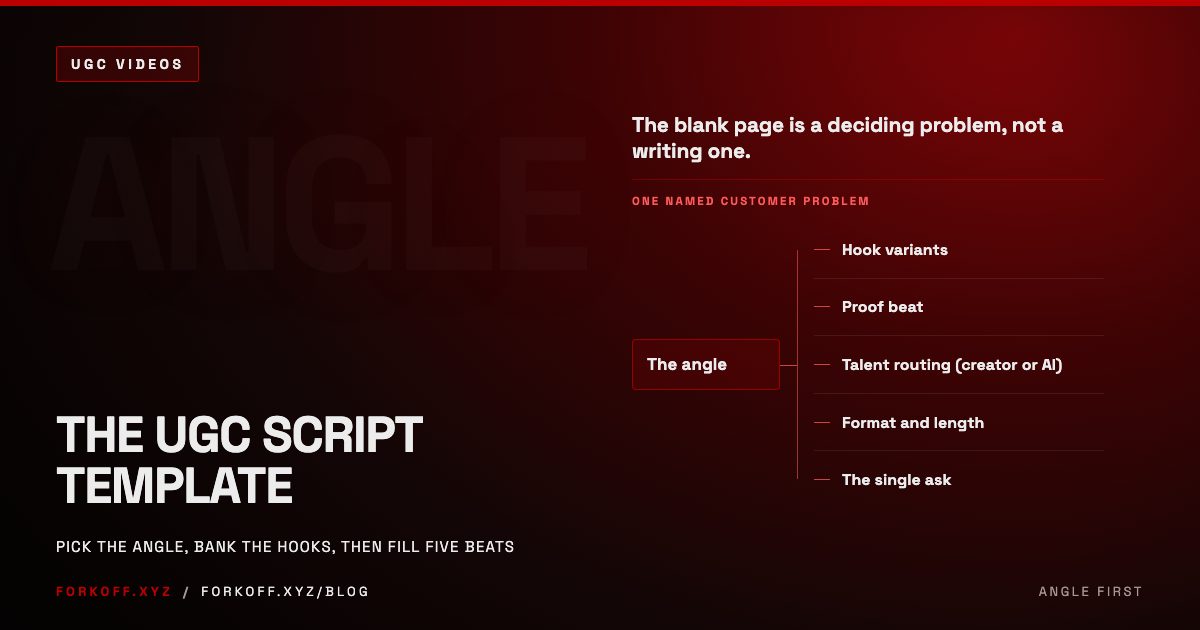
The UGC Script Template: Pick the Angle Before You Write a Word
A UGC script template that starts with the angle, not the hook. The five-beat skeleton, the hook bank, and how to route each angle to a creator or AI.
 Read
Read
UGC Agency vs In-House vs AI: The 2026 Hire Decision
How to source UGC in 2026: when to hire a UGC agency, build an in-house creator team, or use AI, compared on real cost, performance, and platform risk.
Read