
How to choose a UGC agency in 2026
Updated Jul 23, 2026
Choosing a UGC agency comes down to one question the pricing hides: do they get the video seen, or do they only make it? The market is crowded with AI tools (MakeUGC, Arcads, HeyGen, Creatify) that hand back a rendered file for a couple of dollars, human marketplaces (PassionBits, Icon) that ship footage for $50 to $212, and done-for-you agencies (Admiral Media, The Remarkable) that bill per batch or a $20,000-a-month retainer. Almost none guarantee an outcome; the whole lane competes on unit price, roughly $2 to $11 a video for AI versus about $200 for a human creator (Superscale, 2026). Five things actually decide the choice: whether they distribute or only produce, whether the content reads as authentic, whether commercial rights are clear, whether they screen for real reach, and whether the price maps to a result. FORKOFF is built on the distribution half most vendors skip, on the same engine that has processed 5B+ views.
- 01Distribution, not just production The single biggest divide in the category. Almost every UGC tool and agency stops at a rendered file: PassionBits ships footage with no distribution, and the AI tools hand back a blank timeline. Ask how the content gets in front of buyers (paid social, Spark Ads, creator whitelisting, community seeding) before you ask the price. Production is the easy half.
- 02Does it read as authentic 79 percent of consumers say human-style UGC drives their purchases, so a synthetic clip that looks synthetic fails the one job UGC has. Screen sample work the way a scrolling buyer would: does it stop the feed and read as a real person, or as an AI actor reciting a script.
- 03Clear commercial rights Some tools gate usage rights or leave them ambiguous, which is a legal risk when you run the clip as a paid ad. ClipLoft leads the category on rights clarity precisely because most do not. Confirm in writing that you own full commercial and paid-media rights to everything delivered.
- 04Screening for real reach If the agency also handles distribution or creators, ask how it verifies the audience is real. Creator and impression fraud is endemic across the wider influencer market, so a partner that reports raw impressions with no bot or geo screen is selling you a number you cannot trust.
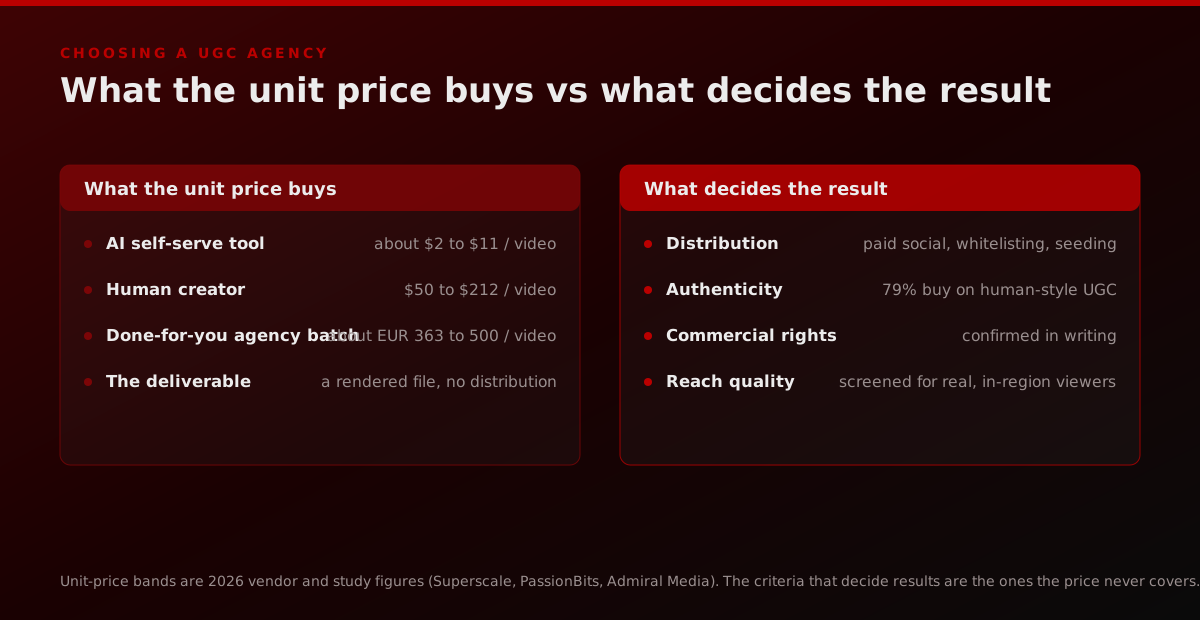
- 05Price that maps to a result Unit price ($2 to $11 AI, $50 to $212 human, EUR 363 to 500 agency batch) tells you what a file costs, not what a campaign returns. Prefer a partner whose price is tied to delivered reach or pipeline over one that bills per rendered clip or a flat retainer with no outcome attached.
- 06Track record in your motion A DTC brand, a B2B SaaS, and a crypto project need different UGC. Ask for named work in your category and channel, not a generic reel. The closest analogs in the set (Icon for human-plus-AI, ClipLoft for rights) each win on one axis; a partner that covers production and distribution and measurement is rarer.
The category competes on unit price, which is the wrong axis
Search 'AI UGC' and you get software: MakeUGC, Creatify, HeyGen, Arcads, Topview, ugcads.ai. Every one sells a seat and hands back a blank timeline, and they compete almost entirely on cost per clip, roughly $2 to $11 a video (Superscale, 2026). The human side (PassionBits at $50 to $89, Icon at about $66 an ad) and the done-for-you agencies (Admiral Media at EUR 363 to 500 a video, The Remarkable at a $20,000-a-month floor) are pricier but still sell production. None of them, per a 2026 category review, offer an outcome guarantee. That is the tell: when the whole lane competes on unit price and volume, the thing that decides results, distribution, is the thing nobody is charging for or promising.
The five questions that actually separate vendors
First, do they distribute or only produce, because a rendered file is not a campaign. Second, does the content read as authentic to a scrolling buyer, since 79 percent of consumers say human-style UGC drives purchases. Third, are commercial and paid-media rights clear in writing, since ambiguous rights are a real risk when you run a clip as an ad. Fourth, if they touch distribution, how do they screen for real reach rather than raw impressions. Fifth, does the price map to a delivered result or just to a rendered clip. Run any shortlist through those five before the call. Most vendors answer the first two with silence, which is the answer.
Where FORKOFF fits
FORKOFF is built on the half the category skips. Production is table stakes; the work that moves a number is getting UGC in front of the right feed, so FORKOFF pairs UGC with paid social, Spark Ads and creator whitelisting, and community seeding through Reddit marketing, and with clipping so long-form founder and podcast footage becomes UGC-native cuts. Reporting is on qualified views, bot and duplicate filtered and geo-checked on an audit ledger, the same integrity layer behind the clipping network that has processed 5B+ views. The engagement is cross-vertical (SaaS, AI, and Web3), and the price is tied to delivered reach rather than a per-clip rate or a flat retainer, which is the one thing a production-only vendor cannot offer.
What to check before you sign a UGC agency
| Criterion | A partner worth signing | A production-only vendor |
|---|---|---|
| Distribution | Gets the content seen (paid social, whitelisting, seeding) | Hands back a rendered file, no distribution |
| Authenticity | Reads as a real person, stops the feed | Synthetic clip that looks synthetic |
| Rights | Full commercial and paid-media rights in writing | Gated or ambiguous usage rights |
| Reach quality | Screens for real, in-region audience | Reports raw impressions, no bot or geo screen |
| Pricing | Tied to delivered reach or pipeline | Per rendered clip or a flat retainer |
| Track record | Named work in your category and channel | Generic reel, no relevant motion |
Unit-price bands (about $2 to $11 for AI, $50 to $212 for a human creator, EUR 363 to 500 for an agency batch) are 2026 vendor and study figures (Superscale, PassionBits, Admiral Media), and they price production only. The criteria that decide results, distribution and reach quality, are the ones the unit price never covers.
Frequently asked questions
What is the most important thing when choosing a UGC agency?
Whether they distribute the content or only produce it. Almost every UGC tool and agency stops at a rendered file, and the AI tools hand back a blank timeline. A clip nobody sees returns nothing, no matter how cheap it was to make, so ask how the content gets in front of buyers before you compare unit prices.
Should I use an AI UGC tool or a human creator?
Use AI for volume and speed on raw material, and humans where authenticity carries the sale. AI tools cost about $2 to $11 a video and generate 50 variations for $99 (Superscale, 2026); human creators cost $50 to $212 but read as real, and 79 percent of consumers say human-style UGC drives their purchases. The better question is who then distributes whatever you make.
How do I know if UGC content is good?
It stops the feed and reads as a real person, not an AI actor reciting a script. Watch sample work the way a scrolling buyer would, on mute, at speed. If it looks synthetic or generic, it fails the one job UGC has, which is to feel like a genuine recommendation rather than an ad.
Do UGC agencies guarantee results?
Almost none do. A 2026 review of the AI-UGC category found the whole lane competes on unit price and volume, with no outcome guarantee anywhere in the set. That is why the price to compare on is cost per view a real person saw, not cost per rendered clip, and why a partner tied to delivered reach is worth more than a cheaper one selling files.
How is FORKOFF different from a UGC tool?
A tool sells you a seat and a rendered clip. FORKOFF produces the UGC and then distributes it (paid social, creator whitelisting, and community seeding through Reddit marketing, plus clipping for long-form-to-short cuts) and reports qualified views, bot and duplicate filtered and geo-checked, on the same integrity layer behind the clipping network that has processed 5B+ views. The price maps to delivered reach, not to a file.
Receipts, deep dives, and playbooks.
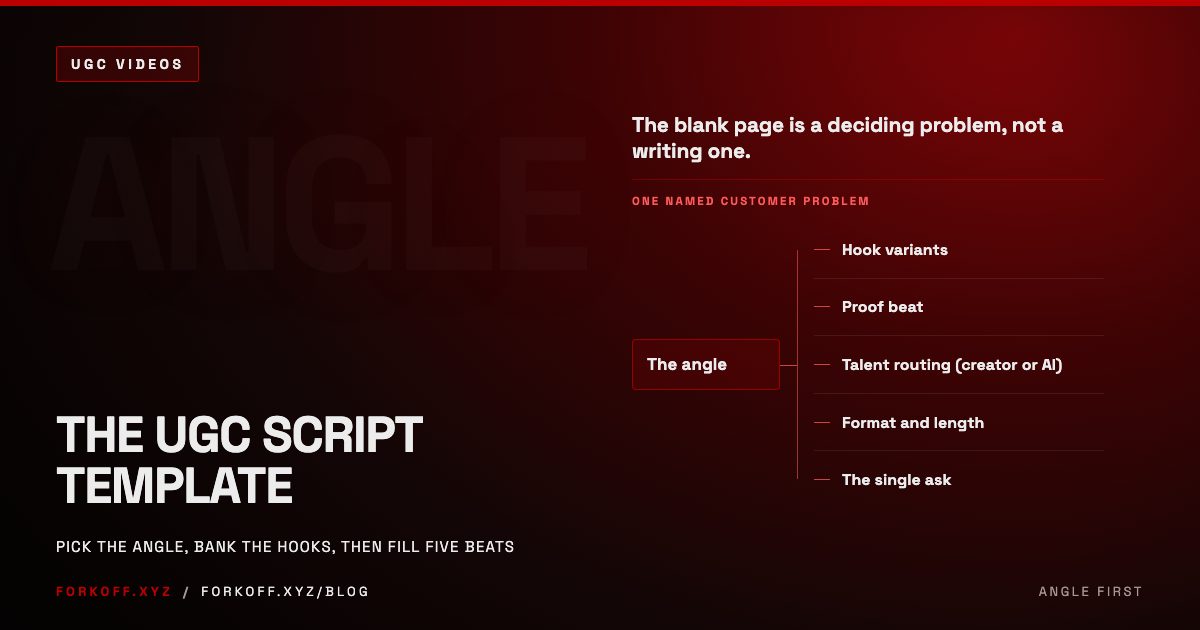
The UGC Script Template: Pick the Angle Before You Write a Word
A UGC script template that starts with the angle, not the hook. The five-beat skeleton, the hook bank, and how to route each angle to a creator or AI.
 Read
Read
UGC Agency vs In-House vs AI: The 2026 Hire Decision
How to source UGC in 2026: when to hire a UGC agency, build an in-house creator team, or use AI, compared on real cost, performance, and platform risk.
Read