
Ugc-videos
UGC video ads are the paid-social creative layer that reads as native content first and an ad second, produced either by real creators or AI-generated spokespeople. The posts below cover the agency-vs-in-house-vs-AI production decision and a working UGC script template, both tied to the FORKOFF UGC video ads engagement rather than a generic creative retainer. See the FORKOFF UGC video ads service.
Written by the operators running the engagements, measured on a clipping network that has processed 5B+ views.
2 articles in Ugc-videos. All FORKOFF blog.
UGC video ads that convert, not just look native
UGC video ads work because they read as a real person's genuine take rather than brand-produced marketing, but that native quality is a means to a conversion outcome, not the goal itself, and a UGC ad with no working script structure underneath its authentic feel will underperform a polished ad regardless of how native it looks. The posts here cover the production-sourcing decision (agency, in-house, or AI-generated), the script structure that determines whether a UGC ad actually converts, and how to measure a UGC ad program against real outcomes rather than engagement alone.
Agency vs in-house vs AI production
An agency brings a tested creator network and production pipeline but adds cost and a briefing overhead for every new variant; in-house production is cheaper per-video but requires building creator relationships and a review process from scratch; AI-generated UGC can turn around new variants in hours at a fraction of the cost of either but currently reads as synthetic to a meaningful share of viewers in categories where audience trust in a real human matters. The right choice depends on how many variants a testing cadence actually requires and how trust-sensitive the specific product category is.
A working UGC script template
A UGC ad script that opens with the product name and a feature list reads as an ad from the first line and gets scrolled past; a script that opens with the specific problem the creator was facing, states it in language a real person would use rather than marketing copy, and only introduces the product as the solution after establishing the problem, holds attention long enough for the pitch to land. The template that works consistently follows that problem-first structure rather than a product-first one.
Measuring what a UGC ad actually earned
Impression count and watch-through rate say whether an ad held attention; they say nothing about whether it produced a qualified lead or a sale, and a UGC ad program judged only on watch-through will keep producing videos that are engaging but not persuasive. Tracking a UGC ad's performance against a real downstream action, an application, a signup, a qualified reply, rather than against engagement metrics alone is what tells a testing cadence which variant to scale and which to kill.
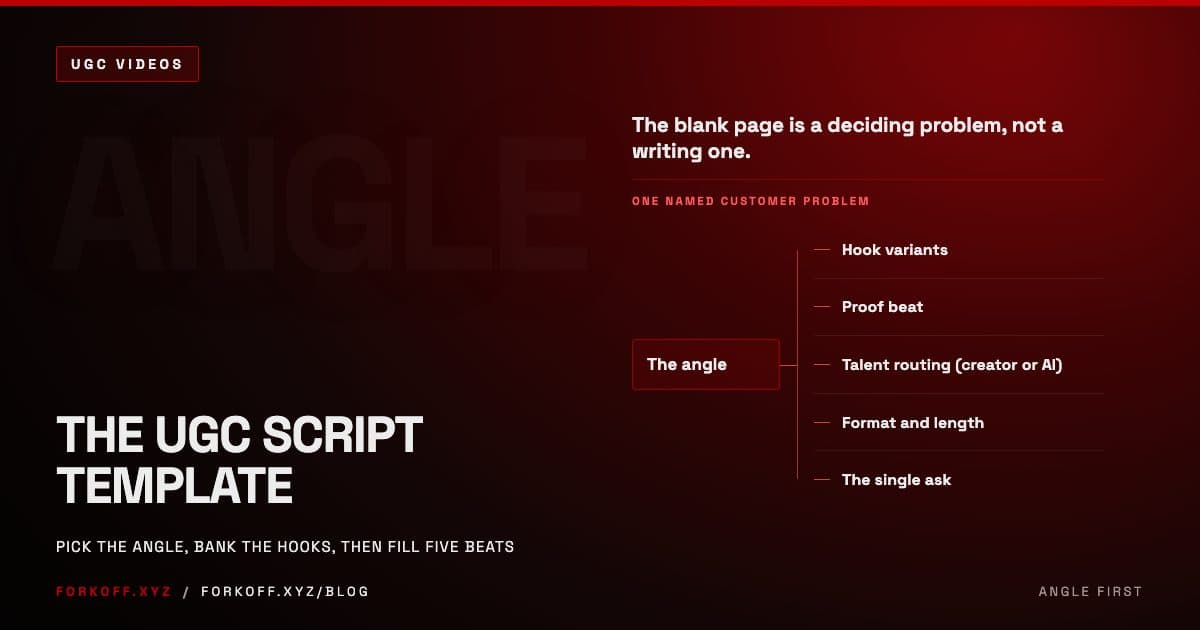
The UGC Script Template: Pick the Angle Before You Write a Word
A UGC script template that starts with the angle, not the hook. The five-beat skeleton, the hook bank, and how to route each angle to a creator or AI.
 Read
Read
UGC Agency vs In-House vs AI: The 2026 Hire Decision
How to source UGC in 2026: when to hire a UGC agency, build an in-house creator team, or use AI, compared on real cost, performance, and platform risk.
ReadShowing 1-2 of 2 blogs
All 2 Ugc-videos posts
Read sister categories
Clippings
Creator-led clipping that turns founder content into qualified organic reach. Geotargeted distribution. Audit ledger on every cycle.


Podcast
Founder podcasts that compound. Two to four founder hours per week converted into multi-platform recall, not vanity downloads.

Founder Funnel
Founder-led growth playbooks that survive past PMF. Distribution architecture, not single-channel hacks.

Event Management
Event activations that compound across the calendar. Founder houses, vox pops, hacker houses, and citation blitzes.

Ecosystem Strategy
Ecosystem distribution playbooks for protocols, foundations, and AI platforms past PMF. Builder grants and category narrative architecture.
AI Search and AEO
Getting cited by ChatGPT, Perplexity, Claude and Google AI Overviews. Schema, answer units, and the signals AI crawlers actually read.
Reddit Marketing
Compliant, non-spam Reddit distribution. Operator accounts, subreddit fit, and the moderation rules that decide whether a post survives.
Twitter and X Growth
Founder-led distribution on X. Thread architecture, reply surface, and follower quality over follower count.
Launch Video
Product and company launch video that carries a real launch beat, not a sizzle reel. Format, timing, and what separates reach from noise.
KOL and Influencer
Creator and KOL partnerships priced on qualified delivery. Roster screening, authenticity checks, and payout math shown before acceptance.
SaaS GTM
Go-to-market for B2B SaaS past PMF. Qualified pipeline over signups, and the product-health metrics that survive a board review.
Ugc-videos engagements that compound
Outcome-priced engagements, audit-proof on every cycle. Five active engagements per quarter, capped on purpose.
Frequently asked questions
How does the FORKOFF blog organize categories?
Each category maps to a FORKOFF service line: clipping, founder-led growth, podcast, Reddit, Discord, activations, plus uncategorized for cross-cutting posts. Each category index aggregates articles in that lane and links to the underlying service.
How often are new articles added to each category?
We publish 2 to 4 operator-grade articles per week across all categories combined. Most categories see 1 to 2 new pieces per month. Higher-velocity lanes like clipping and founder-led growth get more weekly cadence.
Who writes the category content?
Articles are co-authored by FORKOFF operators and the founders we work with. Every claim ties to an audit ledger entry from a live engagement. Each piece is reviewed against our 3-tier verification matrix before it ships.
Can I subscribe to a specific category feed?
Category-specific RSS feeds are available at /blog/<category>/rss.xml (where supported). All categories also ship to @officialforkoff on X and to the FORKOFF newsletter within an hour of publish.
How do I apply for the related engagement?
Each category page has a primary CTA pointing at the matching FORKOFF service. Apply via Calendly for a 30-minute intro. Five engagements per quarter cap, by application only.
Talk to FORKOFF about your ugc-videos engagement.
Receipts, deep dives, and playbooks.
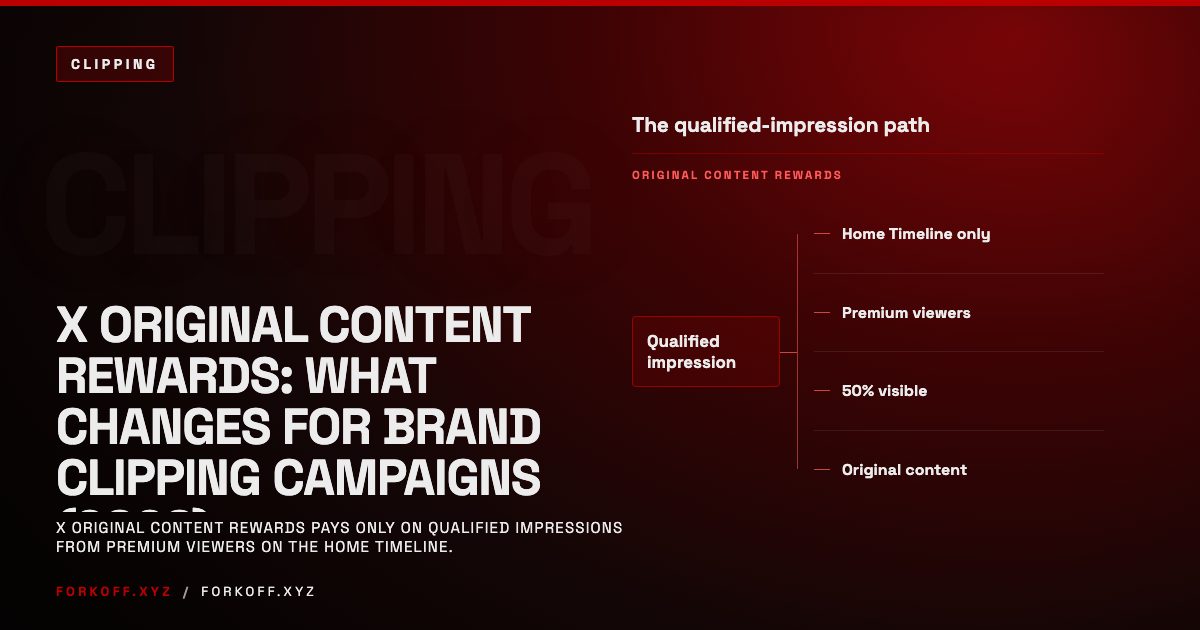
X Original Content Rewards: What Changes for Brand Clipping Campaigns (2026)
X swapped Creator Revenue Sharing for Original Content Rewards, so recycled-clip payouts are gone. What brands running clipping campaigns change now.
Read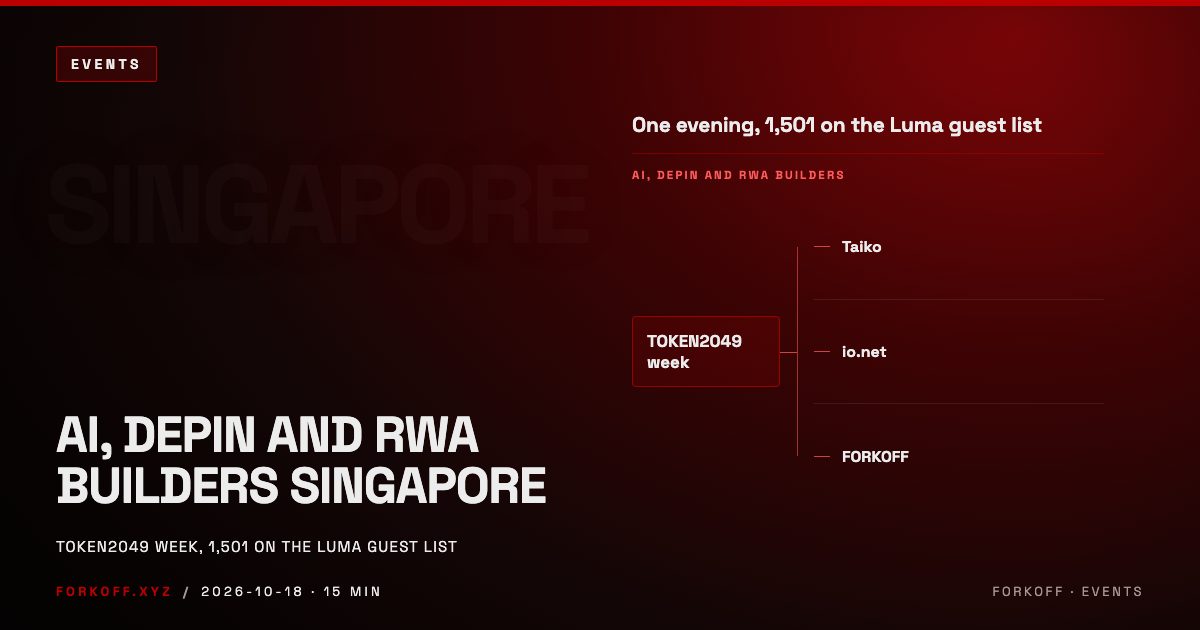
AI, DePIN and RWA Builders at TOKEN2049 Singapore 2025: 1,501 on the Guest List
A recap of AI, DePIN and RWA Builders, the evening side event FORKOFF hosted with Taiko and io.net during TOKEN2049 week in Singapore: panels, partners, data.
Read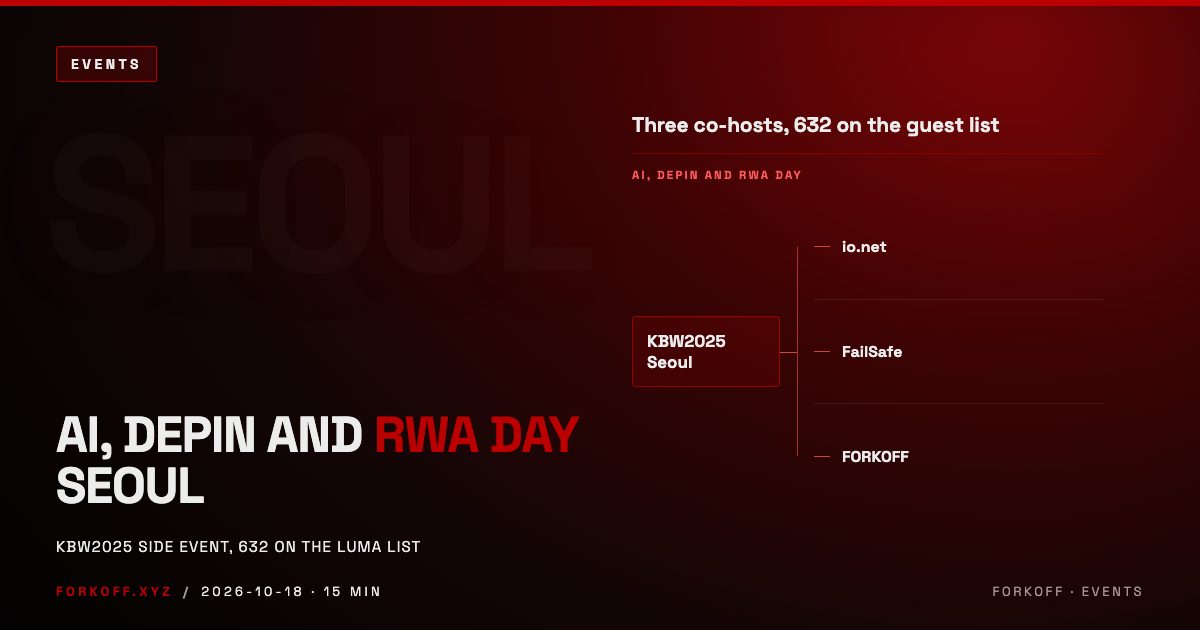
AI, DePIN and RWA Day at Korea Blockchain Week 2025: 632 on the Guest List
A recap of AI, DePIN and RWA Day, the half-day side event FORKOFF co-hosted with io.net and FailSafe in Seoul during KBW2025: hosts, agenda and real numbers.
Read