A clipping campaign mistake is any avoidable decision, made at brief time or during a pay-per-view clipping run, that spends brand budget on views that never convert to pipeline. In 2026, with clipping now a standard brand ad line item, eight of these mistakes recur often enough to be predictable, and each one is fixable before you fund the next campaign.
The 8 clipping campaign mistakes that quietly burn brand budget in 2026
Clipping became a standard brand ad line item in 2026 because pay-per-view runs $1 to $5 CPM against $15 to $40 CPM for paid social (Lumina). The cheap headline rate hides where budget actually leaks. The eight mistakes: (1) optimizing for raw views instead of qualified views, (2) skipping view verification and paying for bot or farmed views, (3) the wrong platform, format, and geo mix, (4) misaligned clipper payout incentives, (5) skipping usage rights and whitelisting, (6) burst-posting that trips spam and velocity flags, (7) no hook or retention testing, and (8) treating clipping as one-off UGC instead of a distribution flywheel. Each one is fixable before you fund the next campaign. FORKOFF runs clipping on qualified views with a per-view audit ledger across a network that has processed 5B+ views.
Clipping stopped being a growth-hacker curiosity in 2026 and became a line item on real brand media plans. Variety documented the mass adoption across the music industry this year, and the reason is simple math: pay-per-view clipping runs at roughly $1 to $5 CPM, while premium paid social runs $15 to $40 CPM, per this clipping agency cost breakdown. When a channel delivers comparable reach at a fraction of the cost, finance signs off fast, and the budget moves.
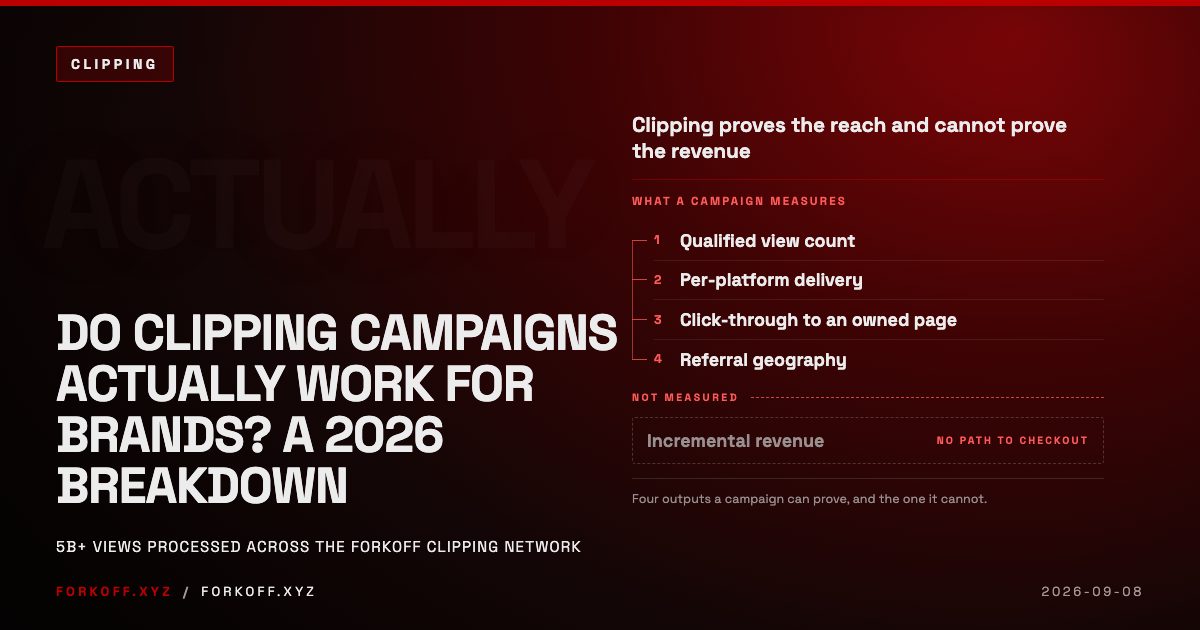
The problem is that the cheap headline rate hides where the budget actually leaks. A clipping campaign is easy to launch and easy to run badly, and the failures are quiet. There is no error message when you pay for botted views, no alert when your clips land on the wrong platform, no warning when you have no rights to the asset that just went viral, and no popup the day a coordinated posting burst gets your accounts throttled. That silence is why buyers ask whether clipping agencies are legit at all, and the honest answer separates the model from the operators abusing it. The budget drains, the dashboard shows a big reach number, and nothing shows up in pipeline. By the time anyone connects the two, the next campaign is already funded on the same broken assumptions. Whether the channel is worth funding at all is the prior question, and the 2026 clipping effectiveness breakdown answers it against verified cost-per-thousand reference points.
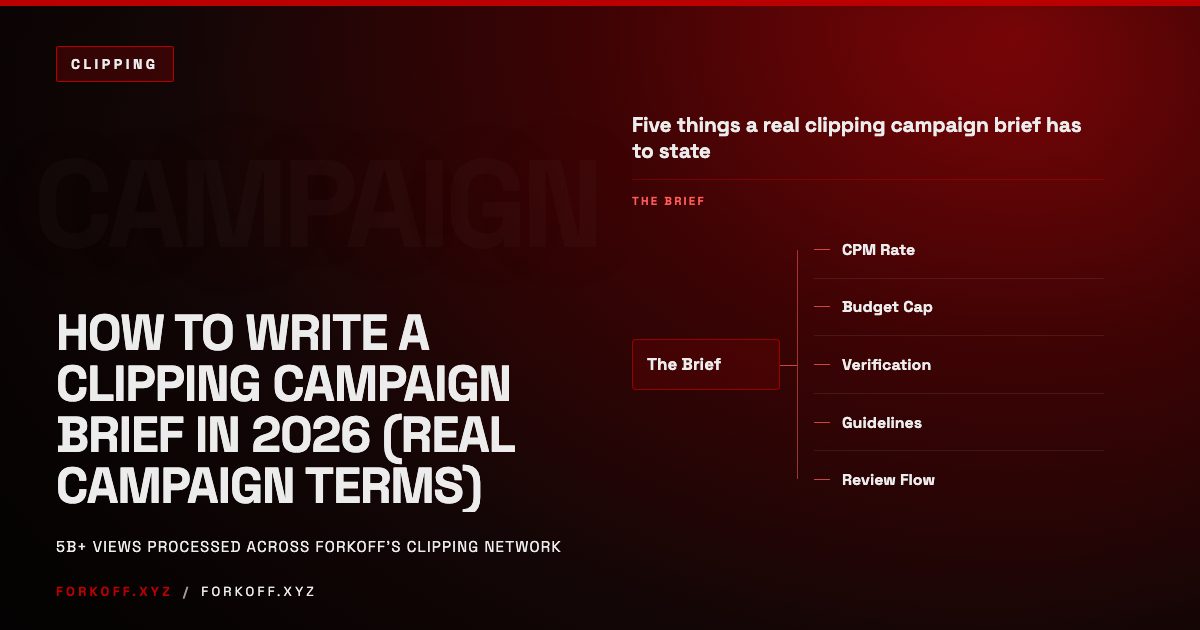
That gap between the number on the dashboard and the outcome in the business is where this post lives. We have run clipping as a managed channel across a network that has processed 5B+ views, and the failures repeat. The same eight mistakes show up campaign after campaign, brand after brand, and each one is invisible until you know where to look. None of them require a bigger budget to fix. They require a different brief, and how to write a clipping campaign brief that actually covers the elements above is the practical next step from here.
This is the brand-side field guide to the eight clipping campaign mistakes that quietly burn budget, what each one actually costs, and the fix to run before you fund the next campaign. Read it as a pre-flight checklist, not a post-mortem.
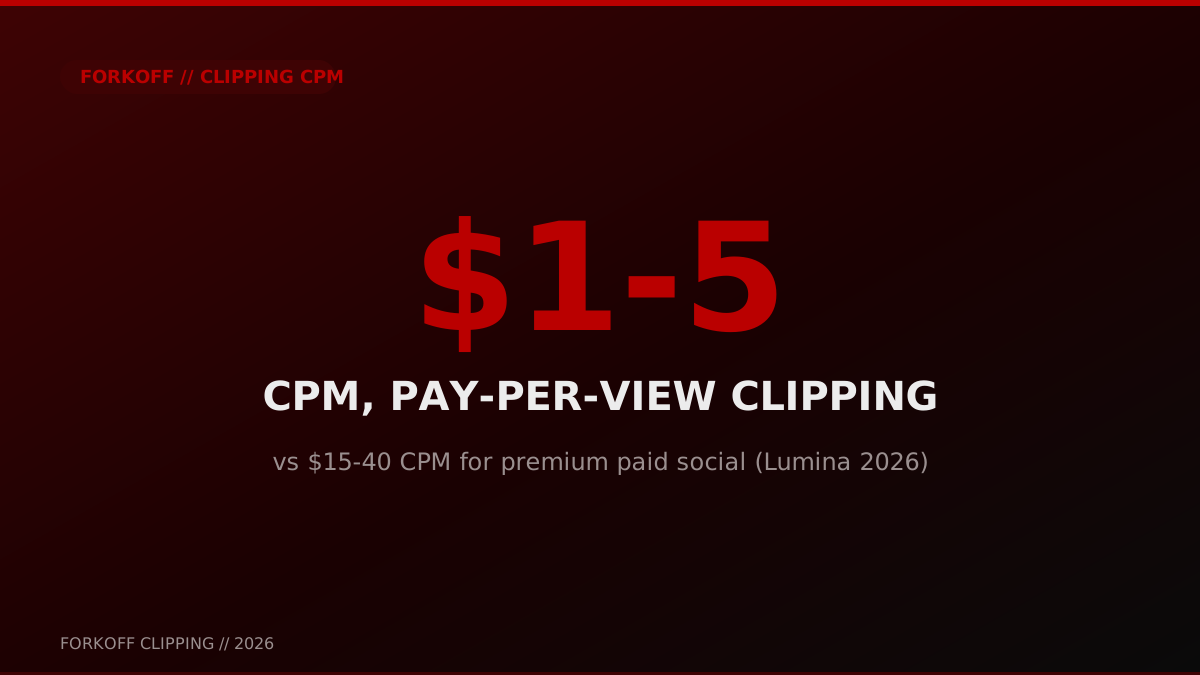
Clipping CPM vs paid social CPM, 2026
| Channel | Typical CPM (per 1,000 views) | What you actually buy |
|---|---|---|
| Pay-per-view clipping | $1 to $5 | Raw views, verification not included by default |
| TikTok ads | ~$4.82 average | Targeted impressions, platform-verified |
| YouTube ads | ~$7.61 | Targeted impressions, platform-verified |
| Meta ads (FB + IG) | ~$8.19 average | Targeted impressions, platform-verified |
| Premium / paid social ceiling | $15 to $40 | Premium placements, brand-safe inventory |
Clipping CPM range from Lumina Clippers 2026. Paid social averages from Gupta Media (Oct 2025). Premium ceiling from Lumina. CPM looks cheap, but clipping does not include verification by default.
Industry Context
Clipping became a standard brand ad line item in 2026 because the headline economics look unbeatable. Pay-per-view clipping runs at roughly $1 to $5 CPM versus $15 to $40 CPM for premium paid social, and Trends.vc puts pay-per-view distribution at 3 to 8 times below paid social cost. Whop alone reported 3.5 billion clipped views in a single month. The arbitrage is real, which is exactly why the mistakes below are so expensive, they erase the arbitrage one unverified view at a time.
Source: Lumina Clippers 2026, Trends.vc clipping report 2026
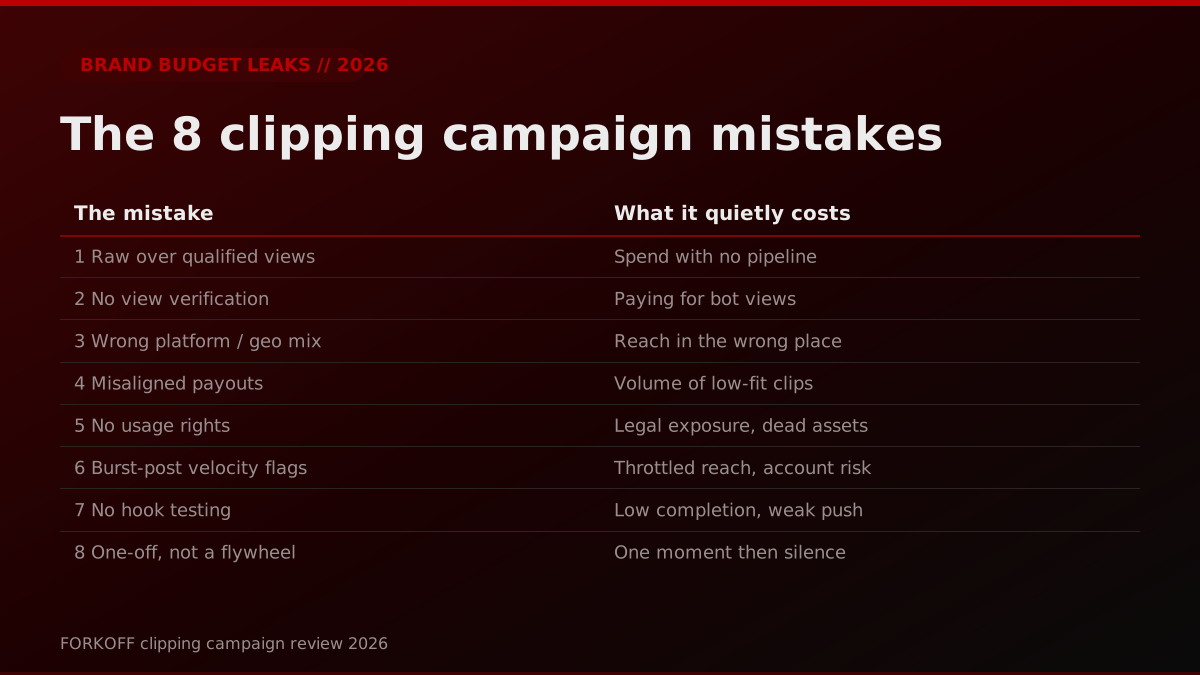
A note on how to read this list before we start. The mistakes are ordered roughly by how much budget they tend to waste, but they are not independent. Pay on raw views and you invite bot traffic; invite bot traffic and your retention data is junk; junk data sends you to the wrong platforms; the wrong platforms train your clippers to chase the wrong views. They compound. Fixing the first two, what you buy and how you verify it, removes most of the leak, and the rest are about turning a working campaign into a compounding channel. Take them in order if you are starting from scratch.
Mistake 1: are you optimizing for raw views instead of qualified views?
The first mistake is the one every other mistake hides behind. Brands fund a campaign, watch the raw view counter climb, and call it a win. Raw views are the easiest number to grow and the easiest number to fake, which is exactly why they are the wrong number to optimize against. When the success metric is a number that can be manufactured for pennies, the campaign optimizes toward manufacturing it.
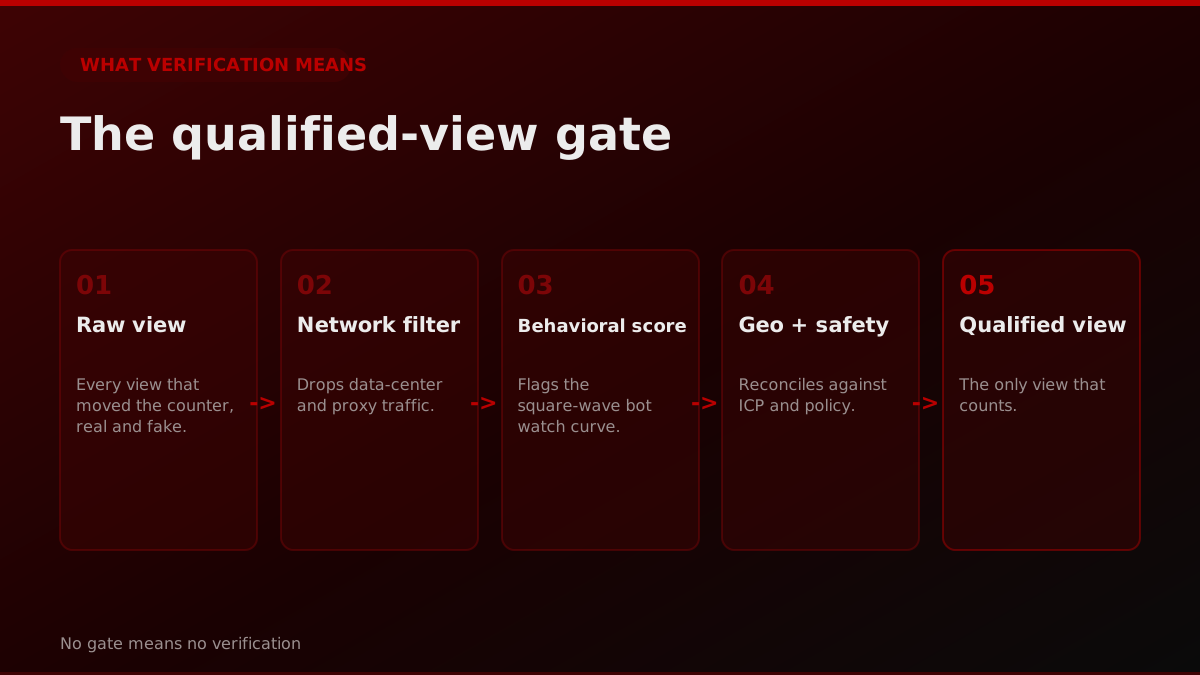
A qualified view is a view that passed a gate: real human traffic, in your target geo, that watched past a meaningful threshold, on a brand-safe surface. A raw view is everything that moved the counter, including the bot in a data center that watched three seconds to clear a payout minimum and the genuine human in the wrong country who will never be your customer. Pay-per-view clipping runs $1 to $5 CPM against $15 to $40 CPM for premium paid social, so the unit looks cheap, but a unit with no pipeline value is not cheap at any price. Trends.vc puts pay-per-view distribution at three to eight times below paid social cost, which is the real arbitrage, and buying ten times as many worthless views as your competitor is not an advantage on top of it.
The trap is psychological as much as financial. A reach number that climbs feels like progress, and a dashboard full of millions of views is easy to present in a marketing review. Nobody walks into that review and says the views did not convert, because the campaign was never instrumented to know whether they did. The headline metric and the business metric were never connected, so the gap is never seen.
The fix is to change what you are buying before you change how much you spend. Contract on qualified views, not raw views, and make the verification gate part of the deal rather than an afterthought you bolt on later. If you run a podcast or founder-led show, our podcast clipping service is built around exactly this gate, and the broader managed clipping service applies it across formats. Define, in writing, what counts as a qualified view for your campaign: which geos, what minimum watch time, which platforms, what brand-safety policy. Then make payout contingent on views that clear that bar. FORKOFF prices clipping on cost per qualified view for exactly this reason, and the full breakdown of the metric lives in our qualified views explainer and the clipping CPQV benchmark. The point is not the acronym, it is that the number you reward should be the number you actually want. We unpack why this metric, rather than subscriber counts or raw reach, in the managed clipping playbook, and it is the same standard behind our podcast service for founder-led shows.
Clipping runs at roughly $1 to $5 CPM versus $15 to $40 CPM for paid social ads.
Ashni
@ashnichrist
NEW Forbes article exposes the Clipping Industrial Complex The clipping brain behind viral campaigns for: Kick, Stake, Clavicular, Caleb Hammer, Netflix, Amazon, Cluely, Pudgy Penguins, HyperX and more... Here's the important info: - he started at 16 with a cracked copy of Pr… Show more
Mistake 2: are you paying for bot or farmed views?
If you do not verify views, someone will sell you views that are not real. This is not a hypothetical. A brand on X documented funding a $2,000 marketplace campaign for app UGC and clipping [Source: @SinaSinry on X, 2026], then watching the submissions roll in: over 40 video links in three days, with roughly 90% looking like botted views and fake comments that existed only to clear the minimum view requirement and trigger payout. Newly created pages, no real creators, geo that did not match the audience the brand had selected. The brand had set the targeting; the marketplace had no enforcement behind it.
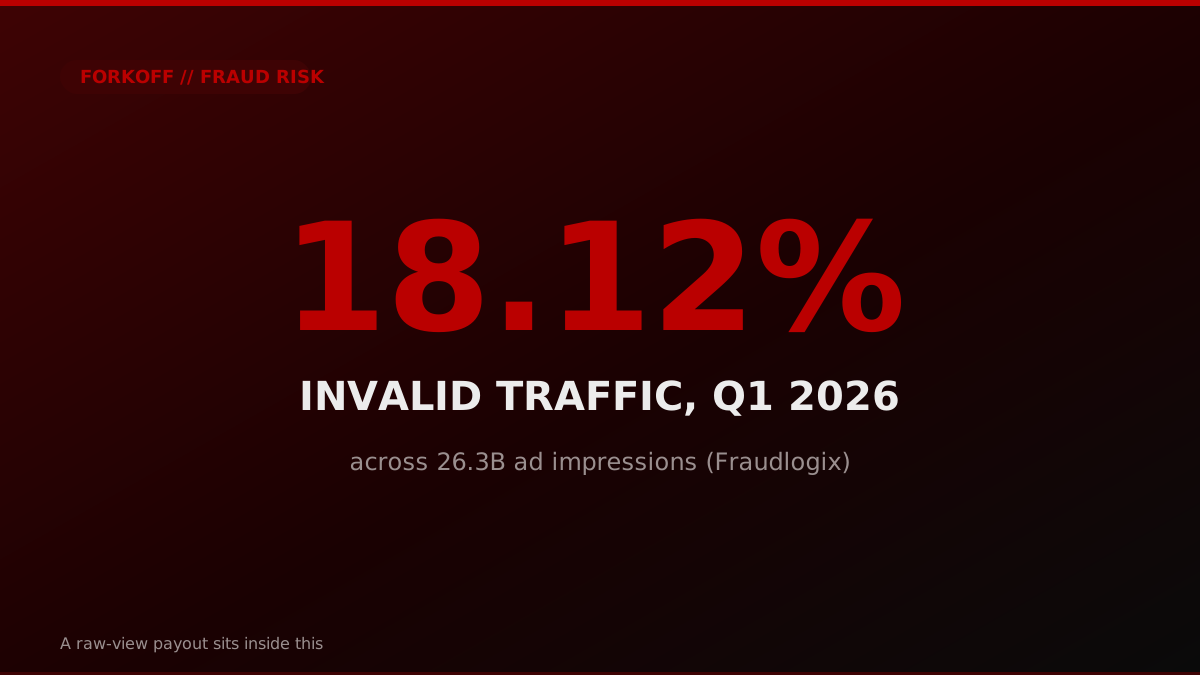
That story is not an outlier, it is the default outcome of a reward model with no gate. When a campaign pays out on raw view counts, it creates a direct financial incentive for anyone with a bot farm to point traffic at it, and bot farms are cheap and patient. The numbers back up how big the blast radius is. Industry-wide invalid traffic ran 18.12% across 26.3 billion impressions in Q1 2026 (Fraudlogix), and in creator marketing specifically, fake or bot followers account for the majority of reported fraud and quality issues per the 2026 Influencer Marketing Hub benchmark. When you pay on raw views with no verification, you have not run a campaign, you have published a bounty for fraud.
The damage is worse than the wasted spend. Botted engagement pollutes every downstream number you might use to make the next decision. If 90% of your views are fake, your completion rates, your comment sentiment, your click-through, and your apparent best-performing clips are all distorted by traffic that was never going to buy. You will optimize the next campaign toward whatever the bots happened to inflate, compounding the error. Bad data is more expensive than no data, because it points you confidently in the wrong direction.
sina sinry
@SinaSinry
Was excited to use @whop for UGC and clipping content rewards. Uploaded my app campaign, funded the account with $2,000, and waited for creators to start making UGC. What I got instead: Over 40 video link submissions across TikTok and Meta in the first 3 days. The result? Mo… Show more
View verification means three layers working together. Network signals filter data-center and proxy traffic, the IP ranges and ASNs that bot operators rent. Behavioral signals score the watch-time curve, because a real human produces a messy drop-off shape while a bot produces a square wave of full or zero watch time. Reconciliation signals check geo against your ICP and surface against your brand-safety policy, so a real view in the wrong country or next to unsafe content gets gated out. Each layer catches what the previous one missed.
The single question that separates a real verification vendor from a reseller of fake views is this: can they hand you the reason codes for the views they rejected? A vendor that gates traffic can tell you what share of views failed on network signals, what share failed on behavior, and the larger slice that failed on geo or brand-safety, with a tag on each rejected view. A vendor that cannot produce that ledger is not verifying anything, they are passing through whatever arrives and hoping you do not check. Ask for the rejected-view breakdown before you fund the account, not after. We walk through the full stack in the 3-layer bot detection system.
Industry Context
Invalid traffic is not a fringe problem. Fraudlogix detected an invalid traffic rate of 18.12% across a sample of 26.3 billion ad impressions in Q1 2026. In creator marketing specifically, fake or bot followers account for 56.5% of all reported fraud and quality issues per the 2026 Influencer Marketing Hub benchmark. A clipping campaign that pays out on raw view counts is sitting directly in the blast radius of that fraud, and the reward model gives bot operators a reason to point traffic at it.
Source: Fraudlogix Q1 2026, Influencer Marketing Hub 2026 benchmark
In Q1 2026, Fraudlogix detected an invalid traffic (IVT) rate of 18.12% across a sample of 26.3 billion ad impressions.
Operator noteAsk for the rejected-view reason codes before you fund any clipping account.
Mistake 3: is your platform, format, and geo mix wrong?
Clips are not interchangeable across platforms, and views are not interchangeable across geos. A brand that targets US buyers and gets a wave of submissions from unrelated regions has not bought reach, it has bought noise, even if every view is technically real. A genuine human view from a market where you do not sell is as useless to pipeline as a bot, it just costs more to feel good about. For context on how the per-platform economics compare, Gupta Media tracks paid social CPMs in the high single digits for Meta and YouTube, so the geo and platform you target are what decide whether a cheap clipping CPM beats them or just looks like it does. The same brand that takes one 9
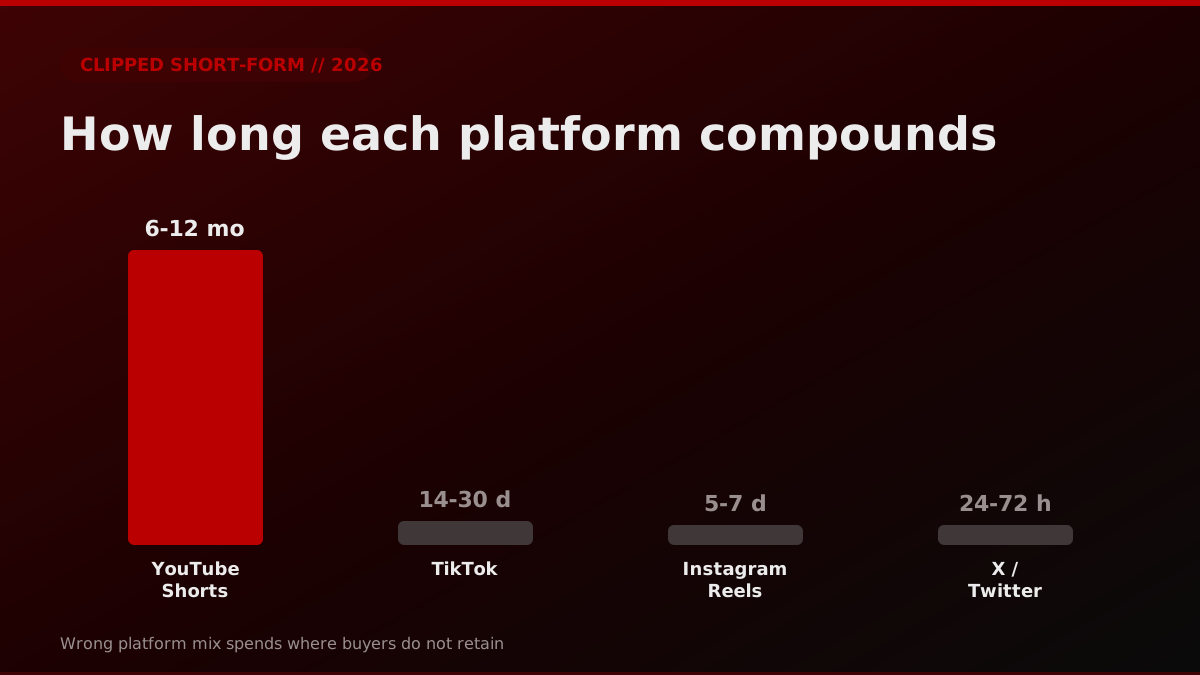
cut and posts it unchanged to YouTube Shorts, TikTok, Reels, and X has shipped four half-tuned clips, not one campaign, because what wins on one surface is mistuned on the others.The platforms behave differently enough that this matters at the budget level, not just the creative level. YouTube Shorts compounds for months on search and transcript discovery, which rewards clips with a clear topic and a searchable hook. TikTok pushes hard then decays inside a month, which rewards trend awareness and a fast open. Reels decays in a week and skews to aesthetic, brand-surface cuts. X moves on velocity and is gone in days, which rewards POV and founder banter over polish. A clip engineered for one is rarely optimal for the others, and expecting long-tail discovery from a platform that does not offer it is a budgeting error dressed up as a content one. If a single platform is your real priority, treat it as its own discipline, the same way we treat Twitter and X distribution as a distinct motion rather than a place to dump cross-posts.
Format compounds the problem. Caption style, aspect ratio, hook length, and pacing all have platform defaults, and a clip that ignores them reads as cross-posted spam to both the algorithm and the viewer. The fix is to pick the platforms where your buyer actually retains, then produce a native variant per platform rather than one upload sprayed across all of them. Fewer platforms done natively beats more platforms done lazily, every time.
How each platform behaves for clipped short-form
| Platform | Compound window | Best-fit clip | Common brand mistake |
|---|---|---|---|
| YouTube Shorts | 6 to 12 months | Search-led, founder voice, deep cut | Treating it like a disposable feed |
| TikTok | 14 to 30 days | Hook-led, trend-aware short | Reusing a copy-paste upload |
| Instagram Reels | 5 to 7 days | Aesthetic, brand-surface cut | Expecting long-tail discovery |
| X / Twitter | 24 to 72 hours | POV, hot take, founder banter | Posting and expecting it to compound |
Compound windows reflect FORKOFF clipping network observation across managed campaigns, 2026. Behavior differs enough that one clip rarely fits all four platforms unchanged.
The skeptics have a point worth hearing here, and pretending otherwise is how brands get sold hype. A widely discussed r/podcasting thread argues short-form video is often a poor ROI for podcasters, and they are right whenever the platform mix and retention are wrong. The platform field itself keeps expanding, with new clipping platforms launching through 2026, which makes the fit question harder, not easier. The clips get made, the hours get spent, and the return never materializes, because the format was forced onto a platform and an audience that did not want it. The lesson is not that clipping fails, it is that clipping fails the same predictable way every time the platform fit is an afterthought. Match the platform and format to where your buyer actually retains, tune each cut to the platform default, and the ROI argument flips.
Why short-form video is often a poor ROI for podcasters
Operator noteOne clip across four platforms unchanged is four half-tuned clips, not one campaign.
Mistake 4: are your clipper payout incentives misaligned?
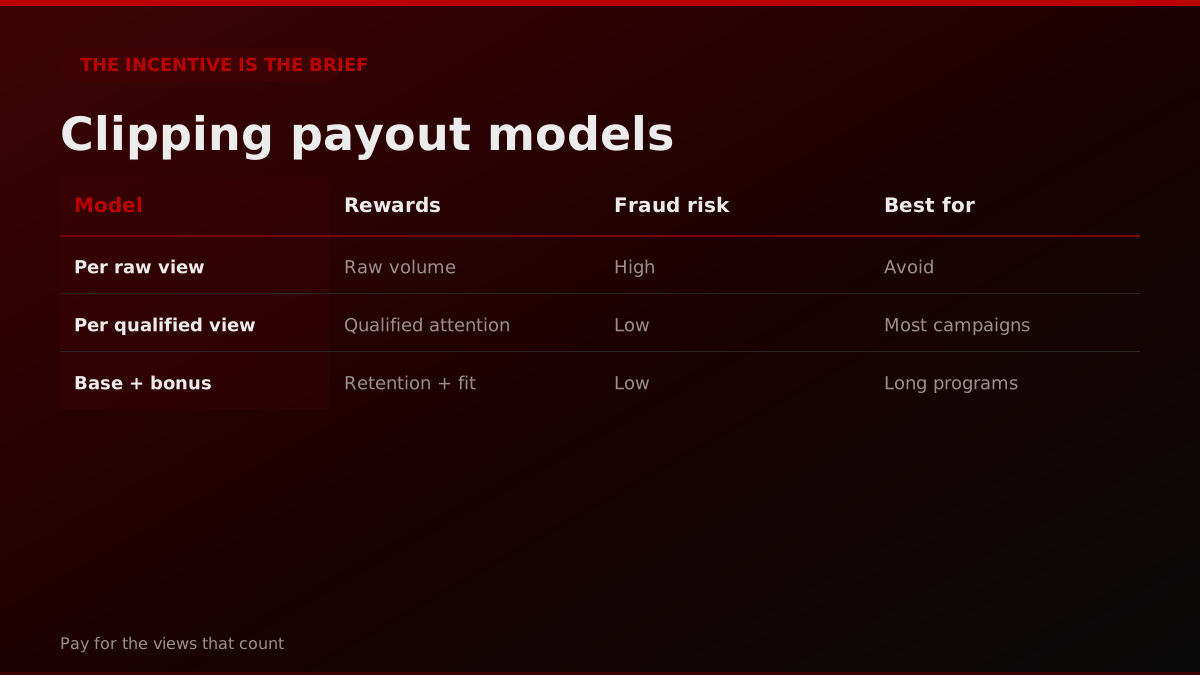
You get the campaign you pay for, and clippers are rational actors. Pay them purely on raw views and you have told every clipper that volume beats fit, retention, and platform discipline. The rational response is to flood every platform with whatever posts fastest, chase any view from anywhere, and optimize for the payout threshold rather than your buyer. No clipper is going to spend an extra hour tuning a hook for retention when the payout is identical whether the viewer stays or bounces at second two.
An operator who has clipped for 137 brands has seen this pattern from the inside, and the throughline is that the incentive structure shows up directly in the output quality. It is also the clearest difference when you compare managed programs against marketplaces, which is why our head-to-heads with Lumina Clippers and Clipping Culture lead with the payout and verification model rather than the per-clip price. Campaigns that reward volume get volume. Campaigns that reward retention get retention. The payout model is the brief that actually gets followed, regardless of what the written brief says.
A healthier structure pays on qualified views, or blends a modest base rate with a qualified-view bonus, so the clipper is rewarded for the views that actually count and protected enough to take a swing on a sharper hook. The base rate keeps good clippers in the program through a slow week; the qualified-view bonus aligns their upside with your pipeline. The cost of getting this wrong is not just wasted spend, it is a library of low-fit clips you cannot reuse and a roster of clippers trained to do the wrong thing well.
There is a second-order effect worth naming. A pure raw-view payout selects for the wrong clippers over time. The careful editors who tune hooks and respect platform fit earn the same as the spray-and-pray accounts, so they leave for programs that pay for craft, and you are left with the volume chasers. A payout model that rewards qualified views does the opposite, it retains the clippers who can actually move your buyer and quietly pushes out the ones who only inflate the counter. Over a few months the roster you keep is a direct function of the incentive you set, which means the payout structure is also a hiring decision you make by accident if you do not make it on purpose.
Mistake 5: do you actually own the clips you paid for?
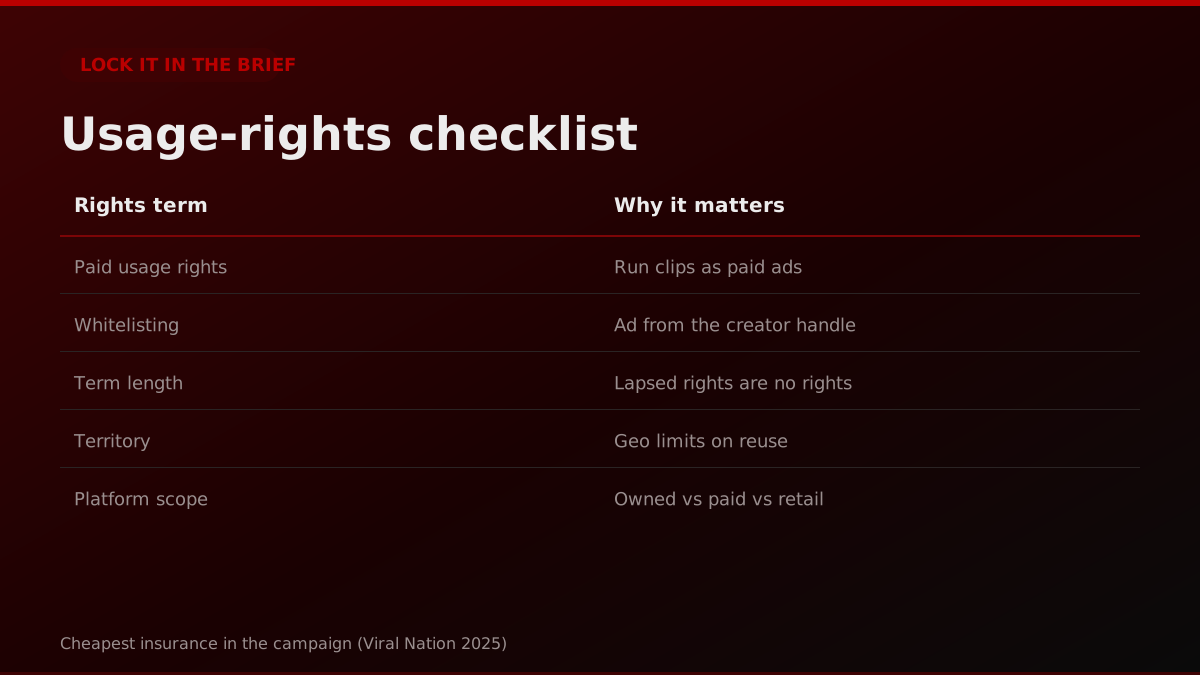
A clip made by an independent creator is not automatically yours. The moment a clip performs and you want to run it as a paid ad, put it on a store screen, drop it into a sizzle reel, or feature it on your owned channels, you need usage rights, and if you did not lock them in the brief, you are negotiating from a weak position with a creator who now knows the clip works. All the negotiating power sits with the person who owns the asset, and that is not you.
This is a documented legal exposure, not a paperwork nicety. Creator-marketing disputes over influencer usage rights have reached $40,000+ legal demands and platform-scale copyright claims when brands repurposed content beyond the original scope (Viral Nation, 2025). The exposure scales with how well the clip performs, because the better it does, the more places you want to run it and the more valuable the rights become. The brands most likely to get burned are the ones whose campaign worked.
Whitelisting is a separate grant that also has to be agreed in advance. It is the permission to run a creator's content as an ad from their own handle, which is what makes creator clips perform as paid media, and it is distinct from simply being allowed to reuse the footage. The fix costs nothing at brief time and a great deal after the fact: specify paid usage, whitelisting rights, term length, territory, and platform scope in the brief before the campaign runs. A rights checklist in the brief is the cheapest insurance in the entire campaign. Keep a simple registry of which clips you have which rights to and for how long, so that when a clip from three months ago suddenly fits a new ad, you already know whether you can run it or whether the term has lapsed. Rights you cannot find are rights you do not have in practice, and a campaign that produces hundreds of clips will lose track of them fast without one.
Operator noteUsage rights and whitelisting go in the brief, not in a panicked DM after a clip pops.
Mistake 6: is burst-posting tripping spam and velocity flags?
Brands new to clipping often treat a campaign launch like a coordinated blast: dozens of clipper accounts posting near-identical clips in the same window to maximize day-one reach. It feels efficient. It is the opposite. Platforms read coordinated bursts of duplicate content as exactly what they look like, spam, and the algorithmic response is to throttle reach or flag the accounts involved. You paid to amplify a launch and quietly bought a reach cap instead.
The mechanics are worth understanding because they are not arbitrary. Recommendation systems are tuned to detect inauthentic coordinated behavior, and a swarm of new or low-trust accounts posting the same clip within minutes of each other is the textbook signature. The clips that survive are the ones that look like organic, independent posts: different cuts, different hooks, different captions, spread across hours and days rather than fired in a single window.
There is account risk on top of the reach cap, and it is the part brands rarely price in. When a platform flags coordinated behavior, it does not just throttle the offending posts, it can suppress or suspend the accounts involved. If those accounts are creator partners, you have damaged relationships you will want again. If they are owned brand accounts, you have put a real distribution asset at risk to save a few days on a launch calendar. The downside of burst-posting is not symmetric with the upside, you are risking durable reach to chase a temporary spike.
The fix is cadence discipline. Distribute posting across native windows for each platform, vary the cut and hook per account so the clips are not duplicates, and let volume build at a rhythm the platforms reward rather than penalize. The goal is the same total volume, sequenced to look like what it should be, a lot of people independently finding the same thing interesting. Velocity that looks organic gets distributed; velocity that looks coordinated gets capped.
Mistake 7: are you testing hooks and retention at all?
Most clipping budgets are spent on producing and posting clips, and almost none on testing whether the first three seconds work. That is backwards. Retention is the lever platforms reward, and the hook is what wins or loses retention in the opening moment. A clip that does not earn the first three seconds never gets the distribution that justified making it, no matter how good the back half is.
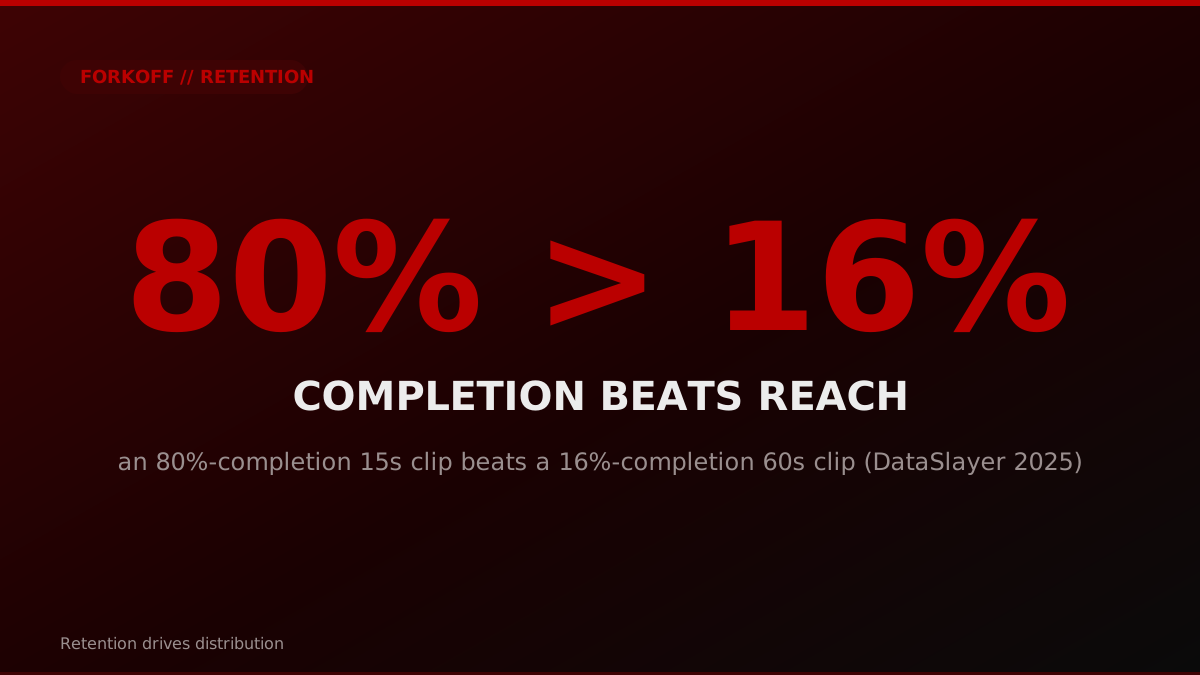
The data is blunt. A 15-second clip with an 80% completion rate, which the TikTok algorithm guide documents, consistently outperforms a 60-second clip with thousands of likes but only 16% completion, because platforms read completion as a quality signal and push accordingly (DataSlayer, 2025). Likes are a vanity metric the algorithm has largely discounted; completion is the metric it acts on. Human-edited clips also outperform AI-generated ones on completion, with a majority of consumers disengaging the moment content feels machine-made, which is a real risk now that AI cutting tools make it trivial to ship volume that all looks the same. Shipping more clips without testing hooks is volume without retention, the most common way a clipping budget evaporates without moving pipeline.
The fix is cheap and it pays back fast: test two to four hooks per clip against the three-second window, keep the winners, kill the rest, and feed what wins back into the next batch as the new baseline. Over a few cycles the program learns which openings hold your specific audience, and the hit rate climbs instead of resetting to zero every week. Hook testing is the highest-return hour in the entire production process, and it is the hour most campaigns skip.
Industry Context
Retention is the distribution lever, not raw views. A 15-second video with an 80% completion rate consistently outperforms a 60-second video with thousands of likes but only 16% completion, because platforms read completion as a quality signal and push accordingly. That is why a hook tested against the first three seconds matters more than the number of clips shipped. Volume without retention is the most common way clipping budgets evaporate without showing up in pipeline.
Source: DataSlayer TikTok algorithm guide, Dec 2025
A 15-second video with 80% completion rate will consistently outperform a 60-second video with thousands of likes but only 16% completion.
Mistake 8: are you treating clipping as one-off UGC instead of a distribution flywheel?
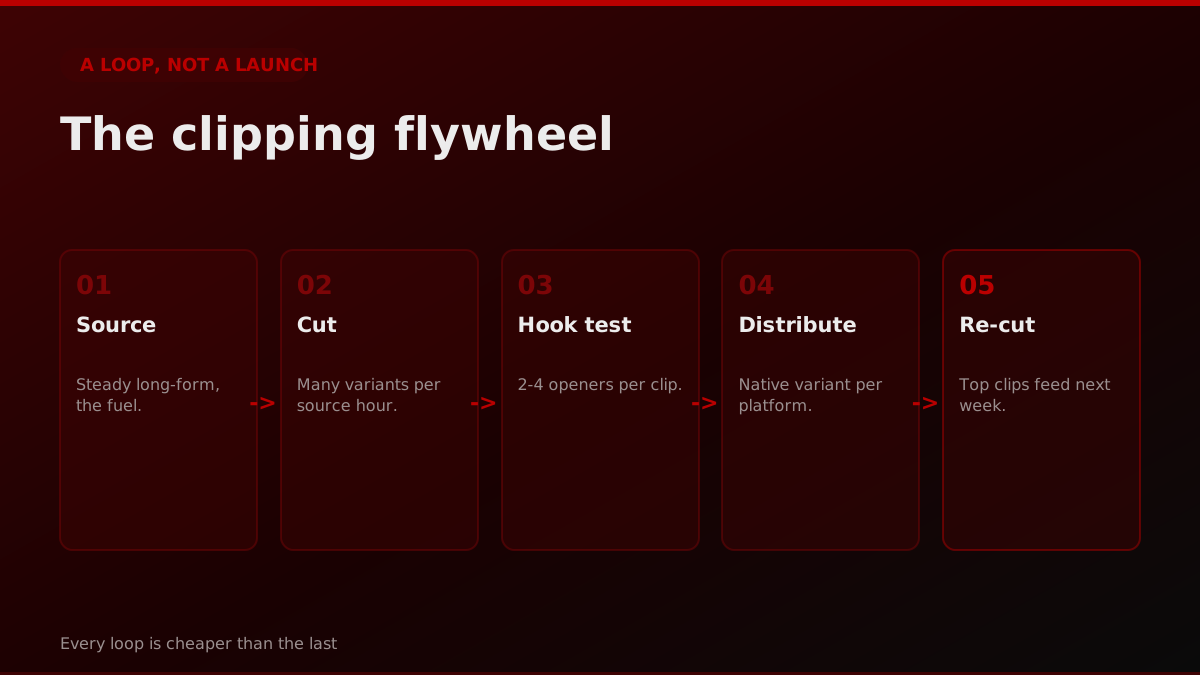
The most expensive mistake is the framing mistake, because it determines all the others. Brands that treat clipping as a one-time UGC drop get one viral moment, maybe, and then silence. They fund a burst, harvest a reach number, and have nothing left when the campaign ends because nothing was built to persist. The brands that go everywhere treat clipping as a compounding system: a steady source feeding a cut process, hooks tested per batch, clips distributed natively and attributed honestly, and top performers re-cut into the next source week as raw material.
An operator who has clipped at scale put it plainly: you cannot break the internet with a handful of talking heads, that is barely enough to test, and the volume of source material is what separates the brands that go everywhere from the ones that get one moment and disappear. Content first, distribution second, and both running as a loop rather than a one-off launch. The single viral clip is a lottery ticket; the system is a business. The same logic is why we treat clipping as part of a wider founder funnel rather than a standalone stunt, and why the whole clipping category on our blog reads as an operating system instead of a bag of tricks.
This is also where the source-volume point bites. A flywheel needs fuel, and a brand recording one short clip a quarter cannot feed a clipping program no matter how good the clippers are. The source cadence is the binding constraint: enough raw long-form material that the cut team always has something fresh to work with, and a willingness to keep producing after the campaign goes live rather than treating launch day as the finish line.
Attention Profit
@attentionprofit
why Andrew Tate became the most googled man on earth and Luke Belmar never came close i clipped for both so i’m speaking from experience here the difference wasn’t just controversy or charisma. it was content volume and willingness to feed the machine clipping for Luke was a n… Show more
That loop is what we built the managed clipping playbook around, and it is the difference between a campaign and a channel. When clipping runs as a flywheel, every source week is cheaper and more effective than the last, because the system already knows which hooks, platforms, and formats convert for your specific buyer. A one-off drop relearns everything from scratch each time; a flywheel never does.
Industry Context
This is not a niche tactic anymore. Variety documented mass adoption of clipping as a marketing tool across the music industry in March 2026, with one artist manager noting it went from a single campaign to mass-adopted within six months. As clipping moves from experiment to standard line item, the brands that win are the ones that bring a process, and the brands that burn budget are the ones that treat a mature channel like a lottery ticket.
Source: Variety, March 2026
How do you choose a clipping model that designs these mistakes out?
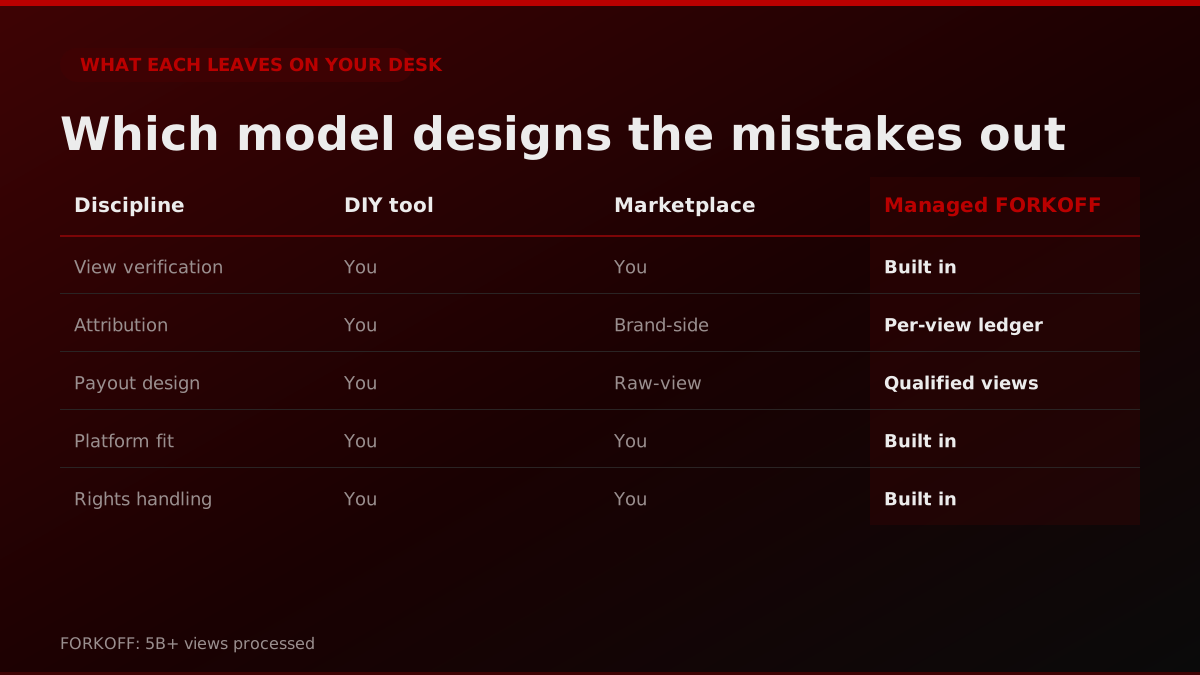
Each of the eight mistakes is a process gap, and which gaps you inherit depends on the model you choose. A DIY editing tool produces cuts and nothing else; verification, attribution, payout design, rights, cadence, hook testing, and platform fit are all left to you, which means a small team is now responsible for eight disciplines it was never staffed for. A marketplace bounty adds clippers but rewards raw volume by default, which is how the campaign in the example above ended up roughly 90% botted, the incentive did the predictable thing. A managed operating system builds verification, attribution, and fit into the model itself rather than bolting them on after the budget is spent.
The Clipping Agency behind 8-Figure Brands.
An agency-side breakdown of how clipping runs behind real brand campaigns, useful context for a brand evaluating the channel.
The honest way to choose is to look at which of the eight mistakes each model leaves on your desk, and whether you have the people and process to close them. If you do, a tool or a marketplace can work. If you do not, you will make some subset of these eight mistakes by default, because the model does not prevent them. FORKOFF runs clipping as that managed operating system, priced on qualified views with a per-view audit ledger, across a network that has processed 5B+ views. The eight mistakes are not optional add-ons we fix on request, they are designed out of the model. If you are weighing the approaches against each other, our clipping comparison hub lays out the tradeoffs, the head-to-head against OpusClip covers the DIY-tool comparison specifically, and the line-item cost case study shows what a real campaign budget actually buys.
Is it a good idea to hire a clipping and distribution agency?
The 8 clipping campaign mistakes, the cost, and the fix
| Mistake | What it quietly costs | The fix |
|---|---|---|
| 1. Raw views over qualified views | Budget spent on reach with no pipeline | Contract on qualified views with a gate |
| 2. No view verification | Paying for bot and farmed views | Require network, behavioral, and policy gates |
| 3. Wrong platform / format / geo mix | Reach in the wrong place for the wrong buyer | Match platform and format to where buyers retain |
| 4. Misaligned payout incentives | Volume of low-fit uploads | Pay on qualified views, not raw views |
| 5. Skipping usage rights | Legal exposure and unusable assets | Lock rights and whitelisting in the brief |
| 6. Burst-posting velocity flags | Throttled reach and account risk | Cadence tuned to each platform default |
| 7. No hook or retention testing | Low completion, weak distribution | Test 2 to 4 hooks per clip on the 3-second window |
| 8. One-off UGC, not a flywheel | One viral moment, then silence | Run clipping as a compounding system |
FORKOFF clipping campaign review, 2026. Each mistake maps to a fix a brand can apply before funding the next campaign.
So is clipping still worth the budget in 2026?
Clipping is one of the best-value distribution channels available to brands in 2026, and that is exactly why the mistakes are so costly: every one of them quietly erases the arbitrage that made the channel worth running in the first place. The $1 to $5 CPM does not save a campaign that pays for bot views, posts to the wrong platforms for the wrong geos, skips rights, trips spam flags, ignores retention, and treats a compounding system as a one-off drop. Cheap reach spent badly is still budget burned, it just burns quietly enough that the next campaign repeats it.
The good news is that all eight are fixable before you spend a dollar, because every one of them is a decision made at brief time, not a cost discovered at the end. Decide what you are actually buying, which is qualified views. Demand verification you can audit, which means reason codes for rejected views. Match the platform and format to where your buyer retains. Align the payout model to retention instead of raw volume. Lock usage rights and whitelisting in the brief. Tune cadence to each platform so the launch does not read as spam. Test two to four hooks per clip against the three-second window. And run the whole thing as a flywheel that compounds rather than a burst that resets.
Do that, and clipping stops being a budget leak and becomes the channel finance signed off on in the first place, a low-CPM distribution engine that actually moves pipeline. The brands winning at clipping in 2026 are not the ones spending the most. They are the ones who brought a process to a channel that punishes the lack of one. Run the checklist before the next campaign, and if any of the eight gaps is one you are not staffed to close, that is the signal to bring in a partner who already has, rather than learning each lesson at the cost of a funded campaign.