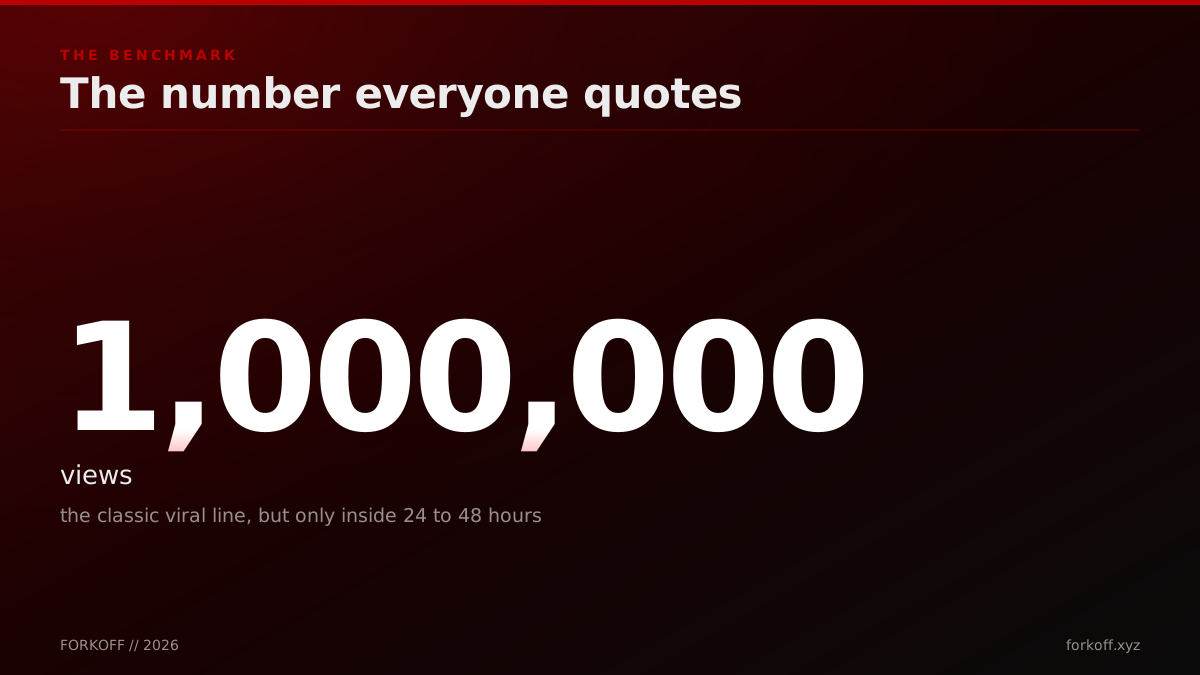
There is no single number that makes a video viral. The classic benchmark is 1 million views inside the first 24 to 48 hours, but that figure only means something once you anchor it to your baseline audience and the speed at which it arrived. A 300-follower account that hits 50,000 views has gone viral. A 5-million-subscriber channel that hits 50,000 views has flopped. This guide gives you both halves of the honest answer: the absolute per-platform thresholds, and the relative rule that tells you when the absolute number is lying.
The short version
There is no single number. The classic benchmark is 1 million views inside 24 to 48 hours, but that figure is meaningless without your baseline. A 300-follower account hitting 50,000 views is viral. A 5-million-subscriber channel hitting 50,000 views is a flop. Use two tests together. First, the absolute per-platform line, roughly 1 million views for TikTok, 1 to 2 million for YouTube Shorts, 5 million for YouTube long-form, 500,000 to 1 million for Instagram Reels, and tens of thousands of engagements for X, each measured inside the first days, not months. Second, the relative line, 10x your 28-day median views, breaking clearly past your usual audience. Then the part almost nobody measures. Most viral views never convert, because a view is not a qualified view. On the FORKOFF clipping ledger a view counts only after it clears a qualified-view gate, and the network has processed 5B+ views moving short-form across platforms. The number that matters is not how many people saw it. It is how many of the right people watched it and acted.
About these numbers
The per-platform thresholds below are directional 2026 estimates. They are drawn from published creator benchmarks and cross-checked against first-hand creator threads, then framed against the FORKOFF clipping network, which has processed 5B+ views moving short-form content across platforms. Where a number is a working estimate rather than a platform-published figure, it is labeled as one. Individual outcomes vary by niche, format, and timing. The one first-party figure that recurs, $0.003 per qualified view across 1.19M views, comes from the FORKOFF clipping ledger and is directional, not a platform guarantee.
Lisa Boo
@Lisamboo
But Jess what counts as viral? I've had ones that have done six thousand and I thought that was pretty good but then I'm looking at these people with 100k plus going “ha 6,000 not viral enough”
What actually counts as viral in 2026?
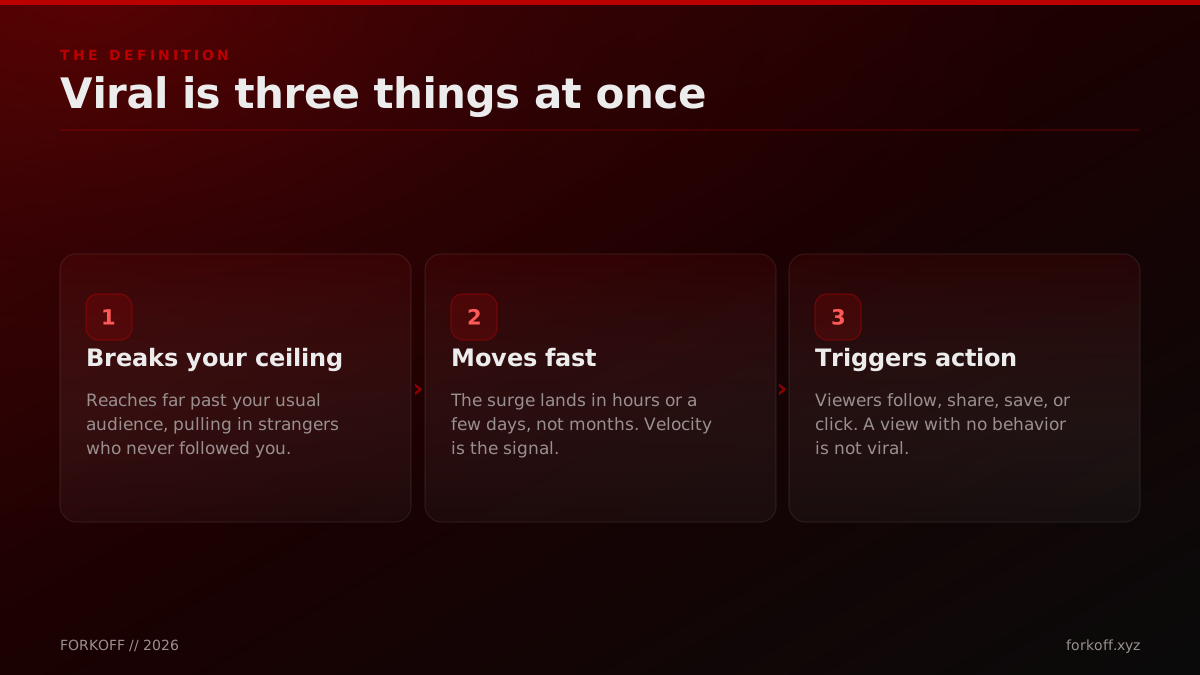
Viral in 2026 means a piece of content breaks decisively past your normal audience, fast, and pulls strangers into watching and acting. It is not a fixed view count. It is an event defined by three properties at once: an audience-breakout (the video reaches far more people than your usual content), speed (the surge happens in hours or a few days, not months), and action (viewers do something, follow, share, save, click). A big number that arrives slowly, or stays inside your existing audience, or produces no downstream behavior, is reach, not virality. The reason "how many views is viral" has no clean answer is that the honest answer is a formula, not a number, and the formula has your own baseline as its main variable.
That is why the same 40,000 views can be a career moment for one account and an embarrassment for another. Google's own AI Overview on this query says it plainly: virality is "highly relative," and "the specific number of views required depends on the platform and your baseline audience size." The listicles that hand you one flat number are answering an easier question than the one you asked.
Viral reach in 2026 comes from strangers, not your subscribers
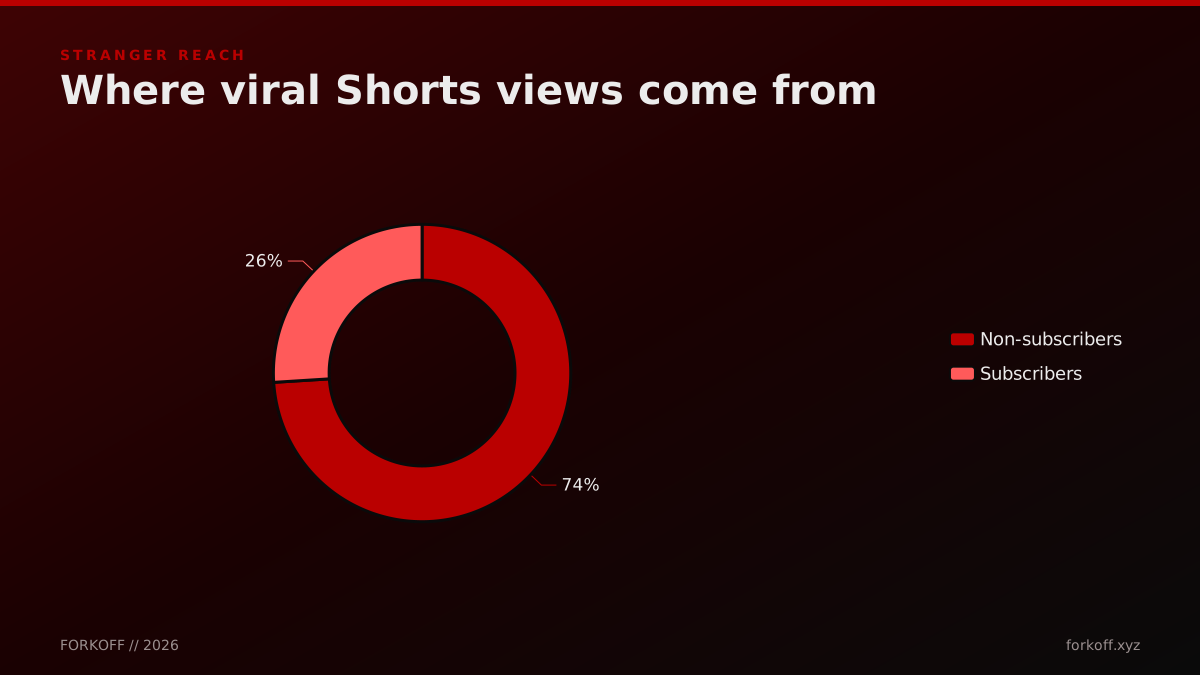
Roughly 74% of YouTube Shorts views come from non-subscribers, which means going viral is by definition an audience-breakout event, not a subscriber-activation event. The bell icon no longer gates the feed. The recommendation system does. This is why the same view count can be viral for a small account and invisible for a large one: virality is measured by how far past your existing audience the content travels, and the platforms are built to push content to people who have never heard of you.
Source: TubeBuddy, YouTube 2026 creators update
How many views is viral by platform (2026 benchmarks)?
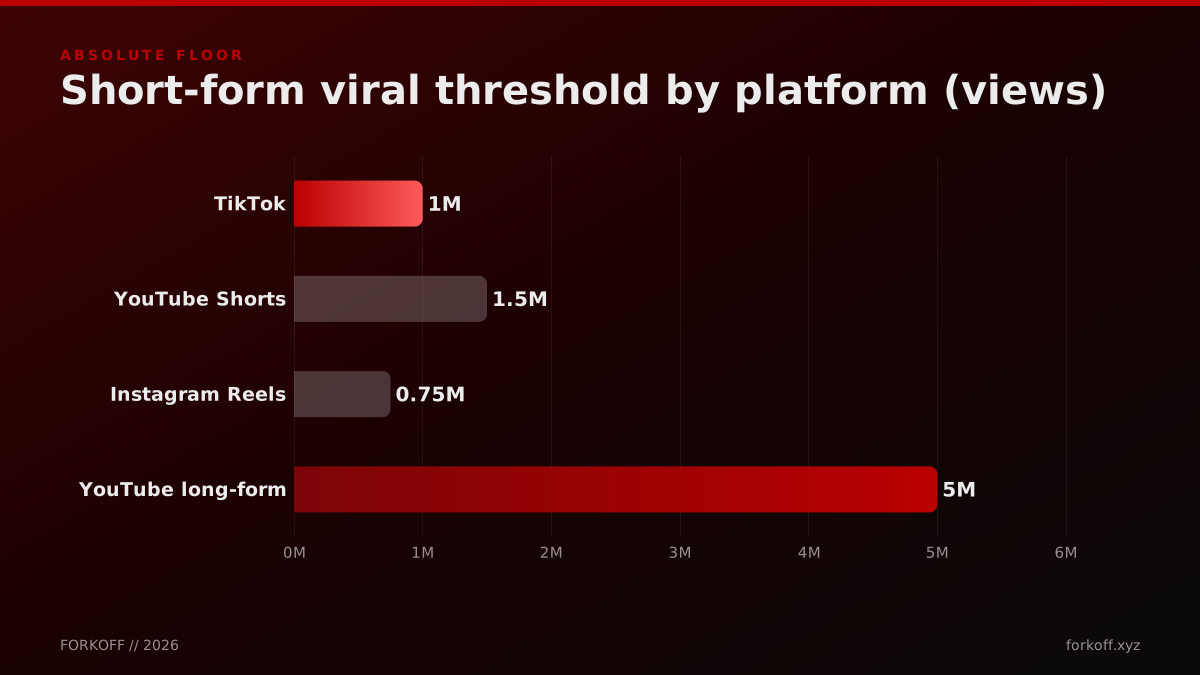
The absolute viral floor differs by platform because each surface distributes content differently and each audience consumes at a different scale. As a working 2026 set of thresholds, measured inside the first days rather than over the life of the video: TikTok reaches viral around 1 million views gained quickly, with the widely cited standard being 1 million in the first 24 to 72 hours. YouTube Shorts needs roughly 1 to 2 million views in a short window. YouTube long-form sits higher, near 5 million views in a week for a clear viral signal. Instagram Reels lands viral for most accounts around 500,000 to 1 million views with strong shares and saves. On X, a post crossing tens of thousands of engagements or hundreds of thousands of impressions fast is behaving virally for most accounts. These floors are the first half of the answer. The second half is your follower tier, which moves every one of them.
Published benchmarks converge on these ranges. Bluehost's viral views benchmarks put YouTube viral status near 1 million views and TikTok viral status as low as 100,000 views when engagement spikes fast. Learning Revolution's per-platform breakdown is stricter, placing a clear TikTok viral moment at 1 million views inside 24 to 72 hours and YouTube long-form viral status at 2 to 5 million views in the first days. Shortimize's TikTok analysis calls 1 million views in one to two days the widely accepted standard. The scale context matters too: Backlinko's TikTok usage data shows how large the active audience is, which is why the absolute bar sits so high on that platform. The spread across sources is itself the point. Even the experts disagree by an order of magnitude, because the real answer depends on who is posting.
How many views is viral, by platform and follower tier (2026)
| Platform | Micro account (under 10K) | Mid account (10K to 500K) | Large account (500K+) |
|---|---|---|---|
| TikTok | 100K+ fast | 500K to 1M | 3M+ in a week |
| YouTube Shorts | 100K+ fast | 1M to 2M | 5M+ in days |
| YouTube long-form | 50K to 100K | 500K to 1M | 5M+ in a week |
| Instagram Reels | 100K+ fast | 500K to 1M | 3M+ with shares |
| X (Twitter) | 50K impressions | 500K impressions | Millions, fast |
| 20K impressions | 100K impressions | 500K+ impressions |
Directional 2026 estimates from published benchmarks (Bluehost, Learning Revolution, Shortimize, Backlinko), cross-checked against creator threads. Fast means inside 24 to 72 hours. Treat each cell as a floor to clear, read against your own baseline.
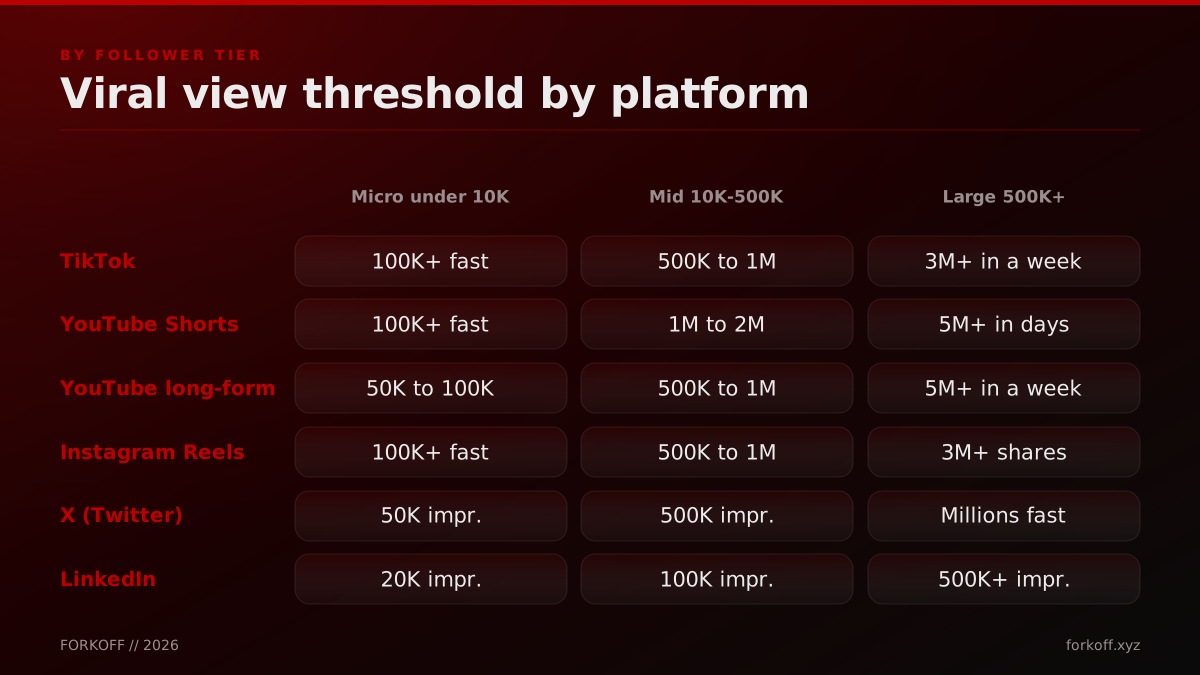
The table above is the fastest way to place yourself. Find your platform row, read across to your follower tier, and treat the cell as a floor to clear rather than a promise. A micro account on any platform reaches viral at a far lower absolute number than a large one, because virality is a breakout event and a micro account has less audience to break past. This is not a technicality. It is the core mechanic that the single-number listicles erase.
I only have 10k followers and 98 percent of my views is non followers.
10k account 423k views in 48 hours on my instagram reel. Is this going “viral”?? Help please..
Why the follower-count multiplier is the honest metric
The one benchmark that survives across every platform and account size is a multiplier, not a number: viral is roughly 10x your trailing 28-day median views, arriving fast, with a jump in follows, saves, and shares. This is the definition working creators actually use, because it self-corrects for account size. A creator whose videos normally do 4,000 views has gone viral at 40,000. A creator whose videos normally do 2 million has not gone viral until they clear roughly 20 million. The multiplier travels where the absolute number cannot, which is why the AI Overview folds it in alongside the per-platform figures and why the sharpest creator threads reach for it first.
Think viral as 10x your 28 day median views plus big jumps in follows, saves, shares. With numbers like 13.2m, those are viral, tbh.
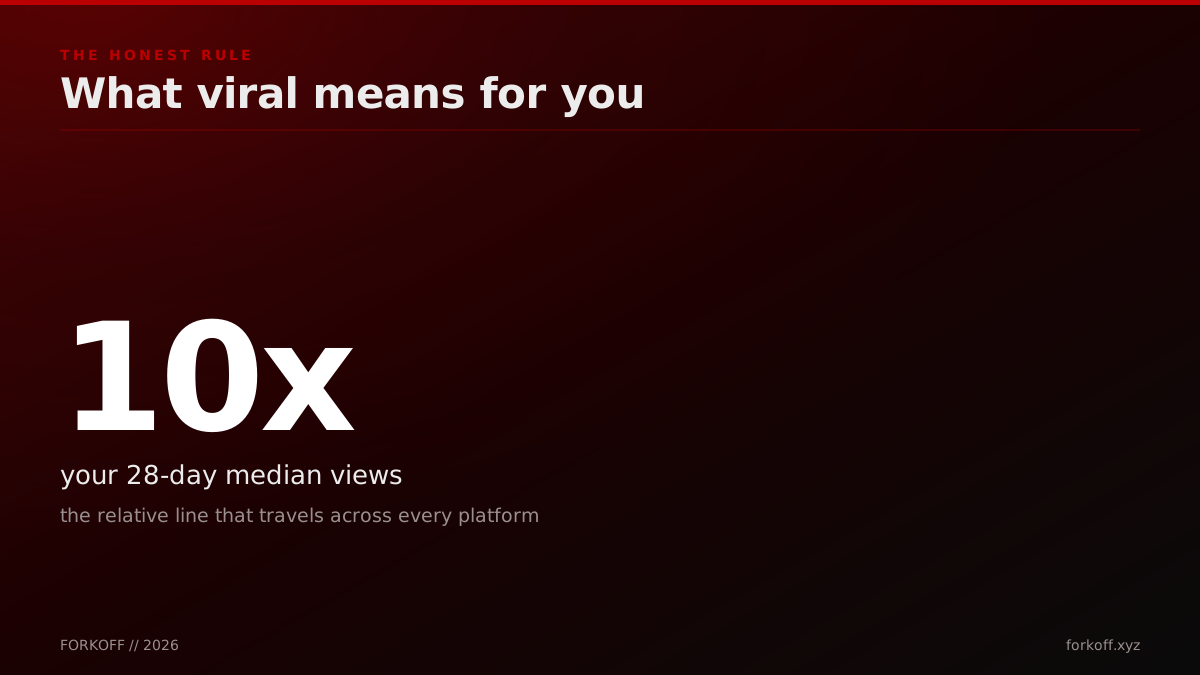
The relative test, when the absolute number lies
| Your situation | The honest read | Why |
|---|---|---|
| 800 followers, a Reel hits 40K views | Viral for you | It broke roughly 50x past your usual reach and pulled in strangers, which is the definition that matters. |
| 2M followers, a video hits 40K views | A miss | It underperformed your own median, so the algorithm suppressed it relative to your baseline. |
| Any account, 1M views over two years | Not viral | Virality is a speed event. Slow accumulation is evergreen reach, not a viral surge. |
| Any account, 10x your 28-day median in 48 hours | Viral | The multiplier plus the speed is the platform-agnostic signal that travels across TikTok, Reels, Shorts, and X. |
The relative rule is the one benchmark that survives across platforms and account sizes. When the absolute number and the relative number disagree, trust the relative one.
Operator noteThe classic mistake is comparing your views to a creator with a different baseline. Viral is measured against your own median, not theirs.
The multiplier also fixes the most common self-scoring error, which is comparing your number to someone else's screenshot. A 10,000-follower creator watching a mega-account post a "modest" 500,000-view video and concluding their own 60,000-view video was not viral has the math exactly backwards. Sixty thousand views on a 10,000-follower account is a 6x-to-60x breakout depending on their median, which is a genuine viral surge. The mega-account's 500,000 views may sit below its own median, which makes it a quiet miss. Anchor to your baseline, never to the loudest number in your feed. On a channel where subscribers barely reach 20,000, the algorithm no longer treats that list as a distribution advantage, a shift we broke down in why 20,000 YouTube subs mean nothing in 2026.
The speed test: velocity beats totals
Virality is a speed event, and the clock is the part the raw total hides. A video that reaches 100,000 views in its first 24 hours is behaving virally. A video that reaches 1 million views over two years is not, it is evergreen. Every major platform weights early velocity heavily because the recommendation engine reads the first hours of watch-through, retention, and share rate to decide whether to widen distribution to a larger stranger pool. That decision is what "going viral" mechanically is: the algorithm choosing to keep expanding the audience because the early signals cleared its bar.
Speed decides virality more than the final total
A video that reaches 100,000 views in the first 24 hours is behaving virally. A video that reaches 1 million views over two years is not, it is just durable. Every platform weights early velocity heavily because the recommendation engine uses the first hours of watch-through and share rate to decide whether to widen distribution. That is why the honest benchmarks are always stated as a number inside a window, not a number in isolation. If your total is climbing slowly, you have reach, not a viral surge.
Source: Sprout Social, social media video statistics
Operator noteVirality is a speed event. A video climbing slowly weeks later is evergreen reach, not the viral surge the benchmarks describe.
The consumption data backs this up: Wistia's state of video research and Hootsuite's social benchmarks both show attention concentrating in the first seconds of a clip, which is where the velocity signal is won or lost. This is why every credible benchmark in this guide is stated as a number inside a window, not a number in isolation. "One million views" is not a viral claim. "One million views in 48 hours" is. If your view count is climbing at a slow, steady rate, you have durable reach, which is valuable and often more monetizable than a spike, but it is not the viral surge the thresholds describe. The distinction matters operationally because the two require different playbooks: evergreen reach rewards search and shelf life, while a viral surge rewards hooks, timing, and the ability to feed the algorithm a strong early retention curve.
How to make shorts that go viral every time
LOGAN E. SMITH
A creator breakdown of engineering short-form virality on purpose. The recurring theme is that hitting the viral threshold is a distribution craft, not a lucky upload, which is the same thesis the benchmarks point to.
How does a video actually go viral on the algorithm?
A video goes viral when the recommendation system decides, based on early signals, to keep widening its audience past your followers into progressively larger pools of strangers. The mechanic is a test-and-expand loop. The platform shows the video to a small seed audience, measures watch-through, retention, replays, shares, and saves in the first minutes and hours, and if those signals clear an internal threshold, it releases the video to a larger pool, then measures again. Going viral is what it looks like when a video clears that threshold several times in a row, fast. Nothing in the loop cares how many followers you have. It cares whether each new pool of strangers keeps watching. That is why virality is a stranger-reach event and why the number that signals it is relative to how far past your own audience the video traveled.
The single most important input into that loop is the retention curve, which is the percentage of viewers still watching at each second of the clip. A video that holds most of its audience through the first three seconds and keeps a strong line to the end tells the algorithm that new strangers are enjoying it, which is the signal to widen distribution. A video that loses half its viewers in the first two seconds tells the algorithm the opposite, and distribution caps. This is why the hook, the first one to three seconds, carries more weight than any other part of a short-form clip, and why a small change to the opening frame can be the difference between 2,000 views and 2 million.
Share and save velocity is the second input, and it is the one that separates a merely strong video from a viral one. When viewers actively send a clip to other people or save it to watch again, the platform reads that as a signal the content has value beyond passive consumption, and it accelerates the expansion. A video can have a decent retention curve and still stall if nobody shares it, because sharing is what pushes the content into social graphs the algorithm cannot reach on its own. The clips that go properly viral almost always combine a strong retention curve with a share rate well above the creator's baseline. Understanding this loop is what lets operators stop hoping for virality and start engineering the inputs that trigger it, which is the whole point of running distribution as a system rather than posting and praying.
Does going viral actually make you money?
Going viral and making money are different events, and conflating them is one of the most expensive mistakes creators make. A viral view count converts to revenue only through a chain: the view has to be qualified, the qualified viewer has to take an action, and the action has to lead to a monetizable outcome, whether that is ad revenue, a follow that compounds, a product sale, or sales pipeline. Break any link in that chain and a million views produces nothing. This is the honest answer to the common question of how many views you need to make a specific amount of money: views are the wrong denominator. Qualified views, and what they lead to, are the right one.
On ad revenue alone the gap is stark. Short-form monetization pays a small fraction of long-form on the same platform, so a short can go viral and earn almost nothing in ad revenue while a far smaller long-form video earns more. A creator chasing viral shorts for a payout is optimizing the wrong variable. The clips that matter are the ones that move a viewer off the feed and into an owned relationship, a follow, a profile visit, a click to a site, a purchase, because that is where the durable value sits. We ran the full cost-and-conversion math in the podcast clipping revenue case study, and the pattern held: a smaller number of qualified views out-earned a larger number of vanity views on every metric that touched revenue.
For brands and founders the implication is sharper still. A viral spike that pulls in the wrong audience is often worse than no spike at all, because it trains the algorithm to send your future content to people who will never buy, which drags down the performance of everything you post next. This is the quiet cost of chasing the viral total: it can actively degrade your distribution to the audience that matters. The teams that win treat reach as something to aim, not something to maximize, and they measure the aim with qualified views rather than raw ones. The economics of buying that discipline versus renting a tool that only counts cuts are laid out in the clipping tools comparison and the Opus Clip versus managed clipping cost breakdown.
Is 10,000, 20,000, 100,000, or 500,000 views viral?
These are the exact questions people search, so here are the direct answers, each resolved by the same rule. Is 10,000 views viral? For an account under about 1,000 followers, yes, that is a clear breakout, especially if it arrived in a day. For an account over 100,000 followers, no, 10,000 views is an ordinary or below-median post. Is 20,000 views viral? It is a strong day for most small and mid accounts and can be viral if it is roughly 10x your median, but it is not viral for a large creator. Is 100,000 views viral? On TikTok, Reels, or X it reads as viral for micro and many mid accounts, particularly with fast engagement, while for large creators it is a baseline. Is 500,000 views viral? For most accounts on any short-form platform, yes, and it is a genuine viral moment for micro and mid tiers, though a mega account may treat it as a routine good day.
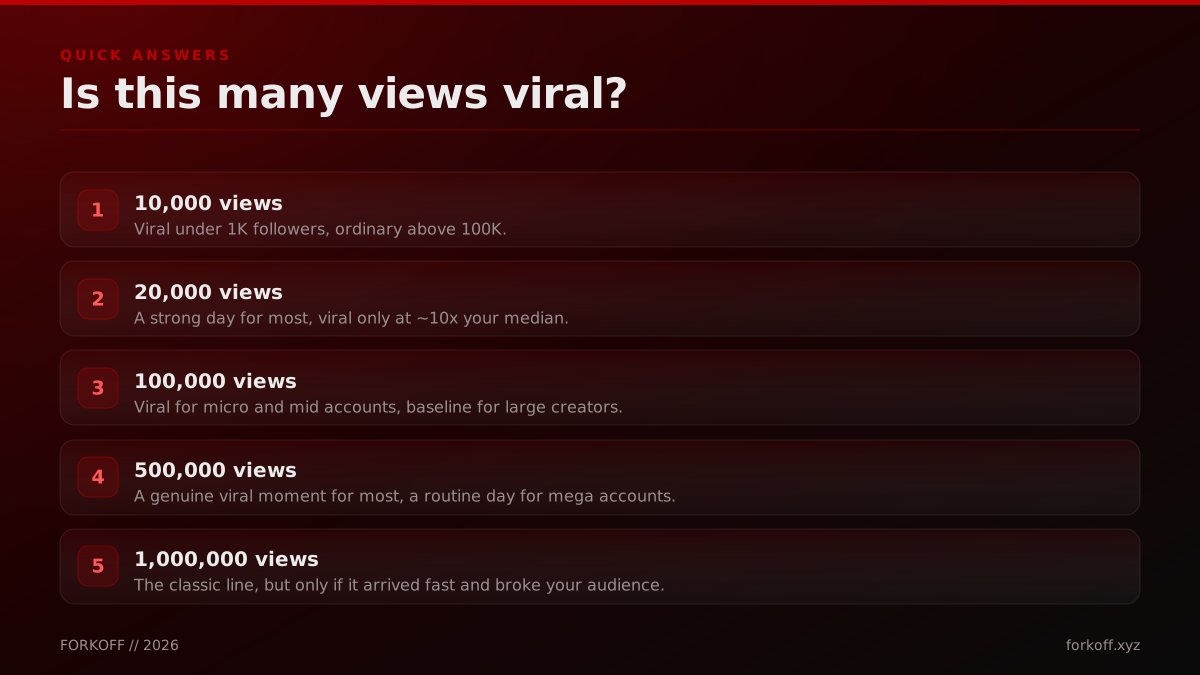
The pattern across all four answers is the same, and it is worth stating once more because it is the entire lesson: no view count is viral or not viral on its own. It is viral relative to your baseline and only if it arrived fast. Anyone selling you a single universal threshold is selling a number that is wrong for most of the accounts that read it.
Why does virality look different on each platform?
The same view count is viral on one platform and a flop on another because each surface has a different audience scale, a different content velocity, and a different distribution mechanic. TikTok is built almost entirely on stranger reach through the For You feed, so its viral bar sits high and virality there is common and fast. Instagram Reels sits lower because the platform still blends follower distribution with discovery, so a mid account can break out at a smaller number. YouTube runs two different economies at once, and the viral bar for a Short is nothing like the bar for a long-form video on the same channel, because Shorts compete in an infinite-scroll feed while long-form competes for deliberate, searched, clicked attention.
X and LinkedIn are different again, because their primary counter is impressions rather than plays, and an impression is a far weaker signal than a completed video view. A post that shows 500,000 impressions on X has been served to a lot of timelines, but the number of people who actually stopped and engaged may be small, which is why on those platforms the engagement count matters more than the raw impression count when you are deciding whether something went viral. LinkedIn compounds the difference with a professional audience that shares and comments differently than an entertainment feed, so a LinkedIn post crossing 100,000 impressions is a genuinely large event even though the same number would be routine on TikTok.
The practical takeaway is that you cannot port a viral threshold from one platform to another, and you cannot compare your TikTok numbers to your LinkedIn numbers as if they were the same currency. Each platform needs its own baseline and its own read. This is exactly why a distribution operation cuts a different variant for each surface rather than cross-posting one file everywhere, because the thing that goes viral on TikTok is often the thing that dies on LinkedIn, and the only way to know is to measure each platform against its own median rather than a single universal number.
What is a viral view actually worth?
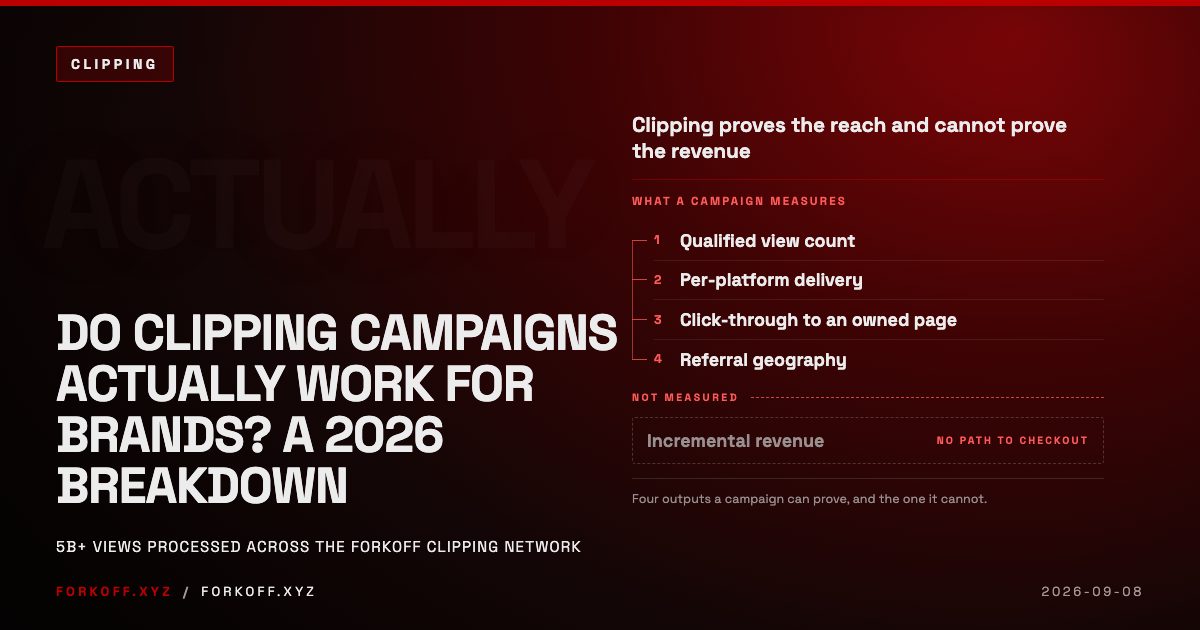
Here is the part almost no guide measures, and it is the one that decides whether virality is worth chasing. A view is not a qualified view. The FORKOFF clipping ledger counts a view only after it clears a qualified-view gate that checks whether the view held to a real watch-through threshold, matched the target audience, landed on a surface where the viewer could act, and came from a genuine human rather than a bot or a low-quality impression. A million-view video made mostly of noise buys nothing: no profile clicks, no branded search, no pipeline. A far smaller video made of qualified views can outperform it on every metric that touches revenue.
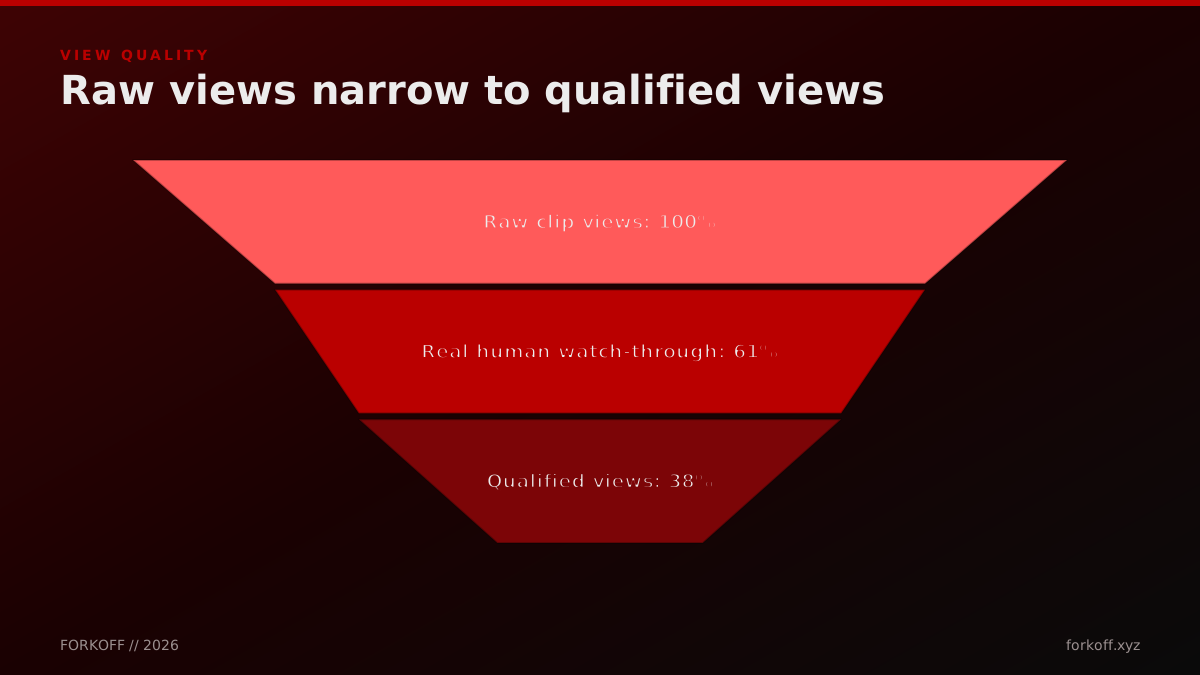
Most viral views are worthless because they never convert
The FORKOFF clipping ledger counts a view only after it clears a qualified-view gate that checks watch-through, audience match, brand-safety, and non-bot signals. Anything that fails one check is not counted. A viral view count is the wide top of a funnel. The number that maps to pipeline is the qualified view, and almost no dashboard measures it because measuring it is the hard, agency-grade part of the job. Chasing a viral total without checking view quality is how creators post a million-view video and gain nothing.
Source: FORKOFF clipping ledger, qualified-views methodology
Operator noteOn the FORKOFF ledger, 1.19M views produced 793 clicks and 17 new paying subscribers. Views that never act are vanity.
This is why the smartest operators stopped optimizing for the viral total and started optimizing for view quality. The viral number is the wide top of a funnel. The qualified view is the narrow bottom, and the bottom is the only part that maps to outcomes. We defined the full metric and the four-step audit in qualified views, the content metric that predicts pipeline, and the same logic drove the 2026 YouTube subs reckoning. If you take one operating change from this guide, make it this: before you celebrate a viral view count, audit how much of it was real. Run your own numbers through the cost-per-qualified-view calculator and the picture usually changes.
Vanity views versus qualified views
The cleanest way to see the gap is to line the two up side by side. A vanity view is a play that hit the counter without holding attention, without matching your audience, on a passive surface, and it maps to nothing downstream. A qualified view held to a real watch-through threshold, came from inside your target niche, landed on a surface where the viewer could act, and correlates with a downstream behavior. Same platform, same counter, completely different asset. A viral total is only as valuable as the share of it that is qualified, which is exactly the number the platforms do not surface and most tools do not measure.
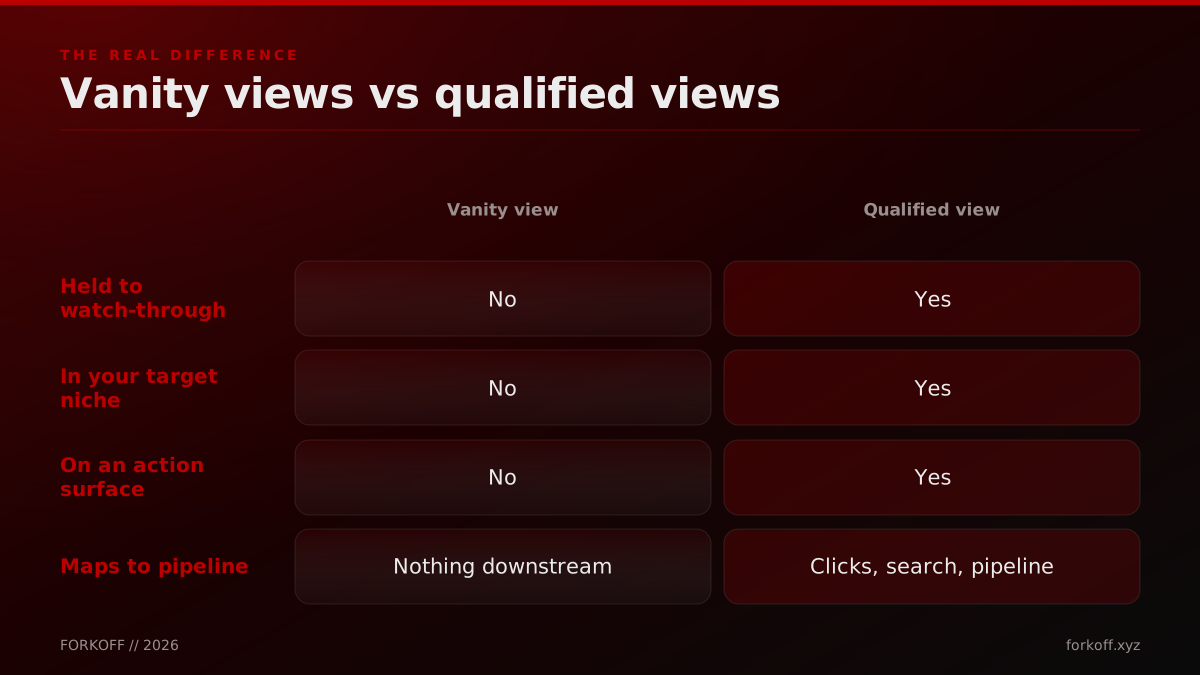
There is a simple test that exposes the gap on any video you have already posted. Take the raw view count and ask three questions: what share of those viewers watched most of the clip, what share of them were the kind of person you actually want, and what share landed somewhere they could act on it. Multiply the answer through and the qualified number is almost always a fraction of the headline. A creator who posts a 500,000-view video and assumes 500,000 people of value saw it is off by a wide margin, because the headline counts every accidental scroll, every bot, every viewer three niches away, and every play on a surface with no path to your profile. The qualified view strips all of that out, which is why it is smaller, harder to fake, and the only number that predicts what happens next.
The practical implication for anyone deciding what to build toward is that "go viral" is a bad target and "manufacture qualified reach" is a good one. Chasing the viral total pushes you toward broad, shallow, trend-chasing content that spikes the counter and converts nobody. Chasing qualified reach pushes you toward content built for a specific audience on a surface where they can act, which produces smaller-looking numbers that do far more work. The managed clipping playbook walks through how a distribution-first motion is built around qualified reach rather than raw views.
How creators actually engineer virality
Virality at any scale beyond a single lucky upload is manufactured, and the mechanics are consistent. Operators cut content natively for the feed rather than cropping long-form, because a clip designed for the surface clears the ingestion gate that a repurposed file fails. They ship volume, because each clip is a separate distribution probe and virality is partly a numbers game against the algorithm's variance. They read which cuts the algorithm rewards, using early retention and share signals to double down. And they compound the cluster, so that once the platform learns who to feed a founder's or brand's content to, the next clip starts warmer and cheaper to distribute. This is the same loop that turns one podcast into dozens of viral-candidate assets, which is the whole thesis behind what a clipping agency actually does.
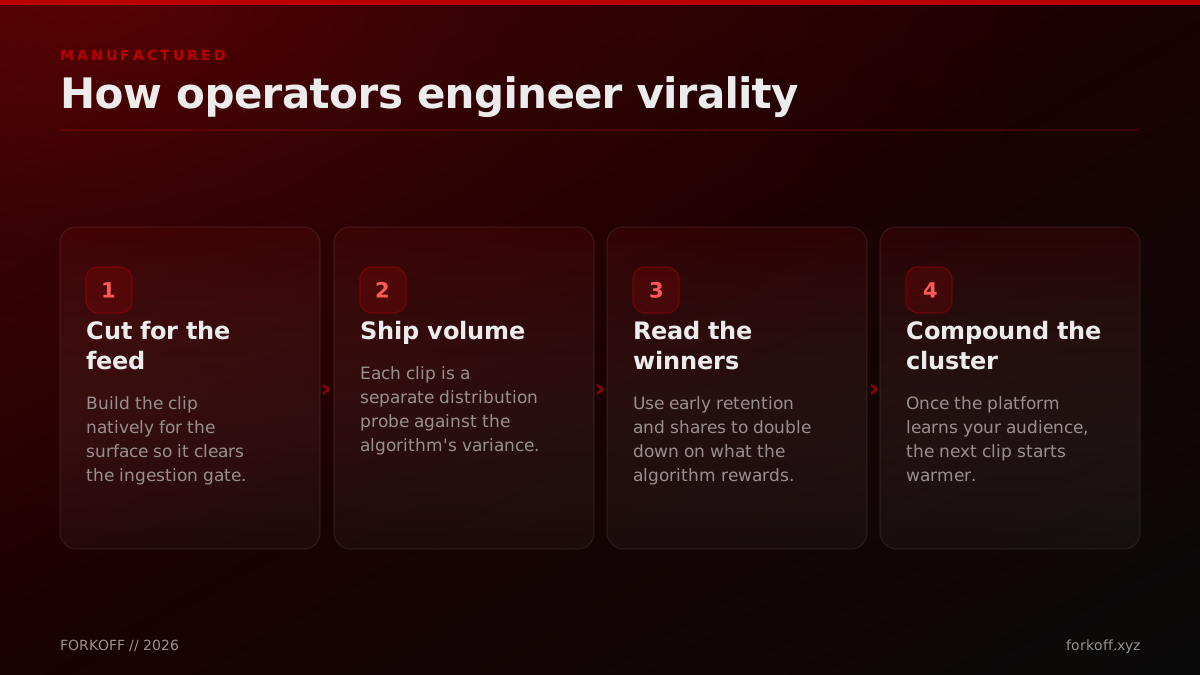
The reason this works is that the platforms reward exactly the behaviors a disciplined clipping operation produces: native format, volume, fast early retention, and audience-cluster consistency. A creator posting one long-form upload a week is giving the algorithm one weak signal. A clip-first operation is giving it 30 to 50 signals per source hour, each tuned to a surface, and letting the winners compound. That is why a small team can engineer repeatable viral surges while a larger creator with a bigger back catalog cannot: the surges come from the distribution motion, not the audience size. The economics of buying that motion versus renting a tool are broken down in the clipping tool versus agency benchmarks and the clipping tools comparison, and the pricing bands sit in the podcast clipping agency pricing guide.
The distribution vantage point: 5B+ views
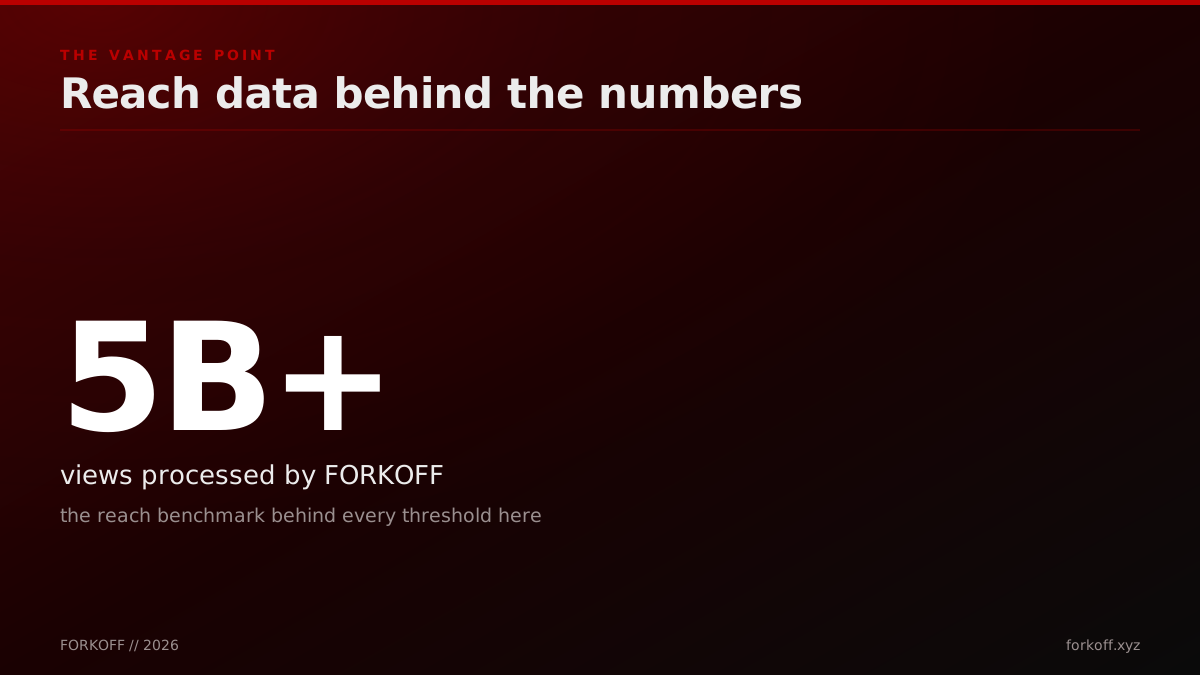
Every threshold in this guide is drawn from a specific vantage point, which is worth naming because most viral-benchmark content is written by people who have never manufactured a viral view. The FORKOFF clipping network has processed 5B+ views moving short-form content across TikTok, YouTube Shorts, Instagram Reels, X, and LinkedIn. That volume is what lets us say with confidence that the absolute thresholds are floors, that the follower multiplier is the honest metric, and that most viral views never convert. A listicle asserting "1 million views is viral" has no reach data behind the claim. The 5B+ number is the reason the qualified-view gap is measured, not guessed.
It also reframes what the whole question is for. If you are a creator asking "how many views is viral" to know whether to feel good about a post, the relative rule is your answer: 10x your median, fast, is a win, celebrate it. If you are a founder or brand asking the question to decide where to invest, the answer is different and sharper: stop optimizing for the viral total and start manufacturing qualified reach, because the total flatters the slide deck while the qualified view pays the rent. The macro precedent for treating clip distribution as the real asset is unpacked in the clip economy and OpenAI's 200M podcast bet, and the revenue side is in the podcast clipping revenue case study.
The bottom line
How many views is viral in 2026 depends on two things the single-number answers ignore: your baseline and your speed. The absolute floors are useful as a starting map, roughly 1 million for TikTok, 1 to 2 million for YouTube Shorts, 5 million for YouTube long-form, and 500,000 to 1 million for Instagram Reels, each inside the first days. But the rule that actually decides it is 10x your 28-day median, arriving fast, breaking past your usual audience. And the number that decides whether any of it was worth it is not the view count at all. It is the share of those views that were qualified, and what those viewers did next: on our ledger, 1.19M views produced 793 landing-page clicks and 17 new paying subscribers. Count views if you want a headline. Count qualified views if you want a business.
If you want the reach manufactured rather than wished for, that is what FORKOFF does. We run clipping and distribution as one system, price on qualified views, and open the ledger so you can see which half of your reach is real. The influencer marketing, Twitter marketing, and Reddit marketing lanes apply the same qualified-reach logic across surfaces, and the founder funnel wraps it into a full distribution motion.
Sources
All claims in this post are grounded in the FORKOFF clipping network's first-party reach data (5B+ views processed, $0.003 per qualified view on the clipping ledger) and the public benchmark sources below.
- Bluehost, How Many Views Is Viral: Social Media Benchmarks for 2026 sources the per-platform absolute thresholds.
- Learning Revolution, How Many Views Is Viral: 2026 Benchmarks by Platform is the strictest per-platform breakdown.
- Shortimize, How Many Views Is Viral On TikTok (2025) sources the TikTok 1-million-in-1-to-2-days standard.
- Wistia, Video Marketing Statistics and Hootsuite, Social Media Statistics source the consumption and early-retention data.
- Backlinko, TikTok Usage Statistics sources the platform-scale context behind the high TikTok viral bar.
- TubeBuddy, YouTube 2026 Creators Update sources the 74% non-subscriber Shorts reach figure.
- Sprout Social, Social Media Video Statistics sources the short-form velocity and consumption data.
- FORKOFF, Qualified Views: The Content Metric That Predicts Pipeline defines the qualified-view gate.
- FORKOFF, Managed Clipping Playbook 2026 is the distribution-first motion built around qualified reach.
For an external creator view on engineering short-form virality, see the Think Media channel for platform-growth breakdowns.