A clipping campaign brief is the document a brand publishes before a clipping campaign launches: the CPM rate, the budget or roster cap, who can apply and what they need to submit, the threshold a view has to clear before it gets paid, the content rules, and who reviews what before money moves. Most brands writing their first one either copy a generic template or skip half of it and find out what they missed after the campaign is already live and the disputes start.
How to write a clipping campaign brief in 2026
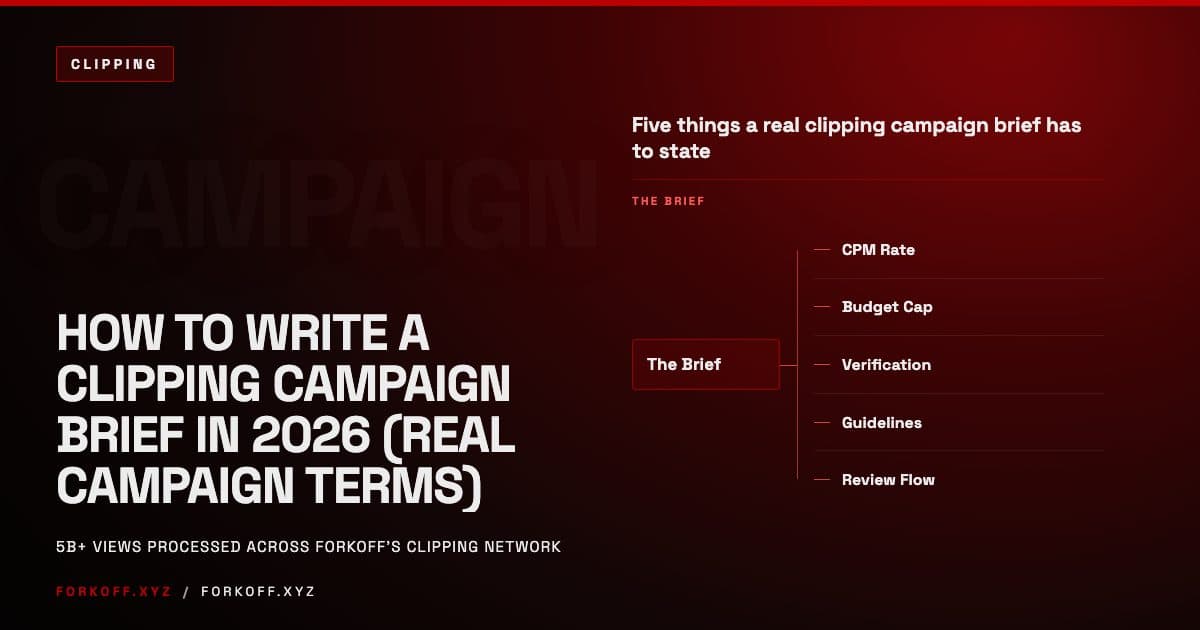
A clipping campaign brief needs six elements to actually work: a CPM rate, a budget or roster cap, submission requirements (account age, follower minimums), a view-verification threshold before payout, content guidelines, and a review and approval flow. Real 2026 campaigns pay $4 to $9 CPM depending on niche, cap rosters at 175 to 400 clippers to match a pre-paid budget, and run application windows as short as 48 hours. A minimum view threshold, commonly around 5,000 verified views, paired with a payout cap per clip, is the standard anti-fraud structure working clipping operators actually use. None of this is generic advice: it is pulled from real, live campaign briefs and operator posts on Reddit and X in 2026. FORKOFF runs clipping as a managed operating system across a network that has processed 5B+ views, so brands who would rather not build this brief themselves have somewhere to send it.
This is not generic advice assembled from a checklist. Every number in this article, the CPM ranges, the roster caps, the application windows, the anti-fraud thresholds, comes from real, live clipping campaign briefs and operator posts pulled from Reddit and X in 2026, most of them posted by brands and agencies actively recruiting clippers right now. The gap this fills is real: search for "clipping campaign brief" and the pages that rank treat the brief as one step buried inside a broader "how a campaign works" explainer. None of them show what a real brief actually says.
What is a clipping campaign brief?
A clipping campaign brief is the contract, in practice if not in law, between a brand and the pool of clippers who will cut and post its content. It answers five questions before a single clip is submitted: what content is available to clip, what the payout structure is, what a clip must include or avoid to qualify, how a view gets verified before it counts, and who approves what. What is a clipping campaign covers the mechanics of clipping itself; this article is about the one document that determines whether that mechanic produces quality clips or a mess of rejected submissions.
This article is a spoke off FORKOFF's managed clipping playbook, the anchor guide for running clipping as a system rather than a one-off. The brief matters more than most brands expect because clipping inverts the usual creative-brief relationship. A traditional agency brief goes to a handful of vetted vendors who ask clarifying questions before starting work. A clipping campaign brief goes out to dozens or hundreds of independent clippers, most of whom the brand has never spoken to, and it has to be complete enough that none of them need to ask. Every ambiguity a traditional brief could paper over in a follow-up call becomes, in a clipping campaign, either a rejected submission or a payout dispute.
There is also, as of this writing, no settled name or standard format for this document. Search for it directly and the results split between marketplace listing pages, vendor "how it works" explainers, like Picsart's own explainer and ClipInfluence's breakdown, that mention a brief in passing, and a Reddit thread asking whether the whole model even works. That is not a sign the document does not matter, it is a sign the category is young enough that the format has not been written down anywhere a search engine can find yet, even though brands and clippers are actively negotiating one every day on Reddit and X, and press coverage of clipping's rise has focused on the tactic's growth rather than the mechanics of running one well. This article exists to close that specific gap: not a definition of clipping in general, which what is clipping already covers, but the one document that determines whether a specific campaign runs cleanly or generates a pile of disputes.

What elements does every clipping campaign brief need?
Pulled directly from real live briefs rather than generic marketing advice, six elements recur in every clipping campaign that runs cleanly. Skip any one of them and the gap shows up downstream, either as an applicant pool that does not match the campaign's needs or as a payout dispute nobody wants to have.
The CPM rate anchors everything else: it sets what a clipper earns per 1,000 verified views and, indirectly, who bothers to apply. The budget or roster cap sets a ceiling, either a hard dollar cap or a maximum number of clippers, so the campaign cannot exceed what was pre-paid. Submission requirements filter who can apply at all: account age, follower minimums (or the explicit absence of one), and platform restrictions. A view-verification threshold decides what actually gets paid, not what gets posted. Content guidelines cover logo visibility, required captions and hashtags, and how long a post has to stay live. And a review and approval flow determines who checks a submission before it counts, and on what timeline.
Operator Breakdown
One of the clearest public breakdowns of clipping-campaign mechanics comes from an independent growth marketer, not a vendor: guidelines matter because they are what separates a campaign that gets on-brand clips from one that gets whatever clippers feel like posting. Logo visibility, caption and hashtag rules, how long a post must stay live, an engagement percentage requirement, and geo targeting split into tiers are the five levers she names (x.com) as non-negotiable in a working brief, alongside typical payouts of $2 to $5 CPM with caps.
Source: @emilylai on X, 2026
Setting the CPM and the payout structure
Real clipping campaign CPMs vary more by niche than most first-time brands expect, and a rate copied from a generic blog-post benchmark (see CPM rates for clipping in 2026 for the full platform-level ranges) is either overpaying against a low-competition niche or underpaying against a tight one, and applications go thin either way.
Clipping campaign CPM by niche, observed live campaigns 2026
| Niche | Observed CPM (per 1,000 views) | Notable brief conditions |
|---|---|---|
| Crypto / Web3 | $6 to $9 | Hard budget caps, 48-hour application windows common |
| AI / SaaS | $4 to $6 | Zero-follower-requirement briefs common to widen the pool |
| AI fintech | $5 | Faceless content accepted, roster capped for quality monitoring |
| Music / artist promo | $1.50 | Rate ladder for repeat performers, paid weekly via direct payout |
| Brand collaboration (funded pool) | Pool-based, up to $500/clip | Pre-funded escrow (e.g. Whop Content Rewards), no per-view invoicing |
Observed from live clipping-agency and brand recruitment posts on X and Reddit, 2026 (see the embedded posts throughout this article). Ranges reflect a small live sample, not a market-wide survey; treat as a starting benchmark, not a guarantee.

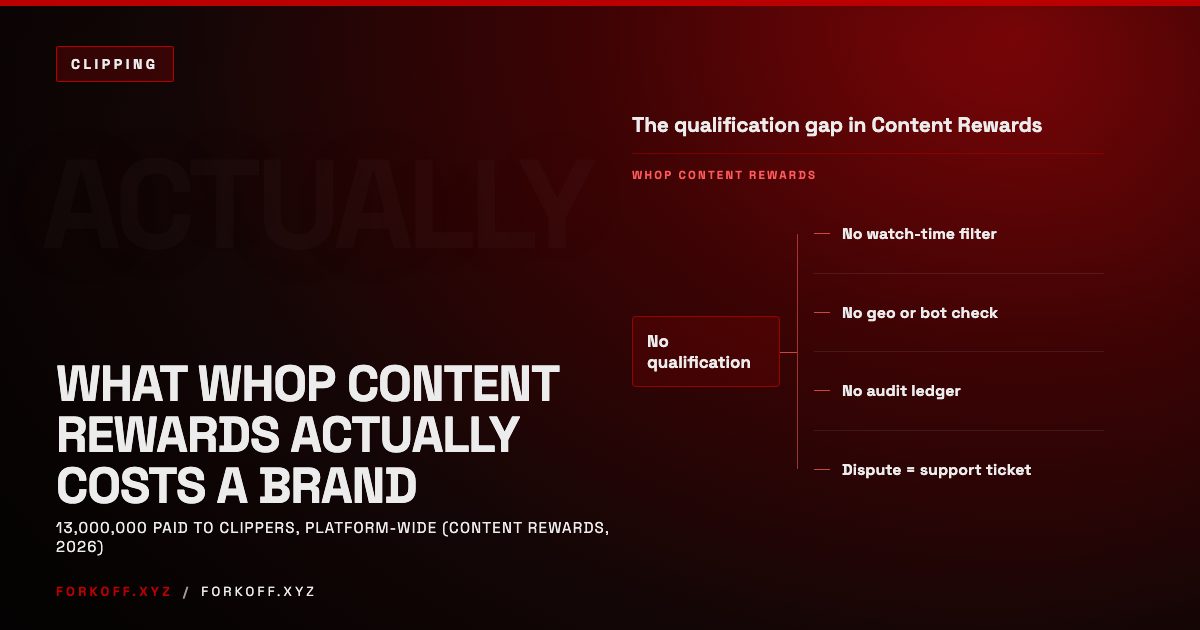
Crypto and Web3 campaigns run the highest observed rates in this research: $8 CPM on one crypto/L1 campaign and $9 CPM on another crypto/web3 run, both paired with a hard budget cap and a short application window. AI and SaaS campaigns tend to run leaner: $6 CPM on an AI/SaaS campaign, $5 CPM on an AI-fintech run, and $4 CPM on an AI/tech campaign, several of which explicitly drop the follower-count requirement to widen the applicant pool rather than compete on rate. A music-promotion campaign in this research ran $1.50 CPM on a rate ladder that increased for repeat performers, paid weekly and directly, no marketplace intermediary, consistent with Variety's reporting on clipping's adoption across the music industry, where one artist manager described the tactic going from a single campaign to standard practice within six months. And at least one brand-collaboration campaign skipped a per-view rate entirely in favor of a pre-funded pool, a $21,000 escrowed budget deposited into Whop's Content Rewards system for editors cutting a Brooke Monk x Kitsch haircare collaboration, paid out per accepted, high-performing clip rather than a flat per-view rate. FORKOFF's own review of what Whop Content Rewards actually costs a brand breaks down a similar per-view economics question from the marketplace side, useful context for a brief author deciding between a marketplace-hosted campaign and a direct one.
The pattern worth noticing across all of these is that the CPM a brand can get away with paying tracks how crowded the niche's clipper supply already is, not some fixed market rate. Crypto and Web3 campaigns pay more in part because the audience niche is narrower and the clippers who can produce genuinely on-brand crypto content are a smaller pool competing for their attention across many simultaneous campaigns. AI and SaaS content is broader and easier for a generalist clipper to produce competently, which is exactly why those campaigns can run leaner and still fill a roster. A brief that sets CPM by looking at a single benchmark number, rather than at how competitive the specific niche's clipper supply is right now, will either overpay against a niche with plenty of willing clippers or underpay against one where demand for clipper attention is genuinely tight.
Fixed rate ladders, paying more per view as a clipper proves themselves over repeat campaigns, showed up as a retention tool rather than a recruitment one. A brand running a single campaign has no use for a rate ladder; a brand planning to run clipping as a recurring channel has every reason to build one, since it rewards the clippers who already know the brand's guidelines and reduces the review burden on every subsequent campaign.
Here is what one of those real crypto-niche briefs looks like when it is posted, budget cap and all:
Reece | Clipping Agency
@rhysclipping
biggest crypto clipping campaign of q2 just went live. $8 cpm. L1 protocol. budget is hard-capped at 40k. once it's gone, it's gone. clipping agency rule - first 200 verified clippers, get a 20% increase in payment. reply "crypto 40k" for the brief.
Budget caps and roster caps
A budget cap and a roster cap answer the same underlying question from two directions: how many clippers can this campaign support before it runs out of money. Real briefs in this research capped rosters between 175 and 400 clippers, and every one of them stated the reasoning plainly: the brand had pre-paid for a specific volume, and the cap kept the applicant pool from exceeding what that volume could pay out.

Setting this number too high produces a flooded applicant pool where most clippers never get meaningfully rewarded, which damages the campaign's reputation among the exact clipper community a future campaign will need to recruit from again. Setting it too low leaves reach on the table the budget could have paid for. The real briefs in this research treated the cap as arithmetic, not a guess: divide the total budget by a realistic average payout per clipper, and that is the roster size the brief should state. FORKOFF's breakdown of a real clipping campaign's cost works through this exact arithmetic against a real funded run, for a brief author who wants to see the math applied to an actual budget rather than in the abstract.
Submission requirements: who gets to apply
Account age and follower requirements are the first filter a clipping campaign brief applies, and the real briefs in this research split into two deliberate strategies rather than one default. Not every operator posting a clipping brief runs it the same way, which is exactly why are clipping agencies legit is a real question buyers ask before committing budget; the requirements below are how the legitimate operators filter for quality rather than just volume. Several campaigns set a firm minimum account age, 30 days was the most common figure, paired with an explicit ban on botted engagement and platform-native promotion tools. Others dropped follower-count requirements entirely, on the logic that a zero-follower clipper with a genuinely good clip can still generate real views, and restricting on follower count filters out exactly the low-cost applicants a lean-CPM campaign needs.
[HIRING] $1.50/1K views for TikTok/IG/Shorts clippers , direct campaign, no agency
Which strategy fits depends on what the campaign can afford to verify. A zero-follower, open-application brief widens the pool but raises the fraud surface, since a fresh account carries no track record. That is exactly why the campaigns that dropped follower requirements paired the decision with a stricter view-verification threshold rather than skipping verification altogether. The two decisions are linked, not independent, and a brief that loosens one without tightening the other is where fraud gets in.
Platform restrictions are the third submission-requirement lever, and the real briefs in this research were specific rather than generic about it, naming shorts, IG, and TikTok explicitly rather than a vague "social media" catch-all. This matters because platform behavior differs enough that a clipper optimizing for one platform's algorithm may produce a clip that underperforms badly on another; a brief that names the exact platforms in scope lets clippers optimize for the right one instead of guessing, and it gives the brand a clean way to exclude a platform where its brand safety requirements are harder to enforce.
Real accounts, real views (30-day account minimum, no botting, no TikTok Promote). Verified at day 7 after posting.
The view-verification threshold and why it is the anti-fraud lever
Of everything in this research, the clearest and most repeated argument was not about CPM or content guidelines, it was about the view-verification threshold, and it came from a source with real standing to make it: a working clipping-agency operator responding directly to "clipping is a scam" criticism.
The Anti-Fraud Argument
The most useful contrarian take in this research came from a clipping-agency operator responding directly to the "clipping is a scam" criticism: the fix is not to distrust the channel, it is to design the brief so fraud cannot pay. Set a minimum view threshold before any payout qualifies, and cap the maximum payout per clip. Below the threshold, a bot-inflated clip earns nothing; above the cap, no single submission can drain the budget. That is a brief-design decision, not a platform feature.
Source: @rhysclipping (Lumina Clippers) on X, 2026
The mechanism is straightforward. A minimum view threshold, commonly cited around 5,000 verified views, has to clear before a clip qualifies for any payout at all. A maximum payout cap per clip, commonly $100 to $500 in this research, limits how much any single submission can earn even if it goes further than expected. Together, the two numbers bracket the payout: below the floor, a bot-inflated clip earns the fraudster nothing, because the campaign never pays until the threshold clears; above the ceiling, no individual submission, fraudulent or not, can drain a disproportionate share of the budget. This is a brief-design decision, made before the campaign launches, not a feature a platform bolts on afterward. 3-layer bot detection systems covers the technical side of catching fraudulent views; this section is about the contractual side, what the brief has to state so the technical detection actually has teeth.
Operator noteFraud prevention is not a platform feature you buy. It is a threshold you set in the brief before the campaign launches.

Reece | Clipping Agency
@rhysclipping
clipping is “scam” lol if you’re running a clipping campaign, without anti-bot tracking, AT LEAST set a minimum threshold such as 5,000 views, and maximum $100-$500 payout per clip before qualifying for any payout no scammers can make profit, and leave you. thank me later
What does a clip have to include? Setting content guidelines
Content guidelines are the most concrete, checklist-shaped part of a brief, and also the part most likely to be underspecified in a first attempt. Logo visibility, whether and how a brand mark has to appear, is the most commonly named requirement across the research, followed by caption and hashtag rules that make a clip traceable back to the campaign. How long a post has to stay live matters more than brands expect, since a clip pulled down early can undercut a verification window that assumes the post is still there to check. And geo targeting, split into tiers where the brief pays differently depending on the audience's location, showed up specifically in the most detailed public breakdown found in this research, a real sign that experienced operators treat geo as a payout variable, not an afterthought.
Emily Lai
@emilylai
CLIPPING: crypto marketers are just discovering what it is. Here's a breakdown and how it's used for growth The purpose of clipping is to get your video content distributed at scale. 1. You attract editors and creators via your own pages (like the crypto marketers we're seeing n… Show more
The temptation with content guidelines is to over-specify: dictate exact hooks, exact pacing, exact framing. ClipAffiliates' guide to running a clipping campaign names this directly as a common mistake, an over-restrictive brief kills the creative variety that makes clips spread in the first place. The brief needs to lock what the campaign genuinely cannot ship without (brand mark, required disclosures, platform rules) and leave the creative execution to the clipper, who is closer to what actually performs on their audience than a brand marketing team drafting a document in advance.
ClipFlip's step-by-step campaign-creation guide is one of the few incumbents that separates the asset upload from the guideline step at all, worth a look for how it structures the intake form even though it does not go as deep on payout mechanics as this article does. Geo targeting deserves its own line in the brief rather than a blanket assumption of a US audience, and not only for payout reasons. A brand launching into a specific regional market, or trying to avoid a specific jurisdiction for compliance reasons, needs the brief to state that explicitly, since a clipper cannot know to filter for it otherwise. Splitting payout into geo tiers, paying more for views from a priority market than from an incidental one, is how the more sophisticated briefs in this research handled the tradeoff between wanting broad reach and needing the reach to land where the buyer actually is.
Review, approval, and the payment cadence
Every clean brief in this research named who reviews a submission and on what schedule, because an undefined review process is where disputes accumulate fastest. Some briefs run review and approval before payout is even discussed, "you review and approve/deny any content before it costs you anything," in the words of one vendor's own description of the model. Others verify on a fixed schedule after posting, a 7-day verification window after a clip goes live was the specific figure in one of the clearest real briefs in this research, giving views time to accumulate and settle before the count that determines payout is finalized.
Read the brief before you grind out 40 clips that get rejected. Rejected clips earn nothing.
How paid clipping campaigns actually works from someone who builds in this space
Operator noteA vague brief does not save you time. It just moves the cost onto rejected clips you still have to review.
Payment cadence is the part clippers care about most and brands underweight most. Weekly payout, paid on a fixed day via a named method (PayPal, direct crypto, or a marketplace's built-in payout system), showed up repeatedly as a trust signal in the recruitment posts sourced for this research. A brief that is vague about when money actually arrives reads, correctly, as a brief written by someone who has not run a campaign before.
Clippers reading a brief are running the same payout math from the other side that how much do clippers earn in 2026 covers in depth, and a brief that is vague on cadence reads as a red flag against that backdrop. A second, less obvious trust signal in the real briefs sourced here was naming the tracking mechanism explicitly, whether submissions run through a Discord channel, a marketplace dashboard, or a shared tracking sheet. Clippers who have been burned by an unmanaged campaign before, one where a brand simply stopped responding once views came in, look for this detail specifically, and a brief that names it upfront filters out exactly the applicants who would otherwise churn out after their first rejected submission.
Application windows: how urgency shapes the applicant pool
Several of the highest-CPM campaigns in this research ran deliberately short application windows, as tight as 48 hours from the post going live to applications closing. This is not a rushed process, it is a specific tactic: a short window creates urgency that pulls in serious applicants fast, and it caps the applicant pool naturally before it exceeds what a hard budget cap can support.

A longer, open-ended application window suits a different goal, building a standing pool of vetted clippers for repeat campaigns rather than filling one specific run. Neither approach is universally correct; the choice should follow from whether the campaign is a one-off or the first of a series, and the brief should state the window explicitly rather than leaving "how long do I have to apply" as a question a clipper has to guess at.
Leaderboard and roster mechanics
Not every clipping campaign uses a leaderboard, but the ones that do treat it as more than a gamification layer. A network built specifically around clipping-campaign infrastructure describes the loop plainly: clippers join, use approved content, follow the brief, post clips, and compete on a leaderboard ranked by verified performance.

Leaderboard Mechanics as an Integrity Signal
A network built entirely around clipping-campaign infrastructure describes its own model in a way most brands never think to ask for: clippers join, use approved content, follow the brief, post clips, and compete on a leaderboard, and the network states plainly that it is "not about fake views, stolen content, spam, or misleading edits" because campaigns only work when clippers follow the brief and create properly. A leaderboard is not just a gamification layer, it is a public integrity check on every submission.
Source: Ascendant Performance Network, Reddit, 2026
Welcome to the Ascendant Performance Network
What makes the leaderboard model useful for a brief specifically is that it turns brief compliance into an ongoing, visible check rather than a one-time approval gate. A clipper who deviates from the guidelines does not just risk one rejected submission, they risk losing standing in a pool that determines future payout tiers. For a campaign expecting repeat participation from the same roster over weeks or months, stating the leaderboard mechanics in the brief upfront, how rank is calculated, what unlocks a higher payout tier, sets the incentive correctly from the first submission.
The mechanics here overlap more with influencer marketing than most brands running their first clipping campaign expect, since a top-ranked clipper on a leaderboard is functionally a micro-influencer the brand is building a relationship with, not an anonymous vendor. A leaderboard also solves a coordination problem a flat per-clip rate cannot: it lets a brand reward the clippers actually driving the bulk of a campaign's reach without having to individually negotiate a better rate with each one. Instead, the brief states the rule once (top-ranked clippers unlock a bonus tier, or first access to the next campaign) and the leaderboard enforces it automatically. This is worth stating in the brief even for a campaign not planning to use a leaderboard at launch, since the absence of one is itself information a clipper deciding whether to apply will want: a flat-rate, no-leaderboard campaign signals a one-off run, while a leaderboard signals an ongoing relationship worth the extra effort of building a track record.
Do you have the source content to write a brief about?
This is the step that gets skipped, and it comes before the CPM line is even written. A meaningful share of brands that inquire about clipping have no clippable long-form content at all, no podcast episode, no stream VOD, no demo recording, nothing a clipper could actually cut from. This shows up repeatedly in FORKOFF's own client conversations: a brand wants clipping without having anything on the shelf to clip, which is a content-production gap dressed up as a distribution question.

Operator noteThe most expensive brief mistake happens before the CPM line is even written, launching with no clippable source content.
The fix is to gate the brief on this question before anything else gets drafted. Review the available long-form assets for clippability, whether they contain hooky, self-contained moments a clipper can extract, and be honest about what clears the bar before writing a single CPM figure. Where the source material genuinely does not exist, the working prescription is to build it first: a short scripted-segment recording session, structured specifically to produce clippable moments, rather than launching a campaign against source content that was never designed to be cut.
This is worth stating as its own line in the brief, not left implicit, because the failure mode when it is skipped is specific and expensive: the campaign launches, the clips underperform because the source material was never hooky to begin with, and the pilot reads as a clipping failure when the real cause was a content-production gap that predates the brief entirely. A brief that names the exact source assets available, and where clippers can access them, closes this gap before a single applicant wastes time on a campaign that was never going to produce good clips regardless of how well the rest of the brief was written.
Common brief mistakes that turn into disputes
A handful of mistakes recur often enough across this research to name directly. 8 clipping campaign mistakes that quietly burn brand budget covers the full list at the campaign level; the brief-specific version of that list is narrower and worth stating plainly here. Leaving the view-verification threshold unstated, or setting it to zero, is the single most expensive gap, because it removes the one lever that keeps fraud from paying. Under-specifying content guidelines while over-specifying creative execution produces the opposite failure, a flood of technically-compliant but creatively lifeless clips that never perform. And omitting the payment cadence entirely is the fastest way to damage a brief's credibility with an experienced clipper pool who has seen vague-payout campaigns before and knows to skip them.
A subtler mistake, less visible until it happens, is publishing a brief that never changes after launch. The real campaigns sourced for this research that ran cleanest treated the brief as a living document for the length of the campaign, tightening a vague guideline once the first batch of submissions revealed where clippers were interpreting it differently than intended, or loosening an overly strict rule once it became clear it was suppressing submissions without improving quality. A brief locked at launch and never revisited accumulates exactly the ambiguity this article argues against, just discovered slowly instead of all at once.
How To Start a Clipping Agency (10k/mo)
A breakdown of what standing up a clipping agency actually involves day to day, useful context for what a managed brief actually coordinates.
DIY brief or a managed clipping agency?
Writing a brief yourself is the right call for a first small campaign, and every real brief sourced for this research proves it can be done well without an agency in the loop. It stops being the cheaper option once the operational load compounds: sourcing and vetting a roster, building or licensing a verification gate, handling flagged-submission disputes, and reconciling qualified views against a spreadsheet every week.
Writing your own brief vs a managed clipping agency
| Task | DIY brief | Managed agency (FORKOFF) |
|---|---|---|
| Write the brief | You draft CPM, requirements, guidelines from scratch | Written for you, calibrated to your niche and budget |
| Source clippers | You recruit, vet, and field applications | Roster sourced and vetted from an existing network |
| Verify views | You build or buy a verification gate | Verification built into the operating system |
| Handle fraud disputes | You review flagged submissions yourself | Handled inside the managed workflow |
| Track qualified views | Manual spreadsheet reconciliation | Reported against a qualified-view standard |
DIY is viable for a first small campaign to learn the mechanics. It stops being the cheaper option once verification, roster management, and dispute handling start eating founder or marketer time every week.

The honest comparison is not "can you write a brief" (you can, this article shows exactly what one needs) but "do you want to run the operational machine behind it every week for the life of the campaign." Is hiring a clipping and distribution agency worth it and clipping agency vs in-house both dig into that tradeoff in more depth. FORKOFF runs clipping as a managed operating system precisely because the brief is the easy 20% of the work; the roster, verification, and payout reconciliation behind it is the other 80%, and it is what what a clipping agency does actually covers day to day.
The break-even point is not a fixed dollar figure, it is a time figure. A single, one-off campaign of a few weeks rarely justifies the overhead of building verification tooling from scratch, and the real briefs sourced for this research that ran that way did fine with a Discord channel and a spreadsheet. The math changes once a brand plans to run clipping as a standing channel rather than a one-time test: at that point the roster-vetting and dispute-handling work repeats every cycle, and the hours spent on it are hours not spent on the parts of marketing a brand's own team is actually positioned to do well. That is the point at which handing the operational machine to a managed system, rather than the brief-writing itself, becomes the better use of the team's time.
Start a $30k/month Clipping Agency on Whop (step-by-step)
A step-by-step walkthrough of standing up a clipping campaign on Whop, the DIY path this article compares against a managed brief.
Don't Start Whop Clipping, Use THIS Clipping Strategy Instead
A clipper-side take on why the default Whop clipping approach underperforms and what strategy actually pays, the recruitment side of the brief this article covers from the brand perspective.
A working brief structure to start from
Pulling every section above into one sequence: state the CPM (with a niche-appropriate rate, not a generic figure), state the budget or roster cap and how it was calculated, state the submission requirements (account age, follower policy, platform restrictions), state the view-verification threshold and payout cap per clip, state the content guidelines (logo, captions, hashtags, geo tiers, post duration), and state the review and approval flow with a real payment cadence.


Every real brief sourced for this research hits all six. None of the vendor guides that currently rank for clipping-campaign queries lay them out in one place with real numbers attached, which is the gap this article set out to close. Lumina Clippers' own explainer gets closest to naming the real stakes, describing the brief, the creator pool, the review step, view verification, and the payout rules together as "the machine" around a clip, and arguing that most guides explain the clip and skip the machine. This article is the missing half of that argument, spelled out with real numbers attached to each part of it. A brief that covers all six, with numbers calibrated to the niche rather than copied from a generic template, is the difference between a campaign that produces clips worth the spend and one that generates a dashboard full of reach nobody can trust.
None of this requires a large team or a big first budget. The smallest real campaign sourced for this research ran on a Discord server, a rate card, and a single operator checking submissions by hand, and it still hit every one of the six elements. What separated it from a vague, first-attempt brief was not scale, it was completeness: every clipper who applied knew the rate, the cap, the requirements, the verification threshold, the content rules, and when they would get paid, before they cut a single clip. That completeness is buildable on any budget; it is a writing discipline before it is an operational one.
If writing and running that brief every week is not where the marketing team's time is best spent, that is exactly the operational load FORKOFF's clipping service and managed clipping for brands exist to take off a brand's plate, calibrated to the same real market this article is built from, not a generic template.