TL;DR: A clipping agency is a managed service that runs a network of short-form editors (clippers), turns your long-form content into hundreds of platform-native clips, distributes them across TikTok, Reels, Shorts, and X, and bills on results rather than hours. It exists because in-house editors do not scale to that volume and DIY tools produce clips but no distribution. Choose one on its clipper-network depth, its quality control, its attribution and reporting, and whether it prices on qualified views rather than raw views.
What a Clipping Agency Actually Does in 2026 (and How to Choose One)
A clipping agency is a managed service that recruits and runs a network of short-form editors (clippers), turns a creator or brand's long-form content into many platform-native clips, distributes them across TikTok, Reels, Shorts, and X, and bills on results rather than hours. The model exists because in-house editors do not scale to hundreds of clips a week and DIY tools produce clips but no distribution. Choose one on its clipper-network depth, its quality control, its attribution and reporting, and whether it prices on qualified views rather than raw views.
What does a clipping agency actually do?
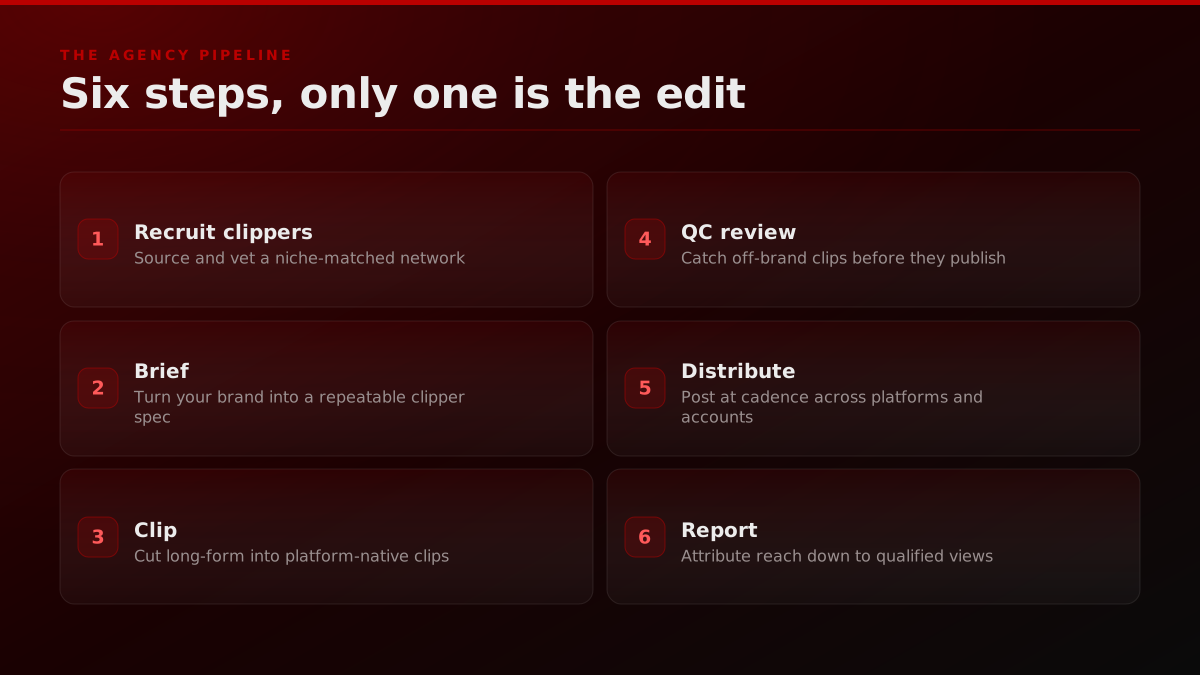
A clipping agency is a managed service that owns the entire short-form pipeline for a creator or brand: it recruits and runs a network of clippers, turns long-form content into many platform-native clips, distributes those clips across networks of accounts, and reports on the results. The word "agency" matters because the unit of work is not an edit, it is an outcome. You hand over a podcast, a stream, a keynote, or a founder's talking-head footage, plus a goal, and the agency returns published, distributed clips and a report on how they performed.
That is the line that separates an agency from the best clipping software on the market. A tool performs the editing step. An agency performs the editing step plus the four operational steps around it that actually consume the time: finding and vetting clippers, briefing them on your brand and content, reviewing every clip for quality and fit before it publishes, and distributing across many platforms and accounts. The managed clipping playbook walks the full operating model; this guide is the buyer's-eye view of what you are actually paying for and how to choose well.
Industry Context
Reddit communities and AI Overviews increasingly surface short clips as the entry point to a creator, so distribution breadth (one clip on many platforms) now matters more than the polish of any single edit.
Agency vs in-house editor vs DIY tool
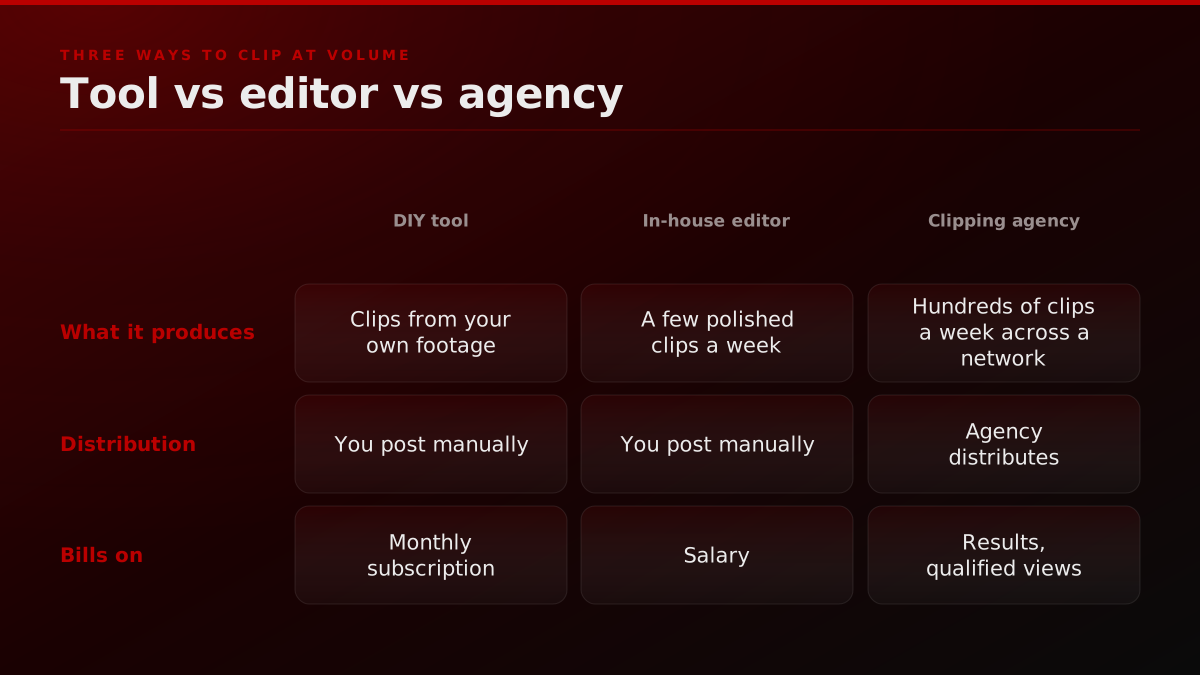
The three ways to produce clips at volume differ on what they produce, who distributes, and what they bill on, and the right one depends entirely on the volume and distribution you need. A DIY tool gives you clips from your own footage that you post yourself on a flat subscription. An in-house editor gives you a handful of polished clips a week that you still post yourself, for a salary. A clipping agency gives you hundreds of clips a week across a network, distributes them for you, and bills on results.
Three ways to produce clips at volume
| Approach | What it produces | Distribution | Bills on |
|---|---|---|---|
| DIY tool (Opus/Submagic) | clips from your own footage | you post manually | monthly subscription |
| In-house editor | a few polished clips/week | you post manually | salary |
| Clipping agency | hundreds of clips/week across a network | agency distributes | results / qualified views |
The full cost comparison across those three lanes, with the per-qualified-view math, lives in the clipping agency vs in-house vs Opus Clip breakdown, and the head-to-head on the managed model versus the most popular tool is in Opus Clip vs managed clipping. The short version: tools and editors are cheaper per clip; an agency is cheaper per qualified view at volume, because the agency's whole job is converting production into distributed reach you would not otherwise achieve. If your bottleneck is "I cannot produce clips," buy a tool. If your bottleneck is "I cannot distribute at volume," that is the agency's job.
Clemente
@Chilearmy123
The rise of clipping in social media is the NBA equivalent of 3 pointers The game evolves to what is MOST efficient We went from celebrities -> influencers -> creators -> clippers The value of an influencer's page has gone down drastically - if they can't make clips t… Show more
How do clipping agencies price?
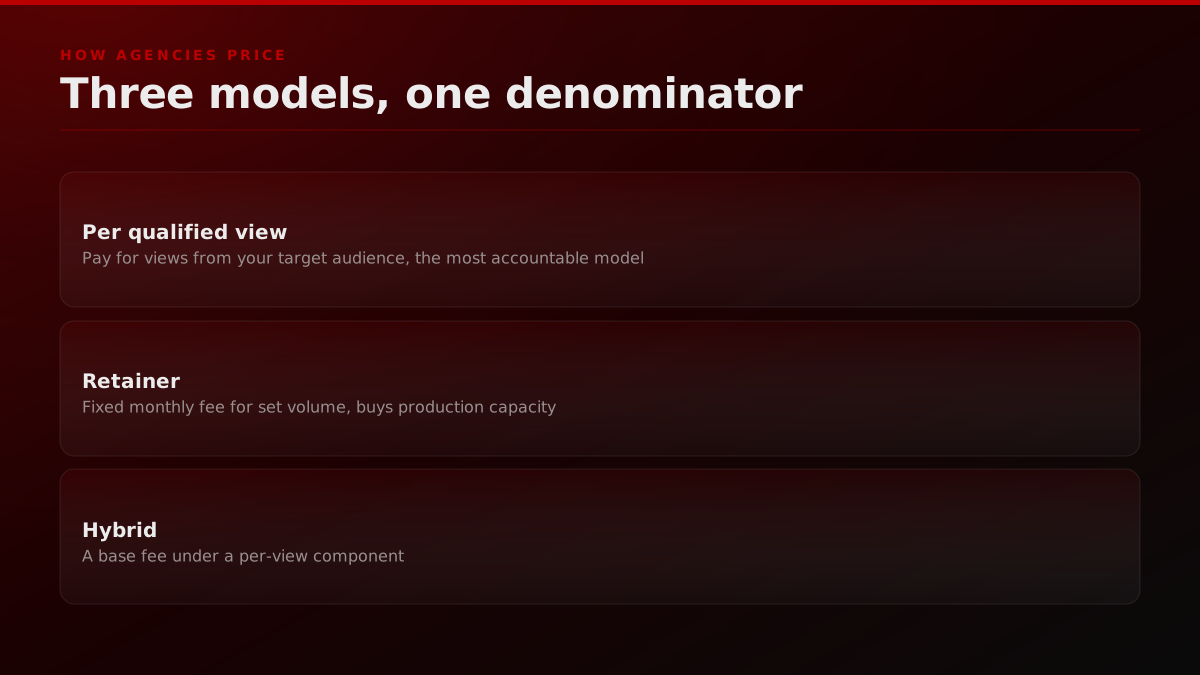
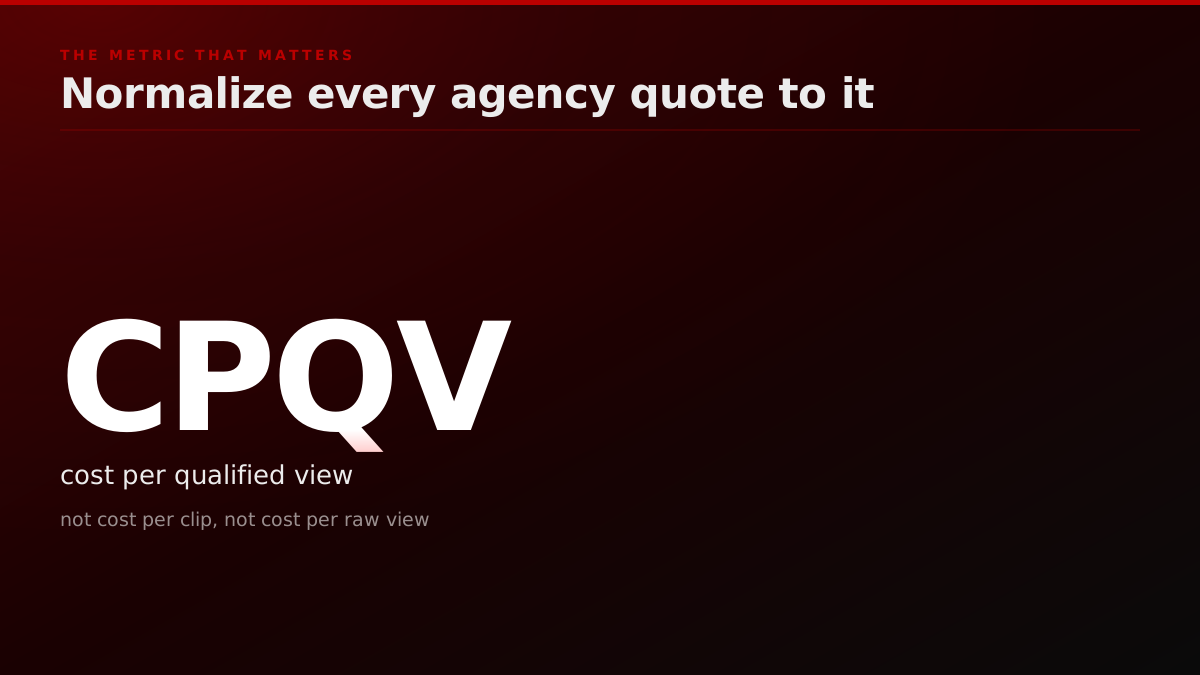
Clipping agency pricing comes in three shapes, and the one a given agency uses tells you what it is actually selling. Per-qualified-view pricing means you pay for views from your real target audience, which is the most accountable model because it ties the bill to outcomes. Retainer pricing means a fixed monthly fee for a set volume of clips and distribution, which buys production capacity. Hybrid pricing puts a base fee under a per-view component. None is wrong, but the headline number to compare across all of them is cost per qualified view, not cost per clip and not cost per raw view.
Industry Context
The 2026 shift is from "make me a clip" (a tool job) to "get me a thousand qualified views from clips this month" (an outcome job), which is the line between a tool and an agency.
The reason cost per qualified view is the right denominator is covered in depth in the CPM rates for clipping guide and benchmarked against real campaigns in the clipping CPQV benchmark. Raw views are easy to inflate and cheap to buy; qualified views are the ones that contain potential customers. When you compare two agencies, normalize their quotes to cost per qualified view and the cheaper-looking one often turns out to be the more expensive one once you strip out the views that were never going to convert. The clipping campaign cost breakdown shows the math on a real campaign. For the short, citation-ready version of these agency-cost questions, see the FORKOFF answers hub.
Reece | Clipping Agency
@rhysclipping
the "pay per view" model that generated 8 billion views and why flat-fee agencies are dying most clipping agencies work like this: you pay $2-5k/month they deliver 20-30 clips you post them yourself results vary wildly good month? you overpaid for what you got bad month? you
What does "qualified view" mean, and why does it decide everything?
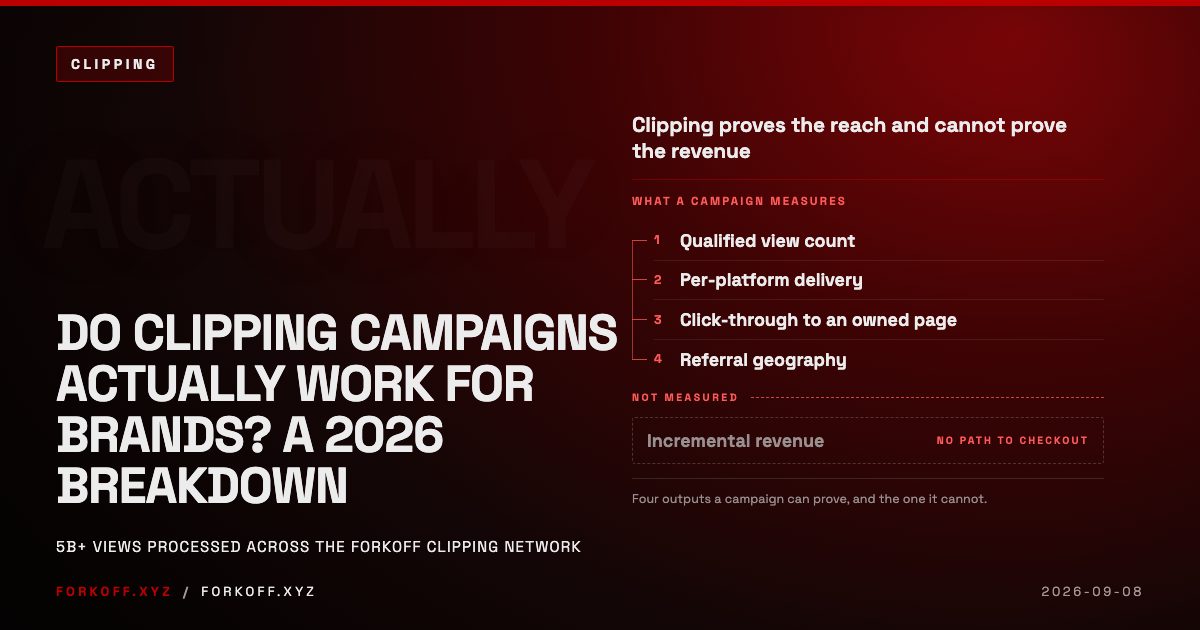
A qualified view is a view from someone in your actual target audience, as opposed to a bot, an accidental scroll-past, or an out-of-market viewer. It is the single most important concept in evaluating a clipping agency, because the clip economy is awash in vanity views. A clip can rack up a million views that contain zero potential customers, and an agency that reports only raw views is, functionally, selling you the same number a bot farm sells. The full definition and how to measure it is in the qualified views metric guide.
A clip that gets a million bot views is worth less than a clip that gets ten thousand views from people who would actually buy.
This is also the cleanest test you can run on a prospective agency. Ask it, in writing, to define a qualified view and to show you how it attributes views to audience. An agency built around outcomes will have a crisp answer and a reporting view to back it. An agency built around volume will deflect to a raw-view screenshot. The 3-layer bot-detection system guide explains why raw-view counts are so easy to game, which is exactly why qualified views exist as a metric.
How does a clip become a qualified view (the distribution mechanics)?
A clip becomes a qualified view through a four-stage funnel, and a clipping agency's real job is engineering each stage so the view that lands is from your audience rather than a random scroll. The stages are production, placement, propagation, and qualification, and most DIY clipping stops at production. Understanding the funnel is what lets you judge whether an agency is selling you reach or selling you raw motion.
Production is the clip itself: a hook in the first second, a payoff before the scroll, and a format native to the platform it will live on. Placement is which accounts post it and when, because the same clip dropped from a cold account dies while the same clip dropped into a warm network with the right posting cadence travels. Propagation is the platform algorithm deciding, in the first thirty to ninety minutes, whether to push the clip beyond the posting account's followers based on early watch-time and engagement. Qualification is the final filter: of the views the algorithm delivered, how many came from people who match your target audience rather than bots, out-of-market scrollers, or engagement-bait traffic.
An agency that only controls production is a tool with a human attached. An agency that controls placement and propagation, through a real network of accounts with posting discipline and early-engagement support, is what actually moves the qualified-view number. This is why the 3-layer bot-detection work matters: it is the qualification filter made measurable, separating the views that count from the views that only look good on a screenshot. When you evaluate an agency, ask which of these four stages it actually owns, because the answer tells you whether you are buying a clip or buying a qualified view.
Nate Curtiss
@natecurtiss_yt
You can literally get millions of views using clipping without filming a new single video. N3on paid clippers $1.4M in five weeks. The top ones make $60k to $100k a month. They did not create anything. They cut his long form into long form YouTube videos and short clips and http… Show more
How do you choose a clipping agency (the four tests)?
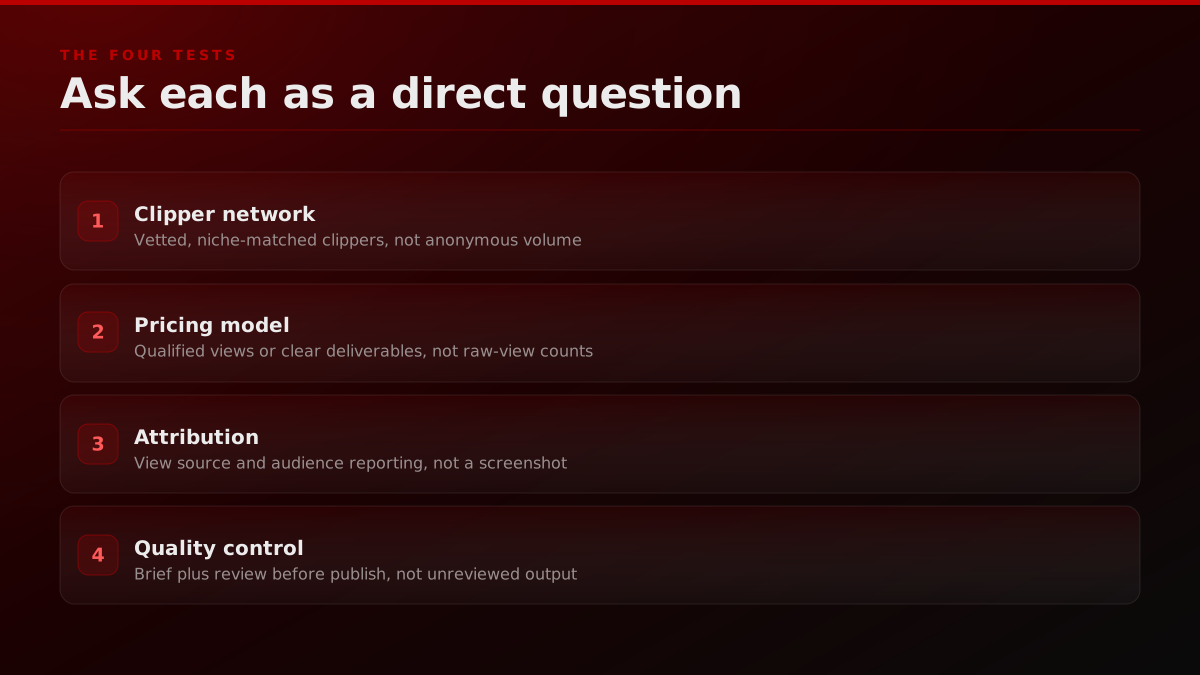
Choosing a clipping agency comes down to four dimensions, and a strong agency is strong on all four while a weak one fails quietly on attribution and quality control. The four are the clipper network, the pricing model, attribution and reporting, and quality control. Run each as a direct question and watch whether you get a crisp answer or a deflection.
What to evaluate in a clipping agency
| Dimension | Strong signal | Red flag | |
|---|---|---|---|
| Clipper network | vetted | niche-matched clippers | anonymous volume with no QC |
| Pricing model | qualified views or clear deliverables | raw-view counts only | |
| Attribution | view source + audience reporting | a screenshot of a view counter | |
| Quality control | brief + review before publish | auto-generated | unreviewed clips |
On the clipper network, ask whether the clippers are vetted and matched to your niche or whether it is anonymous volume; a network that cannot describe its clippers is renting you the same pool everyone else uses. On pricing, confirm it bills on qualified views or clear deliverables, not raw views. On attribution, confirm it can tell you where the views came from and who saw them. On quality control, confirm there is a brief-and-review layer before clips publish. The clipping tools comparison is useful here because it shows what the tool layer does, which lets you ask the agency what it adds on top.
Industry Context
Vanity views are the dominant failure mode in the clip economy; an agency that cannot attribute views to qualified audience is selling the same number a bot farm sells.
What runs in the agency operating stack behind the scenes?
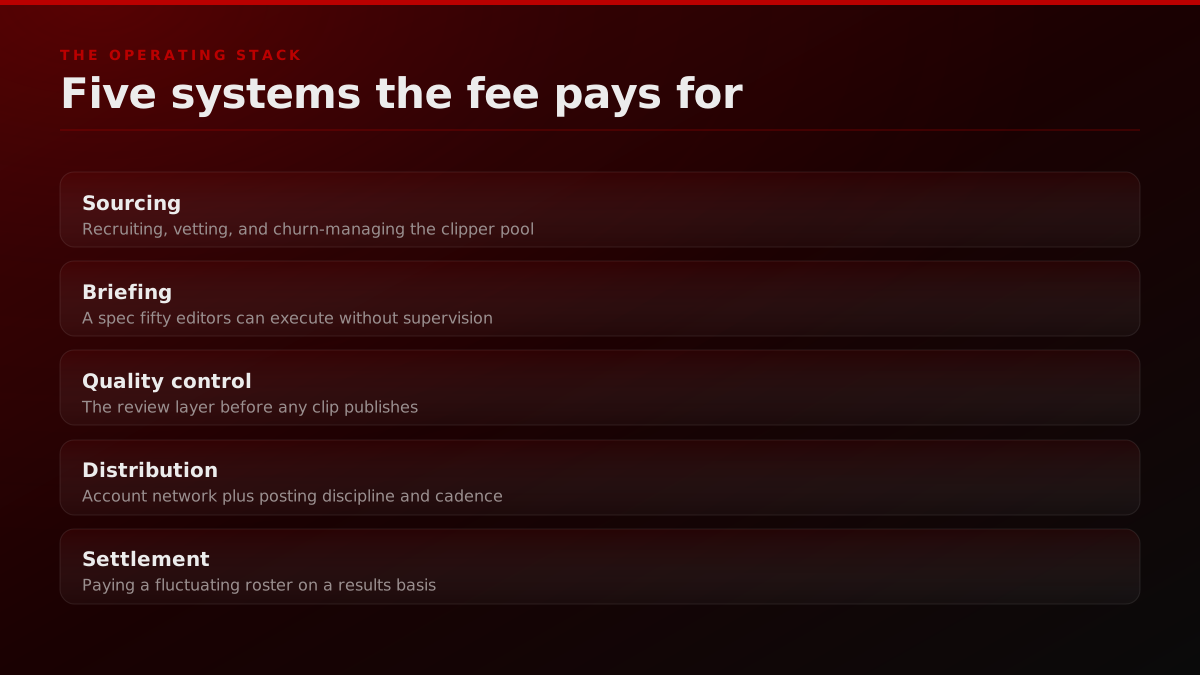
The agency operating stack is five systems running in parallel, and the reason an agency can charge what it charges is that building and running those five in-house is a full-time operations function, not a side task. The five are sourcing, briefing, quality control, distribution, and settlement, and each one quietly fails the teams that try to run clipping themselves.
Sourcing is the recruiting and vetting of clippers, plus the ongoing churn management as clippers come and go. A real network is not a one-time hire; it is a managed pool where the agency knows each clipper's niche, speed, and reliability, and routes work accordingly. Briefing is the system that turns "here is our brand" into a repeatable spec a clipper can execute without supervision, which is the difference between a thousand on-brand clips and a thousand off-brand ones. Quality control is the review layer that catches the off-brand, the inaccurate, and the low-effort clip before it publishes, because in distribution every published clip is a public impression you cannot take back. The managed clipping playbook documents how the briefing-and-QC layer is operationalized.
Distribution is the network of accounts and the posting discipline that gets clips in front of algorithms at the right cadence, and settlement is the payment rail that pays a fluctuating roster of clippers on a results basis without it becoming an accounting nightmare. The how much do clippers earn breakdown shows the settlement side from the clipper's perspective, and the managed clipping revenue case study shows what the full stack produces for a brand. When a founder says "we tried clipping in-house and it fizzled," the failure is almost always in sourcing or settlement, the two systems that look like overhead until you are running fifty clippers and realize the overhead is the job.
Where do streamers look for editors/clippers?
Streamers discuss where and how to source video editors and clippers, the recruiting-and-vetting problem a managed clipping network exists to absorb.
The strategic point is that the editing, the part everyone fixates on, is the cheapest and most commoditized stage in the whole stack. The best clipping software and the clipping tools comparison cover that stage exhaustively, and it is genuinely solved. What is not solved by any tool is the operations stack around it, and that gap is the entire reason a clipping agency is a distinct category rather than a feature of an editing app.
When do you actually need an agency (and when don't you)?
You need a clipping agency when you need both volume and distribution that you are not going to run yourself, and you do not need one when a tool plus an hour of your time covers your goal. If five to ten clips a month from your own footage is enough, the best AI video editor plus your own posting beats an agency on cost. The agency math turns positive when the goal is hundreds of clips a week across many platforms and accounts, with the recruiting, briefing, quality control, clipper payments, and reporting all handled for you.
Operator noteNeed only 5-10 clips a month from your own footage? A tool beats an agency. Agencies win when you need volume plus distribution.
The operational load is the real story. The how much do clippers earn guide shows the scale of a clipper network from the clipper's side, and the managed clipping revenue case study shows what that network produces for a brand. A founder who tries to run fifty clippers in-house usually ships fewer clips, later, with no attribution, because that is a full-time operations job. That is precisely the job an agency exists to absorb, and the broader market context is in the clip economy piece.
What red flags separate a clip engine from a clip farm?
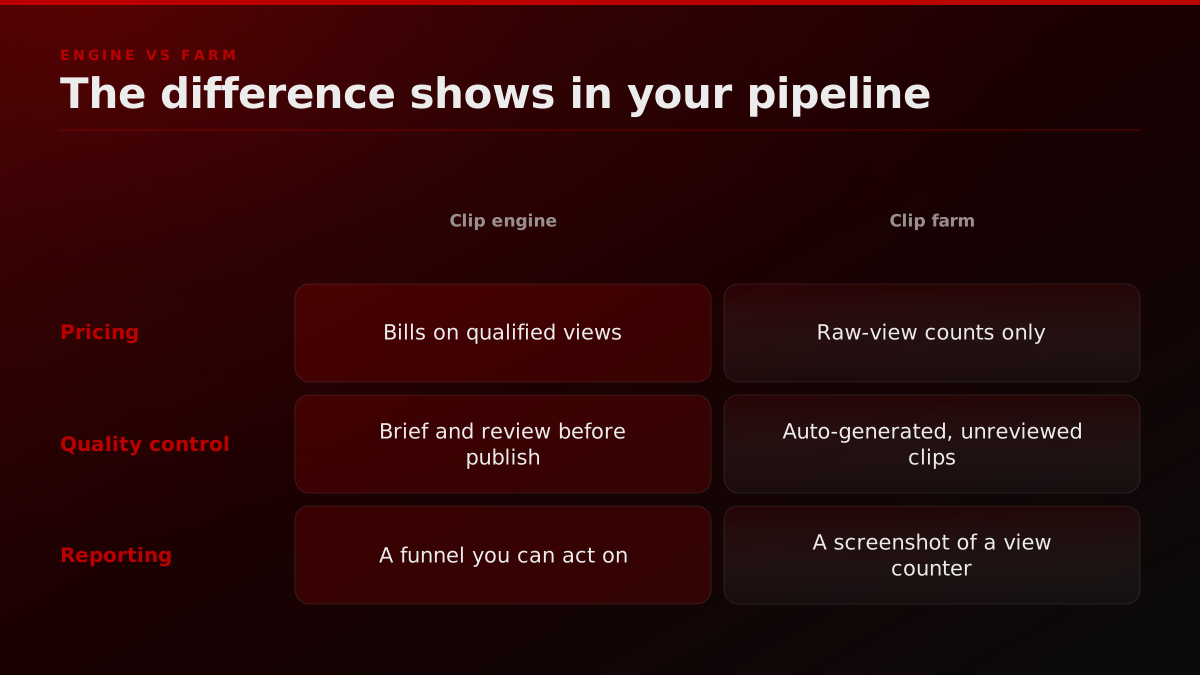
The dominant failure mode in the clip economy is volume without accountability, and the red flags all point at the same gap: views that cannot be attributed to a real audience. An agency that ships auto-generated, un-briefed clips at volume is running a clip farm, not a clip engine, and the difference shows up in your pipeline, not in the view counter. Watch for three signals: a pricing model based only on raw views, no qualified-view definition, and no attribution beyond a screenshot. An AI-driven entertainment clipping agency can land on either side of that line, so the FORKOFF vs Clouted comparison walks through what to verify before you sign.
The hard part of clipping was never the edit. It was finding, briefing, and paying fifty clippers without it becoming a full-time job.
Volume without a briefing and quality-control layer also actively damages a brand. A thousand un-briefed clips dilute a brand's positioning faster than ten well-briefed clips build it, because every off-brand clip is a public impression you do not control. This is the line that the podcast-clipping world learned early; the podcast clipping agency pricing guide covers how the better operators price the QC layer in rather than treating it as optional.
Operator noteA clip network is only as good as its briefing and QC. A thousand un-briefed clips dilute a brand faster than ten good ones build it.
How does FORKOFF run the model?
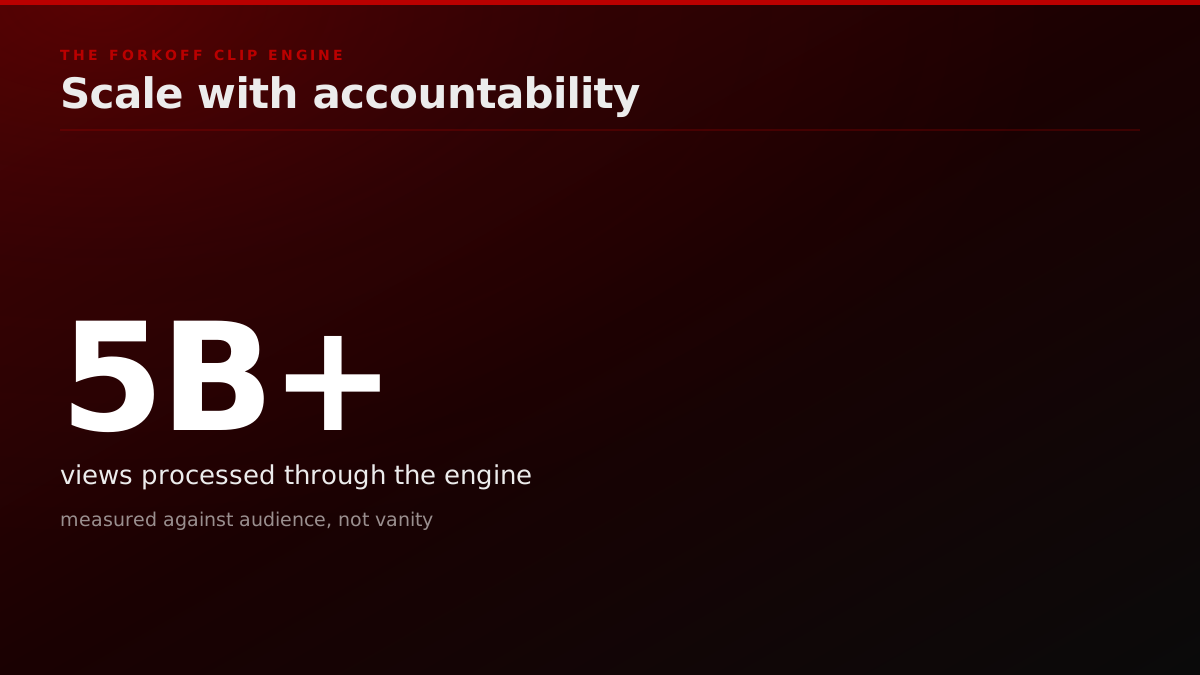
FORKOFF runs clipping as a managed engine rather than a tool: a vetted clipper network, a briefing and quality-control layer, multi-platform distribution, and reporting that bills on qualified views. The proof point is scale with accountability, FORKOFF has processed more than 5 billion views through the clip engine, and the operating discipline is that those views are measured against audience, not vanity. The full service model is on the clipping service page, and the vertical-specific versions for AI startups and crypto launches show how the same engine is tuned per niche.
Operator noteAsk any agency for its qualified-view definition in writing before you sign. If it cannot define one, it is selling raw views.
The reason the model works is the same reason it is hard to run in-house: it is an operations problem disguised as a creative one. Recruiting, briefing, reviewing, distributing, and paying a clipper network at volume is the work; the editing is the easy part. An agency earns its fee by absorbing that operational load and being accountable for the qualified-view outcome at the end of it.
The Clipping Economy
People vs Algorithms
A People vs Algorithms breakdown of the clip economy and how paid clipping floods feeds, useful context on the distribution dynamics an agency is built around.
Five myths about clipping agencies, corrected
The clipping-agency category carries five persistent myths, and each one leads founders to either over-buy or under-buy, so it is worth correcting them before you make a decision. The myths are that an agency is just a fancy editor, that more views is the goal, that bigger networks are always better, that clipping is a creative problem, and that you can easily run it in-house. Each is half-true, which is what makes them sticky.
The first myth, that an agency is a fancy editor, collapses the moment you separate production from distribution: an editor produces clips, an agency distributes them and is accountable for the result, which is a different product. The second myth, that more views is the goal, is the most expensive one, because raw views are easy to inflate and a million unqualified views move nothing; the goal is qualified views, as the qualified views metric guide lays out. The third myth, that bigger networks win, ignores niche fit: a focused network in your audience's communities beats a giant general one, which is the whole point of the vertical tuning below.
The fourth myth, that clipping is a creative problem, is why so many in-house attempts fail; the editing is solved by clipping software, and the real problem is the operations stack of sourcing, briefing, QC, distribution, and settlement. The fifth myth, that you can easily run it in-house, follows from the fourth: founders who try it discover that running fifty clippers is a full-time operations role, not a creative one, and they ship fewer clips with no attribution. The managed clipping playbook and the how much clippers earn breakdown both show why the in-house version quietly costs more than it looks. Correcting these five myths is most of what it takes to buy clipping well.
Why does niche fit decide the result for clipping agencies by vertical?
Niche fit is the most underrated selection criterion, because a clipping agency's network and judgment are only as good as their match to your audience, and a generalist network distributing into the wrong communities produces views that never qualify. The same clip engine tuned for an AI startup launch behaves differently than one tuned for a crypto launch or a podcast, because the hooks that travel, the platforms that matter, and the audiences worth reaching are different in each. An agency that runs one undifferentiated network across every client is optimizing for its own operational simplicity, not your qualified-view rate.
For an AI startup, the clips that qualify are the ones that land in builder and founder communities, which means the network and the hook style have to be tuned for that audience rather than for general entertainment. The AI startup clipping vertical exists precisely because that tuning is non-trivial. For a crypto or token launch, timing and community placement dominate, and the crypto launch clipping vertical is built around the launch-window mechanics that a generalist agency would miss. The point is not that one vertical is harder than another; it is that the qualified-view definition itself changes by vertical, and an agency that cannot articulate how it adapts to your niche is going to deliver views that look fine and convert poorly.
This is also why "how big is your network" is a weaker question than "how much of your network matches my audience." A million-clipper general network that has no depth in your niche is worth less than a focused network that lives in the communities your customers are in. When you evaluate niche fit, ask the agency to name the communities and platforms it would target for your specific audience, and listen for whether the answer is specific or generic. A specific answer means the agency has run your vertical before; a generic one means you would be its experiment.
What should you ask before you sign with a clipping agency?
The sales call is where the clip-engine agencies separate themselves from the clip-farm agencies, and you separate them by asking outcome questions rather than output questions. An output question is "how many clips will I get," and every agency has a confident answer. An outcome question is "how do you define and report a qualified view," and only the accountable agencies have a crisp one. Walk into the call with the second kind of question and the conversation sorts itself.
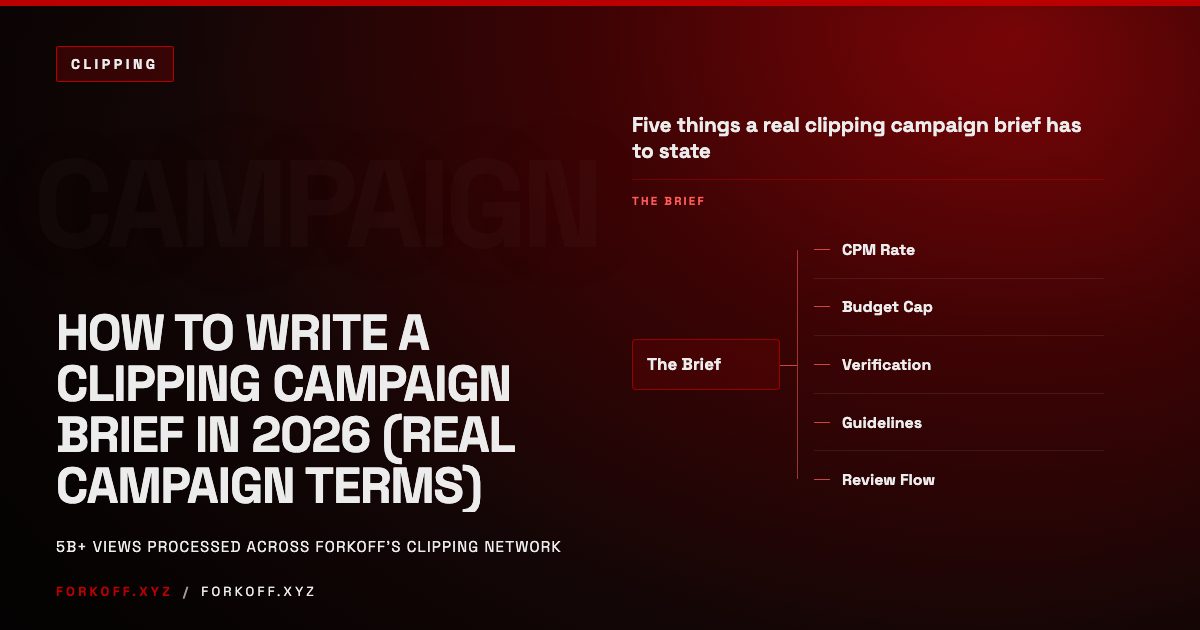
Ask for the qualified-view definition in writing, and ask to see a sample report from a real campaign with the client name redacted if needed. Ask how the clipper network is sourced and vetted, and whether the clippers are matched to your niche or pulled from a general pool. Ask what the briefing process looks like and who reviews clips before they publish, because an agency without a review step is shipping unreviewed brand impressions at volume. Ask which platforms and how many accounts the distribution runs across, since one clip on one account is production, not distribution. Ask how they handle a clip that underperforms: do they learn and re-cut, or do they just post more. The podcast clipping agency pricing guide is a good reference for what a mature answer to these sounds like.
Then ask the pricing question last, framed correctly: not "what does it cost" but "what does a qualified view cost, and what is included in that number." Normalize the answer against the CPQV benchmark and the CPM rates guide before you compare two agencies, because a low headline price often hides a high cost-per-qualified-view once the vanity views are stripped out. The agency that answers all of these without flinching is the one that has built the operating stack; the one that deflects to view counts is renting you a number. The full cost-comparison framing across agency, in-house, and tool lanes is in the agency vs in-house vs Opus Clip breakdown, and the Opus Clip vs managed clipping comparison covers the tool-versus-agency decision specifically.
What does good clipping-agency reporting actually show?
Reporting is where the qualified-view promise either becomes real or stays a slogan, and the report an agency sends every week is the clearest evidence of which kind of operator you hired. A clip-farm report is a single number: total views, screenshotted from a dashboard, with no breakdown. A clip-engine report is a funnel: clips published, reach by platform, watch-time and retention, audience match, and the qualified-view count that falls out of all of it. The gap between those two reports is the gap between a number you cannot act on and a number you can.
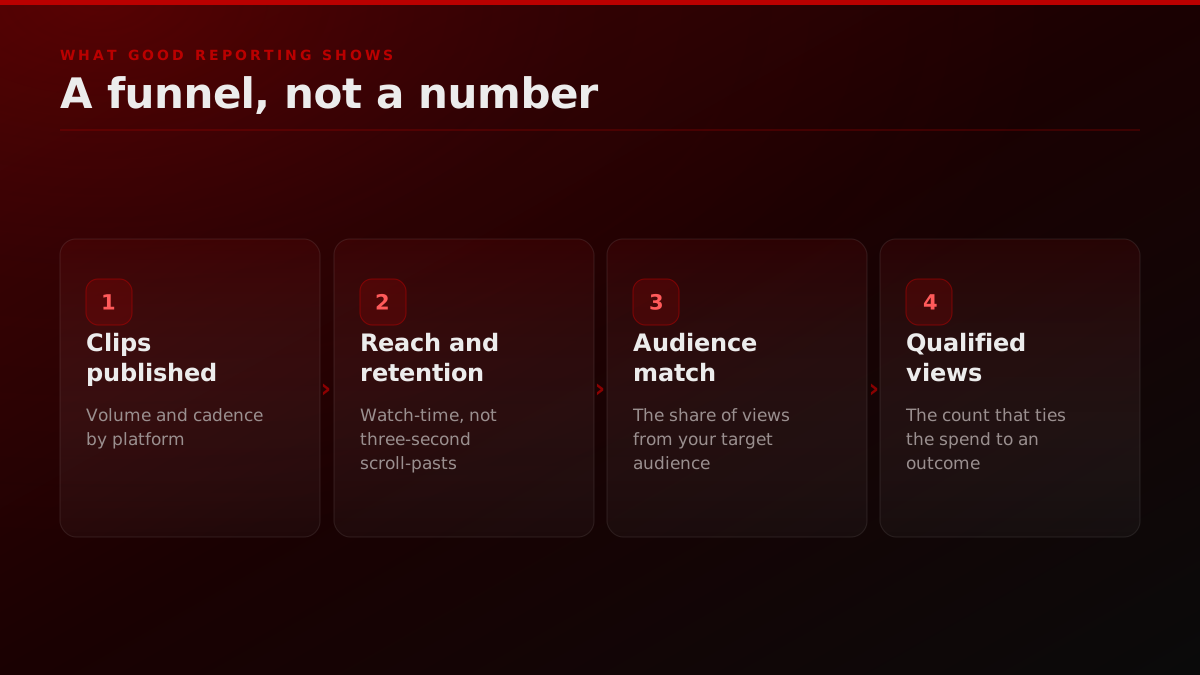
The components worth demanding are specific. Volume and cadence: how many clips went out, on which platforms, on what schedule, because consistency is what trains an algorithm. Reach and retention: not just views but average watch-time and the drop-off curve, since a clip with a million three-second views is a thumbnail people scrolled past, not a clip people watched. Audience composition: the share of views that match your target audience, which is the input to the qualified-view number and the thing a clip farm cannot produce. Attribution: where the qualifying views came from, by platform and by account, so you can see which parts of the network are working for your niche. And a learning loop: what the agency changed this week based on last week's data, because an agency that reports the same format every week without adapting is running a process, not optimizing an outcome.
A good report also tells you what did not work, and that honesty is itself a signal. Most clips underperform; that is the nature of short-form, where a small share of clips carry most of the reach. An agency that only shows you the winners is hiding the denominator, and the denominator is what you are paying for. The operators worth keeping show the misses, explain the re-cut decisions, and treat the underperformers as data rather than something to bury. When you read a sample report in a sales call, look for the losing clips as hard as you look for the winners: their presence, and what the agency says it learned from them, tells you whether you are buying an accountable engine or a highlight reel. The qualified views metric guide is the reference for what the audience-match line in that report should actually measure.
What happens in the first 30 days with a clipping agency?
The first month with a clipping agency is mostly setup, and knowing what that setup should look like protects you from the agencies that skip it. A serious operator does not start posting on day one; it spends the first week building the briefing spec that makes the next eleven months work. Onboarding that goes straight to volume without that foundation is the tell of a clip farm: it is optimizing for an early view count to impress you, not for a qualified-view rate that compounds.
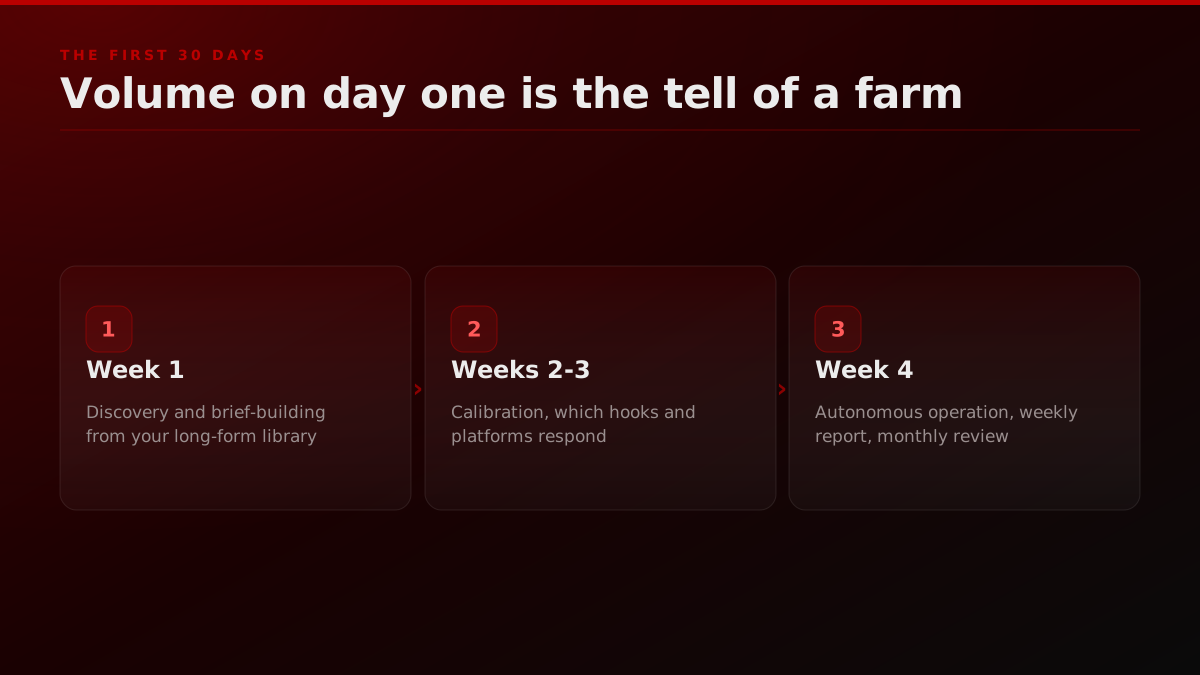
Week one is discovery and brief-building. The agency ingests your long-form library, learns your brand voice and the claims you can and cannot make, identifies the communities your customers actually live in, and turns all of that into a clipper brief: the spec that lets fifty editors produce on-brand clips without you reviewing each one. This is the highest-impact week, and a good agency spends real time on it. If an agency wants to start clipping before it understands your brand, it is going to produce volume you have to disown.
Weeks two and three are calibration. The first clips go out, and the point is not the view count yet, it is the feedback loop: which hooks travel for your audience, which platforms respond, which clippers in the network match your niche. A good agency treats this period as a controlled experiment, deliberately varying hooks and formats to find what works before it scales spend behind the winners. You should expect to be in the loop here, approving direction and flagging anything off-brand, because the calibration you do in week two is what lets the agency run autonomously by month two.
Week four is where the qualified-view machine starts to turn. The brief is tuned, the winning formats are known, the right clippers are routed to your account, and the distribution cadence is set. From here the relationship should shift from heavy involvement to a weekly report and a monthly strategy review, because the entire value of an agency is that it absorbs the operational load once the system is built. If you are still hand-holding every clip in month three, the agency never built the system, and you are paying agency prices for an in-house workflow you are still running yourself. The clean handoff from calibration to autonomous operation is the deliverable; the clips are just what it produces.
Where does the agency relationship break, and how do you prevent it?
Most clipping-agency relationships that fail do not fail on the edit; they fail on a small number of predictable misalignments that are easy to prevent if you name them at the start. The first is a goal mismatch: you wanted qualified views and the agency optimized for raw views because that is the number it knew how to grow. Prevent it by writing the qualified-view definition into the agreement, not the sales call, so the thing you are paying for is the thing being measured. If the metric in the contract is raw views, raw views are what you will get, regardless of what was said on the call.
Does clipping actually make content viral? (content creator)
A marketer asks whether paying clippers to push client long-form content actually drives reach, the buyer-side question the qualified-view framing answers.
The second break is a brand-control gap. Volume without a tight brief means off-brand clips reach the public faster than you can catch them, and a single off-brand clip with reach can do more positioning damage than a month of good ones repairs. Prevent it with an explicit approval lane for the first few weeks and a standing list of claims and framings that are off-limits, so the quality-control layer has a spec to enforce rather than a vibe to guess at. The agencies that resist a brief are the ones that do not have a real QC layer to run it through.
The third break is attribution drift: the relationship starts with detailed reporting and slowly decays into a weekly view-count text once the novelty wears off. Prevent it by treating the report format as a deliverable in its own right, reviewed monthly, so the funnel view does not quietly collapse back into a single number. The fourth and quietest break is cadence collapse, where output starts strong and tapers as the agency's attention moves to a newer client. Prevent it by tying part of the engagement to sustained cadence rather than a front-loaded burst, because in short-form the compounding comes from consistency, and an agency that ships big in month one and thin in month four never lets the compounding start. Name these four at the outset and most of the ways the relationship can break are closed before they open.
Verdict: tool, editor, or agency
Choose a tool if your bottleneck is producing a handful of clips from your own footage, choose an in-house editor if you need a few polished clips a week and want them on payroll, and choose a clipping agency when distribution at volume is the bottleneck and you want the operational load and the qualified-view accountability handled for you. The deciding question is never "who edits cheapest," it is "who gets me qualified views at volume without it becoming my job." If that is the question you are asking, talk to a strategist about a managed managed clipping, or compare the field in our best clipping agency guide first.
External references: short-form distribution mechanics and the creator clip economy are documented across TikTok's creator resources, YouTube's Shorts documentation, Instagram's Reels guidance, industry coverage at Forbes, The Verge, TechCrunch, creator-economy analysis at a16z, and platform reach benchmarks from Sprout Social.