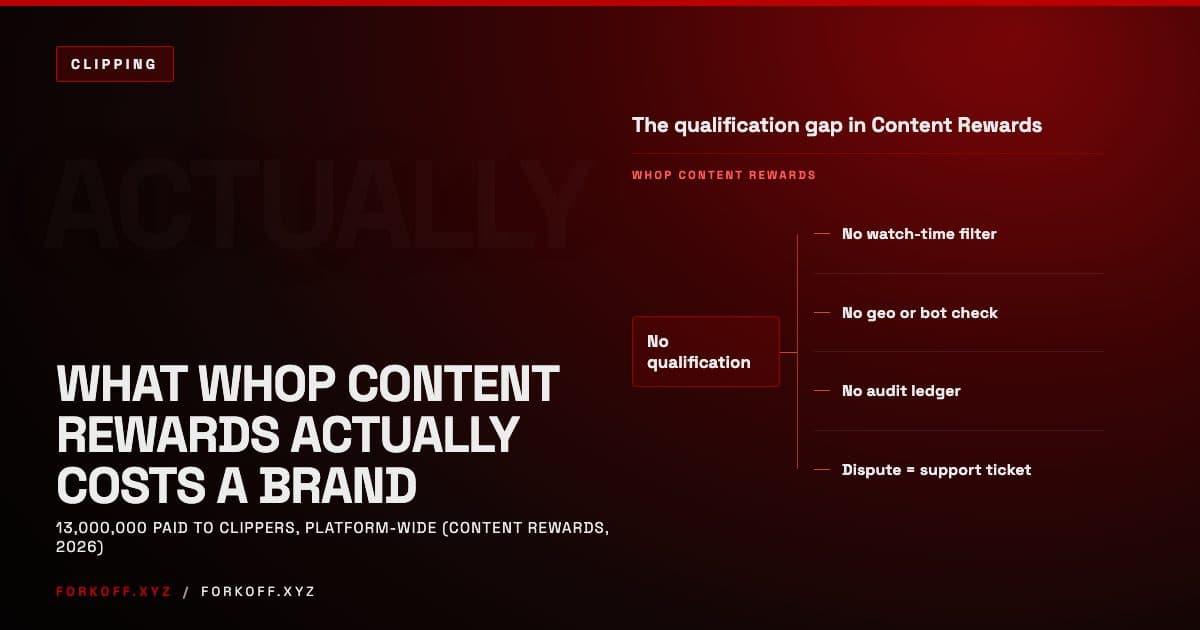
Whop Content Rewards will take a brand's budget, post it as a campaign brief, and pay creators a CPM rate on the views they submit. That much is documented. What is not documented anywhere on Whop's own pages is what a real campaign costs once the budget clears escrow, what happens the first time a submitted view count gets disputed, and where the qualification gap actually shows up on an invoice. This post answers all three from real, sourced campaign disclosures, not from Whop's own marketing copy.
The 30-second rule
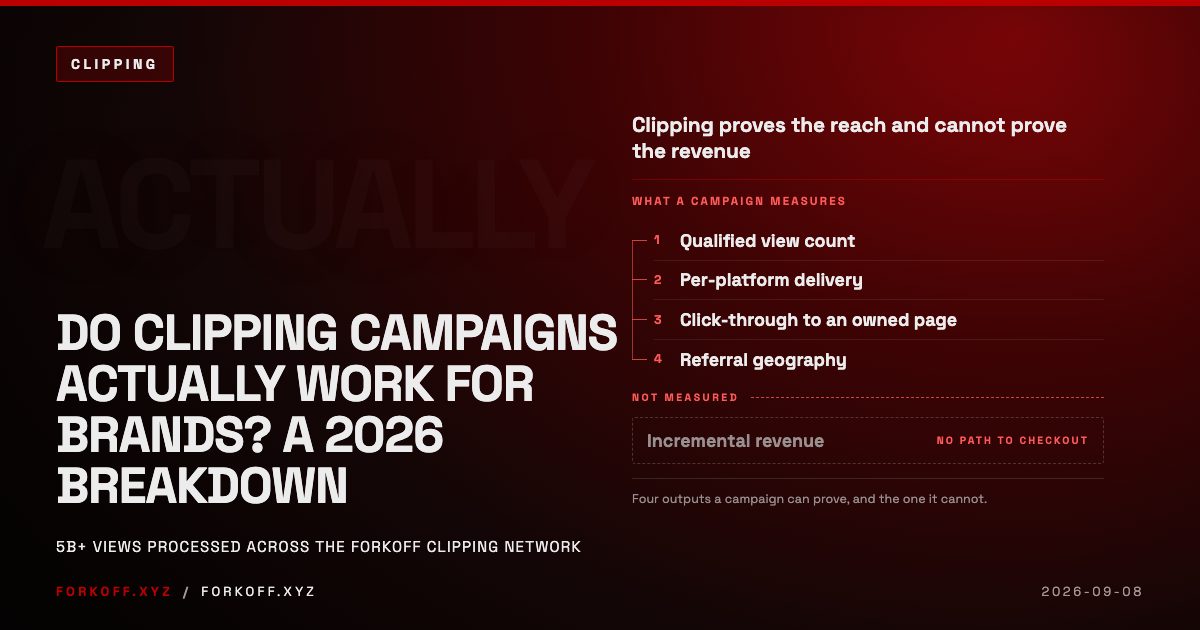
A real Whop Content Rewards campaign costs anywhere from a $2,000 niche pool to $841,850 across four months for a single gaming brand, on top of Whop's 2.7 percent plus $0.30 transaction fee. Content Rewards has paid out $13,000,000 to clippers platform-wide. The number that gets skipped is the qualification gap, submitted views ship raw, with no watch-time, geo, or bot filter, and a disputed count has no audit trail, only a support ticket. A brand buying self-serve creator discovery gets a fast, low-cost campaign. A brand buying an audited outcome needs the qualification layer a managed lane provides.
The 30-second version: real Content Rewards campaigns range from a $2,000 niche pool up to $841,850 across four months for one gaming brand, on top of Whop's 2.7 percent plus $0.30 transaction fee. The platform has paid out $13,000,000 to clippers in total. The number every case study skips is the qualification gap. Submitted views ship raw, with no watch-time filter, no geo check, and no bot detection, and a disputed count has no audit trail beyond a support ticket. A brand buying fast, self-serve creator access gets exactly that. A brand that needs to reconcile a clipping line item against paid-media spend needs a qualification layer Content Rewards does not build.
The gap in the public conversation is not subtle once it is named. Search results for "whop content rewards" return the platform's own onboarding pages, a handful of clipper-side tutorials on YouTube, and Reddit threads from people trying to get paid. Every one of Whop's own top-ranking pages is a vendor page written to get a brand or a clipper to join the platform. None of them is an independent, brand-side breakdown of what the campaign actually costs once the escrow clears and the first dispute lands. That is the specific hole this post fills, using only figures disclosed by campaign operators, Content Rewards staff, and clippers themselves, sourced and dated, not FORKOFF's own campaign data and not a vendor pitch.
Content Rewards at a glance, and why the gap matters
The 30-second rule: Content Rewards is an escrow-and-payout rail sitting on top of the Whop marketplace, not a qualification service. A brand deposits a budget, posts a CPM rate and a cap, and clippers submit links. Whop's job ends at releasing the payout on a raw view count. Nobody on the platform's side audits whether that view count survived a watch-time floor, a geo check, or a bot filter before the money moved.
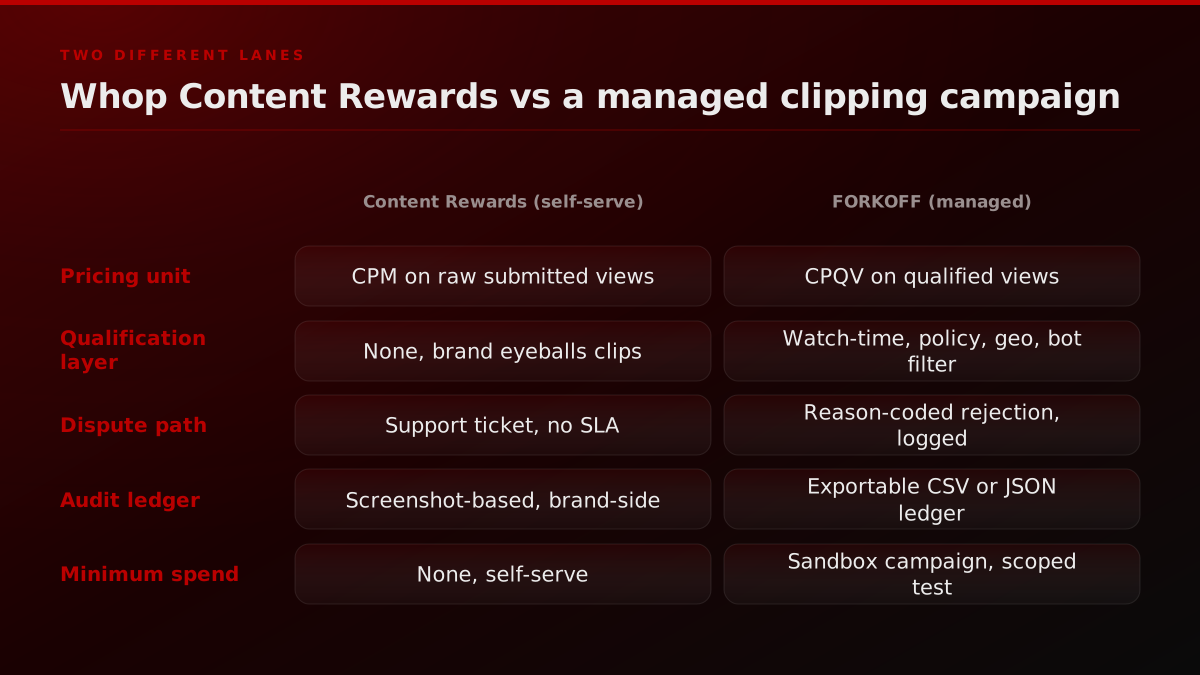
The matrix below shows why that distinction costs real money the first time a submission gets disputed, not before.
Real Whop Content Rewards campaign budgets, verified 2026-08-04
| Campaign | Budget | Outcome | Source |
|---|---|---|---|
| Ethan Wong Vlogs clipping campaign | $2,000 total, $500 cap per clipper | Standard niche-creator pool | Reddit r/VideoEditingRequests |
| Kitsch x Brooke Monk haircare campaign | $21,000 funded pool | Fully escrowed on Whop, transparent tracking | Reddit r/VideoEditors_forhire |
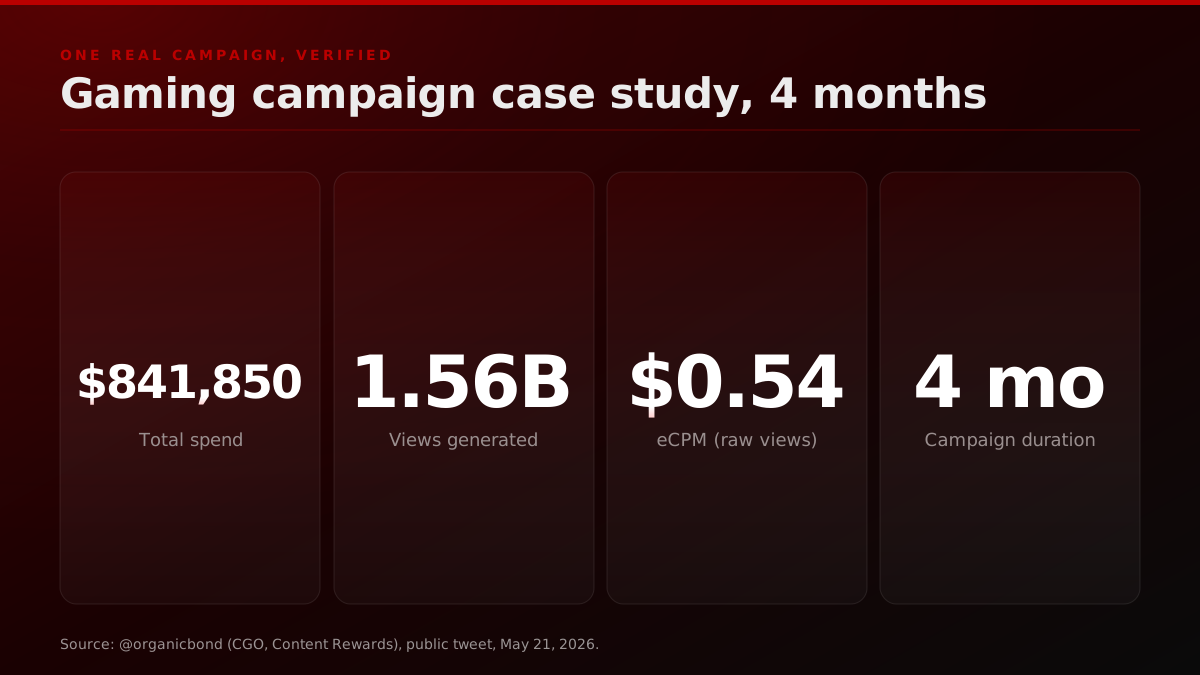
| Gaming brand campaign, 4 months | $841,850 total spend | 1.56 billion views at $0.54 eCPM | Content Rewards CGO, public tweet |
| Kick platform spend, 1 streamer, 1 month | Approx $700,000 | Full clipping distribution for one creator | The Iced Coffee Hour podcast |
Figures self-disclosed by campaign operators and Content Rewards staff on public Reddit and Twitter/X, sampled 2026-08-04. FORKOFF did not run any of these campaigns and cannot verify the underlying view-count audits.
Every row in that table came from a public disclosure, either a campaign operator posting on Reddit looking for clippers, or Content Rewards staff themselves posting the numbers on Twitter/X. None of it is FORKOFF's own campaign data. That matters, because it means these are the costs an independent brand actually paid, not a vendor's best-case pitch deck. Where those disclosed figures sit against the rest of the market is covered in the 2026 clipping campaign effectiveness breakdown.
How does the money actually move through a Content Rewards campaign?
A Content Rewards campaign moves money through five stops: a funded escrow, a posted brief, a clipper submission, a recorded view count, and a payout. Whop's own launch flow documents the first two stops in detail. Each stop is well built. The gap is that only one of the five, escrow, has a formal audit behind it, and the branch where a count gets contested has no equivalent.
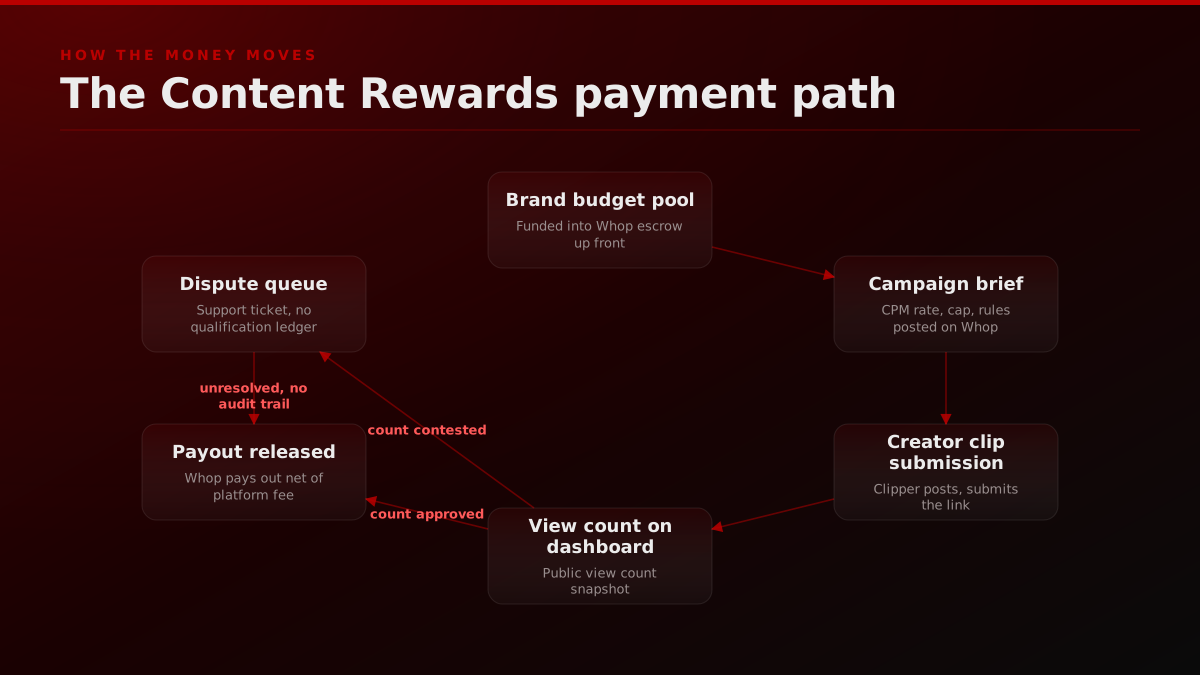
The path is simple by design. A brand funds a budget into Whop's escrow. That becomes a campaign brief with a CPM rate, a per-clipper cap, and posting rules. A clipper submits a link. Whop's dashboard records a public view count. If the count clears review, the payout releases, net of the platform's transaction fee. If the count gets contested, and Reddit has multiple documented cases of exactly this, the submission drops into a dispute queue with no service-level agreement and no independent ledger either side can point to.
Daniel Bitton
@danvsI
Content Rewards Education is live on Whop. What this means for anyone who makes content: -> You now have a clear path to making money -> Step by step, for free, no experience needed Clipping is the highest ROI skill online right now And anyone who can make good content
That last branch is the one this post spends the most time on, because it is the one line item every case study skips.
What does a real Content Rewards budget actually look like?
Whop's own marketing pages for Content Rewards describe the module in terms of reach and creator access. They do not publish what brands actually spend. The real numbers come from campaign operators posting their own budgets while recruiting clippers, and from Content Rewards staff disclosing aggregate figures on Twitter/X.
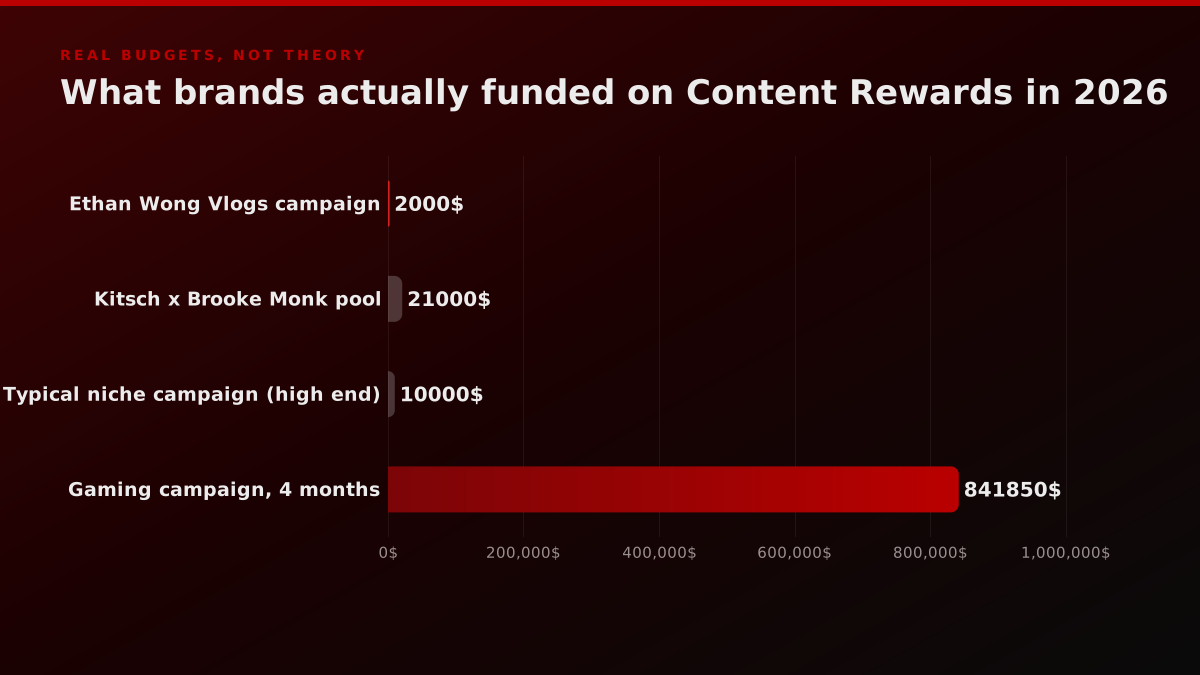
At the small end, a creator running the Ethan Wong Vlogs campaign posted a $2,000 total budget with a $500 cap per clipper, a typical shape for a niche-creator test. At the mid tier, a campaign runner recruiting editors for a haircare brand posted a fully funded $21,000 pool for the Kitsch x Brooke Monk campaign, deposited directly into Whop's Content Rewards escrow. At the high end, Content Rewards CGO Matt disclosed a gaming brand campaign that ran $841,850 across four months and generated 1.56 billion views at a $0.54 eCPM, which he called one of the platform's best-performing campaign types.
[Hiring] Short-Form Editors/Clippers for Brooke Monk x Kitsch Campaign ($21k Funded Pool)
I just launched a massive performance-based clipping campaign for the haircare brand Kitsch, featuring UGC/content from Brooke Monk and other top creators. We have an active, fully-funded $21,000 USD prize pool to pay out editors who can cut viral short-form clips and post them to TikTok, Instagram Reels, or YouTube… Show more
Matt
@organicbond
Launching a gaming campaign on Content Rewards is the easiest way to scale your game in 2026. We've had a combined spend of $841,850 that generated 1.56 billion views at an eCPM of $0.54 in the last 4 months. It's one of the best performing campaign types, because people love
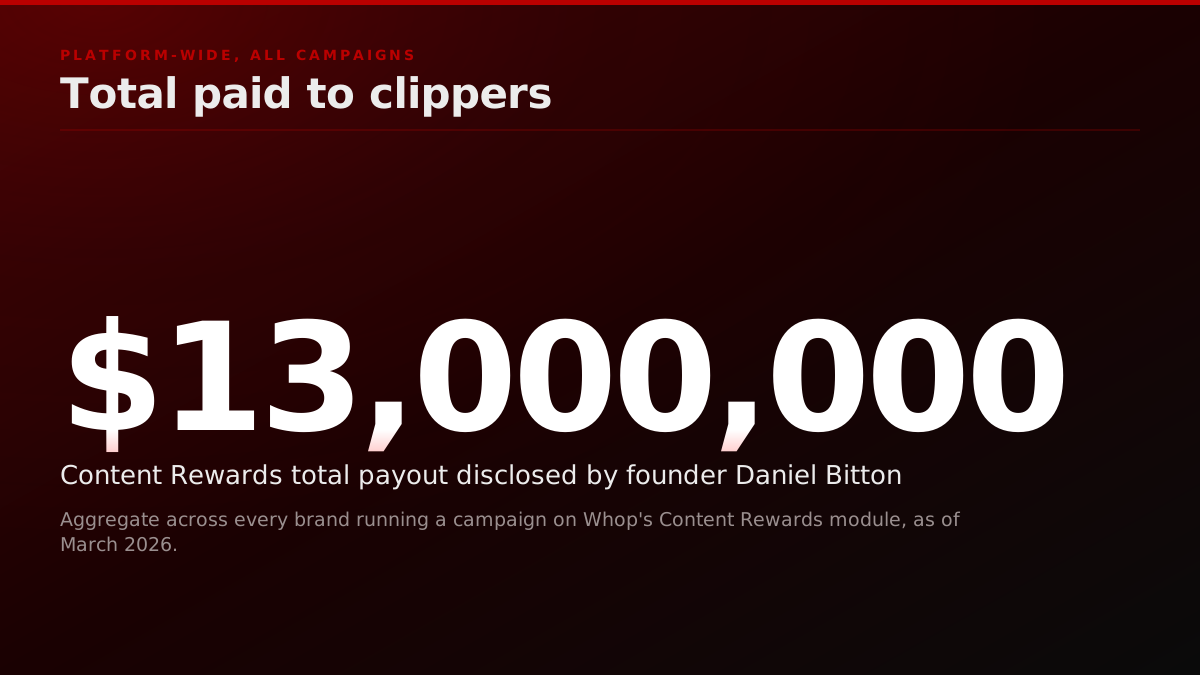
Platform-wide, Content Rewards founder Daniel Bitton disclosed $13,000,000 paid out to clippers across every campaign running on the module. That number is aggregate, not per-brand, and it is the strongest evidence available that real budgets are moving through the platform at meaningful scale.
Daniel Bitton
@danvsI
Content Rewards has paid out $13,000,000 to clippers on Whop We are early
The spread between those figures matters more than any single number. A $2,000 campaign and an $841,850 campaign are not the same product experience, even though both run on the same module with the same fee schedule. At $2,000, a brand is effectively running a manual, single-owner test, one person reviewing every submission by eye, tolerating a wrong payout here and there because the total exposure is small. At $841,850 across four months, the volume of submissions makes manual eyeballing structurally impossible, and the absence of a qualification layer stops being a minor inconvenience and becomes the single largest unmanaged risk in the campaign. Nobody has disclosed what percentage of that $841,850 campaign's submissions were disputed, rejected, or stuck on "Estimated," and that absence is itself informative, a platform built for self-serve speed does not surface that metric because it was never the product's job to track it.
The published fee structure, and what it means for the actual invoice
Whop's transaction rate is public and simple. Every payout released through the platform pays a 2.7 percent plus $0.30 transaction fee on top of the CPM rate the brand set, per the mechanics documented in Whop's own Content Rewards docs and the platform's guide on how to set up a Content Rewards campaign. That fee is not the number brands miss. What gets missed is that the CPM rate itself is denominated in raw, unaudited views, so the true cost of a qualified outcome is higher than the sticker CPM implies once a brand accounts for the submissions that never clear review, the ones that get disputed and stall, and the ones a brand pays for without ever confirming the traffic was real.
Public campaign-hunting guides on Reddit put the healthy range at $1 to $3 per 1,000 verified views, with budgets commonly landing between $2,000 and $10,000 for a mid-size niche campaign. A separate first-hand account from a founder building clipping tools describes the wider real-world band as $1 to $6 per 1,000 views, with a minimum payout threshold under 5,000 views being the norm. Neither range prices in the cost of a dispute, because Content Rewards does not have a line item for one.
How to find the best clipping campaigns
Not every seller on Whop runs a Content Rewards program. But the ones that do are usually in these categories: trading and investing communities, fitness and coaching programs, digital courses, social media growth programs, and online business communities. Look for campaigns that have $2-$10k budget. A good CPM ($1-$3 per… Show more
Where the qualification gap actually costs a brand money
This is the part Content Rewards' own marketing never mentions, and it is documented in public on Reddit. A clipper submitted a video for the Ali Siddiq "FROM INSIDE" campaign that crossed 400,000 views. At the campaign's stated $1 per 1,000 view rate, that submission should have paid the $150 cap. Instead, the clipper received the $2 minimum payout, and the dashboard still read "Estimated" more than a month after the campaign owner confirmed the funds had been released. Whop support redirected the clipper to Content Rewards support. Content Rewards support redirected them to a named individual who never responded.
Nobody in that chain has an audited answer for what happened to the other 399,600 views between submission and payout. There is no watch-time filter that would explain a rejection. There is no geo check that would explain a discount. There is no bot-detection log a brand or a clipper can point to and say the count was adjusted for a specific, documented reason. The count simply did not convert to the payout the stated rate implies, and the only recourse on either side is a support ticket with no service-level agreement.
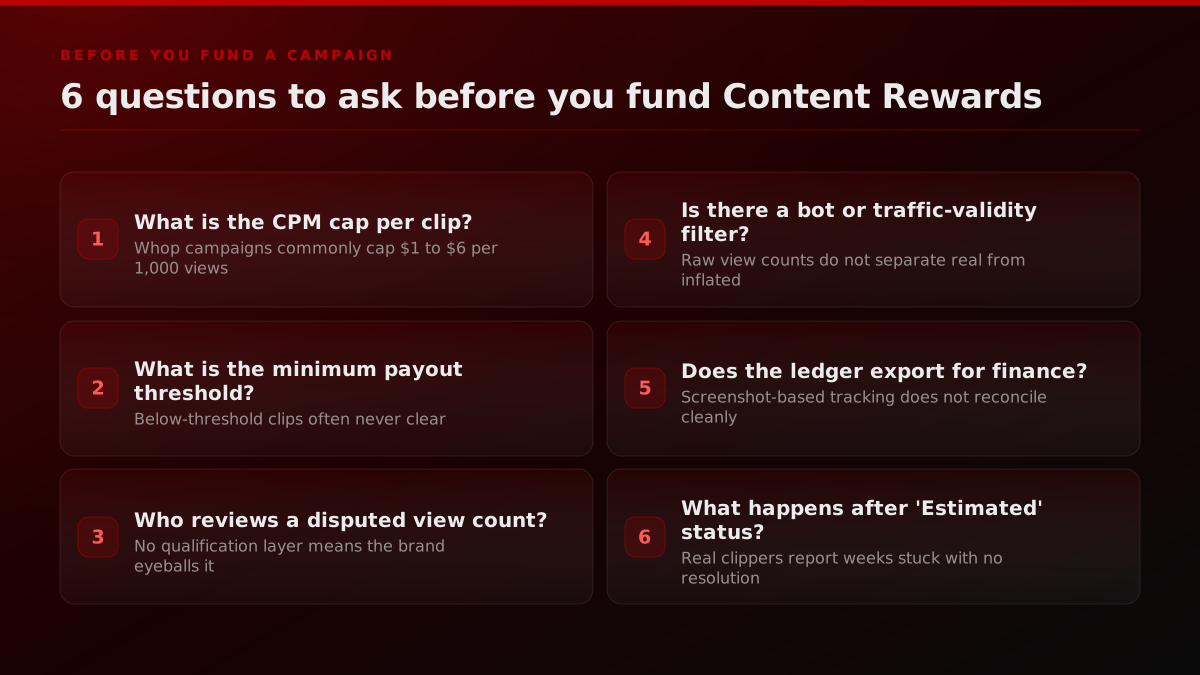
That gap is exactly why a brand running a serious campaign needs the six questions in the checklist above answered before the budget clears escrow, not after the first dispute lands.
What a submission actually looks like on the brand's side
A brand running a Content Rewards campaign does not see raw analytics from TikTok, Shorts, or Reels. A clipper posts to their own account, waits for the public view counter to climb, then submits either a direct link or a screenshot of the count at a given cutoff time. The brand's dashboard shows that submitted number, the campaign's stated CPM rate, and a computed payout. Nothing in that chain independently confirms the view count against the platform's own analytics API, checks whether the traffic geo-matches the campaign's target market, or filters out a spike that looks purchased rather than organic.
That absence is a design choice, not an oversight. Content Rewards is built to move budget from a brand to a creator quickly, and adding a verification layer on every submission would slow the exact self-serve speed the product is selling. The trade-off is reasonable for a brand that treats a clipping campaign the way it treats a small paid-social test, low stakes, fast iteration, acceptable loss if a handful of submissions are wrong. It stops being reasonable the moment a brand treats the same budget the way it treats a line item in a media plan a CFO signs off on, because a media plan needs a number a finance team can defend if it gets audited.
Public campaign postings back this up directly. The Kitsch x Brooke Monk campaign brief describes the budget as "deposited directly into Whop's automated Content Rewards escrow system," which the poster frames as making "tracking completely transparent." Transparent in that context means the brand can see what was submitted and what was paid, not that a third party verified the submission was real before the payout released. Those are two different claims, and the marketing language on most campaign postings does not distinguish between them.
The dispute path, step by step, and why it stalls
The Ali Siddiq campaign example earlier in this post is not a one-off. It is the predictable output of a system with no qualification step, and the escalation path documented in that thread is worth walking through in detail because it shows exactly where the process breaks.
First, the clipper submits a video and the campaign owner confirms the funds are released for the campaign as a whole. Second, the individual submission's payout computes at the stated CPM rate, in this case $1 per 1,000 views with a $150 cap at 400,000 views. Third, instead of the computed payout, the clipper receives the platform minimum, $2, with no stated reason attached to the difference. Fourth, the dashboard status remains "Estimated" rather than resolving to a final paid or rejected state, which means neither the brand's ledger nor the clipper's ledger has a closed record of the transaction. Fifth, the clipper contacts Whop support, who redirect them to Content Rewards support. Sixth, Content Rewards support names an individual staff member as the point of contact, and that contact does not respond.
At no point in that six-step chain does either party receive a reason code, a policy citation, or a specific factor, geo mismatch, watch-time shortfall, suspected bot traffic, that would explain the gap between the computed payout and the actual one. That is the structural difference between a dispute process and a black box. A dispute process produces a reason a brand can act on, tighten targeting, adjust the brief, drop an underperforming clipper. A black box produces a number and a support ticket that goes nowhere, and the brand has no way to tell whether the $148 difference between the stated $150 cap and the $2 minimum payout reflects a real problem with the submission or an unexplained platform-side adjustment.
Why isn't Kick's $700,000-a-month clipping spend the same math?
The strongest recent data point on clipping economics did not come from a brand campaign at all. Streamer Clavicular disclosed on The Iced Coffee Hour podcast that Kick, the platform he streams exclusively for, funds nearly $700,000 of his clipping spend in a single month, and that he personally spends $0 out of pocket on it.
The Iced Coffee Hour
@TheICHpodcast
Clavicular reveals Kick paid $700,000 in "clipping spend" for one month, paying clippers to distribute his content across platforms without him having to spend anything "I have no clipping spend... Kick pays for the clipping because it's got a huge Kick logo, so they're driving
Kick's math is not a brand's math
A single streamer getting a platform to fund $700,000 of clipping in one month looks, at a glance, like proof that clipping budgets can scale without limit. It is not the same transaction. Kick is buying its own logo on every clip at platform scale, a brand-awareness line item with no per-brand cap. A consumer brand running one campaign on Content Rewards is buying a fixed-budget escrow with a CPM cap and a support-ticket dispute path. Citing Kick's number to justify a brand's budget conflates two different buyers solving two different problems.
Source: The Iced Coffee Hour podcast, 2026-07-29 episode with Clavicular
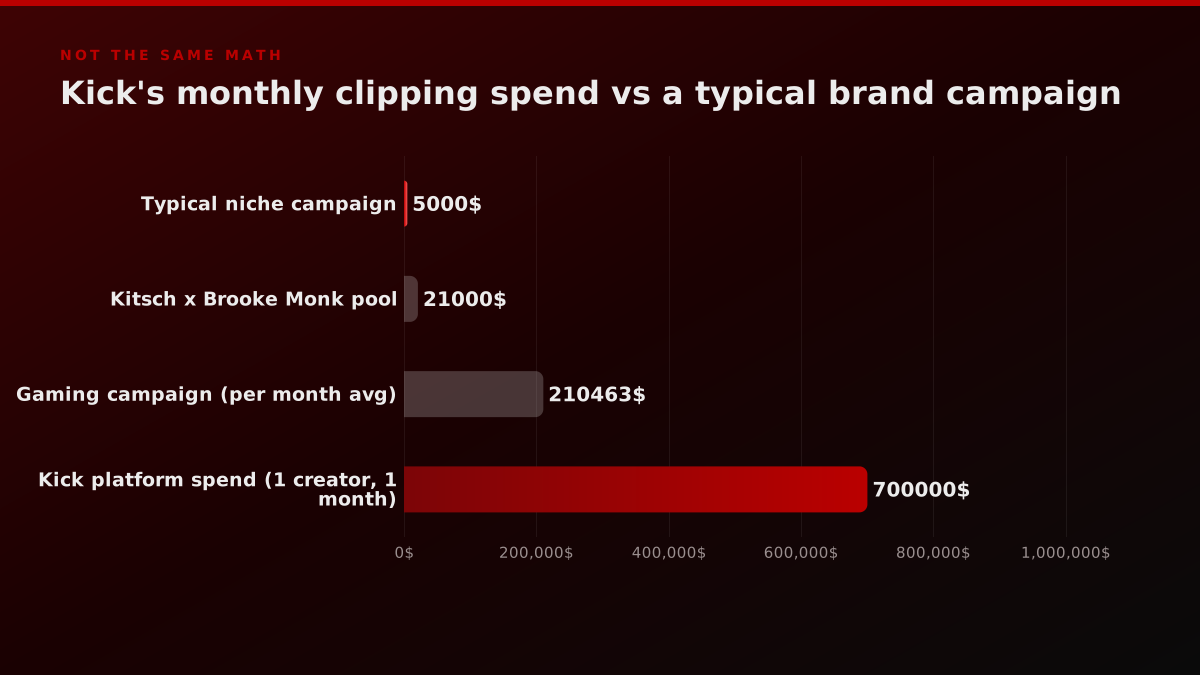
The distinction matters because that number gets cited constantly as evidence that clipping budgets scale without a ceiling. They do not, for a brand. Kick is paying for its own logo to appear on every clip a top streamer generates, a platform-wide brand-awareness line item with no per-campaign cap and no CPM math a single brand's finance team would ever approve. A consumer brand funding a Content Rewards campaign is working from a fixed escrow, a CPM cap, and a support-ticket dispute path, the same constraints described throughout this post. Citing Kick's number to size a brand's own budget conflates two entirely different buyers.
Where does the actual campaign cost accumulate?
A Content Rewards budget splits into three layers, an escrow layer, a payout layer, and a qualification layer. The first two are the ones Whop actually built. The third is the one that is missing, and it is where a brand's real cost risk sits.
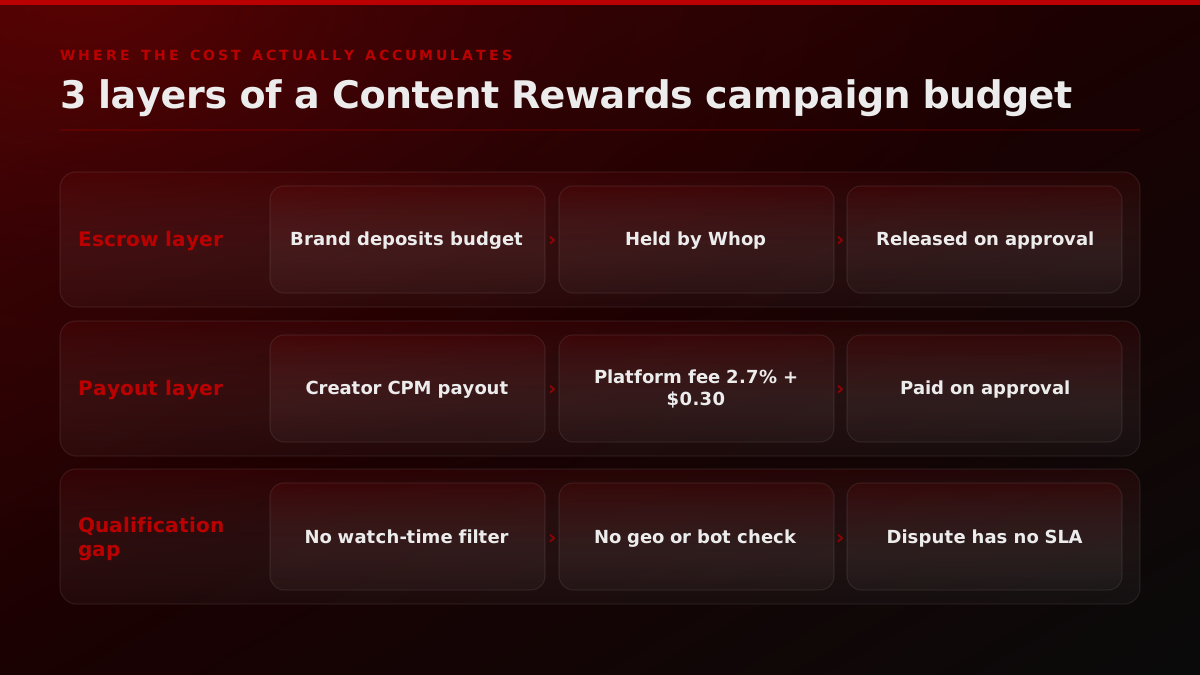
Break a Content Rewards budget into its three real layers and the picture gets clearer. The escrow layer works exactly as advertised, a brand deposits a budget and Whop holds it until a submission is approved. The payout layer also works as advertised, the clipper gets paid the CPM rate net of the platform fee. The gap sits entirely in the third layer, the qualification layer, where there is no watch-time filter, no geo or bot check, and a dispute has no service-level agreement attached to it. That third layer is unstaffed by design, because Content Rewards is an escrow-and-payout product, not a qualification service.
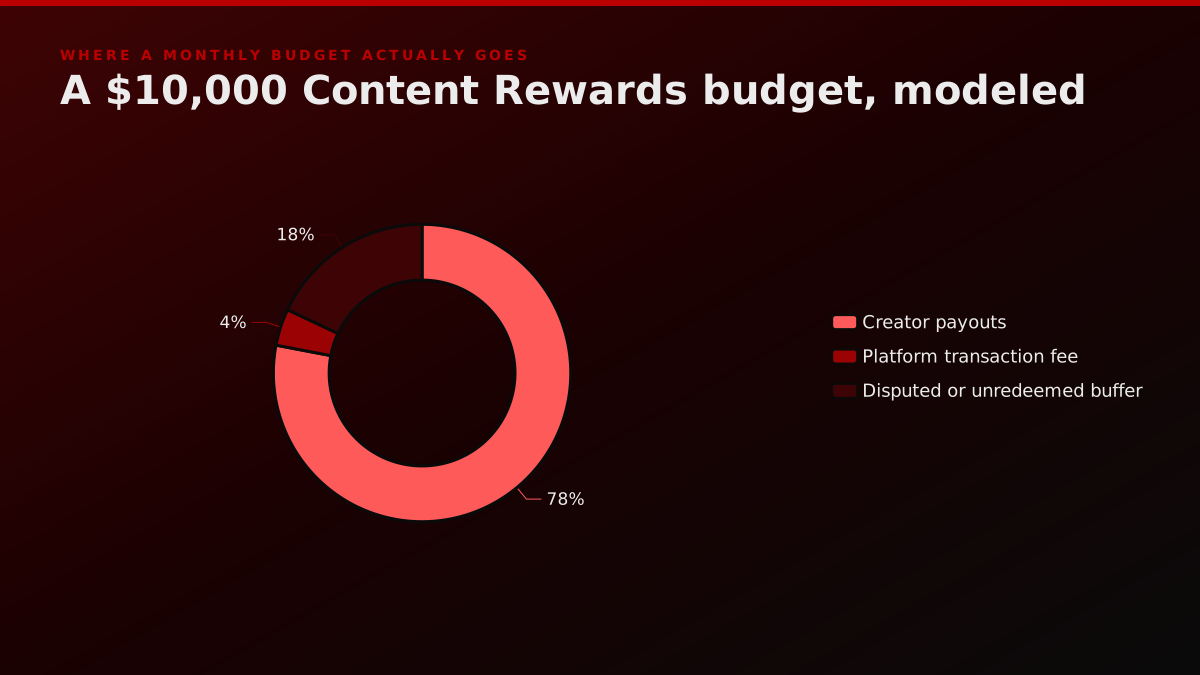
Modeling a typical $10,000 monthly budget against the patterns documented across these Reddit threads puts roughly 78 percent toward clean creator payouts, 4 percent toward the platform's transaction fee, and the remaining 18 percent sitting in a disputed-or-unredeemed buffer, submissions stuck on "Estimated," rejected without a stated reason, or abandoned by clippers who gave up chasing a support ticket. That buffer is not a Whop-specific defect so much as the predictable outcome of a platform that never built the qualification layer in the first place.
That 18 percent figure is a modeled estimate built from the pattern across the disclosed cases in this post, not a number Whop or Content Rewards publishes, and it should be read as directional rather than exact. What it captures directionally is real: every documented dispute in the public record shares the same shape, a submission that looked valid at the point of posting, a payout that did not match the stated rate, and no reason code attached to the gap. A brand modeling its own budget should treat that buffer as a cost of doing business on a self-serve platform, not as an anomaly that only happens to unlucky clippers.
Is a lower eCPM actually cheaper than qualified-view pricing?
Not automatically. A raw eCPM and a qualified-view rate answer different questions, the first counts every submission and the second counts only the ones that passed a filter, so comparing the two headline numbers without accounting for what each one actually measures produces the wrong read on cost.
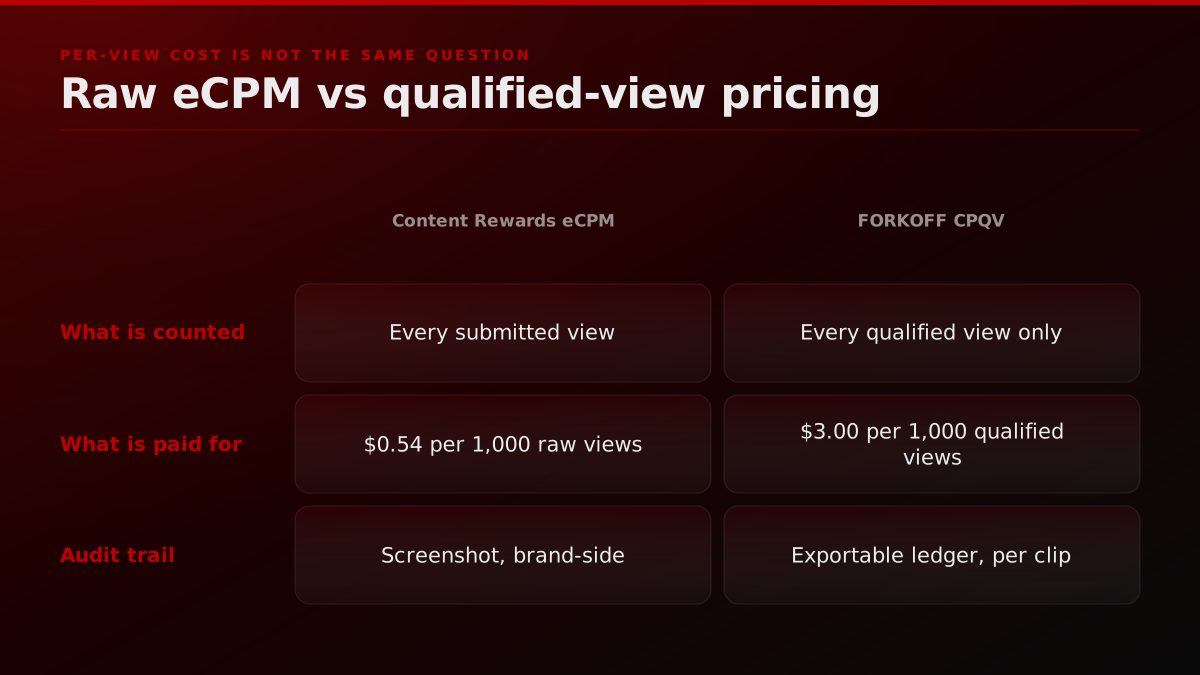
It is tempting to read Content Rewards' $0.54 eCPM on the gaming campaign above and conclude that any managed alternative is automatically more expensive per view. That comparison answers the wrong question. Content Rewards counts every submitted view, whether or not it survived a watch-time floor. FORKOFF's CPQV model, cost per qualified view, counts only the views that passed a watch-time, policy, geo, and bot-validity filter before a dollar moves, priced at $0.003 per qualified view (per the FORKOFF Clipping Ledger pricing referenced on the clipping service page), or $3.00 per 1,000 qualified views. The two numbers are not measuring the same unit, and a brand that compares them as if they were is the same brand that ends up with the "Estimated" dashboard and no ledger to hand its own finance team.
What FORKOFF's clipping network actually processes at scale
FORKOFF's own clipping network has processed more than 5 billion qualified views across managed campaigns, a scale comparable to the largest Content Rewards disclosures above, with one structural difference: every one of those views cleared a qualification filter before it counted toward a payout or a client invoice. That is the practical difference between an escrow-and-payout rail and a managed campaign. Both move real budgets. Only one of them can produce a per-clip, per-view export a finance team can independently check against the media plan.
Two products wearing the same name
Content Rewards is a self-serve escrow and payout rail sitting on top of the Whop marketplace. A managed clipping lane is an agency running qualification, dispute resolution, and reporting on top of the same underlying platforms a clipper posts to. Both move money to a creator for a view. Only one of them can tell a finance team, after the fact, exactly which views were paid for and why. The wedge is not price, it is auditability, and it only shows up the first time a brand needs to explain a clipping line item to a CFO.
Source: FORKOFF Clipping operations, campaign management across multiple Content Rewards adjacent engagements
Five questions a brand should ask before funding any clipping campaign
The checklist earlier in this post covers the platform-specific questions. A brand evaluating clipping as a channel, regardless of which platform it runs on, should also ask these five before it commits a budget: what percentage of submitted views typically get disputed, who owns the qualification decision, what the export looks like for a finance reconciliation, what the escalation path is when a count is contested, and whether the CPM or CPQV rate accounts for the submissions that never clear. A vendor that cannot answer all five with a specific number is asking the brand to run its own qualification layer for free.
The first question, dispute rate, is the one most vendors will not have a real answer to, because most self-serve platforms do not track it as a metric in the first place. A brand should treat a vague answer, "it's pretty rare" without a number, as equivalent to no answer at all. The second question, who owns the qualification decision, separates a platform from an agency cleanly: a platform's answer is "the brand does, manually," and an agency's answer should name a specific team or process. The third and fourth questions, the export format and the escalation path, are the two a finance team will actually ask about the first time a clipping line item appears on a spend report next to paid social and paid search, both of which already produce a reconciliation trail by default. The fifth question is the one this entire post has been building toward: a CPM or eCPM rate that does not distinguish qualified from unqualified views is quoting the wrong unit for a brand that needs to defend the spend later.
Where self-serve Content Rewards is genuinely the right tool
None of this is an argument that Content Rewards is a bad product. For a brand or creator that wants fast, self-serve creator discovery, is comfortable eyeballing submitted clips personally, and does not need a finance-grade export, Content Rewards is the fastest way to get a clipping campaign live with zero fixed cost beyond the funded budget. The full walkthrough of the module covers the setup mechanics well, Whop's own discovery surface shows the breadth of live campaigns a brand is competing against for clipper attention, and a niche campaign in the $2,000 to $5,000 range is a reasonable, low-stakes way to test whether clipping works for a given content library before scaling spend. Whop even runs its own clipping culture hub profiling creators who have built a business around exactly this workflow, which is a useful read for a brand trying to understand the clipper's side of the transaction before writing a brief.
What is Whop Content Rewards FULL Guide (2026)
Money Mind
A full walkthrough of what Whop Content Rewards is and how a campaign actually runs
When a managed lane beats self-serve, and what that actually looks like
The lane shift happens the moment a brand needs three things Content Rewards does not build: a per-view qualification filter applied before payout, a documented dispute-resolution path with a stated turnaround, and an export a finance team can reconcile without a manual audit. Those three needs show up together almost every time a clipping budget crosses from a founder-run test into a real line item on a marketing plan with a CFO reviewing it.
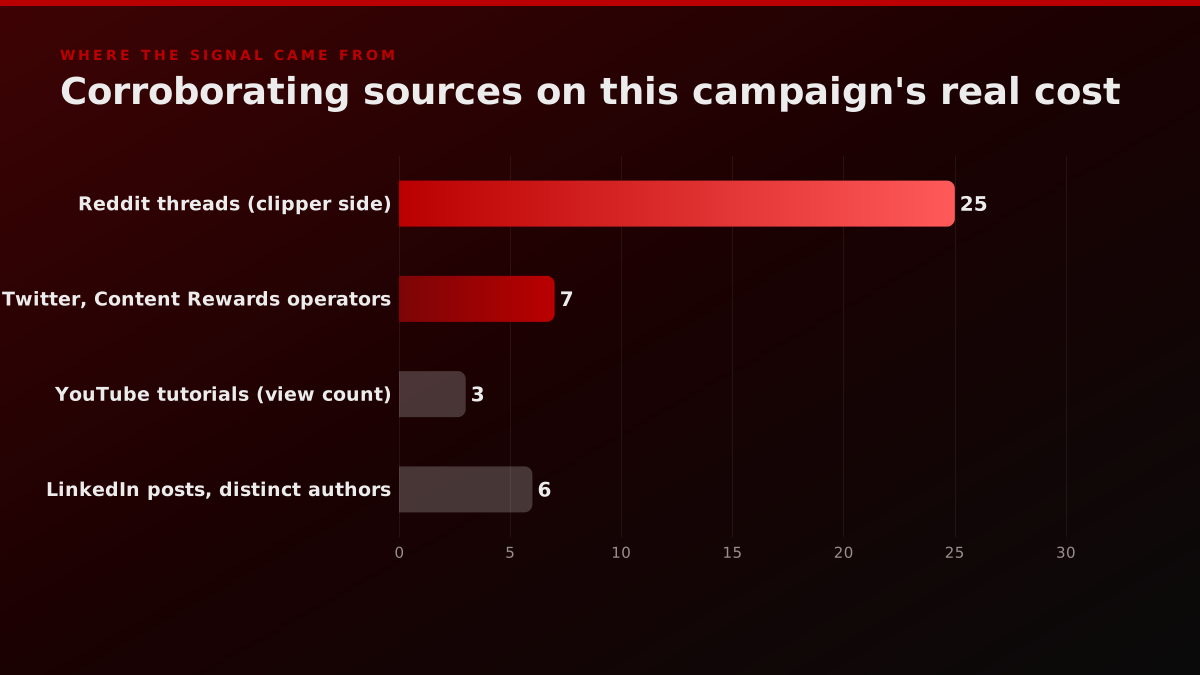
The demand signal on this exact question is heavily skewed toward the clipper side of the conversation. Reddit alone surfaces roughly 25 threads asking how to find a good campaign or complaining about a stuck payout, against a handful of Twitter posts from Content Rewards staff disclosing brand-side spend and a scattering of YouTube tutorials aimed at the same clipper audience. Almost nobody is publishing what the qualification gap costs a brand, which is the reason this specific breakdown does not exist anywhere else on the current search results for this keyword.
Most clips get a few hundred views. Some break out. It's a volume and hit-rate game, not a salary. Nobody is getting rich in week one.
How FORKOFF prices a managed clipping campaign differently
A managed clipping campaign through FORKOFF starts with a sandbox test, the same order of magnitude as the smallest Content Rewards campaigns cited above, scoped specifically to prove the qualification ledger before a brand commits a larger budget. Every submission runs through the same watch-time, policy, geo, and bot-validity filter regardless of campaign size, and every approved view exports to a CSV or JSON ledger that reconciles the same way a paid-media invoice does. The pricing unit is CPQV rather than raw CPM precisely because the qualification work is the product being sold, not an afterthought bolted onto a payout rail.
That sandbox structure exists because of a pattern this post keeps returning to: the qualification gap is invisible at small scale and expensive at real scale. A sandbox test surfaces exactly how the ledger behaves, what a rejection reason code looks like, how fast a dispute resolves, before a brand scales into the budget range where an unaudited 18 percent buffer stops being a rounding error and starts being a five- or six-figure line item nobody can explain to finance. Running the sandbox first costs far less than discovering the gap on an $841,850 campaign after the fact.
For a deeper look at how the broader clipping playbook fits together beyond a single platform comparison, the managed clipping playbook covers campaign structure end to end, and the Whop platform review covers the marketplace itself in more depth for brands evaluating Whop as a creator-discovery surface independent of the Content Rewards cost question.
FORKOFF has also been featured discussing content repurposing across social, email, and blog as part of its broader earned-media record, alongside the full list of placements on the FORKOFF press page.
The short version, one more time
Content Rewards is a real, well-built escrow-and-payout rail that has moved $13,000,000 to clippers and hosted a single campaign as large as $841,850. Its published fee is transparent at 2.7 percent plus $0.30. Its blind spot is the qualification layer, no watch-time filter, no geo check, no bot detection, and a dispute path that ends at a support ticket with no service-level agreement. A brand buying self-serve creator access at a low, predictable CPM should run it directly. A brand that needs to reconcile a clipping line item against the rest of its media plan needs a qualification layer built into the price, which is what a managed lane like FORKOFF's CPQV model is actually pricing.
Related reading on the clipping cost model: how much clippers actually earn, what qualified views actually measure, Opus Clip versus managed clipping cost, what clip farming actually is, whether hiring a clipping and distribution agency is worth it, and what a clipping agency actually does day to day. For the adjacent podcast-side pricing model, see podcast clipping agency pricing, and for a real revenue case study, see the managed clipping revenue case study. A performance-clipping line item running alongside paid media is covered in performance clipping as an ad line item, and the single largest publicly documented outcome in this category is broken down in the Spencer Pratt clipping campaign. FORKOFF's own KOL marketing service sits next to clipping for brands running a broader creator-led distribution mix, and the clipping service page covers the full managed offering. A brand ready to model its own numbers can apply directly rather than guess from a platform's headline eCPM.