
Twitch clipping that prices on qualified views, not raw clip counts.
Vetted clippers route your VODs into TikTok, Shorts, Reels, and X cuts. You pay $0.003 per qualified view. Watch-time, policy, geo, and traffic-validity gate every view before it hits your invoice.
What is Twitch clipping?
Twitch clipping is cutting Twitch VOD broadcasts, raids, sub-trains, host moments, into vertical short-form clips distributed across TikTok, YouTube Shorts, Instagram Reels, and X. FORKOFF runs it as a managed agency across a network that has processed 5B+ views, routing vetted clippers who recognize the culture-fit beats that travel off-platform, then billing $0.003 per qualified view once a clip clears the 8 to 15 second watch-time gate tuned per destination platform at 99.71% legitimacy.
- Pricing
- $0.003 per qualified view (CPQV)
- Model
- Managed clipping network, outcome-priced
- Legitimacy
- 99.71% (post-bot filter)
Twitch clipping has lived in DIY tooling and bounty marketplaces.
Agencies sell effort. Marketplaces sell volume. FORKOFF sells qualified outcomes.
What outcome-priced clipping looks like in production.
Brief to live in three steps.
VOD intake + brief lock
Strategist intakes the streamer's VOD library, locks per-platform watch-time gates (TikTok 8 to 12s, Shorts 10 to 15s, Reels 12 to 18s, X native), brand-safety rules, geo policy, and sanctioned-region exclusions. Brief signed off in under 24 hours from intake. Sandbox size scoped at acceptance.
Twitch-vetted clipper routing
Clippers vetted on prior Twitch qualification rates and per-platform format history. Open-marketplace self-tags are not trusted. routing happens against the FORKOFF roster with deprioritisation on past policy breaks. Roster includes vertical-format specialists for each destination platform plus Twitch-native moment-spotters who recognise raid, host, sub-train, and Kappa-culture beats from the VOD timeline.
Per-channel ledger settle
Every view passes the four-stage gate: watch-time, policy compliance, geo consistency, traffic validity. Filtered views are logged with a reason code and excluded from billing. Audit ledger exports to CSV/JSON. settles weekly to the streamer's payout entity or the brand's finance system. Talent agencies read the per-streamer roll-up; brands reconcile against AppsFlyer / Adjust install records or sponsorship-distribution review.
VOD pacing, raid-and-host culture, and the four-platform fan-out problem.
Twitch clipping fails when treated as a generic vertical surface. Twitch VODs run 4 to 8 hours, sometimes 12 plus on subathon streams. The qualified beat that pulls watch-through on TikTok or Shorts sits inside that long timeline as a 30 to 90 second window. raid moments, Kappa-culture inside jokes, the unscripted meta-call that defines the streamer's voice, the on-camera reaction to chat. Generic auto-clip tools index on audio peak or chat-velocity spike and miss the cultural beat entirely. The clipper roster's job is to recognise the moment a Twitch audience already laughed at and turn it into a 14-second cut that pulls the same laugh from a TikTok cohort that has never seen the streamer.
The four-platform fan-out is the second wedge. A single 60-second Twitch beat ships to TikTok (vertical re-cut, 8 to 12s watch gate, niche-matched hashtag targeting), YouTube Shorts (10 to 15s threshold, channel-shelf placement, monetisation eligibility), Instagram Reels (12 to 18s threshold, Original Audio decision, Story-chain extension), and X (native upload with thread context, no FYP, retweet-distribution model). Same beat, four different watch-time gates. FORKOFF runs the brief against per-platform watch-time gates locked at acceptance. The clipper roster routes accordingly. Clippers whose past briefs over-indexed on TikTok watch-through take the TikTok cuts, clippers whose past briefs over-indexed on Shorts shelf-placement take the Shorts cuts.
The audit ledger ties qualified views back to the source VOD timestamp. Streamers see which moments produced clips that cleared the gate, which underperformed, and which platforms over-indexed for that VOD's content arc. Talent agencies read the per-streamer roll-up and reallocate clipper budget across the roster on the basis of which streamer's content style pulled qualified watch-through that week. Brands buying gaming reach reconcile the qualified-view ledger against sponsorship-distribution review, AppsFlyer install records for app-install briefs, or partner-side performance data for peripheral and energy-drink campaigns.
Twitch's own ecosystem matters at the brief layer. Sub-only VODs vs publicly available VODs change the clip-availability surface. Twitch's clip-hosting at clips.twitch.tv stays platform-native, but the FORKOFF brief vertically re-cuts and ships to off-platform surfaces where qualified watch-through compounds against external distribution. Twitch's policy on betting categories, sponsorship disclosure, and brand-safety rules is volatile and category-specific. clippers who break the floor on prior briefs are deprioritised across all future Twitch briefs, and the policy verdict is enforced at qualification time, not in dashboard cleanup.
Streamers who self-clipped previously inherit the time-cost discipline. A top-1000 streamer running 20 hours of weekly broadcast spends 4 to 8 hours per week clipping their own VODs into TikTok-ready cuts and rarely gets to four-platform parity. FORKOFF replaces that self-clip motion with a managed pipeline. the streamer ships the VOD, the strategist reads it, the clipper roster cuts it across all four destinations, and the qualified-view ledger settles weekly. Outcome-priced means the streamer pays $0.003 CPQV against the views that cleared the brief, not a subscription fee for a tool that ships generic auto-clips most platforms throw away.
Brands buying through this lane get a denominator that survives finance review. AppsFlyer install attribution, partner sponsorship review, treasury reporting for web3 gaming and betting partners. The audit ledger reads cleanly into each. Raw view counts from open marketplaces and DIY tool subscriptions don't.
For the deeper background behind this page, read our guide to clipping Twitch VODs.
FORKOFF vs the alternative.
← scroll horizontally to see more →
| Feature | FORKOFF Clippingoperator-grade | Generic alternativethe rest of the market |
|---|---|---|
| Operating model | Managed agency. Strategist owns the Twitch VOD pipeline end-to-end. Vetted clipper roster routes the VOD against per-platform watch-time gates. ▸ Managed, not DIY | DIY tool subscription (OpusClip, Klap, Vizard) or open-bounty marketplace (Whop). brand or streamer is the qualification engine. |
| Pricing denominator | $0.003 per qualified view (CPQV). Filtered traffic logged with a reason code, not billed. ▸ CPQV vs CPM | Tool subscription with no qualification gate, or raw CPM with hidden legitimacy rate. |
| Twitch-native fit | VOD-to-vertical pipeline tuned to raid, host, sub-train, and Kappa-culture beats. Clippers vetted on Twitch qualification history. | Generic vertical templates that flatten Twitch context into entertainment-mode shorts. moment selection by audio-peak, not culture-fit. |
| Audit trail | Per-view ledger with reason codes. CSV/JSON export for streamer payout and brand-side partner review. ▸ Auditable | Dashboard counts only. no per-view audit, no reason codes. |
Top-streamer roster, 6.4M qualified views in Q1.
▸ NDA · top-streamer talent agency, 12-streamer roster
Talent agency engaged FORKOFF for managed Twitch clipping across a 12-streamer roster spanning gaming and IRL formats. Strategist locked per-streamer watch-time gates by destination, routed the clipper roster against streamer voice fit, and shipped the per-streamer ledger as a weekly settlement deck. 6.4M qualified views ledgered in Q1. Legitimacy rate 99.6%. Talent agency reads the roll-up by streamer for clipper rotation across the roster.
▸ FORKOFF case archive · NDA-protected handle
Who this is for. Who it isn't.
- Streamers in top-10K rank with active VOD library and existing TikTok / Shorts presence
- Talent agencies running multi-streamer rosters needing per-streamer ledger settlement
- Gaming brands buying streamer reach with finance-grade attribution requirement
- Web3 gaming and betting partners needing geo-gating on sanctioned regions
- Peripheral and energy-drink brands reconciling against AppsFlyer / Adjust install records
- Solo streamers wanting a DIY tool subscription (use OpusClip or Klap directly)
- Brands optimising on raw clip-count rather than qualified watch-through
- Streamers with under 10 hours of monthly VOD library (insufficient surface)
- Below-floor budgets that can't run a sandbox tier
- Streamers unwilling to lock a brand-safety policy at brief acceptance
Calculator coming to forkoff.xyz soon. Use the dedicated tool at /tools/cpqv-calculator for the full cost-per-qualified-view math.
Frequently asked
What is Twitch clipping?
Twitch clipping is the discipline of cutting Twitch VOD broadcasts into vertical short-form clips for distribution on TikTok, YouTube Shorts, Instagram Reels, and X. Twitch's native clip surface (clips.twitch.tv) keeps inventory inside the platform; off-platform vertical re-cuts are where qualified watch-through compounds. A Twitch clipping agency runs this end-to-end: VOD intake, beat selection across raid / host / sub-train / Kappa-culture moments, per-platform vertical re-cut, qualification, and ledger settlement. FORKOFF prices the work per qualified view, not per clip.
How does FORKOFF qualify a Twitch clip view?
Four stages at view-record time, and on Twitch the watch-time stage is where culture-fit shows up in the numbers. A raid or sub-train beat that lands with the right caption holds past the 8 to 12s TikTok floor because the chat-energy reads even to someone who has never watched the streamer; a flat gameplay segment with no moment rarely does. So qualification (watch floor per platform, brand-safety policy, geo consistency at playback IP, and the invalid-traffic filter that strips sub-second swipes and bot loops) effectively grades whether the clipper picked the Twitch beat that travels. Clean views bill at $0.003 CPQV; the rest carry a reason code and stay off the invoice.
What makes a Twitch clip qualify on watch-time?
Watch-time threshold is locked per destination platform at brief acceptance. TikTok cuts qualify at 8 to 12 seconds depending on creative pacing. YouTube Shorts cuts qualify at 10 to 15 seconds against the platform's monetisation-aligned threshold. Reels cuts qualify at 12 to 18 seconds with the Original Audio decision factored in. X native uploads qualify on a different model (no FYP, retweet-distribution). The same Twitch beat qualifies at different rates per surface; the clipper roster routes each cut to the platform where it is most likely to clear the watch-time gate.
How do clipper payouts work for Twitch streamers?
Streamers ship the VOD library; FORKOFF runs the managed pipeline. The clipper roster is paid by FORKOFF on settlement, not by the streamer. Streamers receive the per-VOD ledger as a weekly settlement deck and can read which moments produced qualified watch-through, which underperformed, and which destination platforms over-indexed for that VOD's content arc. Talent agencies running multi-streamer rosters get a per-streamer roll-up for clipper rotation across the roster. Brands buying gaming reach pay $0.003 CPQV against the audit ledger.
Do you support Twitch VOD-to-Shorts or VOD-to-TikTok cross-posting?
Yes. The pipeline ships a single Twitch beat to four destination surfaces in parallel: TikTok (vertical re-cut with niche-matched hashtag targeting), YouTube Shorts (channel-shelf placement, monetisation eligibility), Instagram Reels (Original Audio decision, Story-chain extension), and X (native upload with thread context). The qualification ledger reads per-platform per-beat so the streamer or brand can see which surface pulled qualified watch-through for that VOD's content. Source-destination spokes at /clip/twitch-to-youtube, /clip/twitch-to-tiktok, and /clip/twitch-vod-to-youtube ship behind canonical roll-ups to this hub.
Will the qualified-view ledger reconcile against MMP or partner review?
Yes. CSV/JSON export with per-view reason codes, geo, watch-completion, platform, and clipper attribution. Consumer-app brands reconcile against AppsFlyer or Adjust install records. Sponsorship campaigns (peripherals, energy drinks, gaming SaaS) feed the ledger into partner-side performance review. Web3 gaming and betting partners read sanctioned-region exclusions logged in the ledger before scaling spend. Talent agencies read the per-streamer roll-up for clipper rotation.
What is the minimum spend on a Twitch VOD library, and how does the sandbox tier work?
There is no fixed minimum. The sandbox is sized to the roster at intake and billed at $0.003 per qualified view. A deep Partner back-catalog gives the roster more beats to mine, so a single established streamer can fill a larger sandbox from one season of VODs. Brief signed off in under 24 hours, first qualified clips live inside 48. You see the legitimacy rate, geo mix, and per-clip watch-time, plus which culture beats (raids, sub-trains, host moments) over-indexed, before deciding whether to scale. Raw views outside the gate are tracked but never billed.
What counts as a qualified view on a Twitch-sourced clip?
A view qualifies when the off-platform vertical re-cut holds past its destination floor (8 to 12s TikTok, 10 to 15s Shorts, 12 to 18s Reels), comes from your brief geo, and clears the invalid-traffic filter and the brand-safety policy. Because Twitch keeps native clips locked inside clips.twitch.tv, the qualified watch-through that counts here is the one earned on TikTok, Shorts, Reels, or X, not the in-platform Twitch clip view. A beat that pulled the Twitch chat in real time still has to re-earn the hold off-platform; if it does not, the view carries a reason code and stays off the invoice.
Run a sandbox campaign.
14 days. Paid only on qualified views. Audit-ready ledger from day one.
The qualification ledger changed how we report to the board. Real attention, verified weekly, not dashboard vanity.
Growth lead
Series A, 2026, AI infrastructure startup
We went from guessing pipeline attribution to seeing it in a weekly audit ledger. Finance signed off on the next quarter before the first one ended.
Marketing director
Mid-market, 2026, B2B SaaS platform
FORKOFF ran our conference activation across three cities in one quarter. Side events, content capture, post-event distribution. One operator, one ledger.
Head of events
Three cities, one quarter, DevTools company
As Featured In
Full press shelf- DA 55 · 2026-08Keep a Customer Community Engaged Without Over-Promotion

- CFO DriveDA 35 · 2026-08How Finance Teams Align Pricing With Sales Without Eroding Margins
- DA 94 · 2026-07Clipping Agency FORKOFF Crosses 5 Billion View Milestone

- DA 74 · 2026-06Five Things SaaS Founders Get Wrong About Short-Form, and Why Their Best Moments Die in 48 Hours

- LinkedInDA 56 · 2026-06The 2026 DevOps Maturity Test: 11 Engineering Orgs Failed and the One Metric That Replaced the Checklist
- IHDA 75 · 2026-06Most indie products do not fail on the build. They fail on distribution.
- DA 56 · 2026-06The Schema-Match Audit That Lifted Our AI Overview Citation Share From Zero to 23 Percent in 90 Days

- DA 42 · 2026-0525 Country-Specific Considerations for International IP Protection for Your Startup

- DA 68 · 2025-11RedStone, FailSafe, Nibiru and ForkOff Announce The Capital Layer at Devconnect Buenos Aires 2025

- DA 62 · 2025-11RedStone, FailSafe, Nibiru and ForkOff Announce The Capital Layer at Devconnect Buenos Aires 2025

- DA 50 · 2025-11RedStone, FailSafe, Nibiru and ForkOff Announce The Capital Layer at Devconnect Buenos Aires 2025

Receipts, deep dives, and playbooks.
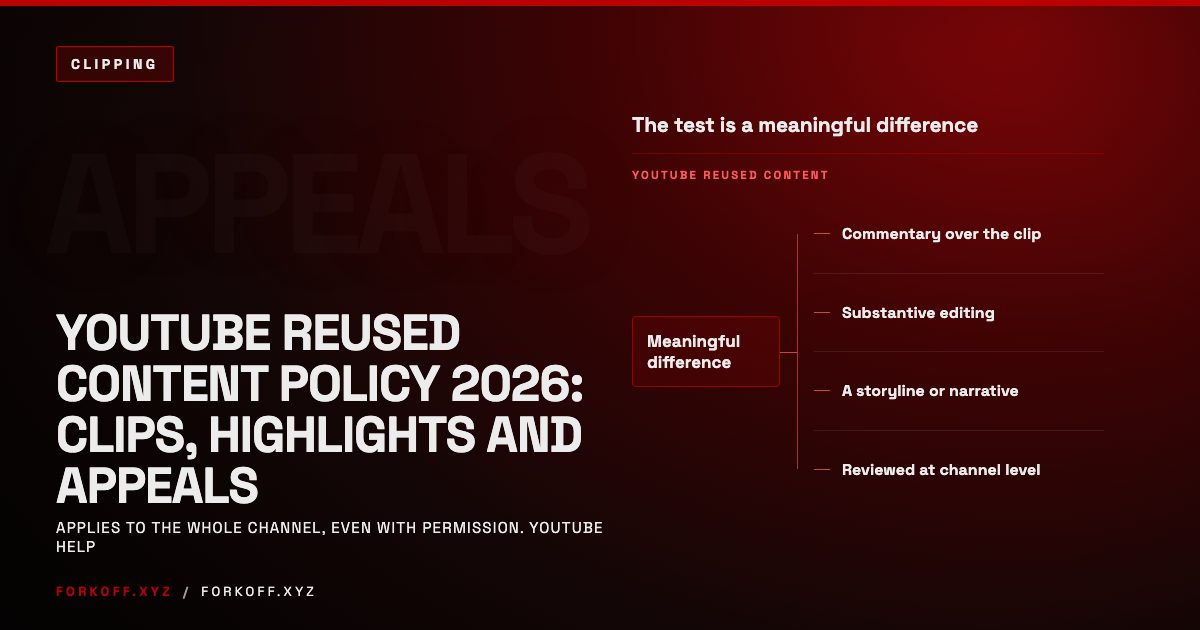
YouTube Reused Content Policy 2026: Clips, Highlights and Appeals
What YouTube's reused content policy actually says, how it treats clips, stream re-uploads and compilations, how to appeal, and how brand clipping stays clean.
 Read
Read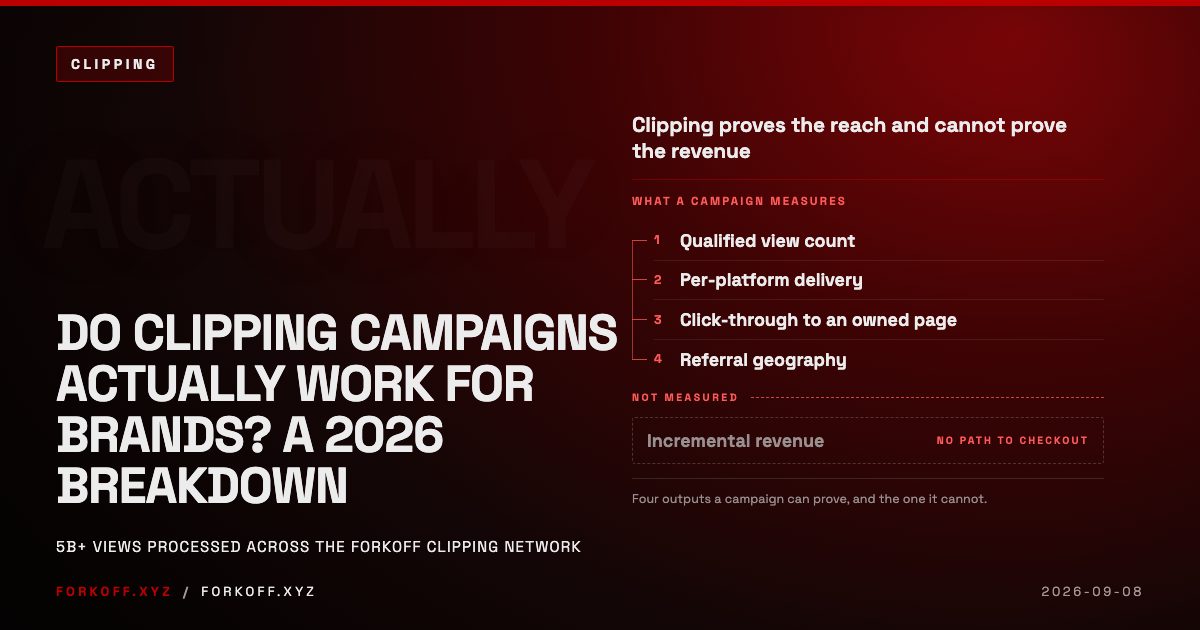
Do Clipping Campaigns Actually Work for Brands? A 2026 Breakdown
Clipping campaigns buy reach at a low unit price and cannot prove revenue. The 2026 breakdown of CPM by content signal, attribution and vendor diligence.
Read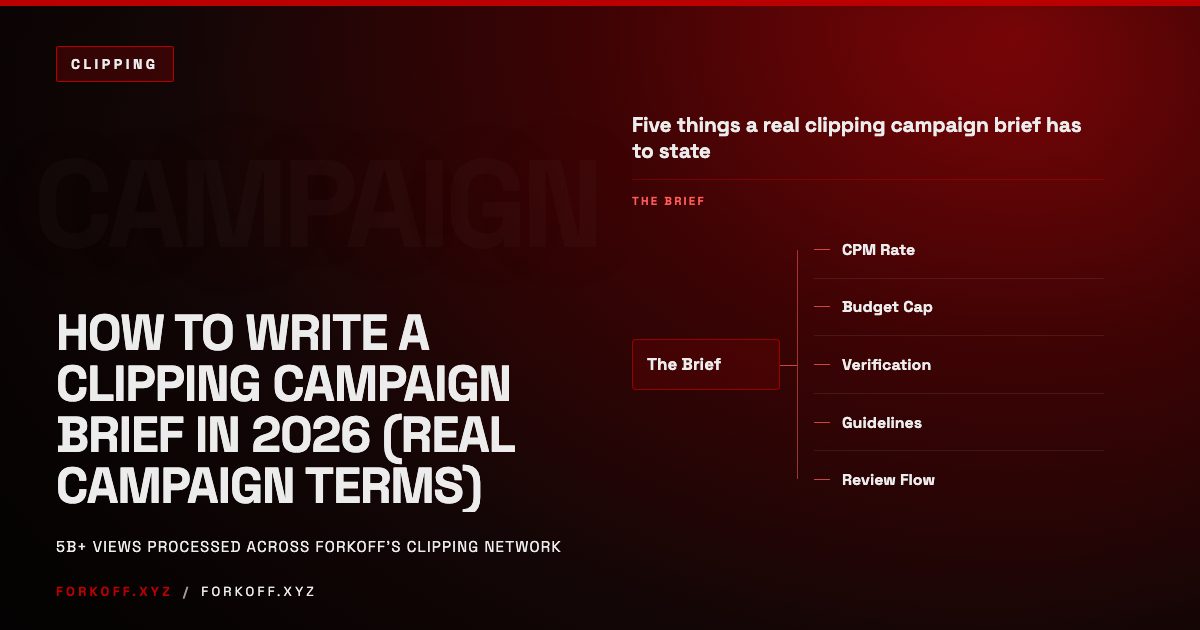
How to Write a Clipping Campaign Brief in 2026 (Real Campaign Terms)
A clipping campaign brief sets the CPM, budget cap, submission rules, and review flow that decide whether a campaign gets quality clips or wasted budget.
Read