
Kick to YouTube. Broadcasts into Shorts and long-form chapter uploads.
FORKOFF ingests Kick broadcast VODs and routes them into YouTube long-form chapters plus Shorts shelf-cuts. Kick carries different broadcast culture than Twitch (no chat-overlay strip on auto-clip, different sub-train mechanics, looser music-policy posture) but the YouTube re-cut brief structure mirrors twitch-to-youtube as the volume-validated parent.
What is the best way to turn Kick content into YouTube Shorts clips?
Kick to YouTube Conversion is a managed clipping lane: vetted YouTube Shorts clippers turn your Kick back-catalog into platform-native vertical cuts, billed only per qualified view at $0.003 CPQV once a four-stage watch-time, policy, geo, and bot gate clears. FORKOFF has processed 5B+ views on this model at 99.71% legitimacy.
- Pricing
- $0.003 per qualified view (CPQV)
- Model
- Managed clipping network, outcome-priced
- Qualification
- Four-stage: watch-time, policy, geo, bot
- Watch gate
- YouTube Shorts: 10 to 15s
Agencies sell effort. Marketplaces sell volume. FORKOFF sells qualified outcomes.
One source library. Four destination surfaces. Per-platform watch-time gates.
Shelf-velocity from Kick broadcast cycle
Mid-roll eligibility on chapter re-edits
What outcome-priced clipping looks like in production.
Kick library to qualified distribution in three steps.
Kick channel intake + brief lock
Strategist intakes the Kick channel and recent VOD library, audits broadcast timelines and music-policy risk (Kick's looser default music-policy posture matters more than Twitch on YouTube re-upload), and locks the brief at acceptance: Shorts watch-time gate, long-form chapter selection, music-licensing rules, audience-geo policy.
Kick-aware clipper routing
Vetted clippers picked on prior Kick-VOD qualification rates, music-policy track record, and Kick-to-YouTube translation craft. Same roster as twitch-to-youtube parent with Kick-specific specialists prioritised. Long-form chapters route through editors with mid-roll eligibility history.
Per-format ledger settle
Each YouTube view passes the four-stage gate: watch-completion (Shorts 10 to 15 seconds, long-form 30 plus seconds), geo, policy verdict, traffic validity. Reason codes log filtered views. Per-Kick-broadcast roll-up shows which moments produced highest qualification rate per format.
Which source moments qualify on which destination.
Not every long-form moment converts. The clipper roster reads the source timeline for these beat types and routes against the destination surface with the strongest qualification curve.
Kick broadcast peak
Multi-second broadcast peak from a Kick stream (gameplay clutch, host reaction, sub-train celebration) that translates to YouTube Shorts shelf
Long-form Kick chapter
Multi-minute focused gameplay arc or guest-stream segment from a Kick broadcast that survives a 30 second hold for re-edit
Sub-only chat moment
Sub-only chat window from a Kick broadcast with strong streamer reaction translated for YouTube audience
Cross-platform tease
Kick-broadcast moment that teases the YouTube channel as long-tail discovery surface for non-Kick audience
FORKOFF vs the alternative.
| Feature | FORKOFF Clippingoperator-grade | Generic alternativethe rest of the market |
|---|---|---|
| Operating model | Managed agency. Strategist owns the Kick-aware brief, picks long-form re-edit chapters, routes Shorts batches against shelf-eligibility rules. ▸ Kick-aware brief | DIY VOD downloaders or self-clipping by the Kick streamer. Kick-to-YouTube translation craft sits on the streamer. |
| Pricing denominator | $0.003 per qualified YouTube view. Same as parent twitch-to-youtube lane. ▸ CPQV consistent | Tool subscription or hourly editor rate, neither tied to qualification. |
| Source-platform map | Kick broadcast culture differs from Twitch (different sub-train mechanics, looser music-policy default) but YouTube re-cut brief structure mirrors twitch-to-youtube as parent. | Auto-clip tools optimised for Twitch only. degrade on Kick broadcast format. |
| Audit trail | Per-clip and per-chapter ledger ties qualified views to the source Kick VOD timestamp. Same export format as twitch-to-youtube. ▸ Auditable | YouTube Studio insights only. no per-Kick-source ledger. |
| Lane fit | Kick streamers running 10 plus hours of weekly broadcast buying YouTube channel growth at retainer scale. | Solo Kick streamers under 4 hours weekly broadcast get cleaner leverage from auto-clip subscriptions. |
Cluster-volume consolidation, Kick broadcast culture, and the parent-lane brief structure.
For the deeper background behind this page, read our guide to clipping livestream VODs.
Who this is for. Who it isn't.
- Kick streamers running 10 plus hours of weekly broadcast buying YouTube channel growth at retainer scale
- Variety Kick streamers needing music-licensing-clean YouTube re-cuts despite Kick's looser broadcast-policy default
- Kick streamers crossing over to YouTube as long-tail discovery surface beyond the Kick broadcast cycle
- Kick streamers with sponsor integrations needing per-broadcast audit ledger for partner reporting
- Solo Kick streamers under 4 hours weekly broadcast (insufficient VOD surface for retainer routing)
- Music-heavy Kick streams where licensing rules block YouTube re-upload entirely
- Streamers happy with raw Kick VOD upload to YouTube without qualification gating
- Brands optimising on raw view counts rather than per-format qualified watch-through
Same source, narrower destination cuts.
When the brief locks to a single destination platform, the spoke page carries the per-destination qualification spec.
Calculator coming to forkoff.xyz soon. Use the dedicated tool at /tools/cpqv-calculator for the full cost-per-qualified-view math.
Frequently asked
How does Kick to YouTube conversion work?
Strategist intakes the Kick channel and recent VOD library, audits broadcast timelines for stream-peak moments and long-form chapter candidates, and locks the brief at acceptance: Shorts watch-time gate, long-form chapter selection, music-licensing rules (Kick has looser music-policy default than YouTube, so audit matters more), audience-geo policy. Vetted clippers re-cut against the brief and post to your YouTube channel.
Why does this canonical to twitch-to-youtube?
Kick is a smaller streaming platform than Twitch with a smaller monthly search volume cluster. The 10-cluster monthly searches for kick-to-youtube consolidate against the 40 monthly searches for twitch-to-youtube as the volume-validated parent. The YouTube re-cut brief structure mirrors twitch-to-youtube; the canonical-tag tells search engines the volume-validated parent is the canonical surface while preserving the Kick-specific synonym-intent landing.
How does Kick broadcast culture differ from Twitch?
Kick has different sub-train mechanics (no Twitch-Partner-tier sub system, looser celebration overlays), looser default music-policy posture (Kick is more permissive than Twitch on background-music tracks, but YouTube re-upload still flags those tracks regardless), and smaller raid-arrival energy than Twitch (Kick raid-arrivals carry less viewer-count surge typically). The brief reshapes per-broadcast against the Kick-specific culture context.
How do you handle music-licensing risk on Kick VODs?
Kick's looser default music-policy posture means Kick broadcasts often carry copyrighted music tracks that policy-pass on Kick but flag on YouTube re-upload. The audit at brief intake matters more on this lane than on twitch-to-youtube. Strategist audits the source VOD audio matrix per broadcast and flags tracks for strip, replace, or skip. Per-upload policy verdict goes into the audit ledger.
Can the same Kick broadcast produce long-form chapters and Shorts batches?
Yes, that is the standard pipeline. Same per-format pipeline as twitch-to-youtube: 1 to 3 long-form re-edit chapters plus a 6 to 12 piece Shorts batch from broadcast peaks. The qualification ledger reads each output by format.
How fast can the campaign go live?
Brief signed off in under 24 hours. First batch of qualified YouTube uploads live in under 48 hours for a sandbox campaign. Identical timeline to twitch-to-youtube.
What is the minimum spend?
There is no fixed minimum. The first campaign is a small sandbox priced per qualified view at $0.003, delivering qualified YouTube views, and larger campaigns are scoped per brief at intake.
What is a qualified view?
A view that passes four checks set by the campaign brief: watch duration, policy compliance, geo consistency, and traffic validity. If any layer rejects it, the view is logged with a reason code and excluded from both spend and payout.
Adjacent clipping routesto plan next
AEO Checker
Four checks in one run: a page's AEO signals, AI crawler access, a mobile Lighthouse audit, and whether ChatGPT, Claude, Gemini, Perplexity and Google AI Overviews name your brand.
Launch Authenticity Checker
Enter a launch post's views and likes, get an Authenticity Grade (A / C / F) from the views-per-like ratio on FORKOFF's RADAR thresholds. Computed live, free.
Launch View-Tier Estimator
Enter follower count and engagement, get your organic view ceiling and which guaranteed tier (1.2M / 3M / 5M) is in reach on FORKOFF's RADAR ~500:1 band. Computed live, free.
Run a sandbox campaign.
14 days. Paid only on qualified views. Audit-ready ledger from day one.
Kick makes the moments. YouTube is where they earn a second life.
A Kick livestream generates hours of raw footage and a handful of moments worth keeping. The job is not just cutting them, it is routing those cuts into YouTube, where a Shorts or long-form clip keeps working long after the stream ends. FORKOFF runs this as a managed campaign: the clipper network pulls the moments from the Kick VOD, ships them to YouTube, and the run is billed on views that qualified, not on how many clips got uploaded.
We have processed 5B+ views across our clipping network, and that per-view record is where the qualification benchmarks for this conversion come from. It is why the price is an outcome: FORKOFF bills at $0.003 per qualified view, the YouTube view that cleared all four checks, rather than a per-clip fee that pays out whether or not a single cut found a real watch-through.
The four-stage gate, applied to YouTube distribution
Every billed view passes a device check, a watch-time threshold tuned to the YouTube surface, a traffic-legitimacy pass, and an audience-geo match, with the filter reason logged. Livestream clips are especially prone to inflated raw counts, which is exactly why the gate matters here. The output is an append-only, exportable ledger. The full method is documented in our qualified-views methodology.
Where a Kick-to-YouTube campaign fits
This is the lane for a streamer or a brand building a Kick presence who wants the highlights compounding on YouTube instead of disappearing with the VOD. See how the managed model runs on the clipping service page, how it compares to other operators in the best clipping agency comparison, or route the same moments to short-form with YouTube Shorts clipping.
Reviewed by the FORKOFF clipping team, the operators who run the qualified-view ledger.
The qualification ledger changed how we report to the board. Real attention, verified weekly, not dashboard vanity.
Growth lead
Series A, 2026, AI infrastructure startup
We went from guessing pipeline attribution to seeing it in a weekly audit ledger. Finance signed off on the next quarter before the first one ended.
Marketing director
Mid-market, 2026, B2B SaaS platform
FORKOFF ran our conference activation across three cities in one quarter. Side events, content capture, post-event distribution. One operator, one ledger.
Head of events
Three cities, one quarter, DevTools company
As Featured In
Full press shelf- DA 55 · 2026-08Keep a Customer Community Engaged Without Over-Promotion

- CFO DriveDA 35 · 2026-08How Finance Teams Align Pricing With Sales Without Eroding Margins
- DA 94 · 2026-07Clipping Agency FORKOFF Crosses 5 Billion View Milestone

- DA 74 · 2026-06Five Things SaaS Founders Get Wrong About Short-Form, and Why Their Best Moments Die in 48 Hours

- LinkedInDA 56 · 2026-06The 2026 DevOps Maturity Test: 11 Engineering Orgs Failed and the One Metric That Replaced the Checklist
- IHDA 75 · 2026-06Most indie products do not fail on the build. They fail on distribution.
- DA 56 · 2026-06The Schema-Match Audit That Lifted Our AI Overview Citation Share From Zero to 23 Percent in 90 Days

- DA 42 · 2026-0525 Country-Specific Considerations for International IP Protection for Your Startup

- DA 68 · 2025-11RedStone, FailSafe, Nibiru and ForkOff Announce The Capital Layer at Devconnect Buenos Aires 2025

- DA 62 · 2025-11RedStone, FailSafe, Nibiru and ForkOff Announce The Capital Layer at Devconnect Buenos Aires 2025

- DA 50 · 2025-11RedStone, FailSafe, Nibiru and ForkOff Announce The Capital Layer at Devconnect Buenos Aires 2025

Receipts, deep dives, and playbooks.
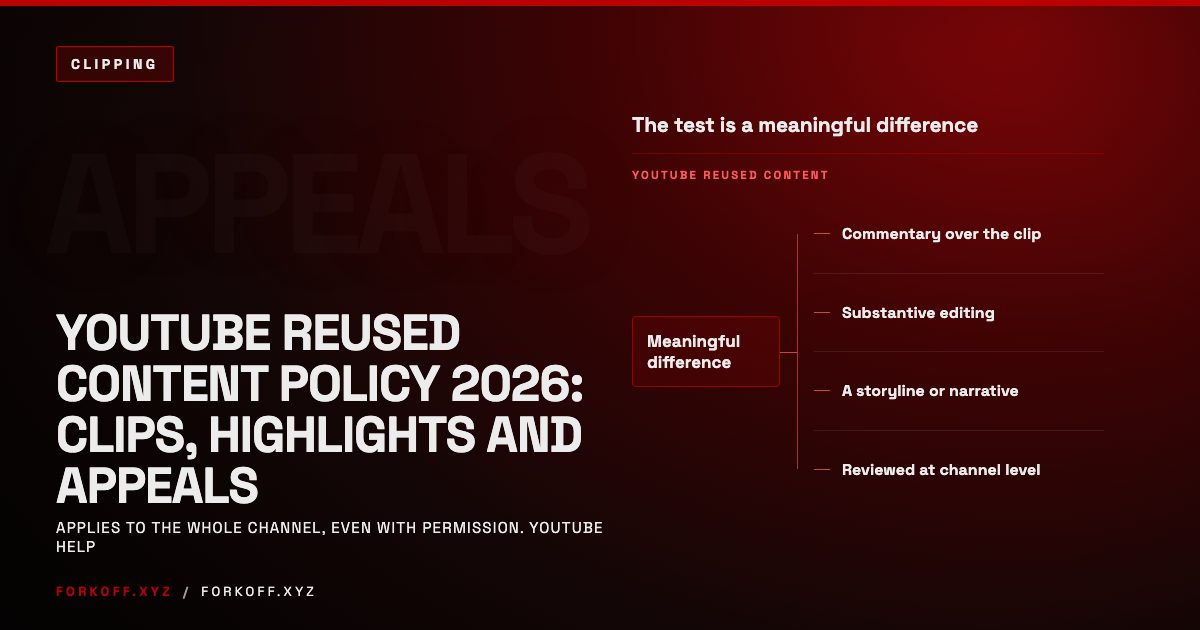
YouTube Reused Content Policy 2026: Clips, Highlights and Appeals
What YouTube's reused content policy actually says, how it treats clips, stream re-uploads and compilations, how to appeal, and how brand clipping stays clean.
 Read
Read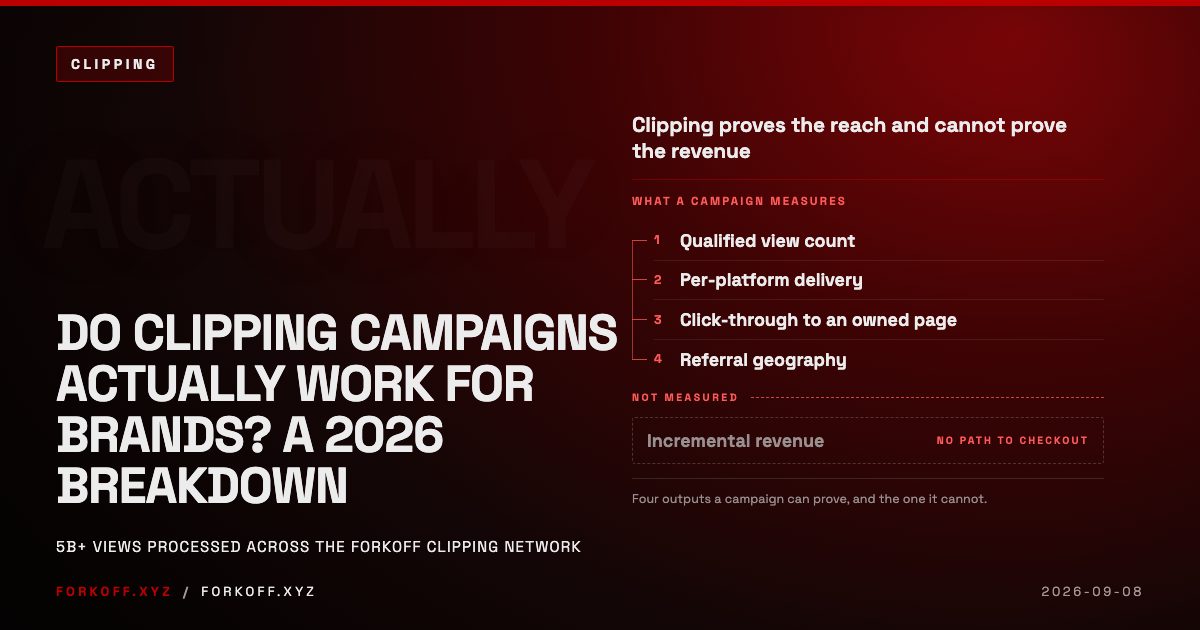
Do Clipping Campaigns Actually Work for Brands? A 2026 Breakdown
Clipping campaigns buy reach at a low unit price and cannot prove revenue. The 2026 breakdown of CPM by content signal, attribution and vendor diligence.
Read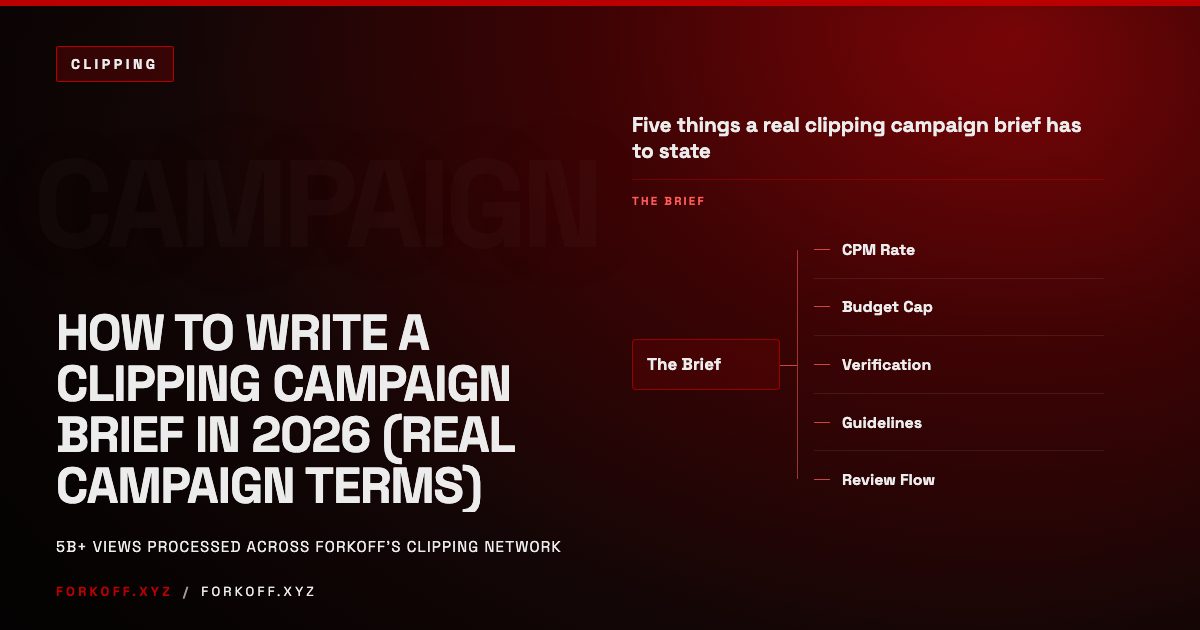
How to Write a Clipping Campaign Brief in 2026 (Real Campaign Terms)
A clipping campaign brief sets the CPM, budget cap, submission rules, and review flow that decide whether a campaign gets quality clips or wasted budget.
Read