
How to build a founder brand in 2026
Updated Jul 25, 2026
A founder brand is the reputation a founder builds in public: the point of view they are known for, the voice buyers recognize, and the trust that makes people follow the person before the product. You build it in five moves. First, pick one point of view you are willing to be known for, because a brand that stands for everything stands for nothing. Second, capture your real voice so the content reads as you. Third, publish consistently on one primary platform rather than spreading thin across five. Fourth, show your work in public so the reputation is earned, not claimed. Fifth, measure recognition, replies from the right accounts and inbound that names you, not follower count. The term was popularized by Dave Gerhardt's book Founder Brand. FORKOFF builds this as an outcome-priced founder spine, the same integrity model behind its 5B+ processed views, so the brand is judged on the pipeline it produces.
- 01Pick one point of view Decide the single thing you want to be known for and the position you are willing to defend. A founder brand is a reputation, and a reputation needs an edge. Trying to appeal to everyone produces a feed nobody remembers. Narrow beats broad every time here.
- 02Capture your real voice Write down how you actually talk: your takes, your enemies, the phrases only you use. The brand has to sound like the person or it breaks on contact with anyone who has met you. This is also why a founder brand cannot be fully ghostwritten.
- 03Publish consistently on one platform Pick the one platform where your buyers already are and post on a locked cadence, rather than spreading thin across five. Recognition is built by repetition, and repetition needs a home. Depth on one channel beats a shallow presence on many.
- 04Show your work in public Post the real process: the numbers, the losses, the decisions and why you made them. A reputation earned in public is durable in a way a claimed one is not. Building in public is what turns a following into a brand people trust.
- 05Measure recognition, not reach Track the signals that mean the brand is landing: replies from the accounts you want, inbound that names a specific post, and people who arrive already knowing your position. Follower count is a vanity number. Recognition among the right people is the asset.
A founder brand is a reputation, not a following
The mistake most founders make is treating the brand as a follower count to grow. A founder brand is a reputation: what a specific set of buyers, investors, and future hires believe about you before they ever talk to you. Ten thousand followers who cannot say what you stand for is a weaker asset than five hundred who can quote your position back to you. The whole discipline is being known for one thing among the people who matter, and being trusted enough that they act on it. That is why building in public works. It converts a claim into evidence, and evidence is what a reputation is made of. If the presence is not producing recognition among the right accounts, it is content, not a brand.
Pick one platform and one point of view
A founder brand compounds from focus, not spread. Two decisions do most of the work. The first is the platform: the single channel where your buyers already gather, whether that is X, LinkedIn, or a specific community. Owning one channel deeply beats a thin presence on five, because recognition is built by repetition in one place. The second is the point of view: the one position you will be known for and defend, covered as the marketing motion at founder-led marketing. Buyers remember people with an edge and forget people who hedge. Once the platform and the point of view are locked, consistency does the rest, which is why cadence reliability is the leading indicator a founder brand is being built rather than just talked about.
How FORKOFF builds a founder brand
FORKOFF treats the founder brand as the reputation layer that makes the whole founder funnel work. The founder approves every draft against a voice guide, the team runs the daily cadence and the comment engineering on a curated ICP list, and the weekly receipt scores whether the brand is producing WARM intros, HIRES, CADENCE reliability, and VOICE fidelity. It is priced on qualified outcomes rather than a posting subscription, because a recognizable brand that books no calls is expensive at any follower count. The report is on outcomes a real buyer produced, the same integrity model that runs on the distribution network behind FORKOFF's 5B+ processed views.
The five layers of a founder brand
| Layer | What it builds | Cadence | Leading indicator |
|---|---|---|---|
| Point of view | The one thing you are known for | Set once, refined quarterly | Buyers can quote your position back |
| Voice | Content that reads as the person | Set once, refreshed quarterly | Founder approves every draft before publish |
| Consistent publishing | Recognition through repetition | Daily on one platform | Shipped-on-time days, no quiet roll-forward |
| Building in public | Trust earned, not claimed | Weekly proof posts | Replies and shares from target accounts |
| Recognition tracking | Proof the brand is landing | Weekly | Inbound that names a specific post |
A founder brand is measured on recognition among the right accounts, not on follower count. The term was popularized by Dave Gerhardt's 2022 book Founder Brand.
What building the brand costs if you outsource it (2026 market bands)
| Layer | Outsourced 2026 price | Source signal |
|---|---|---|
| Personal-brand ghostwriting | $2,000 to $8,000 / month | Clash: US personal branding $3,500 to $25,000+/mo |
| Podcast and speaking placement | $1,000 to $5,000 / month | Podseeker: booking agencies $1,500 to $5,000+/mo |
Public 2026 vendor bands, not FORKOFF numbers. A founder brand is the reputation layer of a founder funnel, so full outsourced builds span roughly $5,000 to $20,000 or more a month. See /answers/how-much-does-a-founder-funnel-cost.
Frequently asked questions
What is a founder brand in simple terms?
It is the reputation a founder builds in public: the point of view they are known for and the trust that makes people follow the person before the product. A founder brand is measured by recognition among the right buyers and inbound that names you, not by follower count. The term was popularized by Dave Gerhardt's book Founder Brand.
How long does it take to build a founder brand?
Recognition starts to compound over months, not weeks. Voice capture and the first cadence can begin in a week, but a brand is earned by repetition, so the real signal is people arriving already knowing your position. Expect leading indicators like reply quality from target accounts before you expect broad recognition.
Can you build a founder brand without a huge following?
Yes, and a small, precise audience is often the stronger asset. Five hundred of the right buyers, investors, and hires who can quote your position beats ten thousand who cannot say what you stand for. A founder brand is about being known for one thing among the people who matter, not about raw reach.
Which platform is best for a founder brand?
The one where your buyers already gather, most often X or LinkedIn for B2B founders. The specific channel matters less than the decision to own one deeply rather than spread thin across five. Recognition is built by repetition in one place, so pick the platform your ICP actually reads and post there consistently.
Do I need an agency to build a founder brand?
No for the content and voice, which cannot be faked and take about 30 minutes a day. What is harder to self-run is the placement outreach and the weekly discipline of tracking recognition and attribution. That is where a managed founder funnel helps, drafting and placing while the founder supplies the voice and shows up in the comments.
How do you know if a founder brand is working?
Track recognition, not vanity metrics. The signals are replies from the accounts you want to reach, inbound demos that name a specific post, and people who arrive already knowing your position. Cadence reliability is the earliest leading indicator. If follower count is climbing but none of those appear, the brand is not reaching the right people.
Receipts, deep dives, and playbooks.
The Distribution Learning Curve: Sell Your Own Growth Before You Buy It
Sequoia says founders must close their own first deals before scaling sales. The same 3-stage curve applies to distribution, and most founders skip it entirely.
 Read
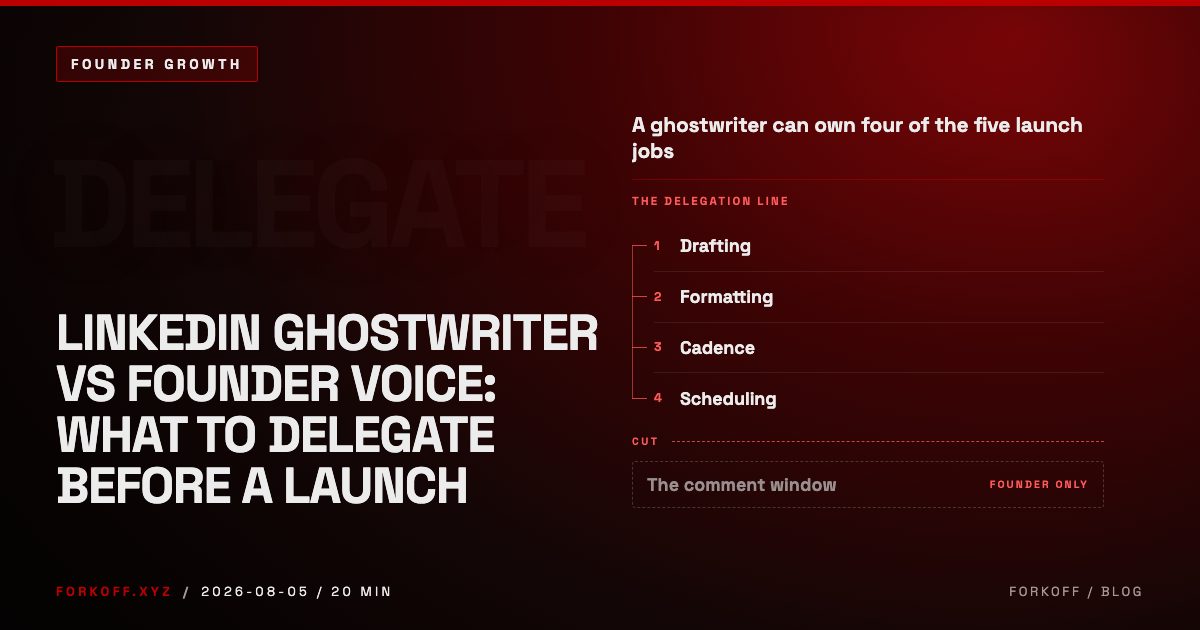
LinkedIn Ghostwriter vs Founder Voice: What to Delegate Before a Launch
A LinkedIn ghostwriter can draft your launch posts. It cannot reply in your comments or show up on the call. Here is where the line actually falls.
Read
Distribution Is the Platform-Team Gap Killing Your Portfolio
Portfolio companies rarely die from bad product. They die in the gap where owned distribution is a function no one on the org chart is staffed to own.
Read