
How to get inbound leads as a founder in 2026
Updated Jul 25, 2026
Inbound leads are buyers who come to you, rather than being chased by outbound. As a founder you generate them by being useful in public: publishing content that answers the exact questions your buyers search, showing up where they already spend time, and making the path to reach you obvious. Three engines produce most founder inbound, and a founder controls all of them. Content and answer-engine visibility make you the result a buyer finds. A consistent social and podcast presence makes you the person a buyer already trusts when they arrive. And word of mouth, earned by doing visible good work, brings referrals you never asked for. The common failure is treating inbound as luck. It is a byproduct of being useful in public on a schedule. FORKOFF runs founder inbound as an outcome-priced spine that logs every lead back to the post or appearance that caused it, the same attribution discipline behind its 5B+ processed views.
- 01Publish answers to real buyer questions Write the content your buyers actually search, in plain language, so both search engines and AI answer engines surface you as the result. An answer page or post that resolves a specific buyer question is the most durable inbound engine a founder has, because it works while you sleep.
- 02Be present where your buyers already are Post consistently on the one platform your ICP reads and appear on the podcasts they listen to. Presence turns you from a cold name into a known one, so when a buyer has the problem you solve, you are already the person they think of.
- 03Give something away A free teardown, a template, a small tool, or a public benchmark gives a buyer a reason to raise their hand. Value up front is the cleanest inbound trigger, because the person who took your free thing is pre-qualified and warm when they reach out.
- 04Make the path to reach you obvious Put a clear, low-friction way to book or reply in your bio, your posts, and your appearances. Inbound dies when an interested buyer cannot find the door. One obvious call to action beats a clever funnel that hides the way in.
- 05Attribute every lead to its source Log each inbound demo and referral back to the post, appearance, or free asset that caused it. Attribution tells you which engine is working so you can do more of it, and it is what separates a repeatable inbound system from a lucky month.
Inbound is a byproduct of being useful in public
Founders who chase inbound with tricks tend to get nothing, and founders who quietly do useful work in public tend to get more than they can handle. Inbound is not a channel you buy, it is the residue of being visibly helpful on a schedule. Every answer you publish, every honest post about what worked and what did not, and every free teardown compounds into a reputation that makes buyers arrive already convinced. The reason it feels slow is that it works on a delay: the post you write today produces the demo six weeks from now. That delay is also the barrier that keeps most founders from doing it, which is exactly why the ones who commit to the cadence pull ahead. The whole game is usefulness plus consistency plus a visible door.
The three inbound engines a founder actually controls
Founder inbound comes from three engines, and a founder owns all three. The first is content and answer-engine visibility: pages and posts that answer buyer questions so search and AI surface you, which is the same discipline behind answer engine optimization. The second is presence: a consistent social and podcast footprint, the founder-led marketing motion, that makes you a trusted name before the buyer needs you. The third is word of mouth: referrals earned by doing visible good work, which cost nothing and close fastest because they arrive pre-trusted. Most founders lean on one and ignore the other two. The compounding happens when all three run together, because a buyer who reads your answer, already follows you, and heard your name from a peer is barely a lead at all. They are a warm intro to yourself.
How FORKOFF turns founder presence into inbound
FORKOFF runs founder inbound as part of the founder funnel: the content that makes the founder the search and AI result, the daily presence that makes them the trusted name, and the placement that borrows audiences that already exist. Every inbound demo and referral is logged back to the post or appearance that caused it on a weekly receipt, so the spend maps to leads a real buyer produced. It is priced on those qualified outcomes rather than a posting subscription, the same attribution and integrity model that runs on the distribution network behind FORKOFF's 5B+ processed views. The result is inbound you can explain, not inbound you hope for.
Where founder inbound actually comes from
| Engine | Mechanism | Time to first lead | What to measure |
|---|---|---|---|
| Content and answer-engine visibility | Buyers find you as the search or AI result | Slow (weeks to months) | Inbound that names a specific page or post |
| Social and podcast presence | Buyers already trust you when they arrive | Medium (weeks) | Replies and demos from target accounts |
| Word of mouth | Referrals from visible good work | Fastest, once seeded | Referred demos, closest to close |
A founder controls all three engines. The compounding happens when they run together, so a buyer arrives having read your answer, already following you, and referred by a peer.
Inbound vs outbound for an early-stage founder
| Approach | Who moves first | Cost profile | Best when |
|---|---|---|---|
| Inbound | The buyer comes to you | Time up front, compounds over months | You can commit to publishing on a cadence |
| Outbound | You reach the buyer | Pays off immediately, does not compound | You need pipeline this month, not next quarter |
| Founder-led sales | You close what inbound and outbound surface | Founder time, highest conversion early | Before a dedicated sales team exists |
Inbound and outbound are complements, not rivals. Most early founders run outbound for immediate pipeline while building the inbound engine that lowers acquisition cost later. See /answers/what-is-founder-led-sales.
Frequently asked questions
How do founders get inbound leads without a big audience?
By being useful in public on a schedule. Publish content that answers the exact questions your buyers search, appear where they already spend time, and give something away. A small, precise audience that trusts you produces more inbound than a large one that does not. The lever is usefulness plus consistency, not raw follower count.
How long does it take to get inbound leads as a founder?
Inbound works on a delay. Content and answer-engine visibility take weeks to months to produce demos, presence produces faster once you are a known name, and word of mouth is quickest once seeded. The delay is why most founders quit early, and why the ones who hold the cadence pull ahead. Expect it to compound, not switch on.
What is the best inbound channel for a founder?
There is no single best channel, there are three engines that compound together: content and answer-engine visibility, a consistent social and podcast presence, and word of mouth. Leaning on one and ignoring the others is the common mistake. The strongest inbound happens when a buyer finds your answer, already follows you, and heard your name from a peer.
Is inbound better than outbound for a startup?
They are complements. Outbound pays off immediately but does not compound, so it is right when you need pipeline this month. Inbound takes time up front but lowers acquisition cost over months as it compounds. Most early founders run both: outbound for now, inbound for the durable engine that makes later growth cheaper.
How do I turn social media into actual leads?
Publish content that answers real buyer questions, engage the specific accounts you want to reach rather than posting into the void, give a clear reason to raise a hand, and make the path to book obvious. Then log which post caused each inbound so you can repeat what works. Presence without a visible door produces impressions, not leads.
How do I know which posts are driving inbound?
Ask every inbound lead what brought them and log it back to the source, or use a tracked link and a simple attribution note on a weekly receipt. Attribution is what turns a lucky month into a repeatable system, because it tells you which of the three engines is working so you can do more of it.
Receipts, deep dives, and playbooks.
The Distribution Learning Curve: Sell Your Own Growth Before You Buy It
Sequoia says founders must close their own first deals before scaling sales. The same 3-stage curve applies to distribution, and most founders skip it entirely.
 Read
Read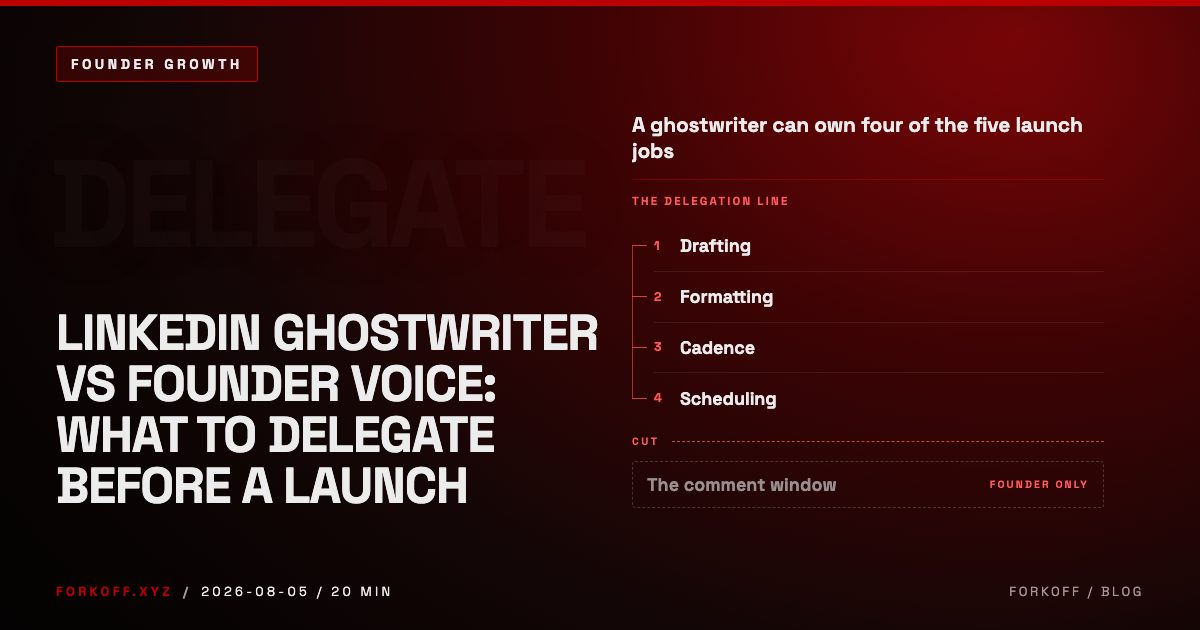
LinkedIn Ghostwriter vs Founder Voice: What to Delegate Before a Launch
A LinkedIn ghostwriter can draft your launch posts. It cannot reply in your comments or show up on the call. Here is where the line actually falls.
Read
Distribution Is the Platform-Team Gap Killing Your Portfolio
Portfolio companies rarely die from bad product. They die in the gap where owned distribution is a function no one on the org chart is staffed to own.
Read