What AI UGC actually is
AI UGC is user-generated-style video produced with AI avatars, synthetic voiceover, and generated scripts instead of a filmed human creator. The buyer decision is not which app to use, it is tool versus agency. A SaaS tool hands you a generator and you run production, testing, and iteration yourself. A done-for-you agency owns the strategy, the volume, and the outcome. FORKOFF is the agency side, outcome-priced rather than per-seat.
The output looks like a real person holding a product and talking to camera, but no creator, no shoot, and no shipped samples were involved. Three formats dominate: AI-avatar spokesperson clips, product-in-hand demos composited around a generated presenter, and hook-plus-b-roll ad cuts assembled from stock and voice.
The term exists because the paid-social feed rewards native, person-to-camera video, and brands wanted that format without the creator-sourcing cost. Search 'ai ugc' today and every result on page one is a SaaS tool (makeugc.ai, createugc.ai, HeyGen, Creatify, ugcads.ai, topview.ai), which tells you the category is being sold as software first.
This guide covers the part the tools skip: whether software or a done-for-you agency is the right buy for your stage.
The real decision: AI-UGC tool vs done-for-you agency
This is the only decision that matters, and it is not which app has the best avatars. An AI-UGC tool hands you a generator. You still write the brief, pick the winning angle, run the volume, read the analytics, and iterate. Public pricing sits around 30 to 500 dollars a month (HeyGen, Creatify, Arcads pricing pages), so the software is cheap and the labor is yours.
A done-for-you agency owns the strategy, the volume, the testing loop, and the number at the end. The FORKOFF UGC video ads service is the agency side: outcome-priced, not per-seat. Pick the tool when you have an in-house performance marketer who will live in the dashboard daily and treat AI UGC as one more creative source. Pick the agency when you want the result underwritten instead of the software rented.
The stats sibling breaks the full cost and performance math down in the AI UGC benchmarks study.
When UGC beats a studio shoot
UGC, AI or human, wins where trust and volume beat polish. Nielsen's Global Trust in Advertising survey (56 countries, 28,000+ respondents) found 92% of consumers trust earned media and peer recommendations above every other advertising format, and the Nosto and Stackla consumer survey found 79% say user-generated content highly impacts their purchase decisions, with shoppers 2.4x more likely to view UGC as authentic than brand-created content. Native person-to-camera video inherits that trust in a way a glossy studio spot does not.
Use UGC when you need 20 to 50 creative variants a month to feed paid-social testing, when the product is bought on trust rather than spec (supplements, apparel, apps, DTC consumables), and when speed matters more than a hero film.
Use a studio shoot when you need one flagship brand asset, when regulatory or luxury positioning demands controlled production, or when the creative will run unchanged for a year. Most DTC brands need the first bucket far more often than the second, which is why the UGC format took over the feed.
How an AI UGC campaign actually works
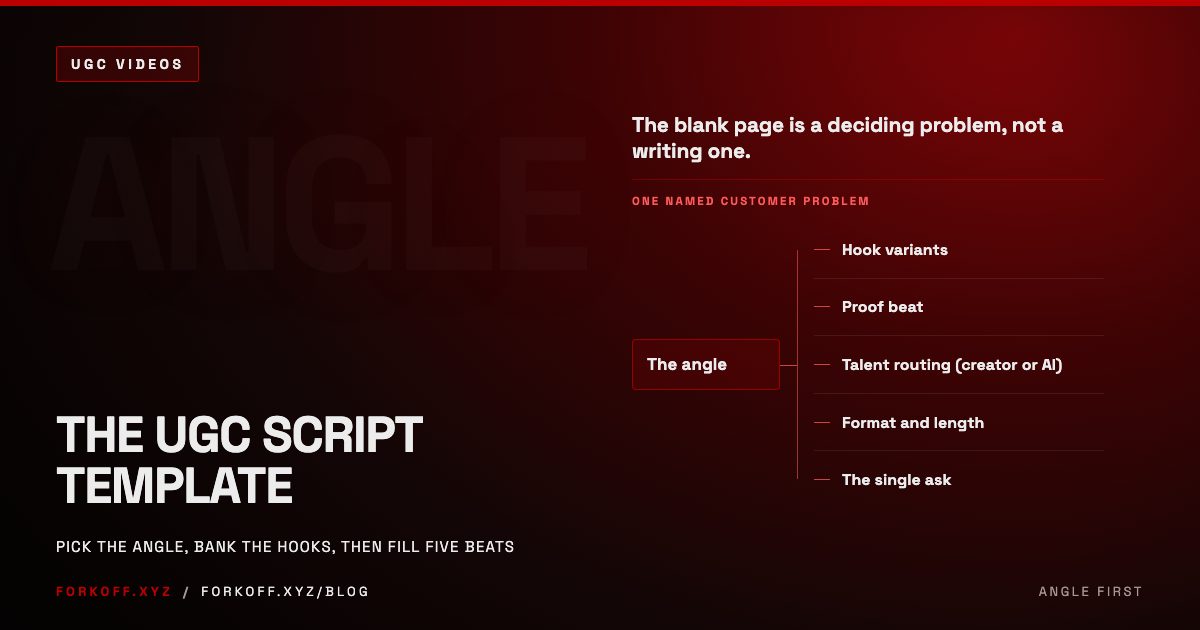
A campaign is not one video, it is a testing engine. Here is how FORKOFF runs the loop, in five steps.
- Angle research. Pull the hooks, objections, and exact language your buyers already use, where Reddit and review mining is the highest-signal source. This is why Reddit marketing feeds the pipeline: a variant that converts starts with the exact words your buyers use.
- Scripting. Write 10 to 20 hook variants against those angles.
- Production. Generate the AI-UGC cuts or brief human creators, batching for volume.
- Testing. Run the variants on paid social, kill losers fast, scale winners.
- Iteration. Rebrief the next batch off what won.
A tool gives you step three. An agency runs all five and reports on the outcome, not the render count. FORKOFF has processed 5B+ views across its clipping network, so the distribution and testing muscle is the same engine pointed at UGC creative.
What actually breaks an AI UGC campaign
Most AI UGC campaigns fail for one of three mechanical reasons, and avatar quality is rarely one of them. The first is skipping angle research and generating variants off a single guess at what buyers care about, which produces volume with nothing for the algorithm to separate on. Forty clips built on one weak angle behave like one ad running forty times, not forty independent tests.
The second is starting a test with no kill criteria decided in advance. A losing variant keeps spending because nobody set, before the budget went live, what cost per result counts as a loss for this campaign. Deciding that threshold after the numbers come in is how a team convinces itself a loser is still warming up.
The third is treating the software subscription as the whole strategy. A tool is one input into a research, production, testing, and iteration loop, not a replacement for it. A brand that buys the generator and skips the research step is paying for the cheapest part of the process and skipping the part that decides whether any of it converts. This is the exact gap a done-for-you engagement closes: the software is rarely the bottleneck, the discipline around it is.
AI UGC, real creator UGC, and clipping: picking the right format
These three formats solve different jobs, and most brands that run only one of them are leaving a job undone. Real creator UGC is filmed by an actual person who used the product, and it carries lived, verifiable trust that works hardest in testimonial-heavy and trust-gated categories such as supplements, skincare, and apps handling money. It is slower and more expensive per asset, and it is worth that cost specifically for the small number of hero placements a brand runs unchanged for months.
AI UGC wins on speed and unit cost for the part of the funnel that needs volume, not a single perfect asset: the twenty to forty hook variants a paid-social testing loop burns through in a normal month. It inherits most of native UGC's format trust because the person-to-camera, unpolished shape is doing the work, not the polish, but it is the wrong tool for the handful of placements where a buyer needs to know a real customer is behind the claim.
Clipping is a third job entirely: it takes an asset that has already proven itself, whether a paid-social winner or existing long-form content, and turns it into organic reach on top of the spend already committed. It does not generate new creative, it compounds a creative that already won. The three formats stack rather than compete: AI UGC for the volume of the test, real creators for the hero placements the category demands, and clipping to extend whatever wins beyond the paid budget that found it. FORKOFF runs all three from one operating engine rather than asking a brand to stitch together three separate vendors.
How much creative volume is actually enough
There is no single right number, but the shape of a working batch is consistent across the campaigns FORKOFF runs. A batch that is too small to learn from is the most common early mistake: three or four variants against one audience rarely produces a statistically readable winner before the budget runs out, because the algorithm has not had enough distinct options to separate. A batch that is too large without enough angle variety wastes spend the same way, because ten renders of one hook are not ten tests, they are one test with nine expensive duplicates.
The working shape is closer to eight to twelve genuinely distinct angles per testing round, each represented by one or two variants rather than ten near-identical cuts of the same idea. That keeps the batch small enough to fund properly and wide enough that a clear winner actually separates from the pack within the first week of spend. Once a winner is visible, the next round rebriefs entirely around that angle rather than restarting from a blank page, so each cycle compounds instead of starting the research over.
Cadence matters as much as batch size. A single round tests one hypothesis about what the buyer responds to; the compounding value shows up over three or four consecutive rounds, where each round's winner narrows what the next round tests. A brand that runs one batch, calls it done, and moves on has paid for the cheap part of AI UGC and skipped the part that actually returns the investment.
Read results on cost per result, not on views or watch time. A clip can hold attention and still fail to move a buyer to act, and a hook that looks unremarkable on a view-count dashboard can be the cheapest conversion in the batch. Set the kill threshold on cost per result before the round starts, apply it the same way to every variant regardless of how much the team likes a particular script, and let the number decide which angle earns the next round's budget rather than a gut feeling about which clip looks best.
AI UGC for DTC and ecommerce
DTC is where AI UGC earns its keep. Paid-social creative fatigues in days, so a store running Meta and TikTok ads needs a constant refill of native-looking clips, and shooting that volume with human creators costs 59 to 500 dollars per video on platforms like Billo.
AI UGC drops the marginal cost of variant number 21 to near zero, which is the whole point. You are not making one perfect ad, you are feeding an algorithm that wants 40 to try.
The catch is that volume without angle research produces 40 identical clips that all lose. The DTC brands that win pair AI production with real buyer-language research and a disciplined kill-and-scale loop. That is the agency job, not the tool job. When a creator clip wins on paid, pair it with clipping to turn the winner into organic reach. For the full DTC playbook, cost math, and testing loop, see the AI UGC for DTC brands guide.
Where FORKOFF fits
FORKOFF is a done-for-you, outcome-priced AI marketing agency, not a UGC SaaS tool. We do not compete for the 'log in and generate a clip' buyer. The tools own that intent and own it well.
We are the buy when you want the strategy, the volume, and the number owned by an operator on the seat. The engagement pairs AI UGC production with buyer-language research, paid-social testing, and organic amplification through the 5B+ view clipping network.
See the full service scope at the UGC video ads service, the cost and performance data in the AI UGC benchmarks study, and the sibling flagship at clipping. Where real-creator and KOL activation decide the sale, influencer marketing carries the human side, and the how to go viral on TikTok guide breaks down the short-form reach mechanics the clips ride on. For B2B SaaS specifically, where the buyer researches in communities before buying, the Reddit UGC-to-pipeline motion covers the distribution and attribution play. When you want the result underwritten instead of the software rented, talk to a strategist.