
What is founder-led sales in 2026?
Updated Jul 25, 2026
Founder-led sales is the founder personally running the sales process, prospecting, demos, and closing, before there is a dedicated sales team. It works in the earliest stage because the founder has the deepest product knowledge, the most credibility with a skeptical first buyer, and the authority to change the product based on what they hear on a call. A hired rep can do none of those three. Founder-led sales is where the repeatable playbook gets written: the objections, the words that land, and the buyer who is actually a fit. It is distinct from founder-led marketing, which fills the top of the funnel with warm attention, and from a founder brand, which is the reputation that makes the calls easier. Pipedrive and other operators note that direct selling by the founder is what closes early deals before a sales function exists. FORKOFF runs a founder funnel that feeds these calls warm, priced on the outcomes it produces, the same model behind its 5B+ processed views.
- 01Do it yourself first Take the first fifty to a hundred sales conversations personally, with no SDR in between. The founder hears the raw objections, the real reasons buyers say no, and the language that makes them say yes. This is data no rep can gather for you, and it is the whole point of the stage.
- 02Sell the problem, not the feature Early buyers do not buy a feature list, they buy a founder who clearly understands their problem better than they do. Lead with the problem and the outcome, and let the product be the answer. Founders win here precisely because they know the problem cold.
- 03Take every call and learn the objections Say yes to every qualified conversation and write down each objection and how the call turned. The pattern that emerges is your playbook: the three objections that matter, the proof that resolves each, and the buyer profile that closes fastest.
- 04Write down the repeatable playbook Turn the patterns into a written motion: who to target, what to say, which objections to expect, and what proof closes them. A playbook is what makes the process handoff-ready, and without it a first sales hire has to rediscover everything from zero.
- 05Know when to hand off Transition out of founder-led sales when the motion is repeatable and the founder is the bottleneck, not when you are simply tired of selling. The signal is a written playbook that a hire can run to similar results, which is when a first sales rep starts to make sense.
Why founders sell better than reps in the early stage
In the first stage a founder outsells any rep they could hire, for three reasons a rep cannot match. The founder has the deepest product knowledge, so no technical question stalls the call. The founder carries the most credibility with a skeptical first buyer, because they are the person who built the thing and can speak to the vision without a script. And the founder has the authority to change the product on the spot, so a call becomes a design conversation and the buyer feels heard in a way no rep can offer. Those advantages fade as the company matures and the motion becomes repeatable, which is exactly when a rep starts to win on volume. But early, the founder is not just the best salesperson available, they are the only one who can gather the learning the whole company will run on.
Founder-led sales vs founder-led marketing
These two are constantly confused and they are different motions. Founder-led marketing fills the top of the funnel with warm attention and inbound by using the founder as the marketing channel. Founder-led sales is the 1:1 conversion at the bottom: the demos and the closing. The reputation that makes both easier is the founder brand. The practical value of keeping them separate is diagnosis. If calls are booked but nobody closes, that is a founder-led sales problem, in the pitch or the qualification. If no calls are booked at all, that is a marketing and inbound problem. Founders who blur the two spend on reach when the real gap is closing, or hire a rep when the real gap is pipeline.
When to transition out of founder-led sales
The right time to hire a first salesperson is when the motion is repeatable and the founder has become the bottleneck, not when the founder is simply worn out. SaaStr and other operators frame the transition around a written, repeatable playbook: if a new hire can run your motion and reach similar results, you are ready, and if they cannot, you are hiring too early and will burn the hire. Founder-led sales is the phase where that playbook gets written, which is why skipping it or handing it off too soon is the expensive mistake. FORKOFF's founder funnel supports this stage by feeding the founder's calls warm, so the scarce founder hours go to conversations that were pre-qualified by presence and inbound rather than cold prospecting.
Founder-led sales vs a hired sales team, early stage
| Factor | Founder-led sales | Hired rep, too early |
|---|---|---|
| Product knowledge | Deepest possible, no question stalls the call | Learning the product, defers technical asks |
| Credibility with first buyer | High: the person who built it | Lower: a rep selling someone else's vision |
| Ability to change the product | On the spot, turns a call into a design chat | None, can only relay feedback |
| Playbook | Written from real objections | Must rediscover the motion from zero |
| Scales | No, founder time is the ceiling | Yes, once a playbook exists to run |
Founder-led sales wins early on knowledge, credibility, and product authority. A rep wins later on volume, but only once the founder has written a repeatable playbook for them to run.
Frequently asked questions
What is founder-led sales in simple terms?
It is the founder personally running sales, prospecting, demos, and closing, before there is a dedicated sales team. It works early because the founder has the deepest product knowledge, the most credibility with a first buyer, and the authority to change the product based on what they hear. It is also where the repeatable sales playbook gets written.
Why is founder-led sales important for startups?
Because early deals close on the founder's knowledge and credibility, and because the founder gathers the learning the whole company runs on: the real objections, the language that lands, and the buyer who is actually a fit. A first rep cannot gather that. Skipping founder-led sales means hiring before you know what you are selling or to whom.
How is founder-led sales different from founder-led marketing?
Founder-led marketing fills the top of the funnel with warm attention and inbound by using the founder as the marketing channel. Founder-led sales is the 1:1 conversion at the bottom, the demos and the closing. Keeping them separate lets you diagnose whether a stalled pipeline is a reach problem or a closing problem, which need different fixes.
When should a founder stop doing sales?
When the motion is repeatable and the founder has become the bottleneck, not when they are tired of selling. The signal is a written playbook a new hire can run to similar results. If a hire cannot reach similar results with your playbook, you are hiring too early and will likely burn the hire and the pipeline.
How many sales should a founder do themselves?
Enough to write the playbook, commonly the first fifty to a hundred conversations. The goal is not a revenue number, it is the pattern: the three objections that matter, the proof that resolves each, and the buyer profile that closes fastest. Once that pattern is written down and repeatable, a first sales hire starts to make sense.
Does founder-led sales work for technical founders?
Yes, and technical founders often have an edge, because deep product knowledge closes a skeptical early buyer faster than polish does. The part to build deliberately is selling the problem and the outcome rather than the feature list, and writing down the motion so it can be handed off. Presence and inbound help by warming the calls before they happen.
Receipts, deep dives, and playbooks.
The Distribution Learning Curve: Sell Your Own Growth Before You Buy It
Sequoia says founders must close their own first deals before scaling sales. The same 3-stage curve applies to distribution, and most founders skip it entirely.
 Read
Read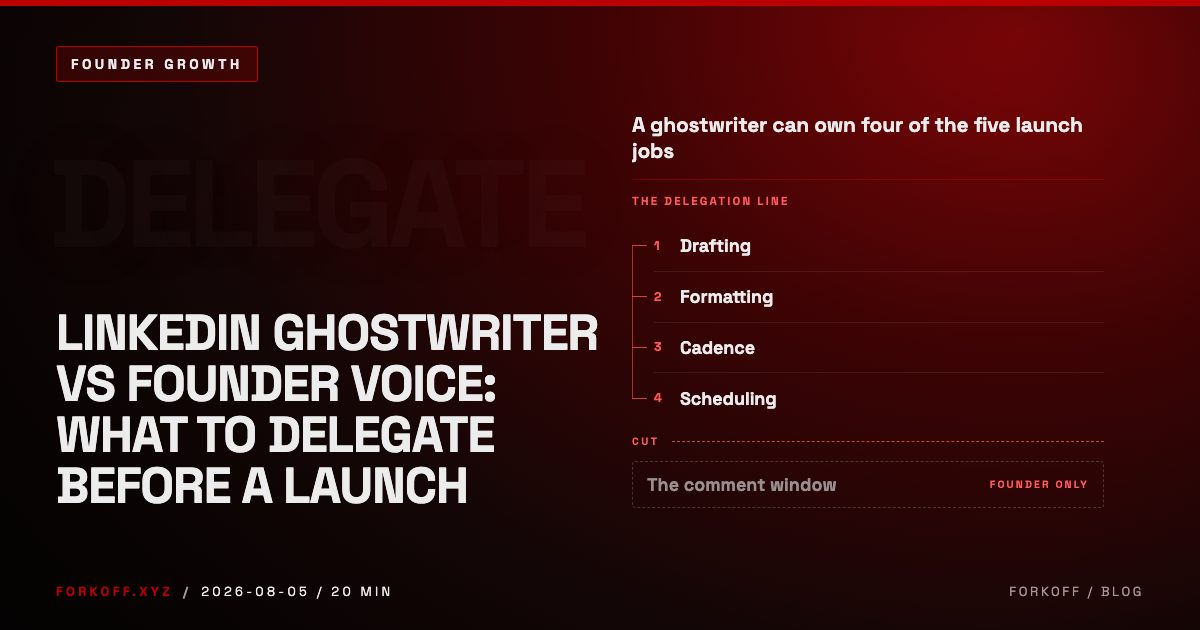
LinkedIn Ghostwriter vs Founder Voice: What to Delegate Before a Launch
A LinkedIn ghostwriter can draft your launch posts. It cannot reply in your comments or show up on the call. Here is where the line actually falls.
Read
Distribution Is the Platform-Team Gap Killing Your Portfolio
Portfolio companies rarely die from bad product. They die in the gap where owned distribution is a function no one on the org chart is staffed to own.
Read