
What is answer engine optimization (AEO)?
Updated Sep 24, 2026
Answer engine optimization (AEO) is the practice of making your brand the source that AI answer engines, such as ChatGPT, Perplexity, Gemini and Google AI Overviews, quote and name when a buyer asks a question. Where SEO competes for a ranked link, AEO competes for a place inside the answer itself, which is often the only thing the buyer reads. The work is answer-first pages shaped around the questions buyers ask, a clear entity, original data engines can cite, and mentions on the sites engines trust. It is measured as citation share: how often you are named across a fixed set of prompts. It builds on SEO rather than replacing it, because Google says its AI features are grounded in its core ranking systems.
Per our own AI Citation Index, a 50-prompt buyer-intent cluster run on 5 engines, forkoff.xyz moved its average cite rate from 22% to 34% in four weeks, with Perplexity at 48% (measured 19 May 2026). FORKOFF AI Citation Index 2026
- 01Map the questions buyers ask List the prompts a buyer types into ChatGPT or Perplexity before choosing a vendor in your category, then the sub-questions an engine expands each one into. That map, not a keyword list, decides which pages you need.
- 02Answer first, on every page Open each page and each section with a 40 to 60 word answer to its question, before any setup or list. Engines lift the passage that resolves the question fastest, and a slow intro hands the citation to a page that answers up top.
- 03Make your entity unambiguous Describe what you are the same way on your site, your Organization schema, your directory profiles and Wikidata where you qualify. An engine that cannot tell you apart from a similarly named company will not name you.
- 04Publish numbers only you have Engines and the writers they quote both prefer sources with original data. One benchmark, index or teardown with named methods gives an engine a reason to cite you instead of a summary of everyone else.
- 05Earn mentions where engines look Answers lean on review sites, forums and publications. In our September 2026 index, 61% of AI answers cited at least one review site or forum, so genuine presence there is part of the work, not a side project.
- 06Measure citation share Run the same prompts on the same engines on a fixed cadence and count how often you are named against competitors. A single screenshot of one good answer is an anecdote; share over time is the number that tells you whether AEO is working.
AEO vs SEO vs GEO
SEO earns a ranked link on a results page. AEO earns a place in the answer an engine gives, whether that is a short cited answer or a list of recommended vendors. GEO, generative engine optimization, is the closest cousin: it focuses on the paragraph a generative engine writes and on how often your brand is named across it, so its main levers are entity clarity, original data and third-party mentions. In practice the three overlap and run on the same pages, which is why FORKOFF runs answer engine optimization as one engagement and scopes the GEO side on its generative engine optimization services page. None of them replaces classic SEO: an engine can only quote a page it can find, and the comparison table below lays out where each one wins.
What Google says you do not need
Google's own guide to its generative AI features, published on Google Search Central, lists tactics it calls unnecessary for Google Search: llms.txt files and other special machine-readable files, special schema.org markup, chunking content into small pieces for AI, rewriting content just for AI systems, and seeking inauthentic mentions. The same guide says its AI features rely on retrieval from its core ranking systems and on query fan-out, where the model runs related sub-queries before it writes. The takeaway for AEO is plain: skip the hacks, rank for the questions and sub-questions buyers ask, and give engines something original to quote. Other engines read the open web in a similar way, so the same work carries across ChatGPT, Perplexity and Gemini.
How AEO is measured
Rank trackers cannot see inside an AI answer, so AEO is measured on its own surface. Freeze a set of buyer-intent prompts, run each one on every engine you care about, and log which brands are named and which sources are cited. Repeat on the same prompts and engines. Our September 2026 Citation Share Index did exactly that for six verticals and 960 answers: on average the three most-cited brands in a vertical took 48.5% of all brand citations, from 38% in consumer apps to 58% in fintech. Before any of that, check that AI crawlers can reach and read your site with the free GEO audit tool, and see the per-engine cite rates for a single domain in the FORKOFF AI Citation Index.
AEO vs GEO vs classic SEO
| Dimension | AEO | GEO | Classic SEO |
|---|---|---|---|
| What you win | A place in the answer or the recommended list | A mention inside the generated paragraph | A ranked link |
| Unit of success | Citation count and position | Citation share across a fixed prompt set | Rank and clicks |
| Main levers | Answer-first pages, question headings, schema hygiene | Entity clarity, original data, third-party mentions | Relevance, links, technical health |
| How it is measured | Weekly scan on a buyer query bench | Same prompts, same engines, share per engine | Rank tracker and Search Console |
| Needs classic SEO underneath | Yes | Yes | Yes |
AEO and GEO overlap and usually run on the same pages. Google's own guide says its generative features are grounded in its core ranking systems, so neither replaces SEO.
FORKOFF AI Citation Share Index by vertical, September 2026
| Vertical | Brands named per answer | Top 3 brands' share of citations | Median brand's share | Answers citing a review site or forum |
|---|---|---|---|---|
| B2B SaaS | 5.8 | 47% | 3.1% | 62% |
| AI and developer tools | 6.4 | 41% | 2.6% | 71% |
| Fintech | 4.9 | 58% | 3.8% | 44% |
| Web3 and crypto | 5.2 | 52% | 2.9% | 68% |
| Cybersecurity | 5.5 | 55% | 3.4% | 49% |
| Consumer apps | 7.1 | 38% | 2.2% | 74% |
40 buyer-intent prompts per vertical, one run per engine on ChatGPT, Perplexity, Gemini, Google AI Overviews, 960 answers in total. Share is a brand's mentions divided by all brand mentions in that vertical.
Frequently asked questions
What is answer engine optimization in simple terms?
It is making your brand the source AI tools like ChatGPT, Perplexity, Gemini and Google AI Overviews quote and name when someone asks a question about your category. SEO gets you a link on a results page; AEO gets you into the answer the buyer actually reads.
Is AEO the same as GEO?
They overlap. AEO is the broader practice of being cited by AI answer engines. GEO, generative engine optimization, focuses on the paragraph a generative engine writes and how often your brand is named across it. Most teams run both on the same pages, and FORKOFF runs them as one engagement.
Does AEO replace SEO?
No. Google says its AI features are grounded in its core ranking systems and use query fan-out, so pages that rank for the questions and sub-questions buyers ask are the ones an answer is built from. AEO sits on top of SEO.
Do I need an llms.txt file for AEO?
Not for Google. Google's guide to its generative AI features says it does not use llms.txt files or special schema markup. Some other crawlers may read llms.txt, so it can be optional hygiene, but it is not what gets a brand named in answers.
How do you measure answer engine optimization?
With citation share: run a fixed set of buyer prompts on each engine, count how often your brand is named against competitors, and repeat on a cadence. In our September 2026 index of 960 answers, the top three brands in a vertical took 48.5% of citations on average, so share is the number worth tracking.
Receipts, deep dives, and playbooks.
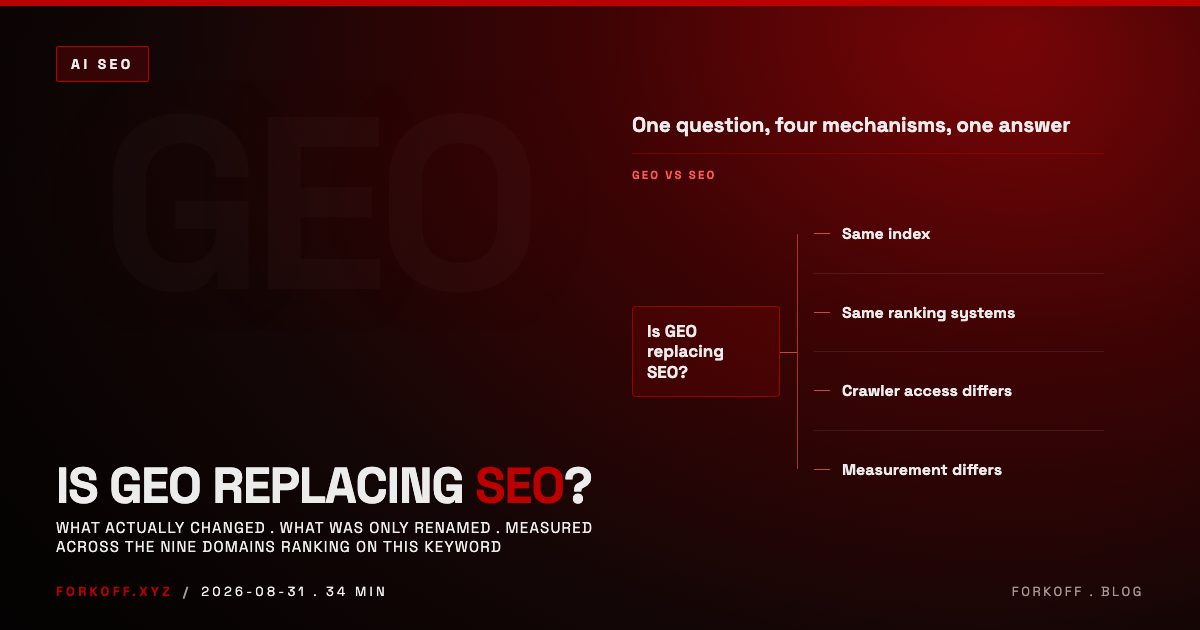
Is GEO Replacing SEO? What Actually Changed, and What Did Not
GEO is not replacing SEO. Here is what genuinely changed, what was only renamed, and measured crawler data on whether the two visibilities differ.
 Read
Read
AI SEO Agency vs AI SEO Software: Build, Buy, or Hire in 2026
AI SEO agency vs AI SEO software, decided with real Reddit AMA retainer figures, published tool pricing, and a stage-by-stage framework.
Read
Best AEO Agencies for AI and SaaS Startups in 2026
9 real AEO agencies for AI and SaaS startups: real disclosed pricing where it exists, platform coverage, and the checklist that spots a relabeled SEO shop.
Read