
What is KOL marketing?
Updated Sep 4, 2026
KOL marketing is paid or earned promotion through Key Opinion Leaders, the trusted niche voices a specific audience already follows, so a brand reaches buyers through a credible co-sign instead of an ad. KOL is the crypto and Web3-native term for what consumer markets call influencer marketing, the same underlying motion: mapping a brand to the right voices, screening those accounts, negotiating the placement, briefing the creative, and reporting what it returned. The category has a real fraud problem: independent research puts 36% of influencer accounts as affected by some form of fraud and roughly half of Instagram influencers as having used fake followers at some point. That is why a KOL marketing agency's real job is screening, not roster size. FORKOFF runs it outcome-priced: cluster-mapped KOLs matched to a brand's actual buyer, a 5-signal bot-screen before every buy, and weekly proof naming each KOL by qualified views and qualified inbound, scoped to tech, SaaS, deep tech and Web3/AI brands where FORKOFF's own network concentrates.
FORKOFF screens every KOL through a 5-signal bot-screen before the buy and uses the resulting engagement-quality data to negotiate 20 to 40 percent off list-rate pricing. FORKOFF KOL Marketing service terms
- 01KOL means Key Opinion Leader Key Opinion Leader is the term crypto and Web3 communities use for the same role a consumer brand calls an influencer: a voice a specific audience already trusts, whose recommendation functions as a credible co-sign rather than an ad.
- 02The category has a real fraud problem Independent research puts 36 percent of influencer accounts as touched by some form of fraud and about half of Instagram influencers as having used fake followers. A KOL agency that does not screen for this is selling you a roster, not a result.
- 03Screening is the actual product Mapping the right KOLs to a brand's buyer cluster and running a bot-screen before the buy, not after, is what separates a real KOL agency from a list of names and a flat fee.
- 04Negotiation happens off real engagement data, not list rate List-rate pricing varies wildly by follower count and cluster prestige. A screened engagement audit is what gets a real discount off that list rate, rather than paying the sticker price.
- 05Reporting names each placement, not an aggregate Weekly proof by KOL, not a single blended number, is what lets you see which placements are working and cut the ones that are not before the budget is spent.
- 06Fit matters more than roster size KOL marketing fits buyers who already follow creators they trust: consumer apps and prosumer software first, then consumer DTC in identity categories, games, and crypto or trading products with a compliance lane. A brand selling to a buyer who does not follow KOL-style accounts needs a different channel, and a fit check should say so plainly, even when the honest answer disqualifies the fit.
KOL marketing vs influencer marketing, same motion, different vocabulary
KOL and influencer marketing are the same underlying discipline: paid or earned promotion through a trusted voice a specific audience already follows. The vocabulary split exists because crypto and Web3 communities adopted the finance-world term Key Opinion Leader before consumer marketing's influencer language crossed over, and the two words now signal different scenes more than different mechanics. A KOL marketing agency operating in AI, Web3, or crypto and an influencer marketing agency operating in consumer or lifestyle brands are running the identical process: mapping the right voice to the right buyer, screening for authenticity, negotiating, briefing, and reporting. The distinction that actually matters when hiring one is not the label, it is whether the agency's network and screening concentrate in the audience your buyer follows.
Why the fraud screen is the whole job
The reason KOL marketing has a trust problem is structural: a placement's value depends entirely on the audience actually being real people who trust the voice, and that is exactly the thing bot farms, follower purchases, and engagement pods fake. Amra and Elma's 2026 review puts 36 percent of influencer accounts as affected by fraud in some form, 49 percent of Instagram influencers as having used fake followers at some point, and 74 percent of marketers as having encountered influencer fraud directly. A roster-led agency that sells at list rate off follower count has no defense against this, because follower count is exactly what the fraud inflates. FORKOFF screens every KOL through a 5-signal bot-screen before the buy, the same qualified-view discipline the clipping network runs, and uses the resulting engagement-quality data to negotiate 20 to 40 percent off list rate rather than paying the sticker price.
Is KOL marketing the right channel for your buyer?
The honest fit question is the one that gets skipped most often: does your buyer follow the kind of voice a KOL campaign amplifies. FORKOFF's KOL network is investor, founder, and crypto-native adjacent, so it is a strong fit for AI, Web3, and deep-tech brands selling to a technical or crypto-fluent buyer, and a poor fit for a brand selling to, for example, enterprise CMOs who do not follow those accounts. Answering that question honestly, including when it disqualifies the fit, is what separates a real screening conversation from a sales call that keeps a mismatched deal open. Where the fit is real, FORKOFF runs a KOL test campaign, by application, for the first one to three placements before any ongoing retainer.
Frequently asked questions
Is KOL marketing the same as influencer marketing?
Yes. KOL, Key Opinion Leader, is the crypto and Web3-native term for the same role consumer marketing calls an influencer: a trusted voice a specific audience already follows. The mechanics, mapping, screening, negotiating, briefing, and reporting, are identical.
How much influencer fraud actually exists?
Independent research (Amra and Elma, 2026) puts 36 percent of influencer accounts as affected by some form of fraud, 49 percent of Instagram influencers as having used fake followers, and 74 percent of marketers as having hit influencer fraud directly. That is why screening, not roster size, is the real differentiator between agencies.
How is a KOL screened before a buy?
FORKOFF runs a 5-signal bot-screen on every KOL before the placement is bought, checking for fake followers and inflated engagement, and uses the resulting engagement-quality data to negotiate off list rate rather than paying sticker price.
Who is KOL marketing a bad fit for?
A brand whose buyer does not follow crypto, Web3, or AI-native voices. FORKOFF's KOL network concentrates in that audience, so a brand selling to a buyer who does not follow those accounts needs a different channel, and a real screening conversation should say so. For SaaS, AI and tech launches the same work runs as influencer marketing, built around the tech creators who carry a launch.
Can I test a KOL agency before an ongoing retainer?
Yes. FORKOFF runs a KOL test campaign, by application, for the first one to three placements, each bot-screened before the buy, before any ongoing engagement is agreed.
Receipts, deep dives, and playbooks.
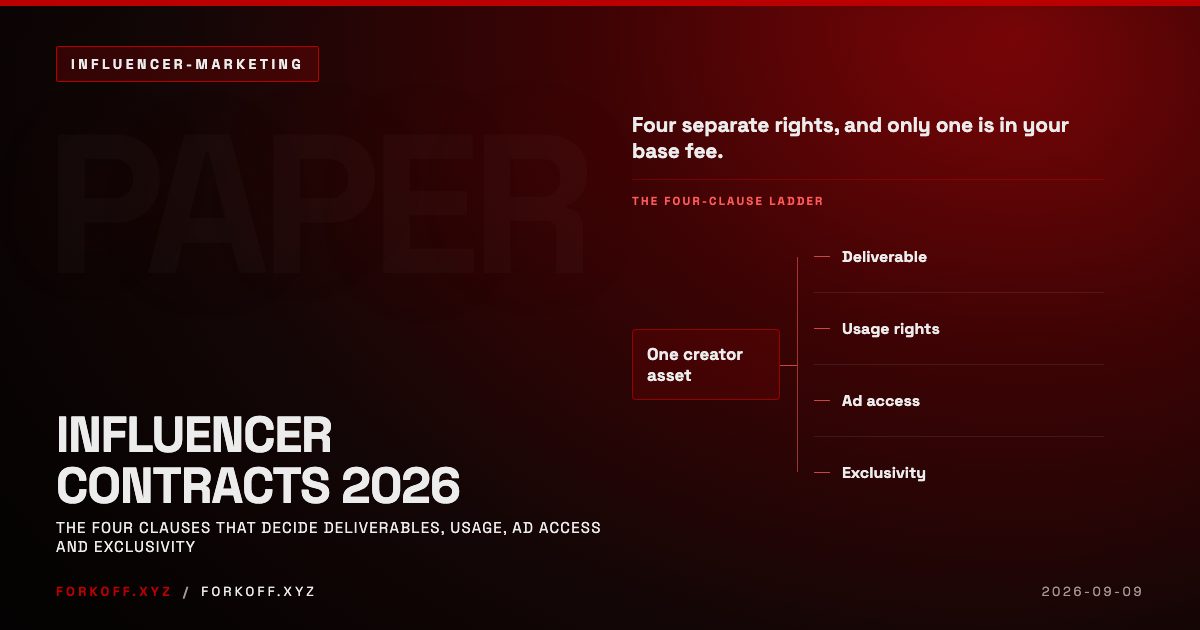
Influencer Contracts in 2026: The Four Clauses That Decide the Deal
Influencer contracts in 2026: the four clauses covering deliverables, usage rights, ad access and exclusivity, plus the AI clause most templates miss.
 Read
Read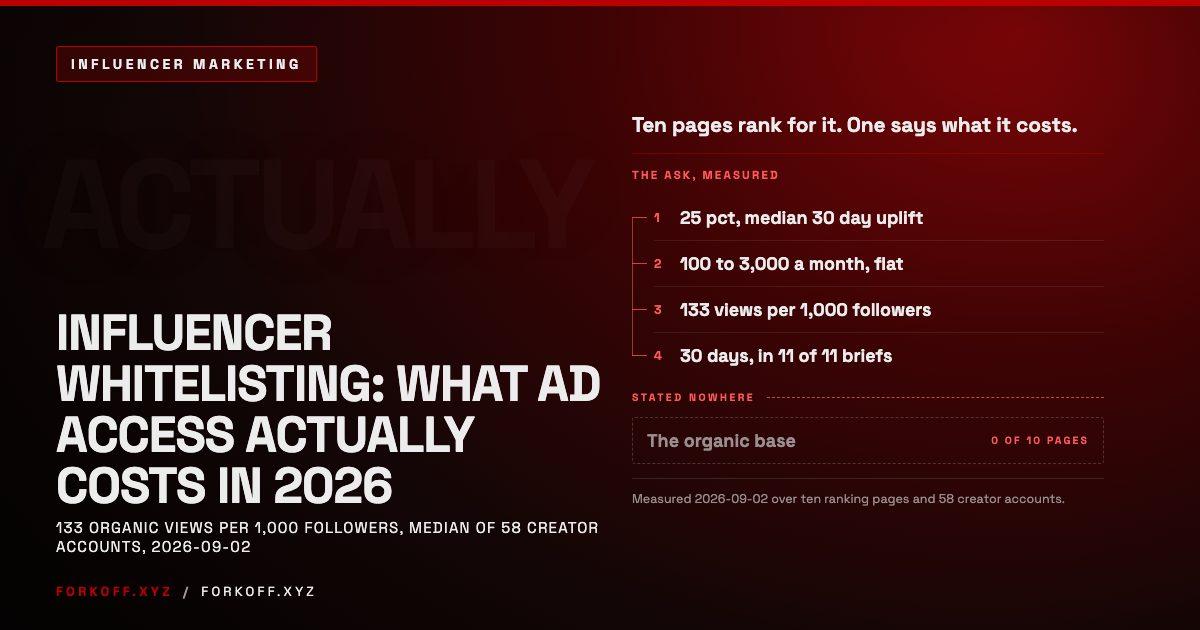
Influencer Whitelisting: What Ad Access Actually Costs in 2026
We read all ten pages ranking for influencer whitelisting. One states a price, a window and a renewal term. Here is what ad access really costs.
Read
SaaS Influencer Marketing: How AI Dev Tools Turn an OSS Traction Spike Into Paid Adoption
What to do in the 48 hours after an open-source traction spike: which creators survive a developer audit, what they cost, and how to attribute the spend.
Read