
How much does an influencer marketing agency cost in 2026?
Updated Jul 23, 2026
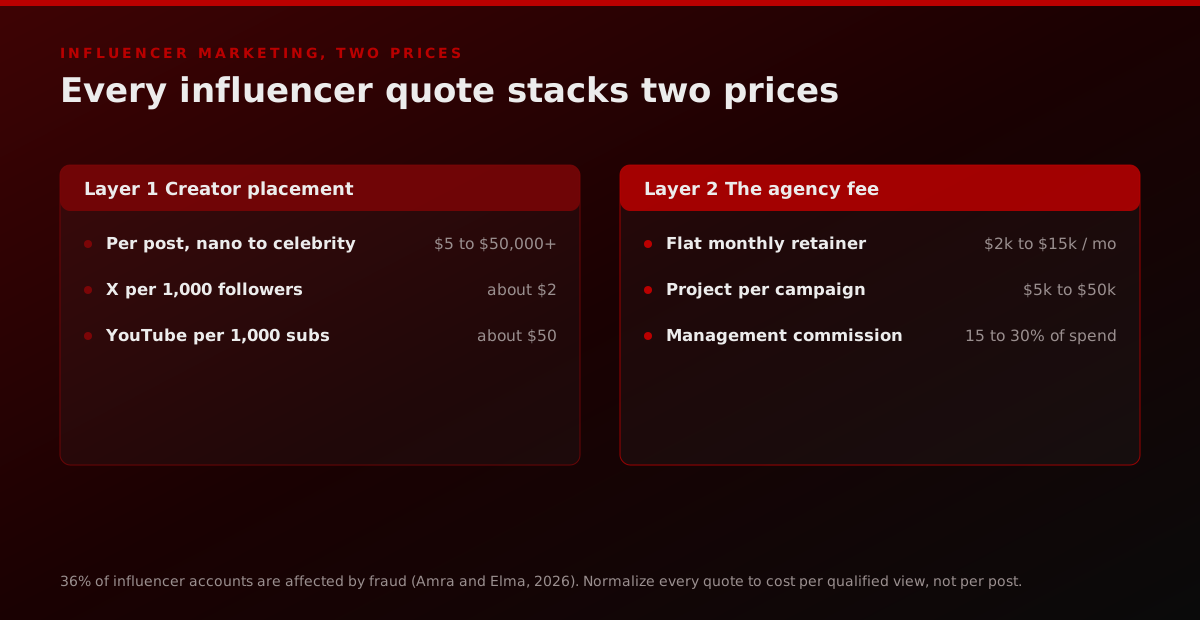
An influencer marketing agency (KOL marketing is the same service) costs on two layers, and the sticker price only shows one. The creator placements themselves run from about $5 a post for a nano TikTok creator to $50,000 or more for a celebrity, with X at roughly $2 per 1,000 followers per post and YouTube at about $50 per 1,000 subscribers per video (Socially Powerful, 2026). On top of that the agency charges its own fee: a flat retainer of about $2,000 to $15,000 a month, a project fee of $5,000 to $50,000 per campaign, or a management commission of 15 to 30 percent of the creator spend it runs (InfluencerFee, 2026). The number nobody quotes is how much of that reach is real. Amra and Elma's 2026 fraud review puts 36 percent of influencer accounts as affected by fraud. FORKOFF prices KOL marketing on the outcome, screening every creator for bot-inflated audiences before any spend and reporting qualified views on an audit ledger, the same integrity layer behind 5B+ processed views, so the bill maps to reach a real person saw.
- 01Individual creator placements The raw cost of a single post. About $5 for a nano TikTok creator up to $50,000 or more for a celebrity, with X at roughly $2 per 1,000 followers per post, YouTube around $50 per 1,000 subscribers per video, and micro TikTok creators (10k to 50k) at $25 to $125 per post (Socially Powerful, 2026). This is what the creator charges, before an agency touches it.
- 02Flat monthly retainer A fixed fee for ongoing management and strategy. Boutique agencies bill about $2,000 to $7,500 a month, multi-platform programs $5,000 to $15,000 or more (AMR Digital, 2026), and dedicated influencer shops quote $3,000 to $30,000 a month (InfluencerFee, 2026). You pay for embedded capacity whether or not a campaign is live that month.
- 03Project or per-campaign fee A one-time fee scoped to a single activation, commonly $5,000 to $50,000 per campaign (InfluencerFee, 2026). Cleaner than a retainer for a brand that only runs creator activity a few times a year, and easier to hold to a deliverable.
- 04Management commission A percentage skim on the creator budget the agency runs, typically 15 to 30 percent of the creator fees managed (InfluencerFee, 2026). Where paid media is involved the standard is a base retainer plus 10 to 20 percent of spend (Stackmatix, 2026). This model rewards spending more, not spending well, so read what it is a percentage of.
- 05Full-service program The all-in number for a large managed program, $60,000 to $500,000 or more depending on scope (InfluencerFee, 2026). A 2026 Influencer Marketing Hub survey found 78 percent of agencies default to retainer-based pricing, so expect a fixed monthly fee to anchor most quotes at this scale.
- 06The denominator test Normalize every quote to cost per real, in-region view, not cost per post or per month. With 36 percent of influencer accounts affected by fraud (Amra and Elma, 2026), a cheap placement bought on raw follower count can cost far more per genuine view than a screened one. FORKOFF is outcome-priced against qualified views on an audit ledger, so spend maps to reach a person actually saw.
There are two prices, and the quote usually names one
Most confusion about influencer marketing cost comes from stacking two different purchases into one number. The first is the creator's own rate, which scales with platform, tier, content type, and vertical: Socially Powerful's 2026 guide has Instagram running from about $10 a post for a nano creator to $50,000 or more for a mega account, X at roughly $2 per 1,000 followers, and YouTube at about $50 per 1,000 subscribers per video. The second is the agency's fee for sourcing, negotiating, and managing those placements, which lands as a retainer, a project fee, or a commission. A brand that budgets only the creator rate is surprised by the management layer, and a brand that budgets only the retainer forgets the media on top. Price both, then ask which one the quote in front of you is actually describing.
Why the cheapest agency can be the most expensive per real view
Cost per post is the wrong denominator, because it counts an audience the buyer never verified. Amra and Elma's 2026 fraud review puts 36 percent of influencer accounts as affected by fraud and 49 percent of Instagram influencers as having used fake followers, and 74 percent of marketers say they have encountered influencer fraud directly. When a third of the market is padded, a placement bought on raw follower count and billed as a percentage of spend is a bet that the followers are real. The right comparison is cost per qualified view, a view a genuine, in-region person actually saw, which is the same denominator logic that governs clipping pricing. A slightly higher rate for screened reach beats a bargain rate for an audience that was never there.
How FORKOFF prices KOL marketing
FORKOFF runs KOL marketing (the same service crypto and web3 buyers call influencer marketing) as outcome-priced work rather than a flat retainer or a percentage skim on creator spend. Screening is the product: every creator is checked for bot-inflated followings and engagement quality before a dollar moves, so budget goes to real audiences. Reporting is on qualified views, bot and duplicate filtered and geo-checked on an exportable audit ledger, the same integrity layer that runs on the FORKOFF clipping network, which has processed 5B+ views. The engagement is cross-vertical (SaaS, AI, and Web3) rather than exposed to a single crypto cycle. Because the model bills against qualified delivery, the number falls out of the reach that survives the gate, not out of a rate-card.
What individual creator placements cost in 2026 (cited per-platform bands)
| Platform | Basis | Typical 2026 price | Source |
|---|---|---|---|
| TikTok | Per post, nano to mega | $5 to $5,000+ ($25 to $125 for 10k to 50k) | Socially Powerful 2026 |
| Per post, nano to mega | $10 to $50,000+ | Socially Powerful 2026 | |
| X (Twitter) | Per 1,000 followers per post | About $2 per 1,000 followers | Socially Powerful 2026 |
| YouTube | Per 1,000 subscribers per video | From about $50 per 1,000 subs, mid-tier to $10,000 | Socially Powerful 2026 |
| Agency time (billed hourly) | Per hour | $25 to $49 average, US $100 to $149 | Clutch 2026 pricing guide |
Ranges are published 2026 vendor and directory figures (Socially Powerful, Clutch), not FORKOFF numbers, and they cover the creator or agency-time cost only, before any management fee. Verify with each vendor before you budget.
The agency's own fee, three models compared
| Fee model | How it is billed | Typical 2026 price | What it rewards |
|---|---|---|---|
| Flat monthly retainer | Fixed fee for management and strategy | $2,000 to $15,000+ per month | Embedded capacity; risk of paying for idle months |
| Project or per-campaign fee | One-time, scoped to an activation | $5,000 to $50,000 per campaign | A defined deliverable, not always-on cost |
| Management commission | Percentage of creator fees or ad spend | 15 to 30% of creator spend (10 to 20% on paid media) | Spending more, not spending well |
| Full-service program | Retainer or percentage, all-in | $60,000 to $500,000+ | Scale and speed; 78% of agencies use retainer pricing |
| Outcome-priced (FORKOFF) | Against qualified views on an audit ledger | By application, no flat retainer | Screened, verified reach a real person saw |
Fee-model figures are from InfluencerFee (2026), AMR Digital (2026), and Stackmatix (2026); the 78 percent retainer figure is a 2026 Influencer Marketing Hub survey via InfluenceFlow. The number that decides real cost is the denominator: with 36 percent of influencer accounts affected by fraud (Amra and Elma, 2026), pay for qualified views, not raw impressions.
Frequently asked questions
How much do influencers charge per post?
It depends on platform and tier. Socially Powerful's 2026 data has TikTok from about $5 a post for a nano creator to $5,000 or more for a mega account, Instagram from roughly $10 to $50,000 or more, X at about $2 per 1,000 followers per post, and YouTube from around $50 per 1,000 subscribers per video. Micro creators (10k to 50k) commonly land at $25 to $125 per post. Those are creator rates only, before any agency management fee.
What is the most affordable way to run influencer marketing?
Pair low-tier creators with your own management. Nano and micro creators cost the least per post and often convert better than mega accounts, and running the outreach yourself avoids the 15 to 30 percent management commission an agency charges. The cheapest route that still works spends its effort on screening for real audiences, because a bargain placement in front of bot followers is the most expensive kind of cheap.
How much does an influencer marketing agency charge on top of the creators?
Three common models. A flat retainer of about $2,000 to $15,000 a month, a project fee of $5,000 to $50,000 per campaign, or a management commission of 15 to 30 percent of the creator spend it runs, with paid media typically at a base retainer plus 10 to 20 percent of spend. A 2026 Influencer Marketing Hub survey found 78 percent of agencies default to retainer pricing. Ask which model the quote uses and what the percentage is a percentage of.
Is an influencer marketing agency worth it?
It is worth it when it removes real work (sourcing, screening, negotiation, measurement) and can prove the reach it buys is genuine. It is not worth it when it bills a percentage of spend on creators it never screened, since 36 percent of influencer accounts are affected by fraud (Amra and Elma, 2026). The test is whether the fee maps to verified reach. That is why outcome pricing against qualified views is easier to justify than a commission on unaudited impressions.
What does FORKOFF charge for KOL or influencer marketing?
FORKOFF is outcome-priced rather than retainer-priced or commission-priced. Every creator is screened for bot-inflated audiences before spend, and campaigns are reported on qualified views (bot and duplicate filtered, geo-checked) on an exportable audit ledger, the same integrity layer behind the clipping network that has processed 5B+ views. Ongoing work is scoped by application, so the engagement maps to qualified reach delivered instead of a flat monthly fee.
How do I compare influencer agency prices fairly?
Normalize every quote to cost per qualified view: a genuine, in-region person who actually saw the content, not a raw impression. Add the creator rate to the agency fee, then divide by the reach that would survive a fraud and geo screen. A low headline rate with no screening usually costs more per real view than a higher rate that reports audited delivery. It is the same denominator test that applies to clipping and podcast marketing.
Get the specific number for your campaign.
Receipts, deep dives, and playbooks.
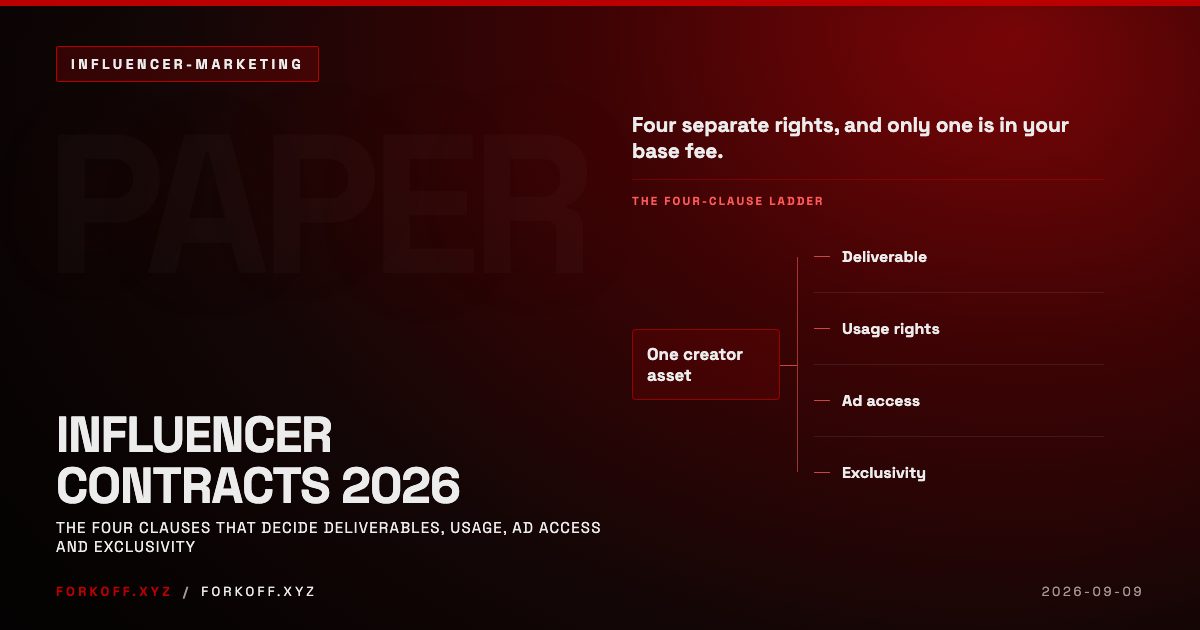
Influencer Contracts in 2026: The Four Clauses That Decide the Deal
Influencer contracts in 2026: the four clauses covering deliverables, usage rights, ad access and exclusivity, plus the AI clause most templates miss.
 Read
Read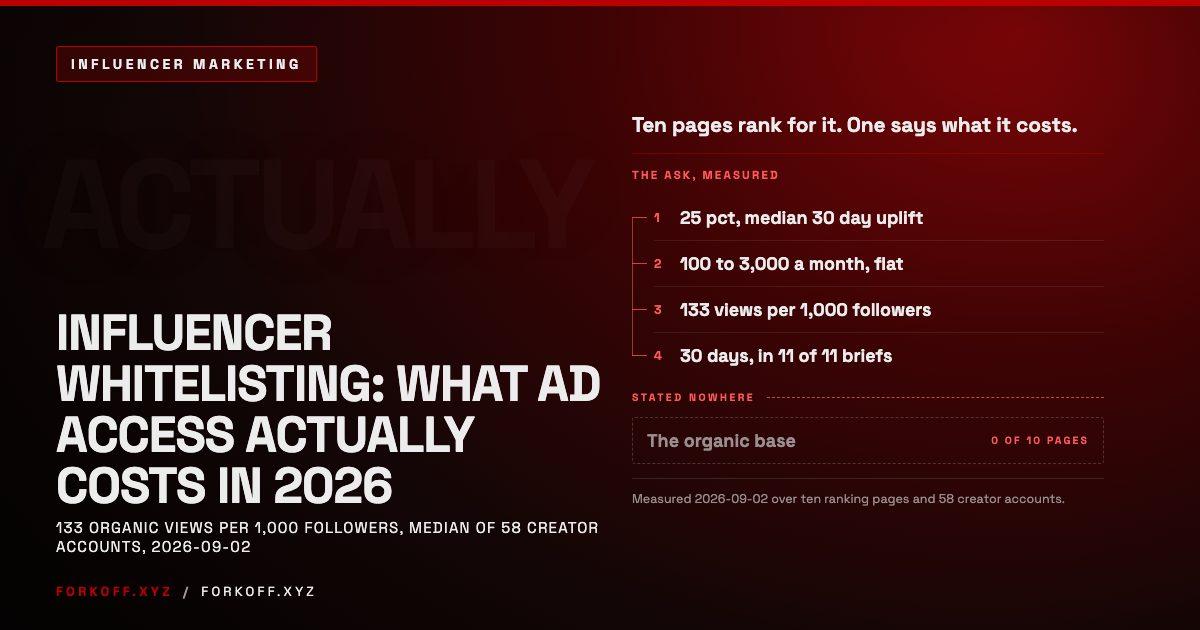
Influencer Whitelisting: What Ad Access Actually Costs in 2026
We read all ten pages ranking for influencer whitelisting. One states a price, a window and a renewal term. Here is what ad access really costs.
Read
SaaS Influencer Marketing: How AI Dev Tools Turn an OSS Traction Spike Into Paid Adoption
What to do in the 48 hours after an open-source traction spike: which creators survive a developer audit, what they cost, and how to attribute the spend.
Read