
How to choose a KOL marketing agency
Updated Jul 23, 2026
Choosing a KOL marketing agency (the same service as influencer marketing) comes down to one question the portfolio never answers: can it prove the reach it sells is real. The category has a fraud problem. Amra and Elma's 2026 review puts 36 percent of influencer accounts as affected by fraud and 49 percent of Instagram influencers as having used fake followers, and 74 percent of marketers say they have hit influencer fraud directly. So the checks that decide a good hire are not creative taste, they are screening, measurement, and fee transparency. Six things separate a real operator from a rolodex: does the agency screen creators for bot-inflated audiences before spend; does it report qualified views you can audit, not raw impressions; can it name results in your vertical; is its fee structure readable (retainer, project fee, or a 15 to 30 percent commission on creator spend); does it disclose whether it represents the creators it proposes; and will it start on a bounded pilot. FORKOFF runs KOL marketing as screened placement plus qualified-view reporting on an audit ledger, outcome-priced rather than a flat retainer.
- 01Confirm it screens creators before spend Ask exactly how the agency vets a creator's audience for bots and fake followers, and whether that screen happens before or after you pay. With 36 percent of accounts affected by fraud and 49 percent of Instagram influencers having used fake followers (Amra and Elma, 2026), an agency that buys on raw follower count is buying you padding. Screening before spend is the single most important control.
- 02Demand measurement you can audit Raw impressions are a number the platform hands out and nobody can verify after the fact. Ask what the agency reports and whether you can audit it. A real operator reports qualified views (a view that cleared a bot, duplicate, and geo check) with a reason code per view, not a screenshot of gross reach. FORKOFF reports on an exportable qualified-view audit ledger, the same integrity layer behind its 5B+ processed views.
- 03Check track record in your vertical Look for named campaigns in your category (crypto, AI, SaaS, or consumer), not a generic client wall. An agency that has run screened crypto KOL waves understands token-launch timing and bot-heavy Telegram clusters, which a generalist DTC shop does not. Ask for the qualified-reach outcome of a recent campaign, not just the creator names.
- 04Read the fee structure Agencies bill three ways: a flat retainer of about $2,000 to $15,000 a month, a project fee of $5,000 to $50,000 per campaign, or a management commission of 15 to 30 percent of creator spend (InfluencerFee, 2026). A commission model rewards spending more, so confirm what the percentage is a percentage of. A defined, narrow brief prices better than an open do-everything retainer.
- 05Ask who owns the creator relationships Before you accept a shortlist, ask directly whether the agency manages or represents any of the creators it is proposing, and whether it earns a margin on their fees (Pulse Advertising, 2026). An agency selling you creators it also profits from has an incentive that is not your reach. Independent sourcing plus disclosed economics is the green flag.
- 06Start on a bounded pilot Never commit a year of retainer to an unproven fit. Ask for a small first wave with a qualified-view target and a report you can read before scaling. A pilot lets you verify the screening and the measurement on real spend, which is the only proof that survives the category's fraud problem.
The category's real problem is not taste, it is fraud
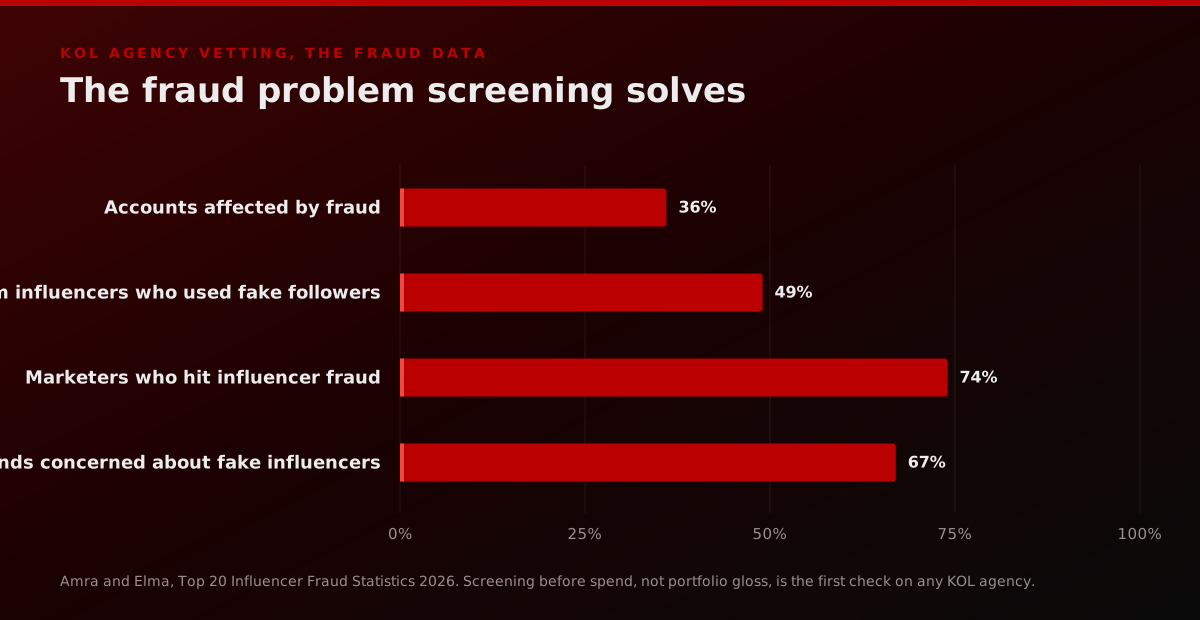
Most guides tell you to judge an influencer agency on creativity and case studies. That misses the structural risk. Amra and Elma's 2026 fraud review puts 36 percent of influencer accounts as affected by fraud, 49 percent of Instagram influencers as having used fake followers at some point, and 74 percent of marketers as having encountered influencer fraud directly, with 67 percent of brands worried about fake influencers specifically. When more than a third of the market is padded, the agency's job stops being who has good taste and becomes who can prove an audience is real before your money reaches it. Every other check on this page is downstream of that one.
Screening and measurement are the two questions that separate operators from rolodexes
A rolodex agency sells access: it has creator contacts and it books them. An operator sells verified reach: it screens each creator for bot inflation before the placement and reports on something a buyer can audit afterward. The fastest way to tell them apart is to ask two questions and watch the answers. First, how do you screen a creator's audience for fake followers, and does it happen before I pay. Second, what do you report, and can I audit it. A rolodex answers both with follower counts and impressions. An operator answers with a screening method and a qualified-view ledger. FORKOFF built its KOL work on exactly these two, the same bot and geo integrity layer that runs on its clipping network, because in a market with a 36 percent fraud rate the receipts are the product.
Green flags and red flags before you sign
You do not need to take a pitch on faith. A credible agency screens creators for real audiences before spend, reports qualified views you can audit rather than raw impressions, can name campaigns it ran in your vertical, prices with a readable structure, discloses whether it represents the creators it proposes, and will start on a bounded pilot. The warning signs are the mirror image: buying on raw follower count with no bot screen, reporting only impressions and reach, a generic client wall with no vertical proof, an opaque management fee that grows when spend grows, an undisclosed stake in the creators on the shortlist, and a demand for a long retainer with no trial. Run any shortlist through the table below before the call, not after.
How FORKOFF runs KOL marketing
FORKOFF runs KOL marketing as one motion: lock the single narrative first, source creators matched to the audience segment, screen every one for bot-inflated followings and engagement quality before spend, sequence the placements as a coordinated wave rather than scattered shoutouts, and report qualified views on an exportable audit ledger. Pricing is on the outcome, not a flat retainer or a commission on creator spend, so the incentive sits on verified reach rather than on booking more placements. The distribution muscle is the same one behind 5B+ processed views and the RADAR and clipping stack, and it is cross-vertical across SaaS, AI, and Web3 rather than tied to a single crypto cycle. The result is the thing the category's fraud rate makes scarce: reach a brand can trust because it was screened and audited, not self-reported.
The fraud problem screening solves
| Statistic | Figure | What it means for a buyer |
|---|---|---|
| Influencer accounts affected by fraud | 36% | More than a third of the market carries some inflation; screening before spend is not optional |
| Instagram influencers who have used fake followers | 49% | Nearly half; a raw follower count is not evidence of a real audience |
| Marketers who have encountered influencer fraud | 74% | Fraud is the base case, not the edge case; assume it until an audit proves otherwise |
| Brands concerned about fake influencers | 67% | The worry is near-universal; an agency that cannot answer the screening question is a liability |
Figures are from Amra and Elma, Top 20 Influencer Fraud Statistics 2026. They are the reason the first question to any KOL agency is how it screens audiences before spend, not what its portfolio looks like.
Green flags versus red flags before you sign
| What to check | Green flag | Red flag |
|---|---|---|
| Screening | Vets each creator for bot inflation before spend | Buys on raw follower count, no audience check |
| Measurement | Qualified views on an auditable ledger | Reports raw impressions and reach only |
| Track record | Named campaigns in your vertical | Generic client wall, no category proof |
| Fee structure | Readable retainer, project fee, or disclosed commission | Opaque fee that grows only when spend grows |
| Independence | Discloses whether it represents the creators it proposes | Undisclosed stake in the shortlist it sells you |
| Commitment | Starts on a bounded pilot with a reach target | Long retainer, no trial, no measurable target |
Clean answers across all six rows signal an operator, not a rolodex. FORKOFF runs KOL marketing as screened placement plus qualified-view reporting on an audit ledger, outcome-priced rather than a flat retainer, tied into the distribution stack behind 5B+ processed views.
Frequently asked questions
What should I consider when choosing a KOL marketing agency?
Six things, in order: does it screen creators for bot-inflated audiences before spend; does it report qualified views you can audit instead of raw impressions; can it name campaigns in your vertical; is its fee structure readable (retainer, project, or a 15 to 30 percent commission); does it disclose whether it represents the creators it proposes; and will it start on a bounded pilot. With 36 percent of influencer accounts affected by fraud (Amra and Elma, 2026), screening and measurement matter more than creative taste.
How do I know if an influencer agency's reach is real?
Ask how it screens a creator's audience for fake followers and whether that happens before you pay, then ask what it reports and whether you can audit it. A real operator screens for bots and geo before spend and reports qualified views with a reason code per view. An agency that answers with follower counts and impression screenshots is selling reach it never verified, in a market where 49 percent of Instagram influencers have used fake followers.
Is a KOL or influencer marketing agency worth it?
It is worth it when it removes the work of sourcing, screening, negotiating, and measuring, and can prove the audience is genuine. It is not worth it when it books creators on raw follower count and bills a percentage of spend, because 36 percent of accounts are affected by fraud and you carry that risk. The deciding factor is whether the agency can hand you an audit of the reach you paid for, not a slide of impressions.
What questions should I ask before hiring a KOL agency?
Five: how do you screen a creator's audience for bots before spend; what do you report and can I audit it; can you name a campaign you ran in my vertical and its qualified-reach outcome; how is your fee structured and what is any percentage a percentage of; and do you manage or represent any of the creators you are proposing. Clean answers to all five signal an operator. Vague answers or impressions-only reporting signal a rolodex sold as more.
How much do KOL marketing agencies charge?
The creator placements run from about $5 a post for a nano creator to $50,000 or more for a celebrity, and the agency adds its own fee: a flat retainer of roughly $2,000 to $15,000 a month, a project fee of $5,000 to $50,000 per campaign, or a management commission of 15 to 30 percent of creator spend (InfluencerFee and Socially Powerful, 2026). See the full breakdown on the influencer marketing agency cost answer page. FORKOFF prices on the outcome instead of a flat retainer.
Should I hire a crypto KOL agency or a generalist influencer agency?
Match the agency to the vertical. Crypto and web3 launches run on different timing, different platforms (Telegram and X over Instagram), and heavier bot inflation, so a screened crypto KOL operator understands the fraud surface a generalist DTC shop does not. The label matters less than the proof: ask for a named campaign in your category and the qualified reach it delivered. FORKOFF runs KOL marketing cross-vertical across SaaS, AI, and Web3 with the same screening layer.
Receipts, deep dives, and playbooks.
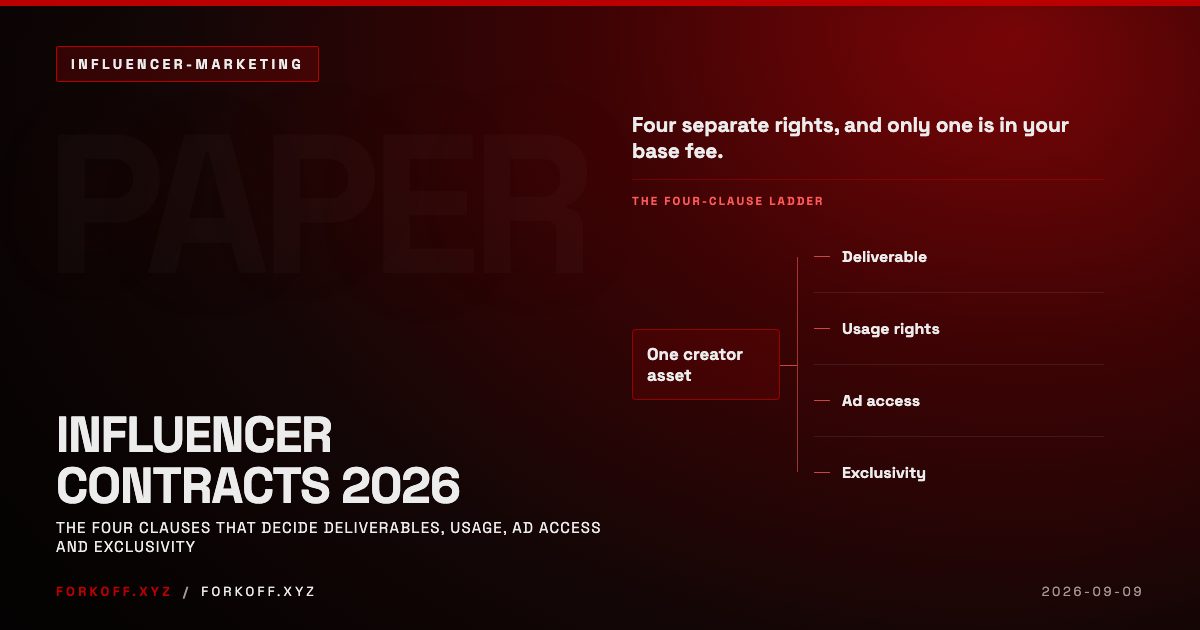
Influencer Contracts in 2026: The Four Clauses That Decide the Deal
Influencer contracts in 2026: the four clauses covering deliverables, usage rights, ad access and exclusivity, plus the AI clause most templates miss.
 Read
Read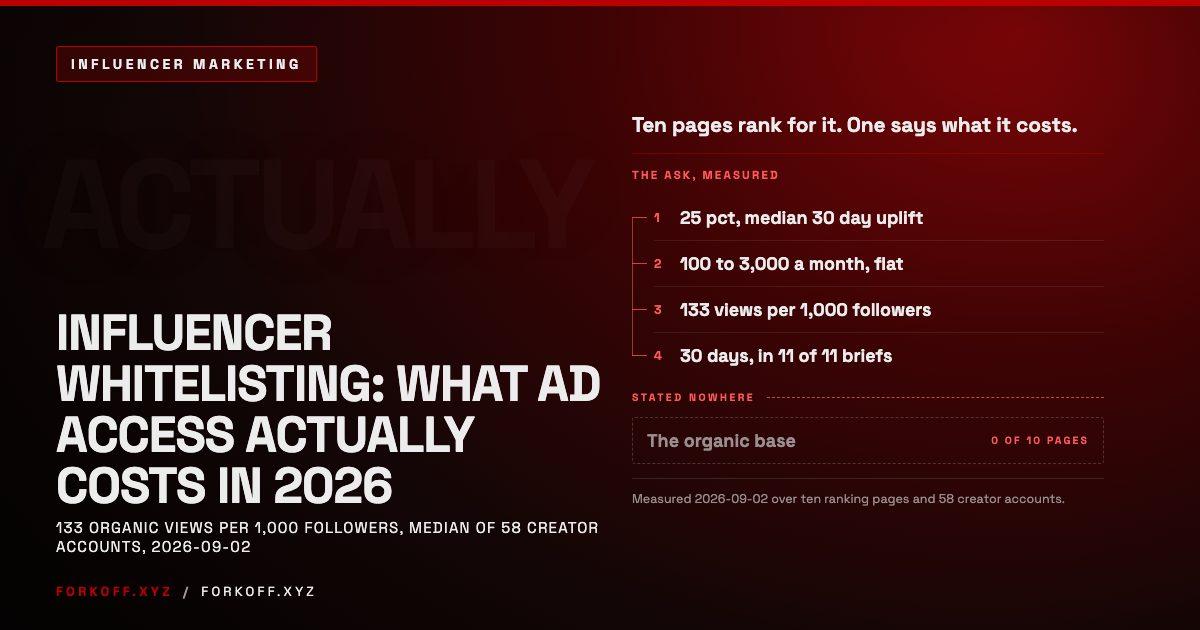
Influencer Whitelisting: What Ad Access Actually Costs in 2026
We read all ten pages ranking for influencer whitelisting. One states a price, a window and a renewal term. Here is what ad access really costs.
Read
SaaS Influencer Marketing: How AI Dev Tools Turn an OSS Traction Spike Into Paid Adoption
What to do in the 48 hours after an open-source traction spike: which creators survive a developer audit, what they cost, and how to attribute the spend.
Read