
How much does event marketing cost in 2026?
Updated Jul 23, 2026
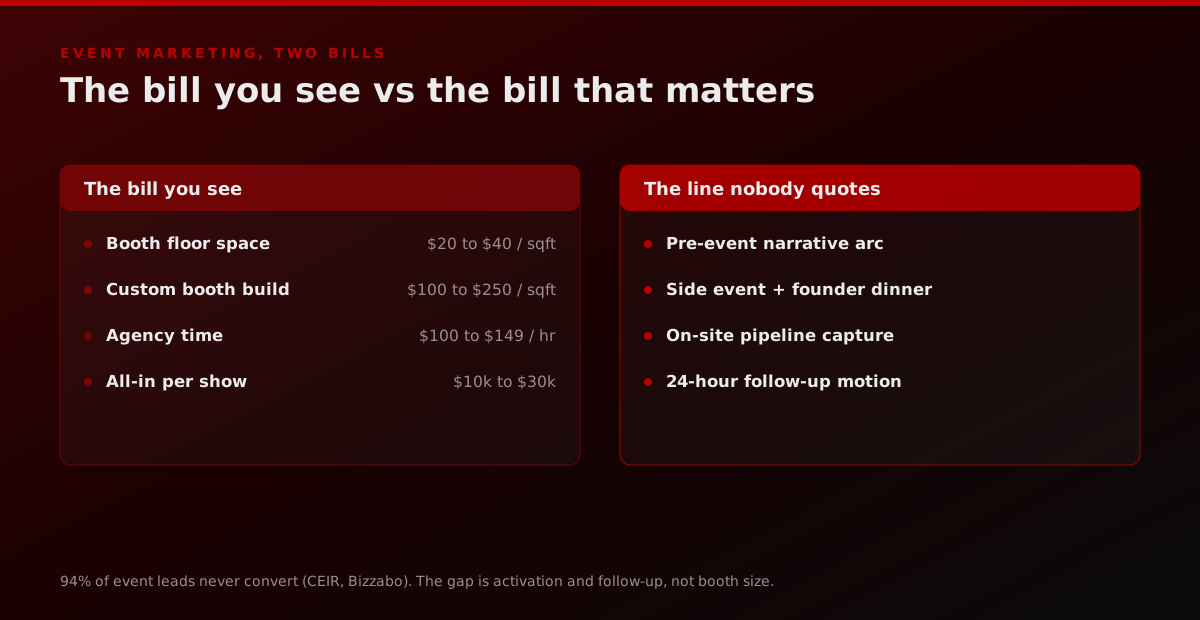
Event marketing costs land in two buckets, and most budgets only plan for one. Agency help bills roughly $100 to $149 an hour on Clutch, and the event itself runs far more: a trade show booth averages $20 to $40 per square foot for floor space alone, a custom build adds $100 to $250 per square foot, and an all-in exhibit commonly lands at $10,000 to $30,000 per show, with total spend usually three to five times the floor-space cost. Sponsorship tiers at crypto and AI flagships climb into six figures. That is the visible bill. The line almost nobody prices is activation and follow-through: the pre-event narrative, the side event and founder dinner, and the post-event attribution that turns a badge scan into a booked meeting. CEIR puts the average trade show cost per lead near $112, yet 94 percent of marketers never convert those leads into opportunities. FORKOFF prices events on outcomes rather than logistics hours, because a booth nobody remembers still returns zero.
FORKOFF's own Event Marketing pricing is built for one number: according to HockeyStack's 198-company study, 52% of marketers attribute at least half of their 2024 closed-won deals to events. HockeyStack Labs, The State of Event Marketing in 2025 (via Vendelux)
- 01Price agency time separately Event marketing agencies bill roughly $100 to $149 an hour on Clutch for strategy, production, and on-site management. That fee almost never includes space, build, food, or travel, so read any agency quote as labor only.
- 02Budget space plus build Booth floor space averages $20 to $40 per square foot and eats about a third of the budget. A custom build adds $100 to $250 per square foot. All-in, a single show commonly runs $10,000 to $30,000, and CEIR's rule of thumb is total spend of three to five times the floor-space cost.
- 03Read sponsorship as a six-figure line Named sponsor tiers at crypto and AI flagships like Token2049, Consensus, and Devcon regularly run into six figures, and the packages are bespoke and unpublished. A gated side event and founder dinner is often the cheaper way to reach the same room.
- 04Price the layer nobody quotes The pre-event narrative, the side event, the founder dinner, and the on-site capture are the half that actually produces pipeline. A booth with no activation arc is a logo on a wall, not a funnel.
- 05Fund the follow-up CEIR pegs the average trade show cost per lead near $112, but 94 percent of marketers never convert event leads into opportunities. Follow-up within 24 hours earns roughly a 48 percent email open rate versus 21 percent a week later, so budget the follow-through, not just the booth.
- 06Price the denominator Compare cost per qualified meeting, not cost per badge scanned. A cheaper activation that books real buyers beats an expensive booth that fills a spreadsheet with names nobody calls.
The bill you see versus the bill that matters
Most event budgets model the visible costs, the space, the build, the agency hours, and stop there. Clutch puts event marketing agency work at $100 to $149 an hour, booth floor space runs $20 to $40 per square foot, and CEIR and EXHIBITOR Magazine data land an all-in exhibit at $10,000 to $30,000 per show with total investment three to five times the floor-space cost. Those numbers are real and easy to quote. The bill that actually decides the return is the one almost no vendor itemizes: the pre-event narrative that gets the right people to your side event, the founder dinner where a deal-table forms, and the post-event follow-up that converts a conversation into a booked call.
Why the cheapest booth is often the most expensive per meeting
Cost per square foot is the wrong denominator. A $25,000 booth that produces a stack of unqualified badge scans has an effectively infinite cost per genuine meeting, because CEIR data shows 94 percent of event leads never convert into opportunities. A smaller spend routed into a gated side event, a warmed guest list, and a 24-hour follow-up motion can outperform it on pipeline while costing less. Model event marketing against qualified meetings booked, not against booth size or badge count.
How FORKOFF prices event marketing
FORKOFF prices events on outcomes rather than logistics hours, by application per single-event activation, with no recurring retainer. Most agencies sell booth staffing, photographer hours, and a step-and-repeat backdrop invoiced cost-plus on logistics. FORKOFF runs the event as a funnel instead: a 30-day pre-event narrative arc across podcast, LinkedIn, and X, IRL activation across booth plus side event plus founder dinner plus on-stage panel, a post-event clipping cadence of 8 to 12 cross-platform cuts per long-form session, and a weekly ledger that reports qualified meetings, partnership conversations, and ABM-warmed cold-email lift attributed by name. Recordings, edited masters, and the clip library stay owned by the founder. One AI Engineer 2025 activation captured 8 founder podcast episodes inside 14 days and produced 96 clips.
What event marketing costs in 2026 (cited bands)
| Line item | Typical 2026 cost | What it covers | Source signal |
|---|---|---|---|
| Agency time | $100 to $149 per hour | Strategy, production, and on-site management, labor only | Clutch Event Marketing Pricing Guide 2026 |
| Booth floor space | $20 to $40 per square foot | Raw exhibit-hall space, about a third of the budget | GES budgeting guide, CEIR Index |
| Custom booth build | $100 to $250 per square foot | Design, fabrication, and install of the stand | 2026 exhibit-vendor pricing guides |
| All-in per show | $10,000 to $30,000 | Space, build, services, shipping, and travel combined | CEIR Index and EXHIBITOR Magazine 2024 |
| Crypto or AI flagship sponsorship | Six figures | Named sponsor tiers at Token2049, Consensus, Devcon | Crypto Daily, Ninjapromo 2026 |
CEIR's rule of thumb is total investment of three to five times the floor-space cost. These are directional public bands, not FORKOFF numbers; verify with each vendor before you budget.
The line nobody quotes: activation and attribution
| Layer | Rough cost shape | What you get | Who owns the work |
|---|---|---|---|
| Do it yourself | $0 plus founder time | Booth duty, manual follow-up, a spreadsheet of scans | You and your team, nights and weekends |
| Booth-only vendor | Cost-plus on logistics | Staffing, photographer hours, a step-and-repeat backdrop | A logistics vendor, per event |
| Side event plus founder dinner | Venue plus production | A private room of real buyers and second-touch pipeline | You or an activation partner |
| Outcome-priced funnel | By application | Pre-event arc, IRL activation, clip waterfall, attributed ledger | A distribution partner runs the loop |
CEIR puts the average trade show cost per lead near $112, yet 94 percent of marketers fail to convert event leads (Bizzabo). The gap is activation and follow-up, not booth size.
Frequently asked questions
How much does it cost to exhibit at a trade show?
An all-in exhibit commonly runs $10,000 to $30,000 per show, based on CEIR and EXHIBITOR Magazine data. Booth floor space alone averages $20 to $40 per square foot and eats about a third of the budget, and a common budgeting rule is total investment of three to five times the floor-space cost once you add build, services, shipping, and travel.
What does an event marketing agency charge?
Event marketing agencies bill roughly $100 to $149 an hour on Clutch for strategy, production, and on-site management. That rate is labor only; it typically excludes venue space, booth build, food and beverage, permits, and travel, which are budgeted separately and usually dwarf the agency fee.
How much does a crypto conference sponsorship cost?
Named sponsor tiers at flagships like Token2049, Consensus, and Devcon regularly run into six figures, and the packages are bespoke, so pricing is not published publicly. Many founders reach the same audience for less by hosting a gated side event and a founder dinner during the conference week rather than buying an official sponsorship.
Why is my event marketing ROI so low?
Because the spend usually stops at the booth. CEIR data shows 94 percent of marketers never convert event leads into opportunities, and the biggest single variable is follow-up speed: a reply within 24 hours earns about a 48 percent email open rate versus 21 percent a week later. Budget for pre-event narrative and post-event attribution, not just the stand.
What is a realistic event marketing budget for a startup?
For a single flagship, plan agency hours at $100 to $149 each plus a $10,000 to $30,000 activation, then reserve real budget for follow-up. The number that decides value is cost per qualified meeting, not cost per square foot. Outcome-priced providers scope the spend to booked pipeline instead of billing logistics hours.
Does FORKOFF charge a flat event marketing fee?
No. FORKOFF prices event marketing on outcomes, by application per single-event activation, with no recurring retainer. The engagement covers a pre-event narrative arc, IRL activation across booth plus side event plus founder dinner, a post-event clip cadence, and a weekly ledger of qualified meetings and partnership conversations attributed by name.
Get the specific number for your campaign.
Receipts, deep dives, and playbooks.
Affiliate Conclave 2026 (Abu Dhabi): Dates, Tickets, Tracks, and Who It Is For
Affiliate Conclave 2026 runs December 15 to 16 at Emirates Palace, Abu Dhabi, co-located with Global Trading Show. Dates, tickets, tracks, a neutral read.
 Read
Read
The Algorithm Alliance: AI and ML Builder Community and Its Next Singapore Meetup
The Algorithm Alliance is an AI and ML builder community run by VAP Group. Its editions, format, who it is for, and the next Singapore meetup, 6 October 2026.
Read
Crypto Mining Guild 2026 (Abu Dhabi): Date, Venue, and the Mining-to-AI Pivot
Crypto Mining Guild 2026 is a December 10 Global Blockchain Show side event at Space42 Arena, Abu Dhabi. Date, venue, format, and the mining-to-AI pivot.
Read