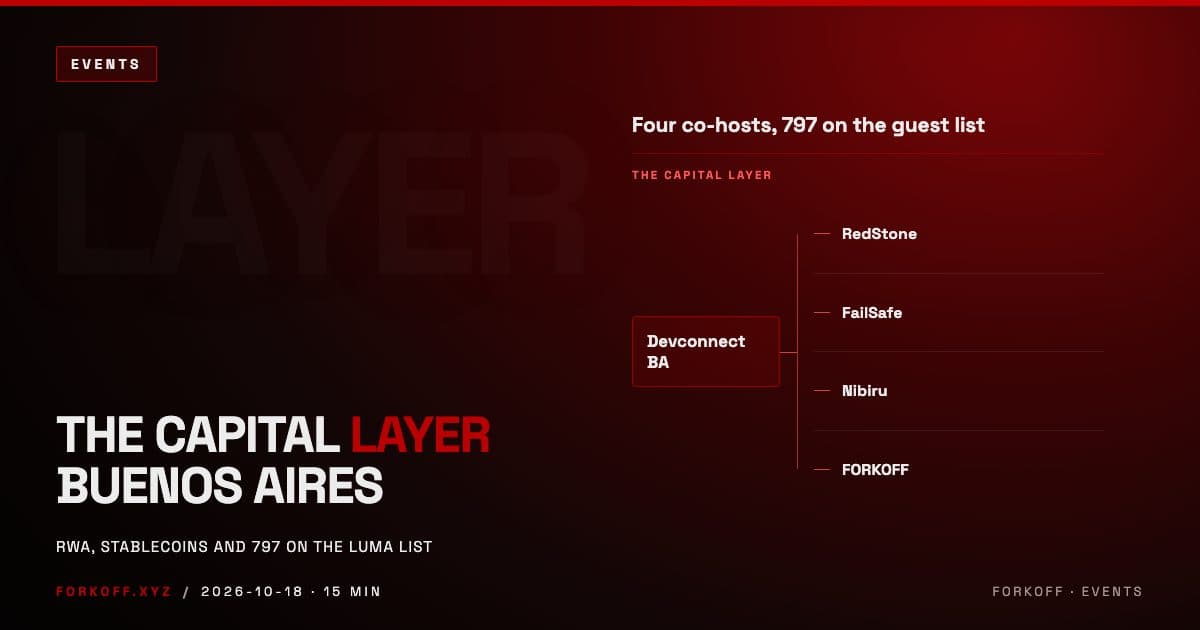
The Capital Layer was an RWA, stablecoin and institutional builders day that FORKOFF co-hosted with RedStone, FailSafe and Nibiru during Devconnect Buenos Aires, on 18 November 2025, from 4 to 7 PM. Devconnect is the Ethereum Foundation's builder week, not Devcon 8 (Mumbai, November 3 to 6, 2026). The Luma page lists 797 people as having gone. This recap covers who hosted it, what the program covered, who the partners were, and what the aftermovie did once it went up.
The short version
The Capital Layer: RWA, Stablecoins and Institutional Builders Day ran on 18 November 2025, from 4 to 7 PM, during Devconnect Buenos Aires. RedStone, FailSafe, Nibiru and FORKOFF hosted it, and the Luma page lists 797 people as having gone. The three-hour program covered tokenized real-world assets, stablecoin design and institutional DeFi through keynotes, panels, technical talks and a networking session. Seven ecosystem partners and nine media partners were named in our posts. On X, the announcement drew 13,642 views, the recap 7,598 and the aftermovie 26,445, which is 55.5 percent of the 47,685 views across all three. The lesson we took into every event since: the film travels furthest, the recap starts the conversation, and both need the partners tagged.

We are writing this as one of the hosts, so here is the disclosure up front. FORKOFF does launch distribution for AI and B2B tech startups: creators, clips, podcasts and Reddit, one team, priced on the outcome, based in San Francisco. We presented The Capital Layer on Luma and ran its distribution. Everything below comes from the Luma page, the press release on crypto.news, the Ethereum Foundation's own Devconnect recap, and the view counts on our three posts as X reported them on 18 October 2026. Where the sources stop, we stop.
What was The Capital Layer at Devconnect Buenos Aires?
The Capital Layer was a three-hour side event on 18 November 2025, run during the Devconnect week in Buenos Aires. Its full name was The Capital Layer: RWA, Stablecoins and Institutional Builders Day. RedStone, FailSafe, Nibiru and FORKOFF hosted it, and it covered tokenized real-world assets, stablecoins and institutional DeFi for an audience of builders and operators.
The event page pitched it in one line that set the tone for the afternoon.
Money is evolving again. It's not just being tokenized, it's being re-architected.
The audience the release named was specific: founders, asset managers, protocol operators, policymakers and technical teams working on capital markets that settle onchain. That is a narrower room than a general Ethereum meetup, and it was meant to be. In a week with hundreds of competing events, a builders day only fills if one group of people looks at the title and knows it was made for them.
The Capital Layer at a glance
| Detail | What the sources say | Source |
|---|---|---|
| Full name | The Capital Layer: RWA, Stablecoins and Institutional Builders Day | published |
| Date and time | Tuesday, 18 November 2025, 4 to 7 PM (GMT-3) | published |
| City | Buenos Aires, during Devconnect Buenos Aires | published |
| Hosts | RedStone, FailSafe, Nibiru, FORKOFF | published |
| Attendance | 797 people listed as went on Luma | measured |
| Format | Keynotes, panels, technical talks, networking | published |
as of 2026-10-18
Per the Luma event page (read 18 October 2026) and the crypto.news release of 26 November 2025. The attendance count is our own event record on Luma.
The format stayed small on purpose. Three hours is long enough for a keynote block, a run of panels, a technical session and real networking, and short enough that people who had spent the day at the main venue would still come. Entry was by registration on Luma, which is how the page recorded 797 people as having gone.
Operator noteTuesday 18 November 2025, 4 to 7 PM in Buenos Aires, inside the Devconnect week., Luma event page
When and where was it, and how many people came?
The Capital Layer ran on Tuesday, 18 November 2025, from 4 to 7 PM local time (GMT-3) in Buenos Aires. Luma shows the exact address only to registered guests. The page lists 797 people as having gone, equal to about 5.7 percent of the 14,000-plus attendees the Ethereum Foundation reported for the whole Devconnect week.
That comparison needs one caveat. Devconnect's 14,000 is a week-long count across a venue the size of La Rural, while 797 is the guest list for one afternoon session. The ratio is there only to show scale: a single three-hour side event put a guest list on Luma equal to roughly one in eighteen people at the main conference, in a week where the Ethereum Foundation counted more than 500 community-run side events competing for the same people.

The timeline around the event was compact. FORKOFF announced it on X on 13 November, five days out, with the theme, the date and the city in four short lines. The event ran on the 18th. The recap went up on the 21st, three days later. The press release ran on crypto.news on the 26th. The aftermovie followed on 9 December, 21 days after the night and 26 days after the first post.
FORKOFF
@officialforkoff
THE CAPITAL LAYER @EFDevcon w/@redstone_defi RWA x Stablecoins x Institutions Nov 18 | Buenos Aires More soon. (link in next tweet)
Five days of notice is short by conference standards and normal by side-event standards. Most people at Devconnect built their calendars in the final week, from Luma and from the posts of teams they already followed, which is why the announcement leaned on the co-host tag rather than on a long description.
Operator note797 people listed as went on Luma, about 5.7 percent of Devconnect's 14,000-plus., Luma and the Ethereum Foundation recap
What did the program cover?
The program covered three pillars: real-world assets, stablecoins and institutional DeFi. Under RWA it looked at tokenized treasuries, credit markets and asset-backed issuance. Under stablecoins it covered reserve transparency, jurisdictional compliance, liquidity design and settlement. Institutional DeFi covered how traditional finance, custody platforms and oracles connect to onchain settlement.

Those three pillars share a single question, which is why they sat well in one afternoon: what has to be true about data, compliance and settlement before institutional money moves onchain at scale? Tokenized treasuries need prices someone trusts. Stablecoins need reserves someone can verify. Institutional DeFi needs custody and oracles that a risk committee will sign off on. The release described the goal as unpacking how global capital markets are being redesigned onchain.
The format split that question four ways. Keynotes covered tokenized asset issuance, stablecoin architecture and institutional adoption trends. Panels took on attestation systems, oracle reliability, liquidity frameworks and regulatory considerations. Technical discussions went deeper on real-time solvency proofs, compliance-grade data flows and the infrastructure for asset-backed markets. A networking session closed the afternoon, connecting founders, liquidity providers, custodians and institutional operators.

Every segment was designed to deliver actionable insight rather than broad commentary, with a focus on integration pathways and market-ready solutions.
The networking block was not an afterthought. For most people who give up an afternoon of a conference week, the conversations after the panels are the reason they came. Putting it last, with a room already filtered by theme, meant the people talking to each other at 6
PM had sat through the same two hours of argument about oracles and reserves, which makes a first conversation much shorter.Who hosted The Capital Layer, and what did each co-host bring?
Four companies hosted The Capital Layer, per the crypto.news release: RedStone, FailSafe, Nibiru and FORKOFF. Each covered a different layer of the stack the event was about. RedStone brought oracles and data, FailSafe brought security, Nibiru brought an execution layer built for finance, and FORKOFF presented the event and ran its distribution.

RedStone is an oracle and data network focused on yield-bearing collateral and institutional price feeds. The release says it secures more than 10 billion dollars in value across protocols including Spark, Morpho, Compound, Pendle, Ethena and Lido, and the Luma page counts more than 80 protocol clients. It is also the official oracle provider for Securitize assets, including BlackRock's BUIDL fund and Apollo's ACRED. For an event about pricing real-world assets onchain, that made RedStone the natural lead co-host, and it is the account our announcement tagged.

FailSafe is a blockchain security company backed by Sequoia and Dragonfly, working with DeFi protocols, stablecoin issuers and infrastructure teams on audits, real-time monitoring, governance security and operational risk. Nibiru runs a high-performance, EVM-equivalent execution layer designed for financial applications. Between them, the four hosts covered the questions a risk team asks first: where does the price come from, who is watching the contracts, where does it settle, and who will hear about it.
A host lineup that maps to one stack reads as a program, not a logo wall
RedStone covers where prices come from, FailSafe covers who watches the contracts, Nibiru covers where transactions settle, and FORKOFF covers who hears about it. Each co-host answered a different question a risk team asks first, so the lineup itself told guests what the afternoon would cover before a single slide went up.
Source: crypto.news release, 26 November 2025
Who brought what to The Capital Layer
| Organization | Role at the event | What it does | Source |
|---|---|---|---|
| RedStone | Co-host | Oracles and data, 10 billion dollars secured | published |
| FailSafe | Co-host | Security audits and real-time monitoring | published |
| Nibiru | Co-host | EVM execution layer for finance | published |
| FORKOFF | Co-host, presenter on Luma | Launch distribution for AI and B2B tech startups | published |
| Chainwire | Supporting partner | Crypto PR distribution to 100-plus news sites | published |
| Tectonic | Supporting partner | Quantum-secure defense technology stack | published |
as of 2025-11-26
Roles and descriptions per the crypto.news release of 26 November 2025 and the Luma event page; the FORKOFF line is our own company description.
Operator noteFour co-hosts, one per layer of the stack, oracles, security, execution and distribution., crypto.news release
The Luma page lists eight host accounts in all, adding community and education accounts such as CoinEasy and EduDAO to the four companies. That spread is part of how a side event fills a room: each host account sends the invite to its own followers, so the guest list is the union of several audiences rather than one.
Who were the ecosystem and media partners?
Seven ecosystem partners were tagged in our recap and aftermovie posts: RedStone, Functor Network, Mindo AI, FailSafe, Tectonic, Tokenized Summit and Nibiru Chain. Nine media partners carried the story: PANews, crypto.news, Coiniseasy, The Blockopedia, Ventures BD, CoinRank, Chainwire, Coin Gabbar and Odaily. That is 16 named partners for one afternoon.

Operator noteSeven ecosystem partners and nine media partners, 16 named partners in all., FORKOFF recap and aftermovie posts
The release adds detail on two of them. Chainwire is a crypto PR distribution platform, connected by API to the homepages of more than 100 crypto news sites, and it handled distribution for the release. Tectonic describes itself as a quantum-secure defense technology stack. The partner list is broader than the hosts on purpose: an ecosystem partner brings an audience and a reason for that audience to come, which is what a side event in a crowded week runs on.

The media list matters for a different reason. Nine outlets across English and Chinese language crypto press, including PANews and Odaily on the Chinese side, meant the event did not only reach the people in Buenos Aires. The release ran on crypto.news and was carried by CoinRank, which is why those two pages still sit in the top three Google results for the event's name almost a year later. Our press page collects the coverage FORKOFF has earned since, and our India Blockchain Week 2025 recap shows the other side of the arrangement, with FORKOFF as the media partner.
Nine media partners in two languages stretched the reach past Buenos Aires
With PANews and Odaily on the Chinese-language side and crypto.news, CoinRank and Chainwire on the English side, the release reached readers who were never going to be in the room. Almost a year on, two of those reposts still hold positions two and three in Google for the event's name, behind only the Luma page.
Source: Live US Google results read 18 October 2026
FORKOFF
@officialforkoff
Buenos Aires showed up. The Capital Layer co-hosted with @redstone_defi brought together founders, researchers, operators, and ecosystem partners for an afternoon of real conversations around RWA, stablecoins, and institutional onchain finance. Ecosystem partners: @FunctorNetwork… Show more
The recap post named every one of these partners in one place. That was deliberate, and it shows up in the numbers in the next two sections: tagging a partner gives that partner a reason to reply and repost, and the recap ended with 68 replies on 7,598 views.
Operator noteRecap posted three days after the event, 68 replies on 7,598 views, every partner tagged., FORKOFF recap post on X
What did the aftermovie do that the recap could not?
The aftermovie, a 51-second film posted on 9 December 2025, became the most-viewed Capital Layer post on X, with 26,445 views when read on 18 October 2026. That is 3.5 times the recap's 7,598 views and 55.5 percent of the 47,685 views across all three posts, even though it went up 21 days after the event.
FORKOFF
@officialforkoff
Every city gives The Capital Layer a different texture. Snapshot of that momentum and the people driving it. Roll the film. Partners: @redstone_defi @FunctorNetwork @MindoAI @getfailsafe @tectonicxyz @TokenizedSummit @NibiruChain Media: @PANews @cryptodotnews @Coiniseasy @thebloc… Show more
Every city gives The Capital Layer a different texture. Snapshot of that momentum and the people driving it.

The reason is that the two posts do different jobs. A recap is news. It says the event happened, who was there and thank you, and it peaks while people still remember the night. A short film is a reason to watch on its own merits, including for someone who was never in Buenos Aires. It keeps getting shared after the news has gone stale, which is exactly the window in which the aftermovie did its work.

The film did the long-tail work the recap could not
The aftermovie went up 21 days after the event and still became the most-viewed of the three posts, at 26,445 views against 7,598 for the recap. A recap is news, so it peaks while people still remember the night. A 51-second film is a reason to watch even for someone who was never in Buenos Aires, which is why it kept travelling.
Source: FORKOFF posts on X, read 18 October 2026
The share of total views makes the same point from the other direction. The announcement took 28.6 percent of all views and the recap 15.9 percent. The film, made from footage of the same afternoon, took more than both combined.

We make films like this as part of how we run events, and it is the clearest argument for budgeting the edit before the event rather than after. The footage only exists if someone films the room with the edit in mind. A short cut that opens on the room, names the partners and fits in under a minute is the version that travels, and our video production work builds the same kind of asset for launches.
Operator noteAftermovie at 26,445 views, 3.5 times the recap and 55.5 percent of all views., FORKOFF posts on X, read 18 October 2026
How did the three posts compare on X?
The three posts did three different jobs, and the numbers line up with each job. The announcement reached 13,642 people with 25 likes. The recap reached fewer people, 7,598, but drew 105 likes and 68 replies. The aftermovie reached the most, 26,445, with 69 likes and 66 replies. Every post carried a video, from 19.5 seconds to 51.

The three Capital Layer posts on X
| Post | Date | Views | Likes | Replies | Reposts | Source |
|---|---|---|---|---|---|---|
| Announcement | 13 Nov 2025 | 13,642 | 25 | 4 | 4 | measured |
| Recap | 21 Nov 2025 | 7,598 | 105 | 68 | 5 | measured |
| Aftermovie | 9 Dec 2025 | 26,445 | 69 | 66 | 5 | measured |
| All three posts | 13 Nov to 9 Dec | 47,685 | 199 | 138 | 14 | derived |
as of 2026-10-18
Method: Read from each post's detail on X on 18 October 2026. Views are X's own view count; reposts exclude quote posts (3, 2 and 3 respectively).
Engagements per view combine likes, replies, reposts and quotes, divided by views.
Measured per view, the order flips. Counting likes, replies, reposts and quotes together, the recap drew 2.37 engagements per 100 views, the aftermovie 0.54 and the announcement 0.26. The recap is the post that tagged every partner by name, and a tagged partner has a reason to reply. Reach and conversation came from different posts, which is why one post was never going to do the whole job.

The recap and the film drew the replies, the announcement did not
Reply counts read from each post's detail on X on 18 October 2026. Both the recap and the aftermovie tagged every ecosystem and media partner; the announcement tagged two accounts.
The recap earned the conversation, measured per view
Per view, the recap was the most engaged post by a wide margin: 180 likes, replies, reposts and quotes on 7,598 views, or 2.37 percent, against 0.54 percent for the aftermovie and 0.26 percent for the announcement. Tagging every partner in one post gave each of them a reason to reply, and 68 replies is what that looks like.
Source: FORKOFF recap post on X
The text of each post shows how the jobs split. The announcement gave the date and the city and pointed to registration in the next post. The recap named the city but not the date, and tagged everyone. The aftermovie tagged everyone and asked people to roll the film. None of the three tried to do all of it.
Three posts, three different jobs
Announcement
Recap
Aftermovie
Video attached
States the date and city
Points to registration
Tags the ecosystem partners
Tags the nine media partners
Read from the text of each post on X, 18 October 2026. The recap names Buenos Aires but not the date, so it is marked partial.
The practical rule we took from it is simple. Announce with logistics, recap with names, and ship a film for reach. If you only have budget for one post after an event, the numbers here say the film earns more views and the recap earns more replies, so pick by which one you need.
What were the side events at Devconnect Buenos Aires like?
Devconnect Buenos Aires 2025 was the largest Ethereum Foundation event to date, with more than 14,000 attendees from more than 130 countries, 45 percent of them from Argentina. The Foundation counted more than 500 community-run side events across the city and 40 more inside La Rural. The Capital Layer was one of those 500.

Devconnect Argentina 2025, the week around the room
| Measure | Reported figure | Source |
|---|---|---|
| Attendees | 14,000+ | published |
| Countries represented | 130+ | published |
| Share from Argentina | 45 percent | published |
| First-time EF event attendees | 53 percent | published |
| Community-run side events | 500+ | published |
| Events inside La Rural | 40 | published |
as of 2025-12-04
Per the Ethereum Foundation blog, Devconnect Argentina Recap, 4 December 2025.
Devconnect Buenos Aires wrapped up as the largest Ethereum Foundation event yet, bringing together a global mix of developers, founders, creators, and curious newcomers.
The main venue, as the Devconnect site describes it, ran as a World's Fair for the first time, with eight themed districts, DeFi among them, more than 80 exhibiting teams and 15 community hubs. Around it, the side events covered everything from hackathons and hacker houses to meetups and parties. In a market that crowded, the side events that filled were the ones with a narrow theme and co-hosts who each brought their own audience, which is the condition The Capital Layer was built around.
A side event competes with 500 others for the same week
The Ethereum Foundation counted more than 500 community-run side events across Buenos Aires that week. A three-hour builders day only fills a room in that market if the theme is narrow enough to be the obvious choice for one audience, here people working on RWA, stablecoins and institutional rails, and if the co-hosts each bring an audience of their own.
Source: Ethereum Foundation, Devconnect Argentina Recap
Devconnect Argentina 2025 Recap: The First Ethereum World’s Fair
Ethereum Foundation
The Ethereum Foundation's own recap of Devconnect Argentina 2025, the World's Fair week The Capital Layer ran inside.
The city itself suited the theme. The Ethereum Foundation put crypto ownership in Argentina at about 20 percent, used for savings, inflation hedging and payments, and wARS, a peso-pegged stablecoin, launched on Ethereum, Base and World Chain during the week. People at Devconnect could pay for food with crypto inside the venue. An afternoon on stablecoin reserves and settlement lands differently in a city where stablecoins are already how people buy coffee.

Buenos Aires was the right city for this theme
The Ethereum Foundation put Argentine crypto ownership at about 20 percent, used for savings, inflation hedging and payments, and wARS, a peso-pegged stablecoin, launched on Ethereum, Base and World Chain during the week. A stablecoin and RWA day in a city that already pays with stablecoins is a different conversation from the same panel in a city that only reads about them.
Source: Ethereum Foundation, Devconnect Argentina Recap
A visitor who tried to live on stablecoins in Buenos Aires that same month wrote up the experience on r/ethereum, from booking a bed to buying ice cream. It is a useful counterweight to the panels: the theory of compliant, liquid stablecoins meets a shopkeeper who wants pesos or dollars in cash.
Part One of Can I Pay With This? A stablecoin experiment in Buenos Aires.
First Contact with Reality (Part Two of Can I Pay With This?)
For anyone planning around a future Devconnect, our playbook for hosting a side event at a crypto conference covers the planning in more depth, and our breakdown of crypto event ROI for a dinner against a booth covers where the money tends to convert. The ETH NYC 2026 side events directory, for the June 8 to 10, 2026 week in New York, shows how crowded the same format gets in another city.
What would we repeat at the next edition?
FORKOFF would repeat four things: a narrow theme matched to the city, a co-host lineup where each host covers a different layer, a recap within 72 hours that tags every partner, and a short film for reach. The numbers support each one. The film took 55.5 percent of views, and the recap drew 2.37 engagements per 100 views.
From four co-hosts to a 797-name guest list and three posts on X
The order matters as much as the pieces. The room comes first: a week the target audience already attends, so nobody has to fly in for one afternoon. The hosts come second, chosen so that each one brings an audience the others do not have. The announcement goes out with the logistics. The event itself stays to one theme and three hours. The recap tags everyone while the night is fresh. The film goes out once the edit is right, even if that takes three weeks.

What we would change is the measurement. View counts are what the platforms report for free, and they say how far the story travelled. They do not say how many of the 797 people on the guest list went on to a second conversation, and that is the number that decides whether an event was worth it. FORKOFF's events work now tracks qualified conversations and follow-up meetings, with a pipeline read 45 days after the event.
The format had started two months before Buenos Aires, at AI, DePIN and RWA Day in Seoul, where the announcement rather than the recap did most of the reach. Five days after Seoul, AI, DePIN and RWA Builders at TOKEN2049 Singapore ran the same themes as an evening, where a recap that tagged every speaker took a fifth of the views. We ran the same format again three months later. The Infra Layer: AI, DePIN and RWA Day took place in Hong Kong on 10 February 2026, and the recap's closing line, "More cities soon," is still the plan. If you want to know how we score whether a conference spend paid off, our cost per qualified lead playbook for crypto event sponsorship lays out the method.
How does FORKOFF run events like this one?
FORKOFF runs events as a dealflow system, not as a visibility exercise. The goal is to turn presence into pipeline: qualified conversations and follow-up meetings, not attendance volume. For The Capital Layer that meant choosing the week and the theme, lining up co-hosts with their own audiences, and running the announcement, recap and film around the night.
The work starts well before the event. We map the buyer to the right room, decide whether a stage slot, a side room or a hosted session like this one is the right use of the budget, and build the pre-event cadence so the right people already know the event exists before the week starts. On the night, the room is set up for conversations rather than for footfall. After it, the recap and the film keep the event working, and the follow-up is mapped within 72 hours.
Events sit inside a wider launch distribution practice. The same team runs founder funnel work, which covers speaking slots, podcasts and placements for founders, and clipping, which turns long-form footage like panel recordings into short clips that travel. The events service page explains how we scope an engagement, and our post-event follow-up playbook covers what happens after the room empties.
If you are deciding whether a side event, a sponsorship or simply attending is the right move for your next conference week, the crypto conference sponsor decision matrix is a good place to start. Or talk to us directly, and we will tell you plainly whether a room like The Capital Layer makes sense for what you are trying to close.
Related reading for planning a conference side event
These posts cover the planning, the economics and the follow-up behind a side event like The Capital Layer, and each one draws on the same events practice. Start with the hub on cost per qualified lead, then read the side event playbook, the dinner and booth breakdown, and the counter-case on conference ROI before committing a budget.
The crypto event sponsorship cost per qualified lead playbook is the hub for the category. The side event hosting playbook is the operator reference our own events team works from. The net negative ROI debate is the honest counter-case worth reading first, and the comparison of B2B conference sponsorship against paid ads runs the same math outside crypto. For another event FORKOFF supported as a media partner, see the preview of India Blockchain Week 2026. And if the name sounded familiar, The Capital Circle is a different event entirely, an investor and founder series we covered as a media partner.