What AI UGC for DTC brands is
What is AI UGC for DTC brands?
AI UGC for DTC brands is user-generated-style ad video made with AI avatars and generated scripts instead of a filmed creator, used to feed the constant creative volume that Meta and TikTok paid social burns through. At roughly two dollars a video versus 150 to 212 dollars for a human, the cost of the next test variant drops to near zero. The DTC win is not cheap clips, it is the volume of researched hooks you can test fast, with the survivors scaled on paid and amplified organically.
▸ Scope: United States and Tier-1 markets. Numbers are cited to named sources, not FORKOFF pricing.
- AI cost per video
- ~2 dollars (Superscale, Jan 2026)
- Human cost per video
- 150 to 212 dollars (Superscale)
- UGC drives purchases
- 79 percent of consumers (Nosto, Stackla)
- FORKOFF views processed
- 5B+ across the clipping network
AI UGC for DTC brands is user-generated-style ad video made with AI avatars and generated scripts instead of a filmed creator, produced to feed the constant creative volume paid social burns through. The output looks like a real person holding a product and talking to camera, with no shoot and no shipped samples. Three formats dominate for ecommerce: AI-avatar spokesperson clips, product-in-hand demos composited around a generated presenter, and hook-plus-b-roll ad cuts assembled from stock and voice.
Search 'ai ugc for ecommerce' today and page one is tool homepages (arcads.ai, createugc.ai) and how-to videos. That tells you the category is sold as software first. This guide covers the part the tools skip: whether cheap AI creative actually moves paid-social revenue for a DTC store, and how to run it so it does. The tool-versus-agency question in general is covered in the AI UGC tool vs agency guide; this page is the DTC and ecommerce cut.
The DTC math: cheap creative changes a recurring cost
The number that created the category: a Superscale January 2026 study put an AI UGC video at roughly two dollars against 150 to 212 dollars for a comparable human creator, and a 50-variation batch at about 99 dollars against 7,500 to 10,600. Turnaround dropped from 2 to 3 weeks to about 16 minutes.
For a DTC brand the point is not the one-time saving, it is the shape of a recurring cost. Paid-social creative is a consumable. An ad set fatigues within days, so you refill 20 to 50 variants a month, every month. At 150 dollars a human variant, a 30-variant cadence is 4,500 dollars in creative supply alone. At AI unit costs it is a rounding error, and the freed budget moves to media and to the research that makes the variants distinct.
| Vendor | Model | Cited price |
|---|---|---|
| MakeUGC | Self-serve tool | 49 dollars per month for 5 videos |
| Arcads | Self-serve tool | Roughly 110 dollars per month for 10 videos |
| HeyGen | Self-serve tool | Creator tier 29 dollars per month |
| Icon | Human plus software | 399 dollars for 6 ads |
| Admiral Media | Done-for-you agency | Roughly 363 to 500 euro per video |
| Billo | Human UGC marketplace | Roughly 59 to 500 dollars per video |
Prices are list prices from public pricing pages, cited as market reference points. FORKOFF is outcome-priced and carries no per-video price.
The full cost and performance math, with every named source, is in the AI UGC benchmarks study, and the buyer-facing version of the cost question is answered on how much a UGC video costs.
Why cheap volume alone loses
The failure mode is mechanical. Generate 40 clips from one weak angle and you have 40 near-duplicate losers, and the paid-social algorithm has nothing to separate. Creative volume only helps when the variants span genuinely different angles, hooks, and objections. The AI tool made variants cheap. It did not make them different.
That difference has to come from buyer-language research upstream of the generator. The highest-signal source is the language your buyers already use, mined from communities and reviews, which is why Reddit marketing feeds the pipeline. A hook that converts starts with the exact words a buyer uses, not a copywriter's guess.
So the DTC wedge is not the cheap render. It is the research plus the test discipline wrapped around it. Cheap creative with no angle research is a way to lose money faster, not a way to win. Named numbers and trust data sit in the benchmarks study: 79 percent of consumers say user-generated content drives their purchases (Nosto and Stackla), and Nielsen's Global Trust in Advertising research found people trust recommendations from people they know above every other ad format.
Does AI UGC look fake to buyers
Partly true, and it is the strongest real objection to the whole category. Some avatar output still reads as synthetic, especially in close-up, and especially in a category where the viewer is already primed to scrutinize a face, like skincare or supplements. A brand that has already run a demo and watched it fall flat has good reason to be skeptical, and a guide that pretends otherwise loses that reader immediately.
The honest read is that AI UGC is strongest as top-of-funnel test volume, where the hook does the work in the first second and a viewer scrolling a feed is judging the opening line, not studying the pixels. It is weakest as the single high-trust hero asset a brand runs at scale for months. Those are two different jobs, and the fix is routing each to the right producer rather than pretending one format wins both.
In practice that means AI production for the 20 to 40 variants a testing loop burns through every month, and a real creator or an existing customer's own footage for the two or three assets carrying the heaviest trust weight, particularly in a trust-gated category. Overclaiming here, insisting AI passes as human in every placement, is the fastest way to lose a buyer who has already tried a tool and seen the ceiling. The argument this guide makes is narrower and truer: the marginal cost of a test variant collapsed, and the winners still get scaled through a human-anchored asset when the category calls for one.
The metric the pricing pages do not print
Every AI UGC vendor prints a cost per render on its pricing page. None print a cost per result. A brand that generates 40 identical clips off one weak angle has a per-render cost near zero and a per-result cost of infinity, because zero of the forty convert differently from each other. The pricing page answers the wrong question.
The number that actually decides whether a DTC store wins with AI UGC is cost per winning creative across a full test batch, not cost per video on a vendor's homepage. Thirty near-duplicate variants born from one angle can cost less up front than fifteen well-researched ones and still lose on cost per acquisition, because none of the thirty separate from each other in the algorithm's eyes. Cheap production with no angle research is a way to spend the saved budget on media that has nothing distinct to test.
This is not a fringe read of where the category is headed. The IAB's 2025 Digital Video Ad Spend and Strategy Report found a large majority of ad buyers already running generative-AI video somewhere in their creative workflow, so a store that has not solved creative-volume economics is now competing in the same auction against rivals who already have. The auction rewards whoever feeds it the most distinct, well-researched variants at a sustainable cost, never whoever renders the most clips. The reframe this guide argues for is simple: stop shopping render price, start measuring cost per winning creative, and treat the AI unit-cost drop as budget freed for angle research and paid-social testing rather than as the win itself.
When the tool is honestly the better buy
This has to be conceded plainly, because it is true and a DTC brand can check it in a week. A store with an in-house performance marketer who already lives in the ads dashboard daily, who can write twenty hook variants without a briefing document, and who treats a self-serve AI-UGC tool as one more creative source rather than the whole strategy, does not need an agency. That marketer already owns angle research, the kill-and-scale discipline, and the reporting. The generator is the only missing piece, and a tool at 29 to 249 dollars a month fills exactly that gap for less than a single day of a marketer's time.
The tool branch is the right buy for a store with a small, well-defined catalog, a marketer who has already run enough paid-social cycles to read cost-per-result without help, and no need for a human hero asset because the category is not trust-gated. That is a real, common DTC shape, and this guide would rather name it than pretend every brand needs a managed engagement. What a tool cannot supply is the researcher who mines the buyer language upstream, the discipline that kills a losing angle on day three instead of week two, and the organic amplification that turns a paid winner into a second channel. A guide that never names when the tool wins reads as a pitch rather than a decision framework, and a sophisticated DTC buyer notices the difference immediately.
The tool vs agency decision for a DTC brand
This is the only decision that matters, and it is not which app has the best avatars. An AI-UGC tool hands you a generator. You still write the brief, pick the winning angle, run the volume, read the analytics, and iterate. Public pricing sits around 29 to 249 dollars a month, so the software is cheap and the labor is yours.
A done-for-you agency owns the strategy, the volume, the testing loop, and the number at the end. The FORKOFF UGC video ads service is the agency side: outcome-priced, not per-seat. Pick the tool when you have an in-house performance marketer who will live in the dashboard daily and owns the angle research. Pick the agency when you want the result underwritten instead of the software rented.
The buyer-facing checklist for choosing between shops is on how to choose a UGC agency. Where a real creator or KOL is the trust asset that decides the sale, influencer marketing carries the human side.
How a DTC AI UGC campaign runs
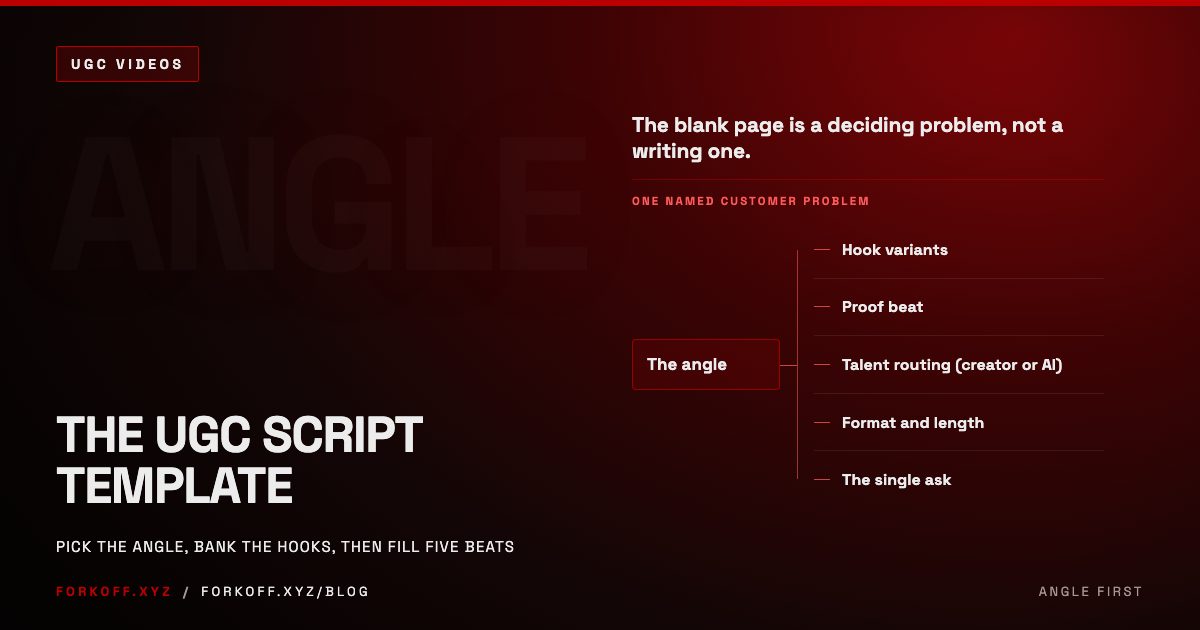
A campaign is not one video, it is a testing engine. Here is how FORKOFF runs the loop for a DTC brand, in five steps.
- Angle research. Pull the hooks, objections, and exact language your buyers already use. Reddit and review mining is the highest-signal source, because a converting variant starts with the words your buyers use, not a copywriter's guess.
- Scripting. Write 10 to 20 hook variants across genuinely different angles, so the test has real variety to separate, not near-duplicates.
- Production. Generate the AI-UGC cuts for volume and brief one human creator for the highest-trust hero, batching rather than polishing one asset.
- Testing. Run the variants on Meta and TikTok paid social, kill losers fast on cost per result, and scale the winners.
- Iteration. Rebrief the next batch entirely around the winning angle and amplify the winner organically, so each round compounds on the last.
A tool gives you step three. An agency runs all five and reports on the outcome, not the render count. When a creative wins on paid, the same asset gets pushed organically through clipping, so the winner earns organic reach on top of paid. FORKOFF has processed 5B+ views across that clipping network, so the distribution and testing muscle is the same engine pointed at UGC creative.
Where FORKOFF fits
FORKOFF is a done-for-you, outcome-priced AI marketing agency, not a UGC SaaS tool. We do not compete for the 'log in and generate a clip' buyer. The tools own that intent and own it well.
We are the buy when a DTC brand wants the strategy, the volume, and the number owned by an operator. The engagement pairs AI UGC production with buyer-language research, paid-social testing, and organic amplification through the 5B+ view clipping network. That is UGC that beats the feed: production plus distribution, priced on the outcome rather than the seat.
See the full service scope at the UGC video ads service, the cost and performance data in the AI UGC benchmarks study, the general model choice in the tool vs agency guide, and the sibling flagship at clipping. When you want the result underwritten instead of the software rented, talk to a strategist.