

FORKOFF is a content distribution agency that turns one long-form moment into 10 to 30 platform-native clips and pushes them across 50+ channels, priced on qualified views with a per-view audit trail. The delivery mechanism is the clipping distribution network, amplified through the KOL graph.
As Featured In
Full press shelf







A content distribution agency gets an already-produced asset in front of an audience across owned, earned, and paid channels, distinct from a production agency that makes the asset. FORKOFF runs content distribution as a short-form clipping network: it turns one long-form moment into 10 to 30 platform-native clips and distributes them across 50+ channels, priced on qualified views at $0.003 each with a per-view audit trail.
What does content distribution cost? FORKOFF prices distribution on qualified views, not a flat per-post fee or a raw-view count, so the budget maps to verified watch-time and valid traffic. A managed engagement runs as a retainer by application, with a sandbox to prove the motion first.
Every figure below is a published benchmark with a named source, a year, and a checkable link. This is the sourced case for pushing one asset across many surfaces instead of publishing once and hoping.
Brands in the top web-mention quartile earn 10x more AI Overview mentions than the next quartile, so how widely an asset travels sets whether AI cites it. (Ahrefs, 2025)
A page cited inside a Google AI Overview earns 120% more organic clicks per impression than an uncited page on the same result. (Seer Interactive, 2026)
Only 38% of AI Overview citations now come from a Google top-10 page, down from 76%, so distribution that builds mentions beats chasing rank one. (Ahrefs, 2026)
Gartner projected traditional search volume will fall 25% by 2026 as buyers move to AI chatbots, so a single channel no longer reaches the buyer. (Gartner, 2024)
90% of decision-makers are more receptive to sales outreach from a company that consistently produces high-quality thought leadership, the reward for sustained distribution. (Edelman-LinkedIn, 2021)
FORKOFF has processed more than 5 billion qualified views across its network, the distribution base behind the reporting on this engagement. (FORKOFF, 2026)
Five patterns we see when a brand shops for content distribution and the reach never compounds. Each row is the FORKOFF fix. Read it before you book the application call.
Agency uploads the full podcast or webinar to one platform, posts it to the owned feed, and reports the view count. Reach is capped at the follower graph. The 25 clip-worthy moments buried inside the asset never reach a single cold viewer.
Atomize every long-form asset into 10 to 30 platform-native clips and push each into recommendation feeds, where the algorithm, not the follower count, decides reach. One asset becomes dozens of independent reach events across five platforms.
Syndication-list agencies submit a piece to a fixed network of auto-publish sites and report placement counts. The destinations are low-authority, nobody reads them, and the buyer cannot tie a placement to a real human who engaged.
Distribute short-form clips into live algorithmic feeds where cold audiences actually watch, then measure qualified views, not placements. A placement on a dead site is not distribution. Watched attention is.
Paid-amplification agencies buy native and recommendation ad placements. The moment spend stops, reach stops. Cost per genuinely engaged view is high once bot, geo-mismatch, and scroll-past impressions are netted out of the dashboard number.
Build a compounding organic short-form library that keeps working after the campaign ends, and layer paid only where organic clips already show resonance. Owned distribution assets accrue; rented impressions evaporate.
Raw-view marketplaces and per-seat tools are paid whether or not a view was a real human. Bot views, sub-second scroll-pasts, and geo-mismatched impressions all count. The reported total looks huge and means nothing to the buyer.
Run every view through four checks: watch duration, policy compliance, geo consistency, and traffic validity. A view that fails any check is logged with a reason code and excluded from both spend and payout. The buyer pays for verified attention only.
Monthly dashboard shows 12 million impressions and no way to verify them. The buyer cannot audit which views were real, which platform delivered, or how spend mapped to qualified attention. Reporting protects the agency, not the client.
Close every campaign with a CSV or JSON proof of per-view reason codes, CPQV math, and platform breakdown the buyer's finance team can audit line by line. The proof is the deliverable, not a screenshot of a big number.
Long-form content dies within a day or two without distribution. The clip-worthy moments stay buried inside the podcast, the panel, the launch talk. Syndication-list agencies blast one asset to dead sites. Paid-amplification agencies rent impressions that vanish when spend stops. FORKOFF atomizes the moment into 10 to 30 clips, pushes each into cold algorithmic feeds, and bills only the views that pass four checks.
Publishing a long-form asset once reaches only the owned audience on one platform. FORKOFF atomizes it into 10 to 30 platform-native clips and pushes each into recommendation feeds across X, LinkedIn, TikTok, Instagram, and YouTube. In cold feeds the algorithm, not the follower count, decides reach, so one asset becomes dozens of independent reach events. A clipper and KOL amplification layer pushes the clips that already resonate beyond organic limits, and a multi-account regional repost carries a winning format into language-locked algorithm pockets.
The distribution motion runs on the same qualified-view accounting as podcast clipping, and pairs with the organic founder spine on Twitter and Reddit. Estimate a budget with the CPQV calculator.
When a buyer asks ChatGPT, Perplexity, or Google AI Overviews what the best option for a job is, the answer is increasingly assembled from social threads and clips. A clip that earns genuine engagement is no longer just a conversation that converts the viewer in front of it. It becomes a signal the answer engine can surface to the next buyer who asks. That makes organic short-form distribution double leverage: it earns attention today and seeds the recommendation an AI engine gives tomorrow.
Distribution motions that atomized long-form moments, ran the four-check gate, layered amplification on resonant clips, and shipped the per-view proof the founder could read in two minutes. Read the longer write-ups inside our case-study hub.
Distributed from 13 days of managed podcast clipping, reaching 1.19M qualified views and converting 27 paying subscribers at $50 a month, $1,290 MRR from one distribution motion.
Cost per qualified view across the network, roughly 33x more cost-efficient than agencies billing $0.01 to $0.10 per raw view, because only views that pass the four checks are billed.
Processed through the FORKOFF distribution network. Scale no syndication list can match, with every qualified view reason-coded in a per-view proof record.
The clip library, narrative anchor, channel roster, and distribution playbook stay with the founder at engagement end.
The qualification ledger changed how we report to the board. Real attention, verified weekly, not dashboard vanity.
Alex Morgan
Growth Lead, AI Infrastructure Startup
Three routes to distribution. Match the engagement to whether you want compounding qualified attention, a syndication placement count, or rented ad impressions before picking.
← scroll horizontally to see more →
| Feature | FORKOFF Content DistributionShort-form clipping network · qualified views · per-view proof | Syndication-list agencyBlast one asset to a fixed site list · placement counts | Paid-amplification agencyRented native and recommendation ad impressions |
|---|---|---|---|
| Distribution surface | 10 to 30 platform-native clips per asset pushed into cold algorithmic feeds across X, LinkedIn, TikTok, Instagram, and YouTube, plus clipper and KOL amplification. | One article or release syndicated to a fixed network of auto-publish sites. No short-form, no cold-feed reach. | Native and recommendation ad placements bought on managed spend. Reach stops the moment budget stops. |
| Pricing unit | Qualified view at an average of $0.003 each. The budget maps to verified watch-time and valid traffic, not impressions a dashboard inflated. | Syndication volume, priced by number of destinations per submission. | Managed ad spend plus agency markup. You rent every impression. |
| What counts as a view | A view that passes four checks: watch duration, policy compliance, geo consistency, and traffic validity. Any failure is logged with a reason code and excluded. | A placement on a syndication site, whether or not a human read it. | A paid impression served, including bot, geo-mismatch, and scroll-past. |
| Reach type | Cold algorithmic feeds where the recommendation engine, not the follower graph, decides who sees the clip. | Low-authority backlinks and placements on sites with little organic traffic. | Paid impressions that disappear when the campaign pauses. |
| Compounding | Organic short-form library keeps working after the campaign. Every clip stays live and eligible for feed resurfacing. | Placements decay; the syndication network does not build an owned asset for the brand. | Zero compounding. Rented reach evaporates when spend ends. |
| Proof surface | Per-view CSV or JSON proof with reason codes, CPQV math, and platform breakdown a finance team can audit. | A placement-count report listing the sites the piece was submitted to. | An ad-platform dashboard of impressions, CTR, and CPM. |
| Pricing model | Qualified-view CPQV plus retainer by application. Sandbox to prove the motion before a longer engagement. | Credit packs or monthly plans priced on syndication volume. | Percentage of managed ad spend, billed monthly. |
| Failure mode | Zero qualified views on a clip triggers a reason-coded flag and a re-cut, not a bigger spend ask. | Underperformance is explained as a syndication-reach limitation, fixed by buying more placements. | Weak results are explained as a targeting issue, fixed by raising the ad budget. |
FORKOFF runs content distribution as an embedded retainer engagement, priced on qualified views. A sandbox proves the motion on a real asset before a longer contract. By application, selective on ICP. You get the operator who holds the narrative anchor plus the team running the clip factory, multi-channel distribution, and amplification underneath, on qualified-view milestones tracked through a per-view audit trail.
Narrative anchor locked in week one. Clip factory running by week three. Distribution shipping into feeds from week four. Priced on qualified views, reported through a per-view audit trail every week. Pair with Clipping, Podcast Clipping, KOL Marketing, or Founder Funnel depending on your stage and lane.
The engine that produces the long-form assets distribution atomizes. Outcome-priced on rankings, citations, and pipeline.
The delivery mechanism under content distribution. Outcome-priced at $0.003 per qualified view, per-view audited.
Long-form podcast moments atomized into a distribution surface. Same qualified-view accounting.
The amplification layer that pushes resonant clips beyond organic reach. Qualified-view attribution.
Distribution feeds the funnel. Founder voice turns attention into attributed inbound.
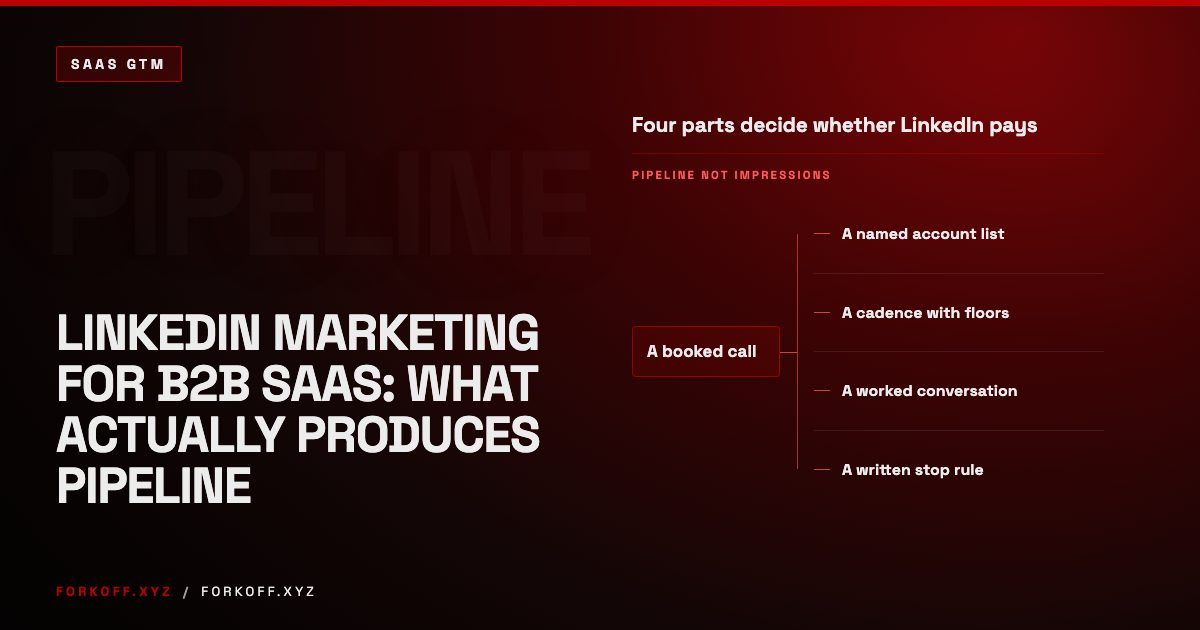
A thousand impressions at our floors is forty readers and eight clicks. Here is the account list, the cadence, and the four numbers at which you stop.
 Read
Read
A go-to-market playbook for AI-infrastructure startups on winning developer adoption and enterprise trust in 2026, with a channel map and benchmark mechanics.
Read
Fintech marketing fails when trust is bolted on after growth. The channel-by-channel distribution playbook for payments, neobank, and lending startups.
Read