
Can clipping campaign views be attributed to revenue?
Updated Sep 4, 2026
No, not directly, and any agency that claims otherwise is selling you a number it cannot back. A clipping campaign is priced and measured as a reach unit: FORKOFF bills $0.003 per qualified view (CPQV), a view that clears a four-stage gate (real human, in-region, traffic-valid, not bot or farm) across a network that has processed 5B+ views at 99.71% sustained legitimacy. That gate proves the view is real. It does not prove the person who watched it later signed up, because clipping has no checkout to instrument the way a paid search ad does. What is measurable is the platform split: clicks and click-through rate on a distinct tracked link for each dedicated brand profile, the actual deliverable of a first campaign. Whether that click becomes a customer is owned by your own funnel, tracked in your own analytics. The honest move is to separate the two out loud, then run the arithmetic in your own unit, CAC or ROAS, before you spend, using the quoted CPM and your existing conversion rate.
FORKOFF's qualified-view gate has processed 5B+ views at 99.71% sustained traffic legitimacy, the same ledger every CPQV campaign is billed against. FORKOFF Clipping service terms
- 01Separate measured from not measured Say this out loud before quoting anything: qualified views and click-through per platform are measured. Whether a click becomes a signup is not, because that step lives inside your own funnel, not the clipping campaign.
- 02Clicks are tracked per platform, per dedicated profile Every dedicated brand account carries its own tracked link (UTM or referral), so a campaign reports which platform drove clicks and at what rate. Campaign one is where this split usually kills or confirms a channel.
- 03CPQV is a reach unit by design, not a conversion unit The $0.003 qualified-view price buys certified reach, a view a four-stage gate confirmed was a real, in-region, non-bot human. It was never built to answer a conversion question, so judging it on one is the wrong test.
- 04Do the arithmetic in your own unit before you commit Take your existing CAC or ROAS floor, your site's own conversion rate, and the quoted CPM, and compute the break-even view count on the call. If the number a clipping campaign would need to hit looks unreasonable against your traffic history, that is the answer, before any spend.
- 05Read the platform split, do not wait for a quarterly report The clicks-per-platform data usually arrives inside the first two weeks. Kill or scale a platform on that signal rather than waiting for a full campaign to prove itself on a metric it was never priced to answer.
- 06Route to a conversion-priced unit when that is genuinely the need When the real requirement is a booked call or a signup, not reach, FORKOFF's founder-funnel service prices directly on that outcome instead of on reach. Ask for the right unit rather than asking a reach product to answer a conversion question.
Why proving clipping drove revenue is the wrong first question
Every buyer comparing clipping to a paid channel they already measure, Meta ROAS, a fixed CPA, an iOS CAC, asks the same question: can you connect a view to a sale. The honest answer is that clipping was never built to answer it directly, because it has no checkout to instrument the way a search or social ad does. The better question is whether the reach it buys is real, and then whether your own funnel converts what reaches it, two separate facts a single number cannot carry. Conflating them is how a buyer ends up judging a reach product against a conversion benchmark it was never priced against, and rejecting a channel that might be working exactly as designed.
What FORKOFF actually measures, and what it does not
FORKOFF measures qualified views (the CPQV gate: real human, in-region, traffic-valid, not bot or farm) and clicks and click-through rate per platform, tracked through a distinct link on each dedicated brand profile. That platform split is the real deliverable of a first campaign, and it is often decisive on its own, a channel with a genuinely low click-through rate is a signal to reallocate before the campaign runs its course. FORKOFF does not measure what happens after the click: your signup form, your checkout, your sales call. That boundary is a property of what cost per qualified view means, not a gap in the tooling, and your own analytics is the correct system of record for it.
The break-even math, done in your own unit
Take three numbers you already have: your CAC or ROAS floor, your site's existing conversion rate from a cold visit, and the CPM quoted for the campaign. Multiply the CPM by the views needed to reach 1,000 conversions at your current rate, and compare that to what you already pay for a conversion through a channel you trust. If clipping's implied cost per conversion beats your paid-channel floor even at a conservative conversion rate, the reach is worth buying regardless of whether any single view can be traced to a name. If it does not, that is the honest answer before a dollar is spent, which is the entire point of asking the question before committing to a retainer rather than after.
Reach pricing vs conversion pricing, side by side
| Clipping (CPQV) | Founder Funnel (outcome) | |
|---|---|---|
| Unit priced | Per qualified view | Per booked qualified call |
| What it proves | The view was real, human, in-region | The call happened and was qualified |
| What it does not prove | Whether the viewer converted | Reach beyond the funnel itself |
| Best fit | Building reach and awareness at scale | Buying a specific, measurable conversion |
Frequently asked questions
Does FORKOFF track clipping views all the way to a sale?
No. FORKOFF tracks qualified views and per-platform clicks through a distinct tracked link on each dedicated profile, which is the actual deliverable. What happens after the click, signup, trial, purchase, is owned by your own analytics stack, because clipping has no checkout of its own to instrument.
Why not just report the raw view count and let me decide?
A raw view count includes bot and farm traffic, which is exactly what a scam vendor bills you for. The four-stage qualification gate (real human, in-region, traffic-valid, not bot or farm) exists so the number you get is a floor you can trust, not a ceiling inflated by traffic that never saw the clip.
What is the fastest way to know if a clipping campaign is working?
The platform click-through split from campaign one, usually visible inside the first two weeks. A platform with a low click-through rate against qualified views is a signal to reallocate immediately rather than waiting for a full campaign cycle.
Should I ask for a revenue guarantee instead?
Only from the right service. Clipping is priced as a reach unit and should never carry a revenue guarantee it was not built to make. If a booked call or a signup is the actual requirement, FORKOFF's founder-funnel service prices directly on that outcome, and that is the conversation to have instead.
How do I compare a clipping quote against a channel I already measure?
Convert both to the same unit before comparing. Take the quoted CPM, your existing conversion rate, and your CAC or ROAS floor from the channel you trust, then compute what clipping's implied cost per conversion would be even under a conservative assumption. That single calculation, done before you spend, is the entire test.
Receipts, deep dives, and playbooks.
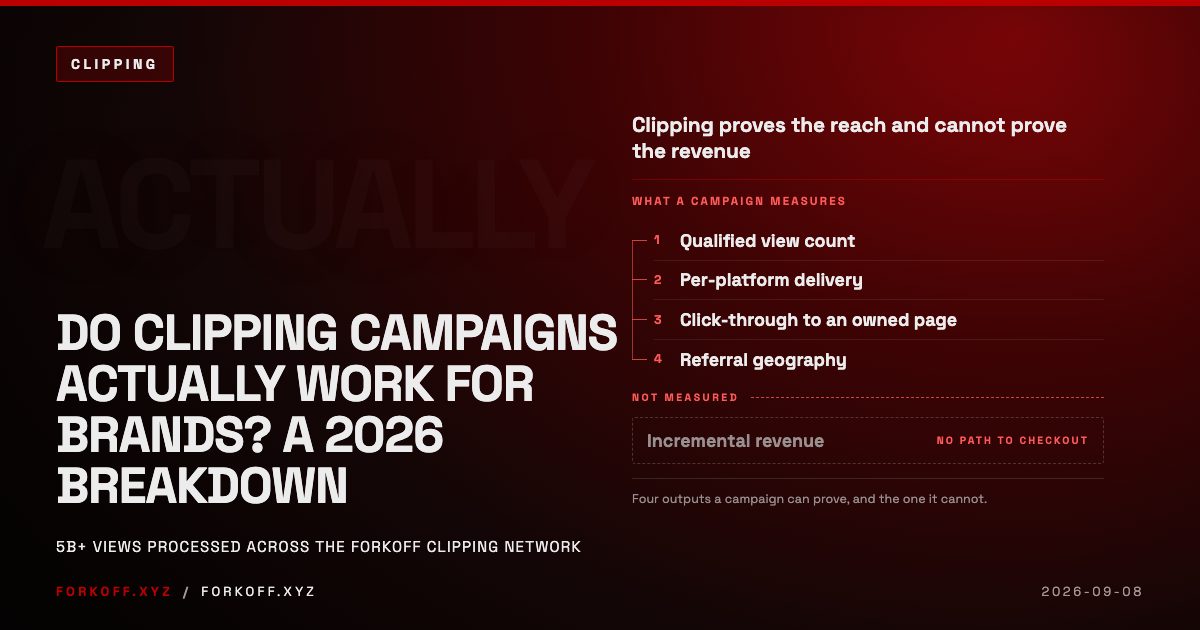
Do Clipping Campaigns Actually Work for Brands? A 2026 Breakdown
Clipping campaigns buy reach at a low unit price and cannot prove revenue. The 2026 breakdown of CPM by content signal, attribution and vendor diligence.
 Read
Read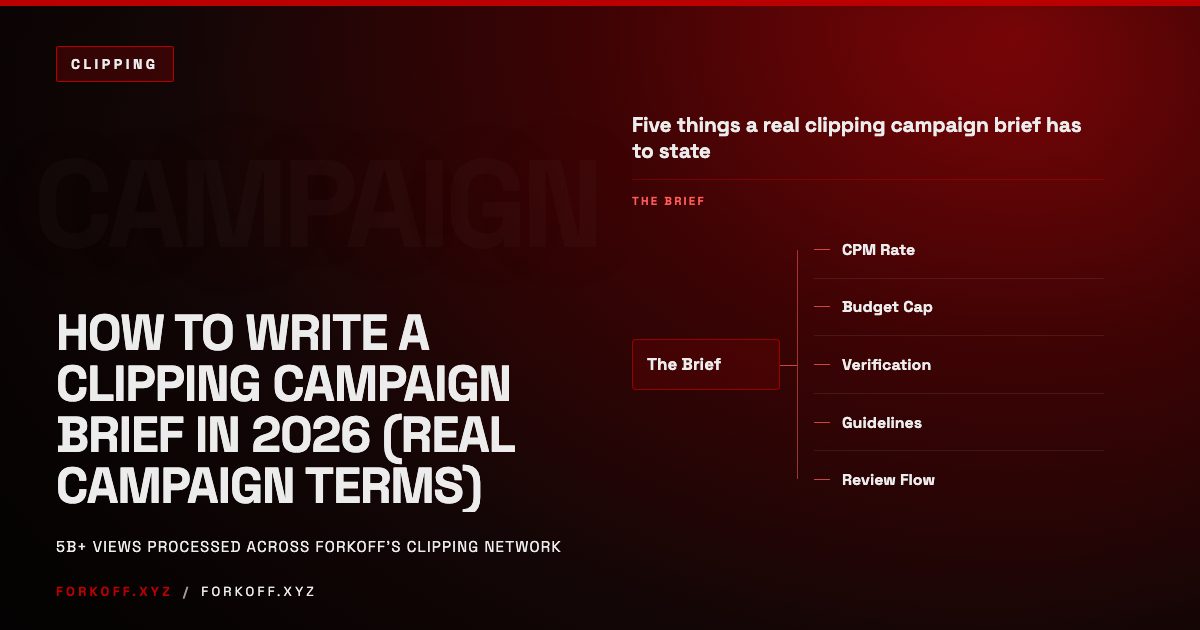
How to Write a Clipping Campaign Brief in 2026 (Real Campaign Terms)
A clipping campaign brief sets the CPM, budget cap, submission rules, and review flow that decide whether a campaign gets quality clips or wasted budget.
Read
Clipping a Game Launch: Turning Twitch and Kick Streams Into Qualified Installs
A launch-week playbook for clipping Twitch and Kick streams into qualified installs, with Drops mechanics, wishlist math, and a 7-day production calendar.
Read