
How much does a clipping agency cost in 2026?
Updated Oct 28, 2026
A clipping agency costs one of two ways. Tool-style services bill a flat subscription, roughly $15 to $100 a month for software you operate yourself. Managed agencies bill on output: either a raw CPM on total views, often $2 to $5 per 1,000 views, or a qualified-view rate where you pay only for views that pass a verification gate. FORKOFF prices on the qualified-view model per qualified view, where a view counts only after four checks (real human, in-region, traffic-valid, not bot or farm), a gate its network runs on every view, with Clipping Foundation as the entry buy. The number that decides real cost is the denominator: paying $2 per 1,000 raw views when only 35 percent of them are legitimate is far more expensive per genuine view than paying only for views that already cleared the gate.
Per our own campaign ledger, a 14-day FORKOFF clipping campaign for a US autonomous drone maker cleared 4.9M qualified views per qualified view verified views. FORKOFF clipping campaign ledger, Q3 2026
- 01Subscription tools Self-serve clip software runs about $15 to $100 a month across the category (tools like OpusClip, Vizard, Crayo, and Sendshort). You make and post the clips yourself; views are not guaranteed or audited.
- 02Raw-CPM agencies Managed networks that bill per 1,000 total views, commonly $2 to $5 CPM, plus a campaign minimum. You pay for views whether or not they are real, in-region, or human.
- 03Qualified-view pricing FORKOFF bills per qualified view. A view counts only after a four-stage gate, so spend maps to genuine, audited reach rather than a raw counter.
- 04The denominator test Compare cost per QUALIFIED view, not per raw view. At $2 CPM, if roughly 35 percent of views are legitimate, the effective cost is about $0.0057 per qualified-equivalent view (that is $5.71 per 1,000), versus FORKOFF billing only views that cleared the gate, before geo or traffic-history filters.
- 05Entry point FORKOFF starts with Clipping Foundation with a three-campaign minimum, so a brand can verify delivery and read the per-view audit ledger before scaling. No subscription, and the term is a defined three campaigns rather than an annual contract.
Why do two agencies quote wildly different numbers?
Because most price confusion comes from comparing a subscription tool to a managed outcome as if they were the same purchase. A $30 a month tool is cheap because you do the work and carry the risk: producing clips, posting them, and hoping they earn views. A managed agency is more expensive per month because it runs the distribution and, in FORKOFF's case, qualifies every view and hands you an exportable audit ledger. The right comparison is not monthly price, it is cost per genuine, watched, in-region view, and that is where a verification gate changes the math. Two managed agencies can also quote very different rates for what looks like the same campaign, because one is pricing every view the platform counted and the other is pricing only the views that survived a check.
What drives the price of a clipping campaign?
Five things, in roughly this order. Region comes first: a view from a buyer in the US or UK is worth more to advertisers and harder to source honestly, so in-region reach in a high-value market costs more than global volume. The content signal comes next: logo placement riding clip volume the network already produces is the cheapest per view, clips cut from your own long-form and posted from network accounts sit in the middle, and dedicated brand accounts built around you cost the most per view and deliver the least volume. Then platform mix, because feeds differ in how easily a clip earns watched views. Then volume, because per-view rates usually fall as the campaign grows. And last, the one that hides inside every quote: what counts as a view. A rate on raw platform views and a rate on qualified views are not two prices for the same thing. The qualified-view band holds across very different briefs. Per our own campaign ledger, a 14-day FORKOFF clipping campaign for a US autonomous drone maker cleared 4.9M qualified views per qualified view verified views.
How do platform-specific rates differ?
Less than the region does, and a flat rate across every platform is itself a signal. TikTok, Instagram Reels, YouTube Shorts and X each rank clips on their own watch signals, so the same cut can earn cheap volume on one feed and struggle on another. Paid short-form ads give a sense of the market: industry CPMs for short-form paid reach typically run $4 to $8 per 1,000 views, and that is the budget line clipping is usually competing with. The practical question is what a quote is pricing. A network that charges one raw rate for every platform and every region is pricing volume, and it will fill the count wherever views are cheapest, which is rarely where your buyers are. A network that prices by verified view in a stated region is pricing audience. Ask for the split in the report too: views by platform and by country, with the qualified share of each. If a quote cannot be broken down that way before the campaign, the report will not be either.
Short-form video agency or clipping agency?
Buy a short-form video agency when you need new content, and a clipping agency when you have content nobody sees. A short-form agency writes, shoots and edits original videos for your own accounts, usually on a monthly plan priced by the number of videos; according to Lyfe Marketing, short-form video marketing services cost $1,350 to $1,500 a month or more depending on volume. The output is assets, and their reach depends on the audience your accounts already have, plus whatever you spend promoting them. A clipping agency starts from long-form you already own, a podcast, keynote, webinar or founder interview, and its output is distribution: many clips posted through accounts that already have audiences, priced per view. The two are often complementary. A brand with no long-form can buy production first and clip it later, while a brand with a back catalog of interviews is usually paying for production it does not need. The pricing follows the output, per video for assets and per view for reach, so compare each on what it delivers to your buyer rather than on the sticker.
Clipping pricing models compared
| Model | How it is billed | Typical price | What you pay for |
|---|---|---|---|
| Subscription tool | Flat monthly fee | $15 to $100 per month | Software you operate yourself; views not guaranteed or audited |
| Raw-CPM agency | Per 1,000 total views | $2 to $5 CPM | Every counted view, real or not, in-region or not |
| Qualified-view (FORKOFF) | Per gate-passing view | Priced per qualified view | Only views that clear the four-stage gate, with an audit ledger |
| Clipping Foundation (FORKOFF) | No subscription | Three-campaign minimum | A bounded entry to verify delivery before scaling |
The number that decides real cost is the denominator. At $2 CPM, if roughly 35 percent of views are legitimate, the effective cost is about $0.0057 per genuine view (about $5.71 per 1,000), versus paying only for views that already cleared the gate.
How much does short-form video production cost?
Far more per asset than clipping, because production makes new footage while clipping reuses what you already have. Full-service short-form agencies that handle strategy, scripting, filming and editing typically charge $750 to $2,000 per video, or $3,000 to $8,000 a month for 8 to 16 videos, according to eMarketed's 2026 pricing guide, and premium production crews start around $5,000 a month and run to $10,000 to $20,000 for high-volume programs. Editing-only subscriptions are cheaper, about $99 to $500 a month, but you supply the footage. None of those prices include distribution. A production agency hands you finished videos to post on your own accounts, where reach depends on the audience you already have. Clipping starts from the opposite end: one long-form asset you already own, cut into many short clips and pushed through accounts with audiences of their own. If your problem is that you have nothing to say on camera, buy production. If you already record podcasts, keynotes or founder interviews and nobody sees them, the cheaper fix is distribution.
What do short-form video editing services cost in 2026?
From about $99 a month to $1,000 or more, depending on volume and whether you get a dedicated editor. Published price lists as of 2026 show the spread: Feedbird starts at $149 a month, Increditors lists $297 a month for 8 videos, budget editing plans start around $99 a month for 5 videos, per-clip shops such as Tasty Edits charge $80 to $94 a short, and dedicated-editor subscriptions such as Vidpros run $495 to $1,000 or more a month. Every one of them assumes you supply the footage and post the result. That makes editing services a fair benchmark for one part of a clipping budget, not the whole of it. If you already have reach and just need clean cuts, an editing subscription is the cheaper buy. If you need the clips seen by people outside your current audience, the editing is the smaller cost and distribution is the larger one, and distribution is the part a clipping agency prices.
Can you create short-form videos without an in-house team?
Yes, and for most brands it costs less. An in-house editor or videographer costs $60,000 to $120,000 or more a year once salary, benefits and equipment are counted, according to eMarketed, and Feedbird puts an in-house hire at $4,500 or more a month. That buys one person's skills and capacity, plus the editing. It does not buy distribution: an in-house editor posts to the brand's own accounts, so reach is capped by the audience you already have. A clipping campaign spends the same money differently. Editing, posting through a network of accounts, review and reporting are bundled into the rate, and the cost scales with the views you buy rather than with headcount. The trade-off is control. An in-house team knows the product and can turn a clip around in an hour; a network needs a tight brief and a review loop. Many brands end up with both: one in-house person who owns the source material and the brief, and a network that handles volume.
Why does the hook decide short-form views?
Because a view only counts as real if someone actually watched, and the first one to two seconds decide whether they do. On a raw-CPM campaign, a weak hook still produces views, autoplay impressions that scroll past, and you pay for every one. On a qualified-view campaign, those same impressions fail the watch check and are never billed, so a weak hook costs the network, not you. That is why the creative and the price are connected even when the rate is fixed. A brief that picks moments with a clear claim in the first frame, captions for people watching on mute, and a clean edit for each platform produces more watched views per clip. Under raw pricing that improves your results without changing your bill. Under qualified pricing it improves the network's economics, which is exactly the incentive you want the network to have.
Does production quality matter?
For how far the budget goes, yes; for the rate, no. Clipping does not need new production, so there is no shoot to pay for. What matters is the quality of the source: clear audio, a speaker who makes specific claims, and moments that stand on their own. A long-form asset with strong moments yields more clips that earn watched views, which means more qualified views for the same campaign. Edit quality matters too, and it is included in a managed clipping rate rather than billed per video. Ask how many distinct clips the agency expects to cut from your source, how it adapts each clip per platform, and who reviews edits before they post. If the source is weak, say a webinar with slides and no clear claims, fix that first. No pricing model turns a flat asset into watched views.
How do you choose the right agency on cost?
Normalise every quote to the same unit, then compare totals at the volume you actually need. Convert a raw-CPM quote into cost per verified view by estimating how much of the count would survive a real check, then compare it with any qualified-view quote. Run the comparison at your forecast volume, at half of it and at double it, because minimums and volume breaks move the answer. Then check what each price includes. Editing, posting, clipper payouts, review, geo routing and reporting should all be inside a managed rate; any of them sold as an add-on changes the comparison. Ask what is charged per: platform views, verified views, or clips. And ask for a sample report before you sign, because the cheapest quote is only cheap if its numbers can be checked. The CPQV calculator runs the normalisation for any quote, and how to choose a clipping agency covers the non-price checks.

What hidden costs should you budget for?
Five, and none of them show up in a headline rate. Minimums: a low per-view rate attached to a large campaign minimum is a large commitment. Platform and management fees: bounty board fees and agency margins sit between your budget and the clippers, so less of the budget reaches the people posting than the rate suggests. Your team's time: on a bounty board, someone on your side reviews every clip and polices fraud, and that time is a cost. Unspent budget: if the rule for what happens to unused money is not written down, it tends to get spent. And rights clearance: a clip with an unlicensed song can be muted or pulled, and the reach it lost is a cost even if nobody sends an invoice. Ask every agency to put the first four in writing with the quote. The fifth is handled by a brief that limits clippers to cleared or platform-safe audio, covered in who owns the clips from a clipping campaign.
Clipping against the other ways to get short-form video
| Option | What you get | Typical 2026 price | Distribution included |
|---|---|---|---|
| AI clipping tool | Software that cuts clips from your footage | $15 to $100 a month | No |
| Editing-only subscription | Edits of footage you supply | $99 to $500 a month | No |
| Full-service production agency | New videos, scripted and shot | $750 to $2,000 per video | Rarely |
| In-house editor or videographer | One person's skills and time | $60,000 to $120,000+ a year | Your own accounts only |
| Raw-CPM clipping network | Clips posted across network accounts | $2 to $5 per 1,000 views | Yes, unverified |
| Qualified-view clipping (FORKOFF) | Clips posted, every view checked | Priced per qualified view | Yes, verified per view |
Market prices as of 2026, according to eMarketed's short-form video pricing guide and published tool pricing. Production and in-house figures buy footage and editing; only the clipping rows buy distribution.
Frequently asked questions
What is the cheapest way to get clips made?
A self-serve subscription tool (around $15 to $30 a month) is the lowest sticker price, but you produce and distribute the clips yourself and views are neither guaranteed nor verified. The cheapest cost per genuine view is usually a qualified-view model, because you do not pay for bot or out-of-region views at all.
What does FORKOFF charge for clipping?
FORKOFF bills per qualified view, where a view counts only after passing a four-stage gate (real human, in-region, traffic-valid, not bot or farm). Rejected views are logged with a reason and never billed, and the per-view audit ledger is exportable. Clipping Foundation, the entry buy, lets you verify delivery before scaling. There is no software subscription.
Is a clipping agency worth it versus doing it yourself?
If you have the time to produce clips, build distribution accounts, and manage account safety, a tool is enough. If you want a delivered, audited reach outcome without that overhead, a managed agency priced on qualified views removes the labor and the risk of paying for views that never happened.
How do I compare clipping agency prices fairly?
Normalize to cost per qualified view. Take any raw-CPM quote, multiply by an honest legitimacy rate, and add the value of an audit trail. A low raw CPM with no qualification often costs more per genuine view than a higher qualified-view rate.
Is TikTok clipping cheaper than Instagram Reels?
Per raw view it can be, because TikTok volume is easy to generate. Per verified view the gap depends far more on the target region and the counter than on the app. Ask for the rate per qualified view by platform and region; a network that quotes one flat raw rate everywhere is pricing volume, not audience.
Do creative decisions change performance and cost?
They change performance, and performance changes cost per real view. Picking moments with a clear claim in the first frame, captioning for muted viewing and cutting natively for each platform all raise the share of views that are actually watched. On raw-CPM pricing that improves results at the same bill; on qualified-view pricing it improves the network's margin, which keeps the network invested in better creative.
Does clipping put your brand in front of new people?
Yes, and that is most of what you pay for. Clips post on accounts with audiences of their own, so they reach people who do not follow you yet, which posting on your own channels cannot do. Ask where those audiences sit by region, because new people outside your market are reach you cannot use.
Should I trust client reviews when comparing short-form video editing prices?
Use them to judge service, not reach. Reviews tell you whether an editor hits deadlines and takes feedback; they rarely tell you how many real people saw the result. For anything sold on views, ask for a sample report with per-clip numbers you can check on the platforms yourself.
How much should I budget for a first clipping campaign?
Work backwards from the outcome. Decide how many verified views you need in your target regions, multiply by the per-view rate, and add your own team's review time. Keep the first campaign to one content signal and a fixed window, so the result is readable before you commit more.
Are there setup fees or long contracts?
It varies by vendor. FORKOFF has no setup fee or subscription. The entry point is Clipping Foundation with a three-campaign minimum term, so the commitment is defined up front and the per-view ledger is exportable from day one.
Receipts, deep dives, and playbooks.
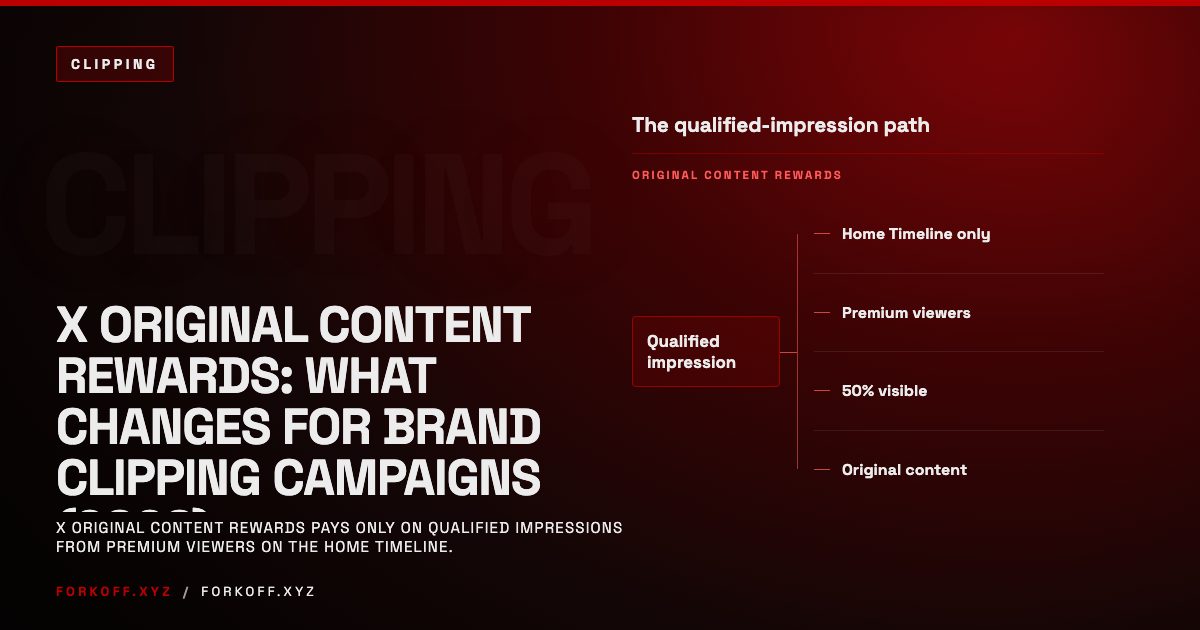
X Original Content Rewards: What Changes for Brand Clipping Campaigns (2026)
X swapped Creator Revenue Sharing for Original Content Rewards, so recycled-clip payouts are gone. What brands running clipping campaigns change now.
 Read
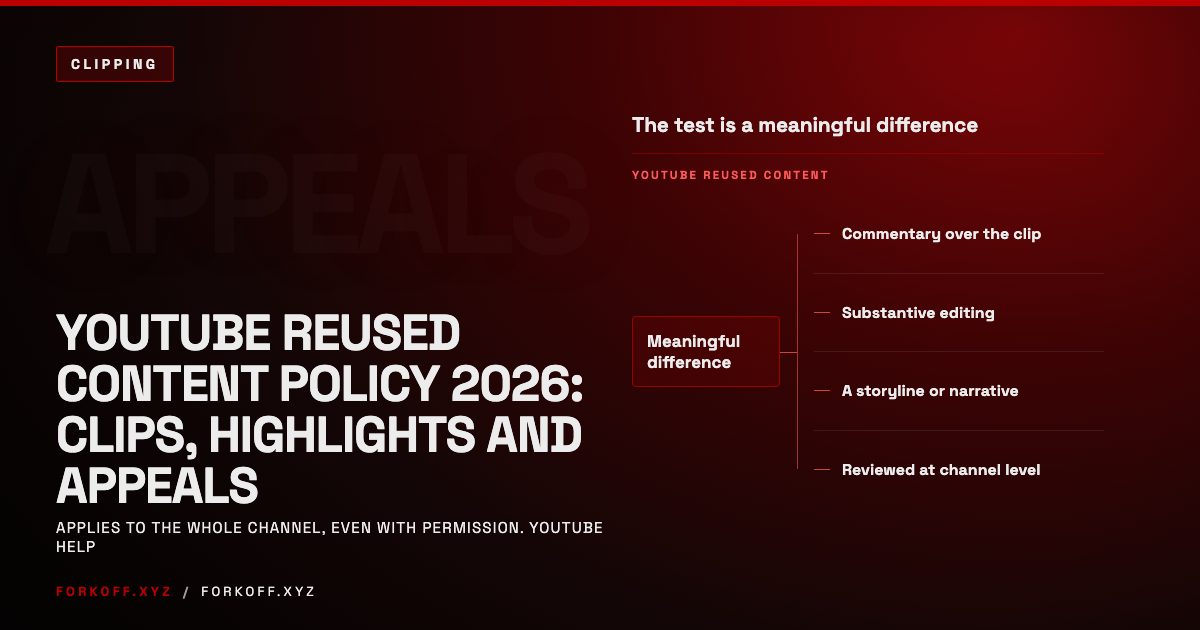
YouTube Reused Content Policy 2026: Clips, Highlights and Appeals
What YouTube's reused content policy actually says, how it treats clips, stream re-uploads and compilations, how to appeal, and how brand clipping stays clean.
Read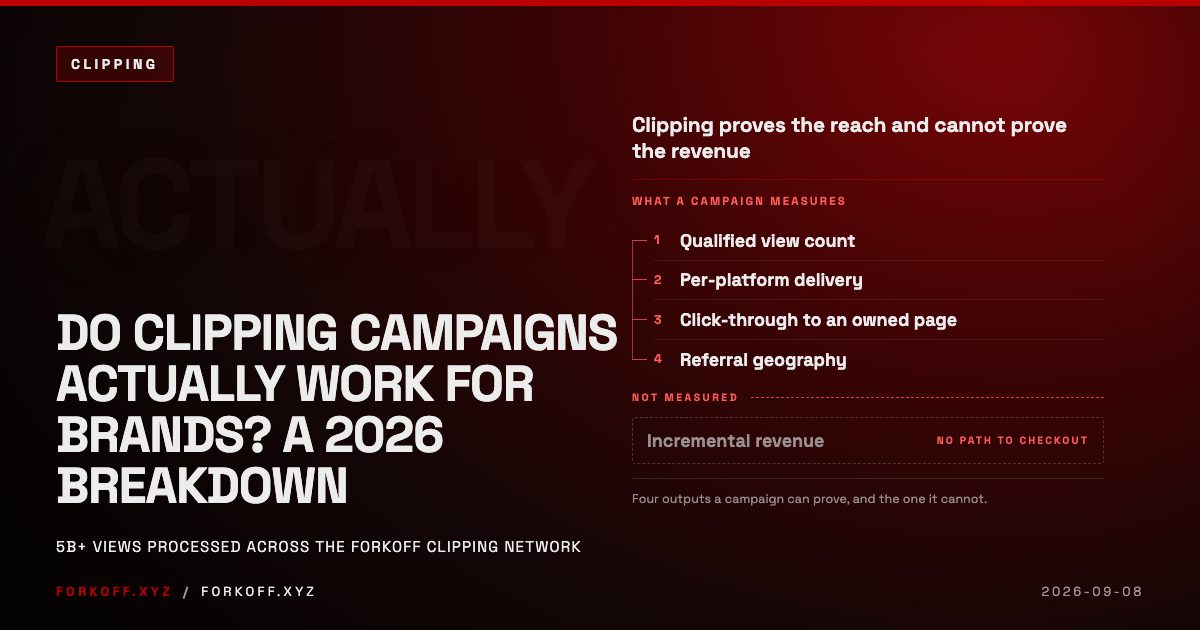
Do Clipping Campaigns Actually Work for Brands? A 2026 Breakdown
Clipping campaigns buy reach at a low unit price and cannot prove revenue. The 2026 breakdown of CPM by content signal, attribution and vendor diligence.
Read