
Do clipping campaigns actually work?
Updated Jul 24, 2026
Clipping campaigns work for brands that buy and measure them on qualified reach, and they underperform for brands that buy them on a raw view counter. A clipping campaign pays a network of creators to cut your long-form content into short native clips and post them across their own accounts, so it moves distribution at a lower unit cost than negotiating each placement directly. The weakness is that raw views are trivial to inflate, so a campaign billed on unaudited views can report a large number while delivering little genuine attention. Across the 30 launches FORKOFF's RADAR has traced, 20 showed paid or amplified distribution rather than pure organic reach, which is why the honest test is an outcome you can audit, not a view total. FORKOFF bills $0.003 per qualified view, counted only after a four-stage gate (real human, in-region, traffic-valid, not bot or farm), against an exportable ledger proven over 5B+ processed views. A clipping campaign works when you can audit the views you paid for.
- 01What a clipping campaign is A brand supplies long-form content, a managed network of clippers cuts it into short native clips, and each clipper posts to their own audience. You pay for the resulting distribution, not for producing one hero video.
- 02Why the model works Distributed native posting reaches audiences a single brand account cannot, at a lower cost per view than direct placements, because clippers are paid on delivered views rather than a flat fee. This is the same economics behind the paid clipper campaigns the LA Times and Digiday covered in 2025.
- 03Where campaigns fail The failure mode is measurement. A raw view counter is easy to inflate with bot traffic, view farms, and out-of-region sessions, so an unaudited campaign can look successful on a dashboard while sending no real humans. Reddit threads keep asking whether campaigns actually convert, not just rack up views.
- 04The test that separates the two A campaign that works can tie spend to views that survived a screening gate and, ideally, to a downstream action. Ask any agency to show a per-view audit trail before you judge whether their campaign worked.
- 05How FORKOFF proves it worked FORKOFF bills $0.003 per qualified view, where a view counts only after clearing a four-stage gate, and every accepted or rejected view is logged with a reason code you can export. RADAR bot-screening adds a second layer, and a bounded sandbox lets you verify delivery before scaling.
The model works, the measurement is where campaigns break
Clipping is a real, legal distribution channel, not an inherent gimmick. If you are new to it, start with what a clipping campaign is. The reason the honest answer is conditional rather than a flat yes is that two campaigns can report the same headline views while one delivered genuine watched attention and the other bought inflated traffic, and the dashboard looks identical either way. This is exactly why FORKOFF built RADAR: across the 30 launches it has traced, 20 carried paid or amplified distribution rather than pure organic reach, and organic posting tops out around a 500 views-per-like ceiling. A view total on its own tells you almost nothing about whether a campaign worked. What tells you is whether the views were real, in-region humans, and whether any of them did something afterward.
What working means: reach you can audit, not a view counter
A clipping campaign works when spend is tied to views that survived a screening gate. FORKOFF defines that unit as a qualified view: a view that clears a four-stage gate for real human, in-region, traffic-valid, and not bot or farm, billed at $0.003 each and logged in an exportable ledger with a reason code on every accepted and rejected view. That is the difference between paying for attention and paying for a number. The vetting move is the same whoever you hire: ask for the per-view audit trail, confirm human and geo screening happen before a view is billable, and read what cost per qualified view means so you can normalize any quote before you judge whether the campaign delivered.
Brands are already asking this question
The demand is visible in the search data and the communities. The head term clipping campaign draws about 320 monthly US searches (DataForSEO, 2026-07-21) with a high commercial CPC, and the live results are led by a Reddit thread asking whether clipping campaigns are effective for brands, sitting above the agencies themselves. Application-based campaign models, where clippers are vetted on account quality, prior work, and niche fit before they can post, are a 2026 sign of the market maturing away from open bounty toward the verification that makes a campaign auditable in the first place.
The three questions that predict whether a campaign will work
You can forecast the outcome before you spend by asking three things. First, what is the billing basis, a qualified view that cleared a gate or a raw platform counter. Second, does the agency screen for real humans and target region before a view is billable, or does it bill the number the platform reports. Third, is there a bounded entry point so you can verify delivery before committing budget. Clean answers to all three predict a campaign that works, because they are the same properties that make the result auditable. Vague answers, or a flat quote on an unaudited counter, predict the failure mode. FORKOFF answers all three with the qualified-view gate, the exportable ledger, and a sandbox, and the same checklist works to judge any agency you consider, which is the core of how to choose a clipping agency.
When a clipping campaign works versus when it fails
| Factor | Works | Fails |
|---|---|---|
| Billing basis | Qualified views that clear a gate | Raw platform view counter |
| Traffic quality | Real humans, in region, screened before billing | Bots, view farms, and out-of-region sessions billed |
| Proof | Exportable per-view ledger with reason codes | A dashboard number with nothing behind it |
| Measurement | Views tied to a downstream action | The view total treated as the outcome |
| Entry point | A bounded sandbox to verify delivery first | Full budget committed on an unaudited counter |
| FORKOFF proof | $0.003 per qualified view, four-stage gate, plus RADAR screening | Not applicable |
The head term clipping campaign draws about 320 monthly US searches (DataForSEO, 2026-07-21), and the live results are led by a Reddit thread asking whether clipping campaigns work for brands. The buyer protects themselves by refusing to judge a campaign on an unaudited counter.
Frequently asked questions
Do clipping campaigns actually work for brands?
Yes, when they are bought and measured on qualified reach. A clipping campaign distributes short native clips of your content across creator accounts, which genuinely moves reach at a low cost per view. It underperforms when it is billed on a raw view counter that can be inflated with bot or out-of-region traffic, because then the reported number does not reflect real attention. The deciding factor is whether you can audit the views you paid for.
Why do some clipping campaigns fail?
They fail on measurement, not on the model. A campaign billed on an unaudited view counter can report a large number while delivering little real attention, because raw views are trivial to inflate with bots, view farms, and out-of-region sessions. A campaign that ties spend to screened, qualified views and, ideally, a downstream action gives you a result you can trust.
How do I measure whether a clipping campaign worked?
Measure on qualified views, not raw clip views. A qualified view is a real, in-region human that is not a bot or farm session, and the strongest version connects those views to a downstream action such as a signup or a follow. FORKOFF bills $0.003 per qualified view and ships an exportable per-view ledger with a reason code on every view, so the outcome is auditable rather than asserted.
How much does a clipping campaign cost?
It depends on the pricing model. A tool subscription charges a flat monthly fee and leaves the distribution to you, while a managed campaign charges for delivered output. FORKOFF prices managed clipping at $0.003 per qualified view, so you pay for screened attention rather than a raw counter. See how much a clipping agency costs for the full comparison.
What makes a clipping campaign trustworthy?
A per-view audit trail. A trustworthy campaign screens for real humans and target-region traffic before a view is billable and can hand you a ledger with a reason code on every accepted and rejected view. FORKOFF adds RADAR bot-screening and a bounded sandbox so you can verify delivery before committing budget. A campaign that only offers a raw view number with no verification is the one to be cautious of.
Receipts, deep dives, and playbooks.
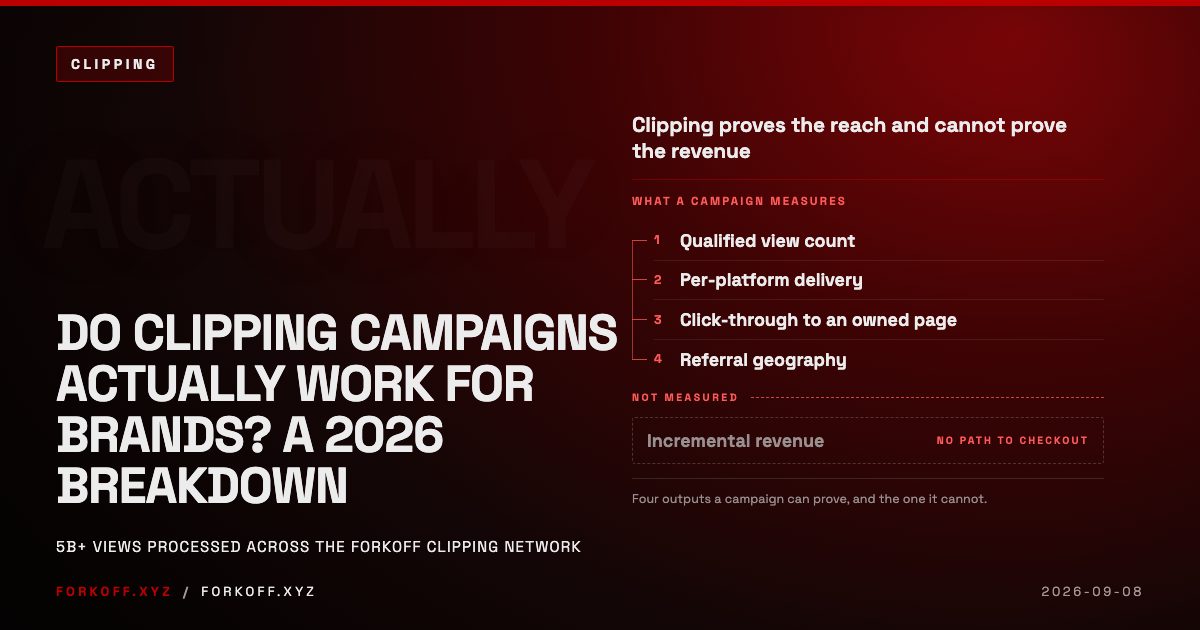
Do Clipping Campaigns Actually Work for Brands? A 2026 Breakdown
Clipping campaigns buy reach at a low unit price and cannot prove revenue. The 2026 breakdown of CPM by content signal, attribution and vendor diligence.
 Read
Read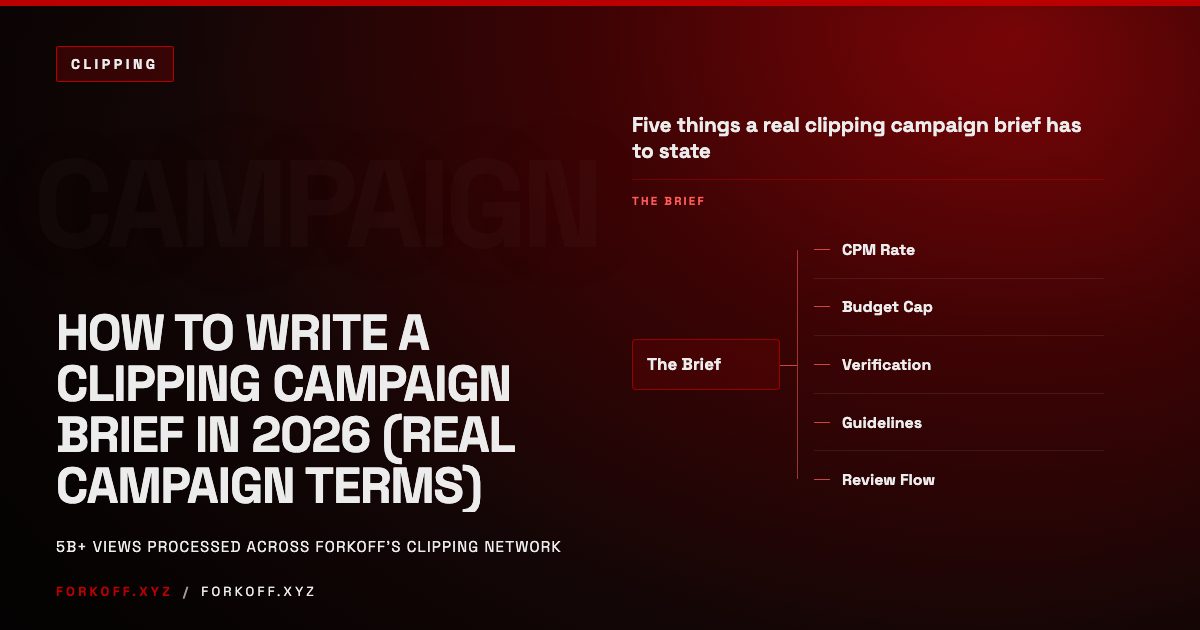
How to Write a Clipping Campaign Brief in 2026 (Real Campaign Terms)
A clipping campaign brief sets the CPM, budget cap, submission rules, and review flow that decide whether a campaign gets quality clips or wasted budget.
Read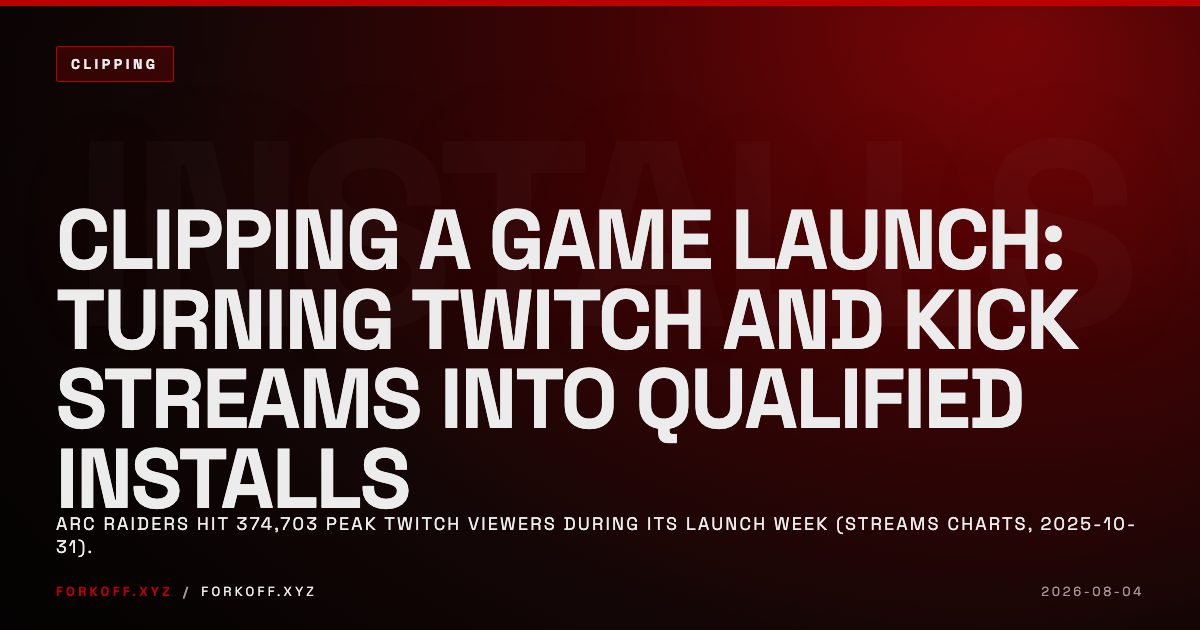
Clipping a Game Launch: Turning Twitch and Kick Streams Into Qualified Installs
A launch-week playbook for clipping Twitch and Kick streams into qualified installs, with Drops mechanics, wishlist math, and a 7-day production calendar.
Read