
What is cost per qualified view (CPQV)?
Updated Jun 27, 2026
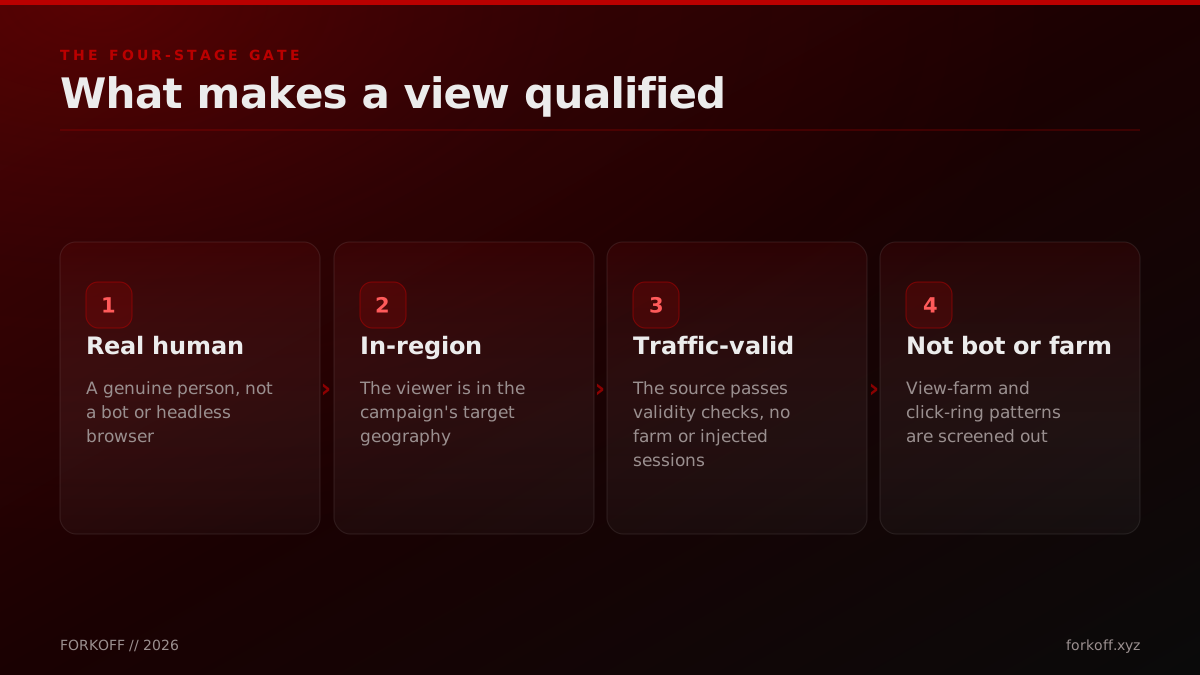
Cost per qualified view (CPQV) is a clipping pricing model where a brand pays only for views that pass a verification gate, not for raw view-counter totals. FORKOFF defines a qualified view as one that clears four checks: a real human watched it, the viewer was in the target region, the traffic source was valid, and it was not a bot or view-farm. FORKOFF's benchmark rate is $0.003 per qualified view. The point of the metric is to move clipping spend off a number anyone can inflate (raw views) and onto a number a brand can audit, with an append-only per-view ledger exportable as CSV or JSON. Across FORKOFF's network, 5B+ views have been processed against this gate.
- 01Real human The view came from a genuine person, not an automated script or headless browser. Bot and emulator traffic is filtered out before a view counts.
- 02In-region The viewer was in the campaign's target geography. Out-of-region views, however real, do not count toward a geo-targeted brief.
- 03Traffic-valid The traffic source passes validity checks (no incentivized, injected, or farm-sourced sessions). The view reflects organic placement, not purchased noise.
- 04Not bot or farm Coordinated view-farm and click-ring patterns are screened. Only the surviving views are billable, and each is logged with a reason code.
Why the denominator matters more than the rate
Two clipping quotes can look identical on headline price and differ enormously in real cost, because they count different things. A raw-CPM model bills every number the platform counter shows, including bot, out-of-region, and farm views. A qualified-view model bills only what survives the gate. That is why a $0.003 qualified-view rate can be cheaper per genuine view than a $2 raw CPM: the raw model is charging you for the noise. The audit ledger is what makes the difference checkable rather than a marketing claim, because every accepted and rejected view carries a reason code a finance or treasury review can read.
Raw view versus qualified view
| Dimension | Raw view (CPM) | Qualified view (CPQV) |
|---|---|---|
| What gets billed | Every platform-counter view | Only views that pass the gate |
| Bot or emulator traffic | Counted and billed | Filtered out before a view counts |
| Out-of-region views | Counted | Not counted toward a geo-targeted brief |
| Farm or injected sessions | Counted | Screened out |
| Audit trail | None | Append-only per-view ledger, exportable as CSV or JSON |
| FORKOFF rate | Not applicable | $0.003 per qualified view |
A $0.003 qualified-view rate can be cheaper per genuine view than a $2 raw CPM, because the raw model is charging you for the noise. Across FORKOFF's network, 5B+ views have been processed against this gate.
Frequently asked questions
What counts as a qualified view at FORKOFF?
A view that passes all four checks: real human, in-region, traffic-valid, and not bot or farm. Views that fail any check are not billed, and every accepted or rejected view is recorded in an append-only ledger with a reason code.
How is CPQV different from CPM?
CPM bills per 1,000 raw views from the platform counter, including bots and out-of-region traffic. CPQV bills only for views that pass a verification gate, so you are paying for genuine, audited reach rather than a number anyone can inflate.
What is FORKOFF's CPQV rate?
FORKOFF's benchmark is $0.003 per qualified view, with a sandbox to start. Because only gate-passing views are billed, the rate maps directly to verified delivery rather than a raw counter.
Can I see proof that views were qualified?
Yes. FORKOFF ships an append-only per-view audit ledger, exportable as CSV or JSON, with a reason code for every accepted and rejected view. It is built to survive a treasury or finance review without being reconstructed.
Why does qualified-view pricing exist?
Because raw view counts are easy to inflate and impossible to audit after the fact. Tying spend to a gated, logged view aligns the agency's incentive with delivering genuine attention rather than maximizing a vanity number.
Receipts, deep dives, and playbooks.
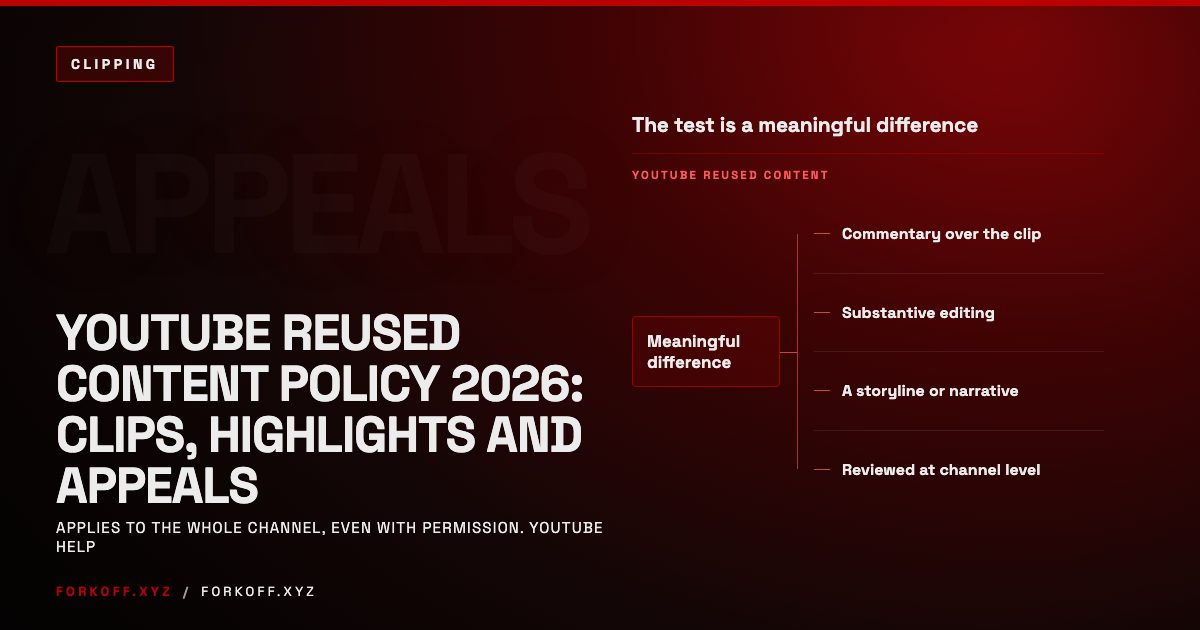
YouTube Reused Content Policy 2026: Clips, Highlights and Appeals
What YouTube's reused content policy actually says, how it treats clips, stream re-uploads and compilations, how to appeal, and how brand clipping stays clean.
 Read
Read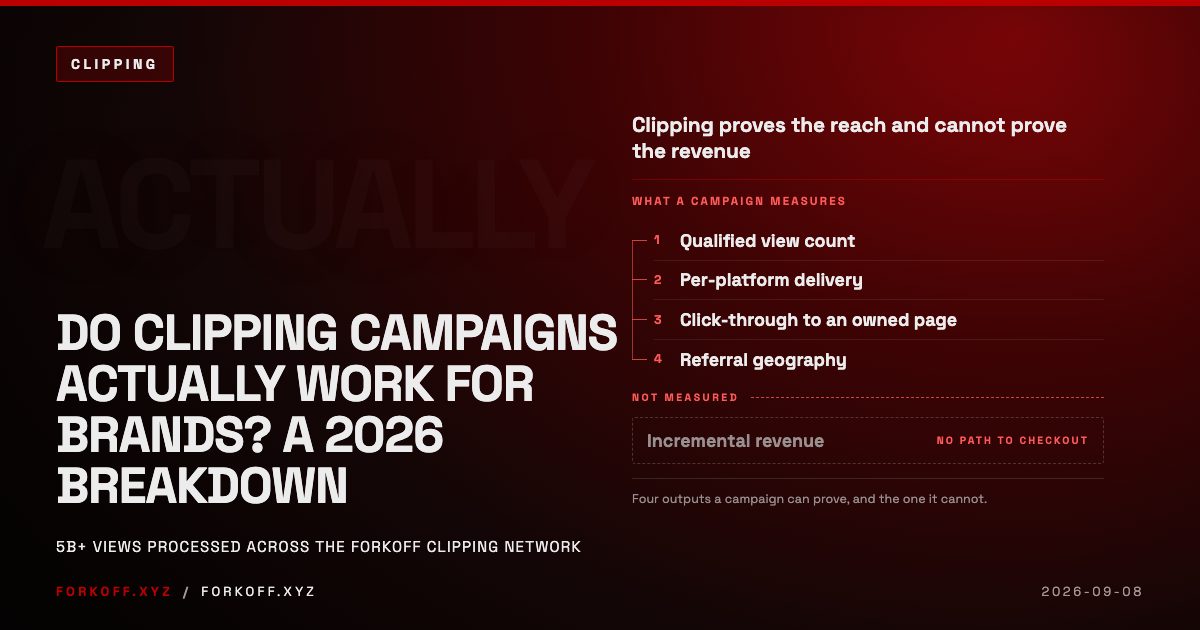
Do Clipping Campaigns Actually Work for Brands? A 2026 Breakdown
Clipping campaigns buy reach at a low unit price and cannot prove revenue. The 2026 breakdown of CPM by content signal, attribution and vendor diligence.
Read
How to Write a Clipping Campaign Brief in 2026 (Real Campaign Terms)
A clipping campaign brief sets the CPM, budget cap, submission rules, and review flow that decide whether a campaign gets quality clips or wasted budget.
Read