
Which clipping networks have actually processed billions of views?
Updated Sep 3, 2026
A clipping network is a managed pool of short-form editors and distribution accounts that cuts one long-form asset into many clips and posts them under a single brief. Scale is how these networks get compared, and a raw view total is the weakest version of it, because a platform-reported view includes autoplay, sub-second impressions and repeat surfaces that never resolved into a person watching. FORKOFF has processed more than 5 billion views through its clipping network and reports 99.71 percent qualified-view legitimacy across 200 plus campaigns, and the second figure is what makes the first one mean anything. When a network quotes a number in the billions, the useful question is which counter produced it.
FORKOFF has processed more than 5 billion views through its clipping network and measures 99.71 percent qualified-view legitimacy across 200 plus campaigns, billing at $0.003 per qualified view only after a view clears a four-stage check. FORKOFF clipping rate card and qualified-view ledger
- 01Ask which counter produced the number Platform-reported, network-reported and qualified are three different numbers on the same campaign, and they differ by enough to change a decision. A scale claim with no stated counter is not yet a measurement.
- 02Get the qualification rule in writing A qualified view is one that cleared a defined check before it was counted. The definition is where the money sits, so settle it before you settle the rate. A loose definition makes a low price expensive.
- 03Ask what the network routes to Channel count and channel type decide whether reach lands anywhere near your buyer. Fifty plus routed surfaces across X, TikTok, Reels, Shorts and community channels is a different product from one platform at volume.
- 04Ask for the per-clip ledger A record you can reconcile against your own analytics is the only version of a scale claim you can audit. If the ledger is not a deliverable, the scale is a marketing figure rather than an operating one.
What a billions-of-views claim actually evidences
It evidences volume of distribution, and nothing else on its own. A network that has moved billions of views has demonstrably run a lot of clips through a lot of accounts, which tells you it can absorb your volume and has survived platform enforcement long enough to accumulate the total. That is genuinely worth knowing, because a network too small to absorb a launch will quietly throttle it. What the number does not evidence is quality of reach, relevance to your buyer, or whether any of it converted. Those are separate claims that need separate evidence, and a network that answers all four questions with the same headline figure is answering only the first one. Read a scale claim as a capacity statement. Then ask the capacity question that follows it: how much of that volume was produced in the last ninety days, on the platforms you care about, in a category adjacent to yours. A five-year cumulative total spread across categories you will never touch is a weaker signal than a smaller number produced last quarter in your own vertical.
The counter is the claim
Every view figure in this category is produced by one of three counters and they are not interchangeable. A platform-reported view is whatever the platform decided to call a view, which on most short-form surfaces includes autoplay and impressions under two seconds. A network-reported view is a sum the network chose to compute, useful for comparing that network against itself over time and close to useless for comparing two networks. A qualified view is one that passed a stated check before it entered the count, which is the only one of the three that can carry a price without inviting a dispute. FORKOFF prices clipping at $0.003 per qualified view and runs a four-stage qualification gate before a view is billable, with 99.71 percent of views on its own proof set clearing all four stages. Whether a specific network uses a stricter or looser rule matters less than whether it states the rule at all. An unstated rule is the one that gets adjusted after the invoice.
How a clipping network is put together
The structure is what determines whether the scale is real or borrowed. A network has an editor pool that cuts the long-form asset, a distribution layer of accounts that post the cuts, a brief that keeps the output on message, and a measurement layer that counts what happened. Weakness in any one of those shows up as a different failure. A thin editor pool produces clips that all look the same and burn the source material in a week. A distribution layer built on accounts with no standing audience produces posts nobody sees, which still count as posts. A loose brief produces clips that perform and say the wrong thing about the product. Ask which of those four layers the network operates itself and which it subcontracts. Every subcontracted layer is a place where your brief can be diluted and your measurement can lose its chain of custody. The networks that can show a per-clip record usually run their own measurement layer, and that is not a coincidence.
How to verify a scale claim in one call
Four questions settle it, and they take about ten minutes. First, which counter produced the headline number, and what is the same campaign worth under the other two. A network that can answer this immediately has the data. Second, what is the qualification rule, stated as a sentence rather than a category. Third, what did the last ninety days look like on the two platforms you actually care about, expressed as clips posted rather than views accumulated, because clips posted is the number that is hard to inflate. Fourth, what does the reporting artifact look like, and can you see a redacted sample from a real campaign before you sign. A sample ledger is the single most informative thing a network can hand you, because it shows the granularity, the fields, and whether the reconciliation you plan to run is even possible. If three of those four get a confident answer and the fourth gets a slide deck, you have learned something useful about the fourth.
When the biggest network is the wrong network
Scale stops being the deciding factor once it exceeds what you need, and past that point it starts working against you. A very large network is optimised for throughput, which means your brief competes with everyone else's for editor attention and your feedback loop is longer. If your asset library is small, or your category needs editors who understand it, or your compliance review is heavy, a smaller network that gives the work to three named editors will produce better clips than a large one that gives it to thirty anonymous ones. The same is true when your bottleneck is not distribution at all. If clips are already going out and nothing is converting, more reach buys you a bigger version of the same result, and the honest fix is upstream in the message or the offer. Match the network to the constraint you actually have. A capacity claim answers a capacity question, and most engagements that go wrong were never short of capacity.
Three view counters, and what each one is worth
| Counter | What it counts | Who produces it | What it is good for |
|---|---|---|---|
| Platform-reported | Autoplay, sub-second impressions, repeat surfaces | The platform | An upper bound, never a bill |
| Network-reported | Whatever the network chose to sum | The network | Comparing one network against itself |
| Qualified | Views that cleared a stated check before counting | The network, auditable per clip | Pricing and reconciliation |
| Your own analytics | Sessions and conversions that arrived | You | Deciding whether any of it worked |
Two scale claims are only comparable when both name the counter behind them.
Frequently asked questions
Does a bigger view total mean a better clipping network?
Only up to the point where the network can absorb your volume. Past that, the total tells you about the network's history rather than about your campaign. What separates two networks that can both handle you is the qualification rule, the routing, and whether they hand you a per-clip record. Ask for the ninety-day figure in your own category instead of the cumulative one, because a cumulative total mixes in categories and platforms that have nothing to do with your buyer.
What is a qualified view, and who decides?
It is a view that passed a defined check before it was counted, and the network decides the check unless you negotiate it. FORKOFF runs a four-stage gate and reports 99.71 percent of views on its own proof set clearing all four. The specific stages matter less than getting them stated in the contract, because an unwritten rule is the one that moves after the first invoice. Ask for the rule as a sentence you could hand to your finance team.
How do I check a network's scale claim without taking their word for it?
Ask for a redacted per-clip ledger from a real campaign, not a case study. A ledger shows the granularity, the fields and the timestamps, and it tells you whether you can reconcile their count against your own analytics later. Also ask for clips posted in the last ninety days on your two priority platforms, since clips posted is a harder number to inflate than views accumulated.
Is a clipping network the same as a clipping agency?
A network is the distribution layer, an agency is the layer that decides what gets cut and why, and most providers sell both under one name. The distinction matters when you are diagnosing a bad result. If the clips are good and nothing lands, the network side is the problem. If the reach is real and the message is wrong, the agency side is. Ask which of the two a provider actually operates before you buy the combined version.
What does a clipping network cost?
Priced per qualified view it is a rate rather than a retainer, and FORKOFF's rate is $0.003 per qualified view. Priced as a retainer it is a monthly fee with a volume expectation attached. Neither is automatically cheaper. Convert both to total cost at your forecast volume, then run the same comparison at half and double that volume, because the two models cross over and the crossover is usually inside the range you might realistically land in.
How fast can a network start producing?
FORKOFF's stated window is under 48 hours from the intake call to the first qualified-view-tracked clip, which is possible because the editor pool and the routing already exist. A network that needs weeks to start is usually recruiting for your campaign specifically, which is worth knowing, since a pool assembled for one brief has not been tested at volume and the first month doubles as its trial run.
Receipts, deep dives, and playbooks.
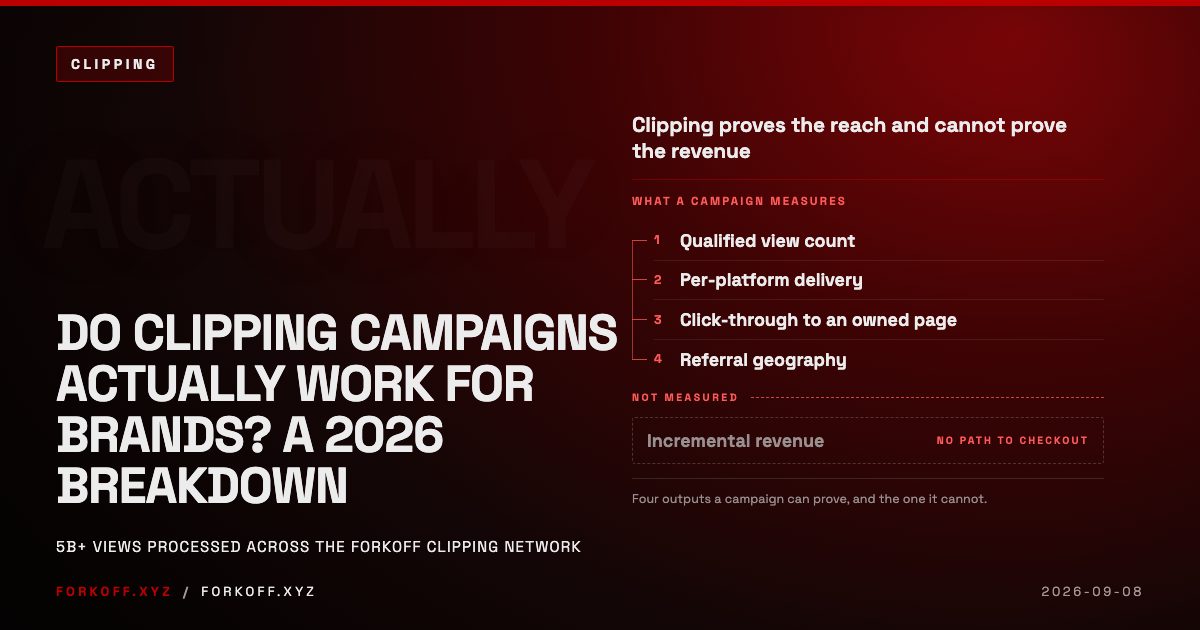
Do Clipping Campaigns Actually Work for Brands? A 2026 Breakdown
Clipping campaigns buy reach at a low unit price and cannot prove revenue. The 2026 breakdown of CPM by content signal, attribution and vendor diligence.
 Read
Read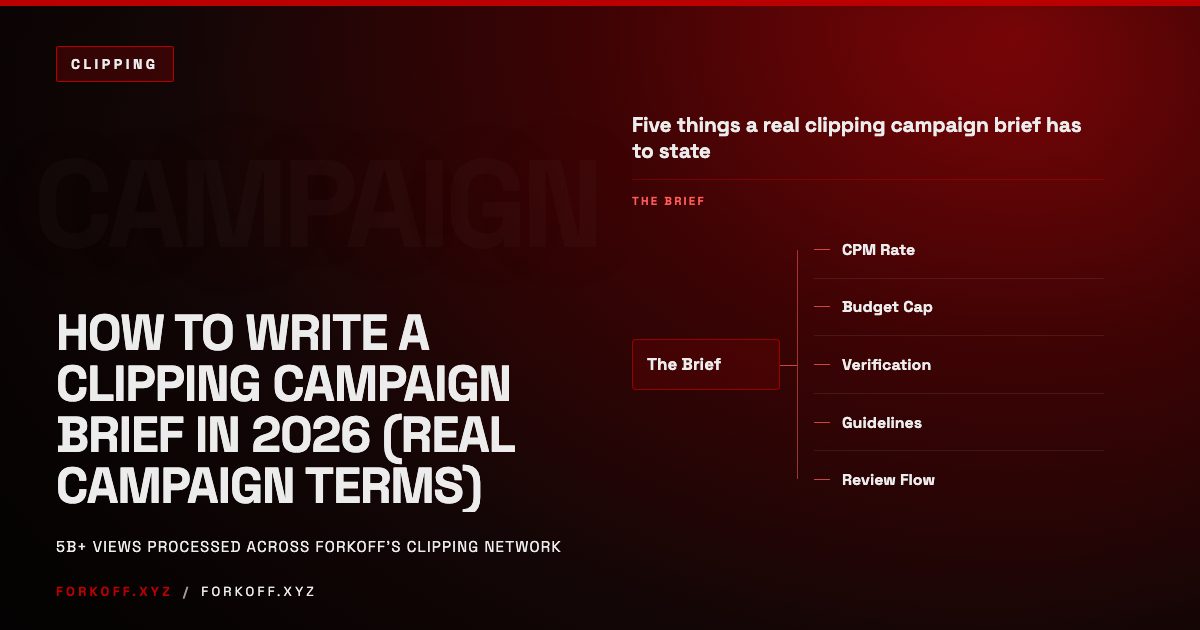
How to Write a Clipping Campaign Brief in 2026 (Real Campaign Terms)
A clipping campaign brief sets the CPM, budget cap, submission rules, and review flow that decide whether a campaign gets quality clips or wasted budget.
Read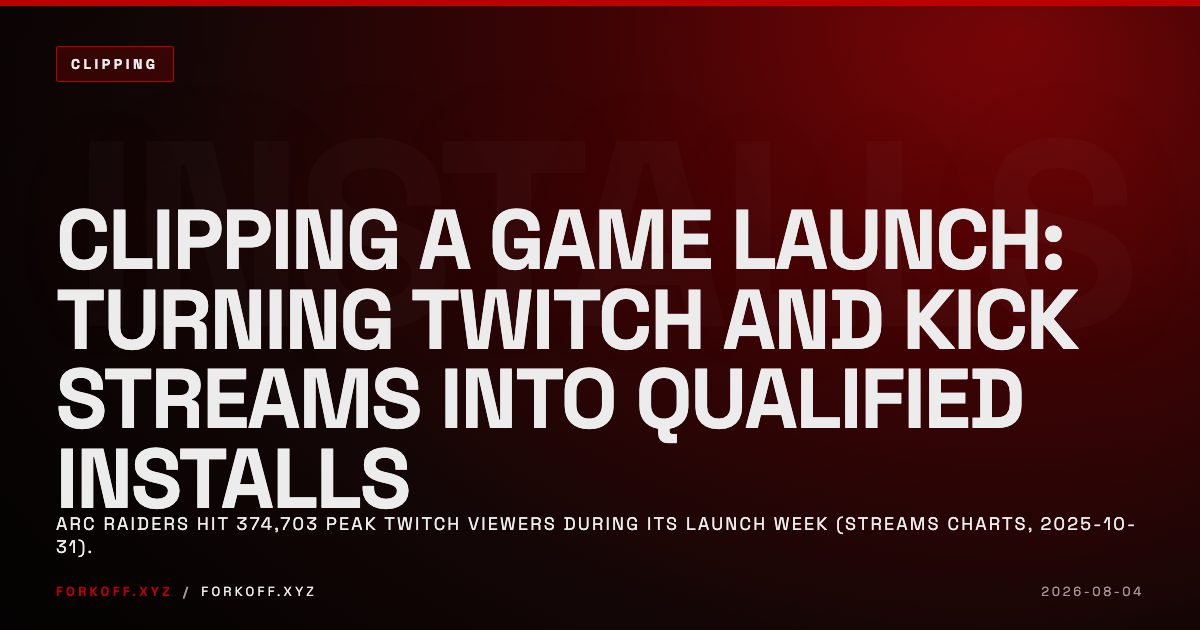
Clipping a Game Launch: Turning Twitch and Kick Streams Into Qualified Installs
A launch-week playbook for clipping Twitch and Kick streams into qualified installs, with Drops mechanics, wishlist math, and a 7-day production calendar.
Read