
What is clipping in marketing?
Updated Jul 24, 2026
Clipping is a distribution model. A long piece of content, a podcast, a livestream, a keynote, or a founder video, is cut into short vertical clips, and those clips are posted across many creator accounts to earn reach on short-form feeds like TikTok, Instagram Reels, YouTube Shorts, and X. The work is not editing alone. It is editing plus distribution: sourcing the clippable moments, cutting them native to each platform, and getting them posted at volume through real accounts. Short-form video is the format audiences watch most, and HubSpot's marketers rank it the highest-return format on social, which is why brands run clipping programs instead of leaning on one hero video. The number that matters is not clips produced or raw views counted. It is qualified views: reach a real, in-region person actually watched. FORKOFF has processed 5B+ views on that qualified-view standard, billing on views that clear a four-signal gate and land on an exportable audit ledger.
- 01The source content Clipping starts with long-form: a podcast episode, a livestream, a conference talk, a YouTube video, or a founder's own recording. The catalog is the raw material, and the more quotable moments it holds, the more clips it yields.
- 02The cut Each moment is edited native to its platform: vertical framing, captions, a hook in the first second, and a length that fits the feed. A clip that reads as a native short outperforms one that looks like a repurposed TV segment.
- 03The distribution The clips are posted at volume across many creator or clipper accounts, not one brand channel. Spreading the same moment across accounts is what turns a single video into feed-wide reach.
- 04The clipper economy Much of this runs on pay-per-view clipping programs, where independent clippers cut and post a brand's content and are paid on the views they earn. It scales distribution well beyond an in-house team.
- 05The measurement Raw view counters are easy to inflate with bots and out-of-region traffic. Serious programs report qualified views instead: reach that cleared a check for a real, in-region human. That is the denominator a buyer should compare.
- 06The proof layer FORKOFF runs clipping on a four-signal gate (real human, in-region, traffic-valid, not a bot or farm) with an exportable per-view audit ledger, the same integrity layer behind 5B+ processed views.
Clipping is distribution, not just editing
The common misread is that clipping means making short videos. Editing is the visible part, but the value sits in the distribution: a network of real accounts that can post the same moment across many feeds at once, plus the reporting that proves the reach was real. A brand can edit a hundred clips in-house and still get no reach if it has nowhere to post them at volume. That is why clipping is run as a managed channel rather than a one-off editing job, and why the reporting standard matters as much as the cut. The unit a buyer should ask about is cost per qualified view, not clips delivered.
Why qualified views are the unit that matters
A raw view counter includes bots, duplicates, and out-of-region impressions, so two clipping programs can report the same headline number while one reached real people and the other reached scripts. A qualified view is one that cleared a check: a real human, in the target region, on valid traffic, not a bot or a farm. Comparing programs on qualified views, rather than a raw counter, is the only way to know what a reported number is worth. FORKOFF bills on that gate and logs every accepted and rejected view with a reason code on an exportable ledger, the standard behind 5B+ processed views.
The clipping pipeline, stage by stage
| Stage | What happens | What a buyer should check |
|---|---|---|
| Source | Long-form content is chosen for its clippable moments | Is there enough catalog to sustain volume |
| Cut | Moments are edited native to each short-form feed | Do clips read as native, with a first-second hook |
| Distribute | Clips post at volume across many real creator accounts | Real vetted accounts, not burner or bot accounts |
| Measure | Reach is reported as raw views or qualified views | Qualified, in-region, human-verified views only |
| Prove | Accepted and rejected views are logged with reasons | An exportable per-view audit ledger |
FORKOFF reports qualified views that clear a four-signal gate (real human, in-region, traffic-valid, not a bot or farm) on an exportable ledger, the standard behind 5B+ processed views.
Frequently asked questions
What is clipping in marketing?
Clipping is a distribution model where long-form content is cut into short vertical clips and posted across many creator accounts to earn reach on short-form feeds like TikTok, Reels, YouTube Shorts, and X. The value is not the editing alone, it is the distribution network plus reporting that proves the reach was real.
What does a clipper do?
A clipper cuts a brand's or creator's long-form content into short native clips and posts them, often across their own accounts, to earn views. In pay-per-view clipping programs, clippers are paid on the views they generate, which scales distribution beyond an in-house team.
Is clipping the same as video editing?
No. Editing is one step inside clipping. Clipping adds sourcing the clippable moments, distributing the clips at volume across many real accounts, and reporting the reach. A program that only edits, with nowhere to post at scale, is not a clipping channel.
How are clipping views counted?
Two ways, and the difference matters. A raw view counter includes bots, duplicates, and out-of-region traffic. A qualified view has cleared a check for a real, in-region human on valid traffic. FORKOFF reports qualified views on an exportable audit ledger at a per-qualified-view rate.
Does clipping actually work for brands?
It works when it is measured on reach a real person watched rather than a raw counter. Short-form video is the format audiences watch most, so distributing many native clips across real accounts can turn one asset into feed-wide reach. The test is whether the program can prove the views were real.
Receipts, deep dives, and playbooks.
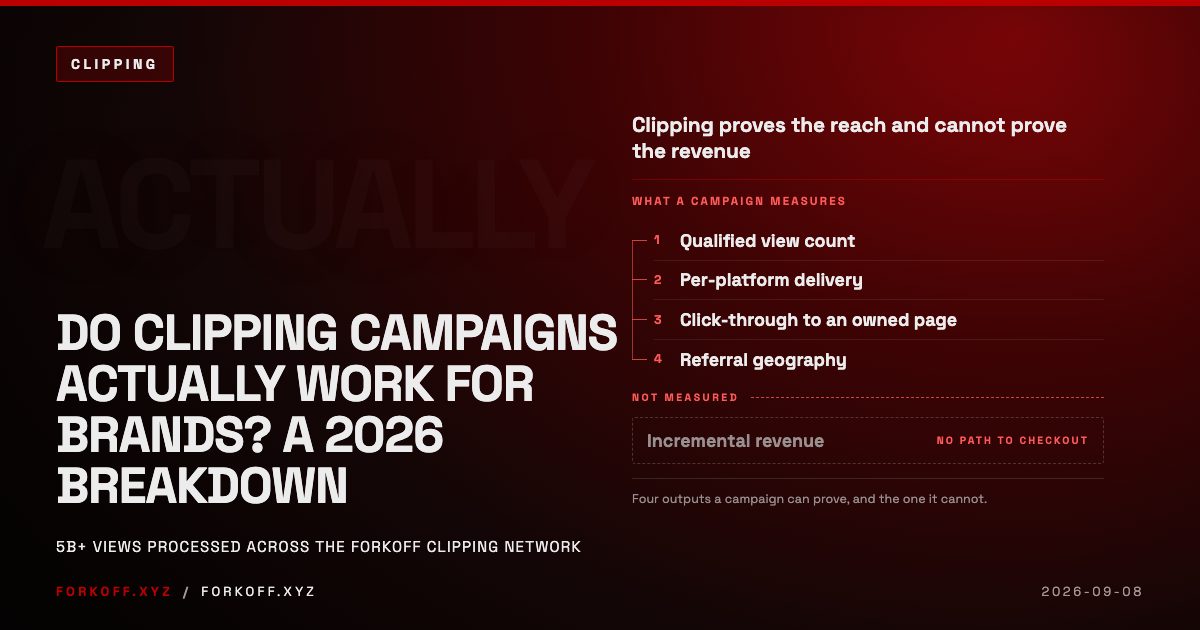
Do Clipping Campaigns Actually Work for Brands? A 2026 Breakdown
Clipping campaigns buy reach at a low unit price and cannot prove revenue. The 2026 breakdown of CPM by content signal, attribution and vendor diligence.
 Read
Read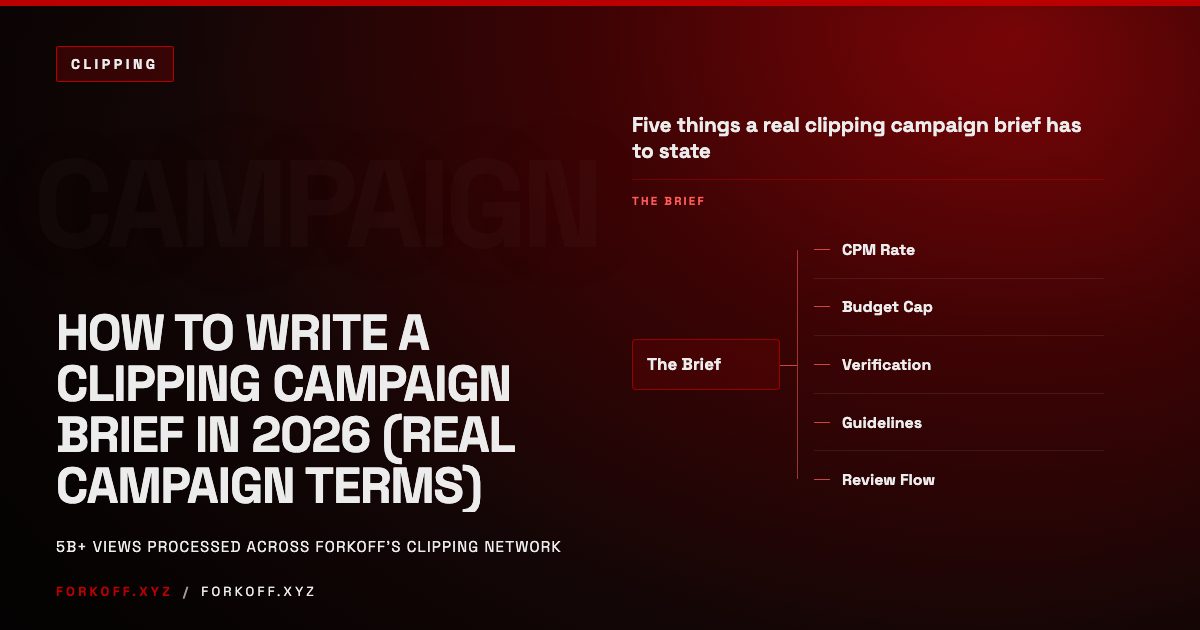
How to Write a Clipping Campaign Brief in 2026 (Real Campaign Terms)
A clipping campaign brief sets the CPM, budget cap, submission rules, and review flow that decide whether a campaign gets quality clips or wasted budget.
Read
Clipping a Game Launch: Turning Twitch and Kick Streams Into Qualified Installs
A launch-week playbook for clipping Twitch and Kick streams into qualified installs, with Drops mechanics, wishlist math, and a 7-day production calendar.
Read