
How to choose a clipping agency in 2026
Updated Jul 23, 2026
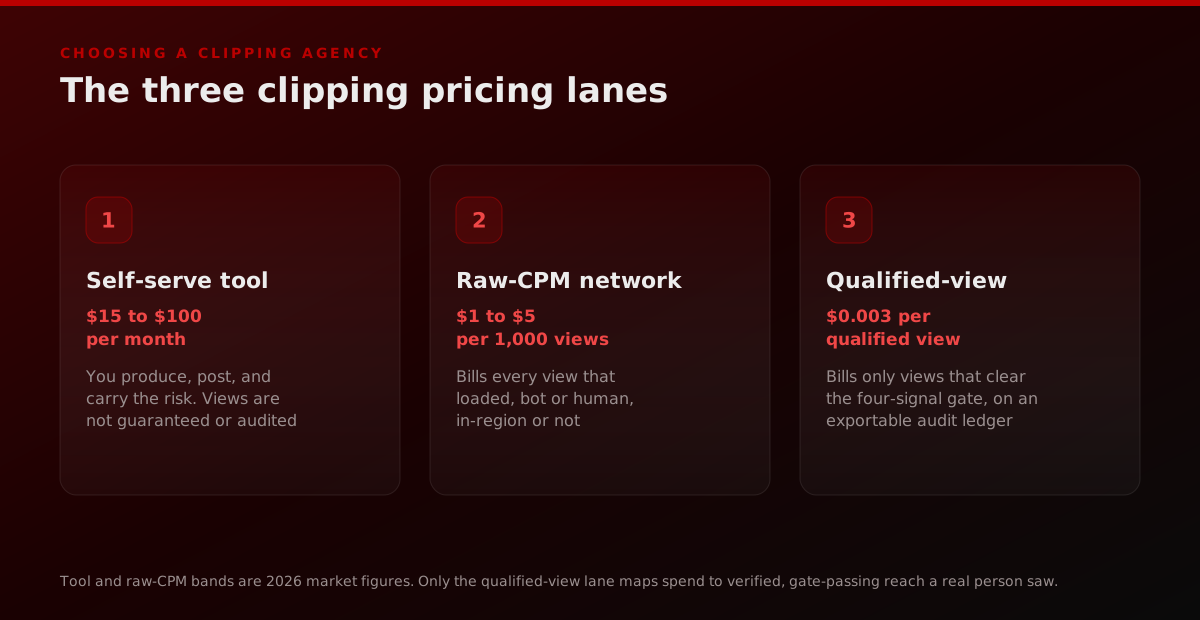
Choosing a clipping agency comes down to one test the sales page hides: can it prove the reach it sells is real. The category runs on three models, self-serve tools you operate yourself (about $15 to $100 a month), raw-CPM networks that bill every view that loaded (commonly $1 to $5 per 1,000 views), and managed agencies that run production and distribution for you. Six things decide the pick: how many creators the agency can activate and whether they are vetted humans or burner accounts, whether it reports verified reach or a raw counter, whether pricing is public and tied to a result, whether posts come from real accounts that will not put your own at risk, whether its proven niche matches yours, and whether distribution genuinely happens rather than editing alone. FORKOFF answers all six the same way: every view clears a four-signal qualification gate (real human, in-region, traffic-valid, not a bot or farm) and is reported on an audit ledger at $0.003 per qualified view, the integrity layer behind a network that has processed 5B+ views.
- 01Network size and vetting Ask how many creators the agency can actually activate, and whether they are vetted humans or automated and burner accounts. A large network number means nothing if the accounts are not real, so ask directly how creators are screened before they post.
- 02Verified reporting, not a raw counter The single question that separates a distribution partner from a view vendor: does it report reach that passed a verification check, or a raw platform counter that includes bots, duplicates, and out-of-region views. Ask what a reported view actually had to clear.
- 03Pricing that maps to a result Look for public pricing and, more important, what the price is charged per. A raw CPM bills every view that loaded; a qualified-view rate bills only views that cleared a gate. A public rate tied to a verified outcome is a stronger honesty signal than a quote you only get on a sales call.
- 04Real accounts and brand safety Ask whether posts come from real creator accounts or bot and burner accounts. Bot-driven posting can get your own accounts flagged and put the brand at risk, so a partner that cannot explain its account sourcing is a partner that cannot protect you.
- 05Niche fit An entertainment-first shop and a B2B, SaaS, or crypto-first shop are not interchangeable. Ask for named work in your category and channel, because the hooks and clippers that travel in music do not automatically travel for a founder or a protocol.
- 06Distribution, not just editing An editor gives you clips; an agency builds distribution around your content. Confirm the agency runs clipper recruitment, briefs, QA, payouts, and posting, not just production. A clip nobody distributes returns nothing, no matter how well it was cut.
The category competes on view count, which is the wrong number
Search for a clipping agency and you get three lanes: self-serve tools (OpusClip, Vizard, Klap) that you run yourself, raw-CPM networks that bill every view that loaded, and managed agencies that run production, a clipper roster, and distribution. Most of them compete on one headline number, total views, and most report it as a raw platform counter. That is the trap. A raw view count includes bots, duplicates, and out-of-region impressions that never reached a buyer, so two agencies can quote the same reach and deliver wildly different real audiences. The number that decides value is cost per qualified view, a view a genuine, in-region person actually saw, not a raw counter you cannot audit.
The six questions that separate a distribution partner from a landing page
Run any shortlist through six checks. One, how many creators can the agency activate, and are they vetted humans or burner accounts. Two, does it report verified reach or a raw counter. Three, is pricing public and tied to a result rather than a number you only get on a call. Four, do posts come from real accounts that will not get your own flagged. Five, does its proven niche match yours. Six, does distribution genuinely happen, or does the engagement stop at editing. Run every name on your list through the same six, including the nine agencies compared here; the ones that answer the first two with silence have already answered the question.
How FORKOFF answers all six
FORKOFF is built on the verification half the category skips. Every view clears a four-signal qualification gate (real human, in-region, traffic-valid, not a bot or farm) and is reported on an exportable audit ledger at $0.003 per qualified view, so the bill maps to reach a real person saw rather than a raw counter. The clipper network is vetted and cross-vertical (SaaS, AI, and Web3), the posting comes from real accounts, and the engagement runs the full chain from clipper briefs and QA to distribution, not editing alone. That integrity layer is the same one behind a network that has processed 5B+ views, and it is the direct answer to every one of the six checks a buyer should be running.
What to check before you sign a clipping agency
| Criterion | A partner worth signing | A view-count vendor |
|---|---|---|
| Network | Vetted, real creators you can size and screen | A big headline number, no vetting detail |
| Reporting | Verified, gate-passing reach on an audit ledger | A raw platform counter with bots and duplicates |
| Pricing | Public rate tied to a verified result | Quote only on a sales call, per raw view |
| Brand safety | Real creator accounts, low flag risk | Bot or burner accounts that risk your own |
| Niche fit | Named work in your category and channel | A generic reel from an unrelated vertical |
| Distribution | Runs briefs, QA, payouts, and posting | Hands back clips, no distribution |
Model bands (about $15 to $100 a month for self-serve tools, $1 to $5 per 1,000 raw views for CPM networks) are 2026 market figures, not FORKOFF numbers, and they price the tool or the raw view, never the verified reach. The checks that decide results, verified reporting and distribution, are the ones the sticker price never covers.
Frequently asked questions
What is the most important thing when choosing a clipping agency?
Whether it can prove the reach is real. Most of the category reports a raw view counter that includes bots, duplicates, and out-of-region impressions, so ask what a reported view actually had to clear before you compare headline numbers. A partner that reports verified, gate-passing reach on an audit ledger is worth more than one quoting a bigger raw number.
What questions should I ask a clipping agency before hiring?
How many creators can you activate, and are they vetted humans or burner accounts. Do you report verified reach or a raw counter. What is the price charged per. Do posts come from real accounts. Do you have named work in my category. Do you run distribution, or only editing. The first two answers tell you the most.
How do I compare clipping agency prices fairly?
Normalize every quote to cost per qualified view. A low raw CPM with no verification often costs more per genuine view than a higher qualified-view rate, because you pay for bot and out-of-region views you never reached. Take any raw-CPM quote, apply an honest legitimacy rate, and compare that to a gate-passing rate.
Is a clipping agency better than a clipping tool?
It depends on where your bottleneck is. If you have the time to produce, post, and manage account safety yourself, a self-serve tool is enough. If the bottleneck is distribution, volume, QA, and verified reporting, a managed agency removes that overhead and, done right, prices on reach a real person saw rather than a rendered clip.
How is FORKOFF different from other clipping agencies?
FORKOFF reports qualified views, not a raw counter. Every view clears a four-signal gate (real human, in-region, traffic-valid, not a bot or farm) and lands on an exportable audit ledger at $0.003 per qualified view. The clipper network is vetted and cross-vertical, posting comes from real accounts, and the same integrity layer sits behind a network that has processed 5B+ views.
Receipts, deep dives, and playbooks.
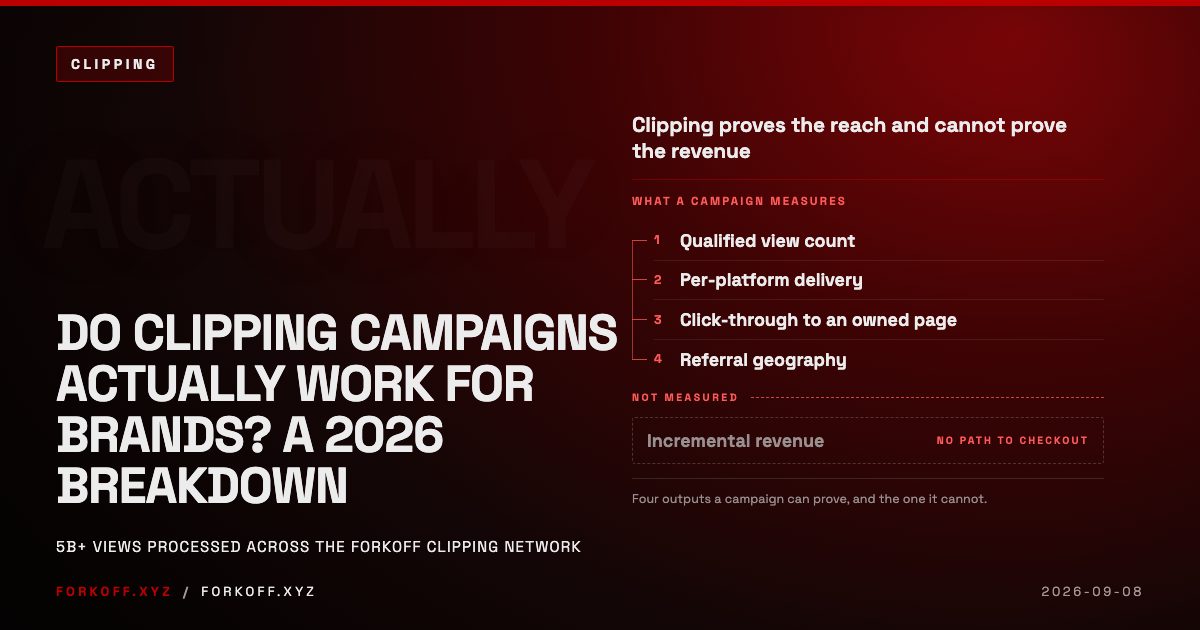
Do Clipping Campaigns Actually Work for Brands? A 2026 Breakdown
Clipping campaigns buy reach at a low unit price and cannot prove revenue. The 2026 breakdown of CPM by content signal, attribution and vendor diligence.
 Read
Read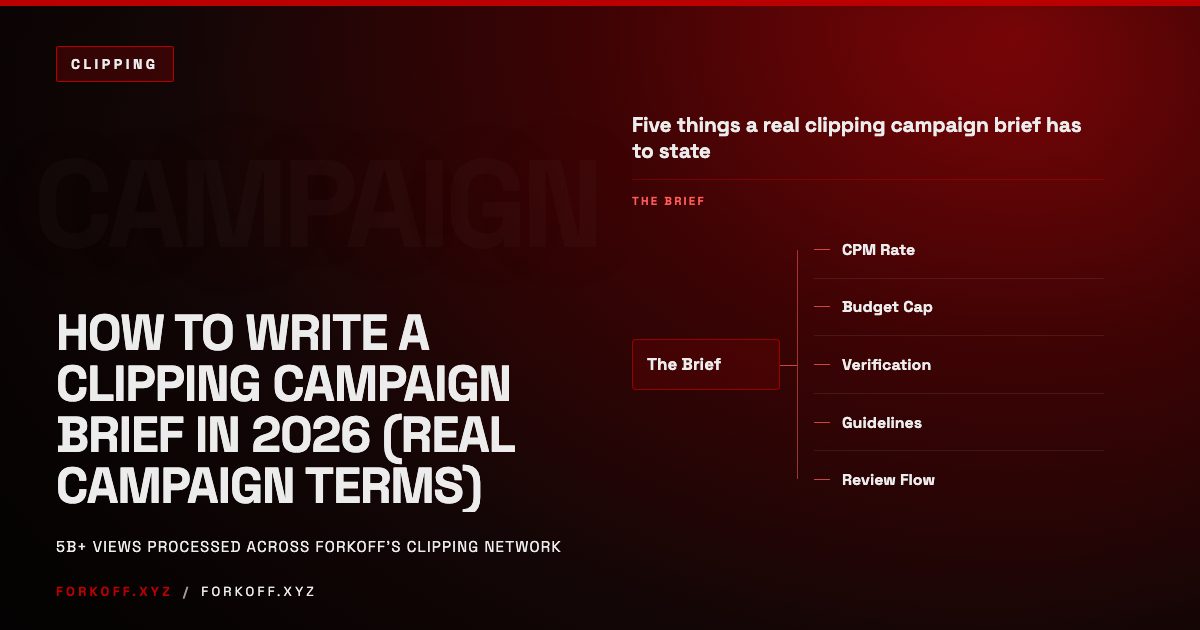
How to Write a Clipping Campaign Brief in 2026 (Real Campaign Terms)
A clipping campaign brief sets the CPM, budget cap, submission rules, and review flow that decide whether a campaign gets quality clips or wasted budget.
Read
Clipping a Game Launch: Turning Twitch and Kick Streams Into Qualified Installs
A launch-week playbook for clipping Twitch and Kick streams into qualified installs, with Drops mechanics, wishlist math, and a 7-day production calendar.
Read