
How to choose a LinkedIn marketing agency in 2026
Updated Aug 5, 2026
Choose a LinkedIn marketing agency on three things the category usually hides: whether they name the person writing in your voice, whether their engagement tactics are policy-compliant, and whether they report on buyer outcomes rather than impressions. FORKOFF researched this category directly in July 2026, dossiering eight founder-brand and LinkedIn agencies across 27 sources, and the findings are unusually consistent. Only one of the eight had a live independent review profile. The agency claiming the largest client base, roughly 185 to 200 clients, had no independent review presence at all. Three of the eight withheld their own founder's name while selling founder visibility as the product. Only two published pricing. Engagement-pod mechanics, which LinkedIn's own policies name, appeared as a standard category deliverable. So the useful vetting questions are not about deliverables or turnaround, they are about attribution, compliance, and proof.
- 01Ask who actually writes the posts Get the name of the specific writer or writers who will hold your voice, not a team description. Three of the eight agencies in our dossier withheld their own founder's identity while selling founder visibility, which is a reasonable proxy for how much attribution you will get on your own account.
- 02Ask directly whether they use pods or comment groups LinkedIn's Professional Community Policies tell members not to agree with others ahead of time to like or re-share each other's content. Engagement-pod mechanics showed up as a standard deliverable across this category, so ask explicitly and treat an evasive answer as a yes. Enforcement is silent reach suppression, and you inherit it.
- 03Demand independent proof, not a case-study deck Only one of eight agencies we dossiered had a visibly live independent review profile, and the one claiming the most clients had none. A self-authored case study is a marketing asset. Ask for a reference call with a current client at your stage, and check whether any third-party review footprint exists at all.
- 04Check whether the pricing is public Two of eight published pricing; the rest were quote-on-call. Public tiers we verified clustered in a budget band of roughly 500 to 1,200 US dollars a month and a premium band of roughly 3,000 to 4,000 US dollars a month. That range is your negotiating context, and opacity is itself a data point.
- 05Distinguish cadence sellers from distribution operators Nearly every agency in the category sells posting cadence as the core deliverable and stops at LinkedIn. Ask what happens to one founder interview: does it become one LinkedIn post, or does it also become a clip, a thread, a Reddit answer, and a podcast booking. That difference is the whole value gap.
- 06Fix the reporting metric before you sign Impressions and follower counts are the category's default proof, and both are easy to grow without producing a buyer. Agree in advance that reporting is on named outcomes: which target accounts engaged, which conversations started, which inbound arrived. FORKOFF reports LinkedIn distribution on qualified views and holds a 4 percent dwell floor and a 0.8 percent click-through floor.
What the category research actually found
FORKOFF dossiered this category in July 2026: eight founder-brand and LinkedIn authority agencies, 27 sources, US and Tier-1 scope. The pattern was consistent enough to be useful as a buyer's checklist. The field is fragmented into small shops of roughly 2 to 30 people. Pricing is mostly opaque, with two of eight publishing tiers. Independent review proof is close to absent: one of eight had a live third-party review profile, and the inversion is telling, because the agency claiming the largest client base, roughly 185 to 200 clients, had no independent review presence whatsoever. Claim size and verifiable footprint moved in opposite directions. Three of eight declined to name their own founder while selling founder visibility. And self-authored best LinkedIn ghostwriting agency listicles are the category's dominant search tactic, with at least one agency ranking itself first on its own list, so the rankings you find while researching are frequently written by the ranked. We are describing the pattern rather than naming shops, because the pattern is what transfers to whoever you are evaluating.
The three questions that separate the field
Vetting gets simple once you know where the category is weak. First, attribution: who writes, named, and do you approve every draft against a voice guide. An agency that will not name the writer is asking you to put an unnamed person's words in your mouth. Second, compliance: are pods, comment groups, or reciprocal-engagement extensions anywhere in the process. This is not a purity test, it is risk transfer, because the reported enforcement is silent distribution suppression and it lands on your account, not theirs. See do LinkedIn engagement pods work for the policy language to quote at them. Third, measurement: what exactly appears in the monthly report. If the answer is impressions, followers, and total engagements, you are buying a number that can be grown without ever reaching a buyer. If it is named accounts, conversations, and inbound, you are buying the thing you actually wanted.
Where FORKOFF sits, stated plainly
FORKOFF sells LinkedIn as distribution, not as a posting subscription. Organic distribution on LinkedIn is one of four components of the launch engagement, it runs standalone or paired with an X launch, and it is built for B2B and DevTools. The structural difference from the category is that LinkedIn is one surface among several rather than the whole product, so one founder interview becomes a LinkedIn post, a clip, an X thread, and a podcast booking, on a distribution network that has processed 5B+ views. Reporting is on qualified views, a view that cleared a four-stage gate for real human, in region, traffic valid, and not bot or farm. The standing doctrine is real accounts, never a pod. Pricing for the LinkedIn component is set per engagement rather than published as a tier, so ask for it directly. Start with FORKOFF Founder Funnel for the always-on motion or product launch for a launch window.
The LinkedIn agency vetting checklist
| What to ask | A good answer | The category default |
|---|---|---|
| Who writes in my voice | A named writer, with founder approval on every draft | A team description, no names (3 of 8 hid their own founder) |
| Do you use pods or comment groups | A clear no, with the policy cited | Pod mechanics sold as a standard deliverable |
| What independent proof exists | A live third-party review profile plus a reference call | None (1 of 8 had any independent review footprint) |
| What does it cost | Published tiers or a straight answer | Quote-on-call (6 of 8 disclosed nothing) |
| What happens to one interview | It becomes several assets on several surfaces | One LinkedIn post, LinkedIn only |
| What is in the monthly report | Named accounts, conversations, inbound | Impressions, followers, total engagements |
Findings from FORKOFF's own competitive dossier on the LinkedIn founder-brand agency category, 8 agencies across 27 sources, July 2026, US and Tier-1 scope. Verified public pricing in that set clustered at roughly 500 to 1,200 US dollars a month (budget tier) and 3,000 to 4,000 US dollars a month (premium tier). Agencies are described as a pattern rather than named.
Frequently asked questions
How do you choose a LinkedIn marketing agency?
Vet on attribution, compliance, and measurement. Get the name of the person writing in your voice, ask directly whether engagement pods or comment groups are part of the process, and fix the reporting metric to named buyer outcomes rather than impressions before you sign. Those three answers separate the field faster than any deliverable comparison, because they are where this category is consistently weak.
How much does a LinkedIn marketing agency cost?
Most do not publish pricing. In FORKOFF's July 2026 dossier of eight agencies, only two disclosed tiers publicly, clustering at roughly 500 to 1,200 US dollars a month at the budget end and 3,000 to 4,000 US dollars a month at the premium end. Treat that as negotiating context. FORKOFF prices LinkedIn distribution per engagement rather than as a published tier, so ask for a quote against your scope.
What are the red flags in a LinkedIn agency pitch?
Four recurring ones: no named writer, evasiveness about pods or comment groups, no independent review footprint despite large client claims, and reporting built on impressions and follower counts. A fifth is worth knowing while you research, because self-authored best LinkedIn agency listicles are the category's dominant search tactic, so a ranking you find may well have been written by the agency ranked first on it.
Should a LinkedIn agency name the ghostwriter working on my account?
Yes, and it is a fair thing to insist on. You are putting another person's words out under your name, so you should know whose they are and approve every draft against a voice guide. In our dossier, three of eight agencies withheld their own founder's identity while selling founder visibility as the product, which is a reasonable signal about how much attribution a client gets.
Is a LinkedIn specialist better than a full distribution agency?
It depends on whether LinkedIn is your whole channel or one of several. Every agency in our dossier stopped at LinkedIn, sometimes with adjacent X outreach, so a specialist is fine if LinkedIn alone is the plan. If you want one founder interview to become a LinkedIn post, a clip, an X thread, and a podcast booking, you need an operator that runs multiple surfaces, which is how FORKOFF is built.
Receipts, deep dives, and playbooks.
The Distribution Learning Curve: Sell Your Own Growth Before You Buy It
Sequoia says founders must close their own first deals before scaling sales. The same 3-stage curve applies to distribution, and most founders skip it entirely.
 Read
Read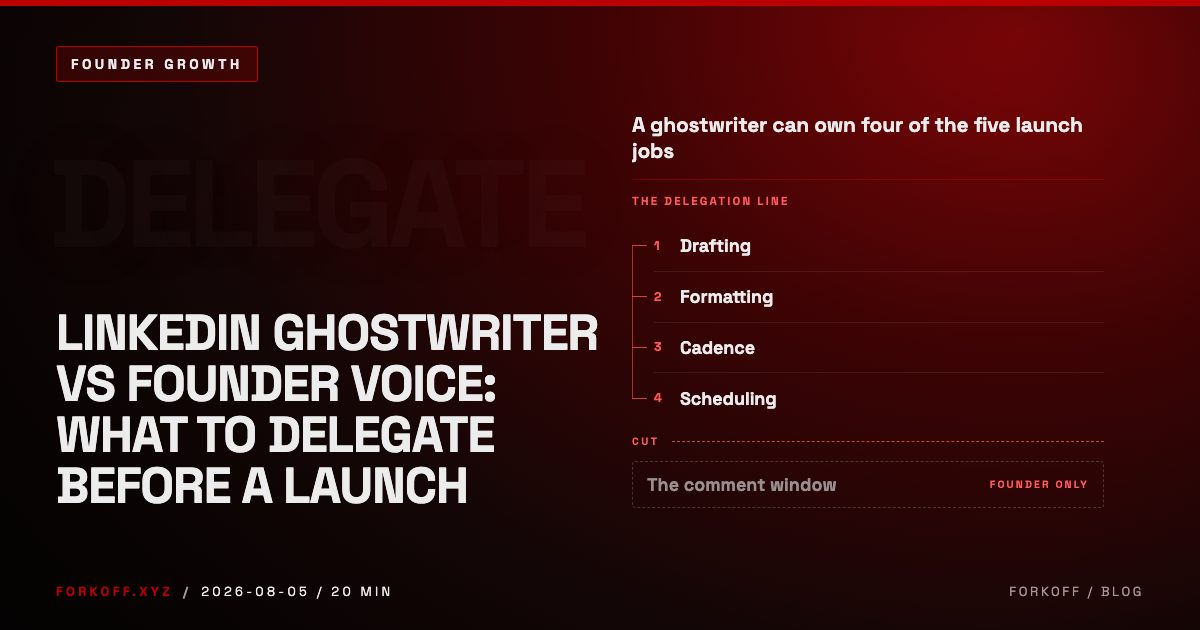
LinkedIn Ghostwriter vs Founder Voice: What to Delegate Before a Launch
A LinkedIn ghostwriter can draft your launch posts. It cannot reply in your comments or show up on the call. Here is where the line actually falls.
Read
Developer Relations for Startups: How to Win Your First 1,000 Developers
Developer relations for startups is a distribution problem, not a hiring one. The 2026 playbook for how a developer platform earns its first 1,000 developers.
Read