
Does LinkedIn marketing work for B2B SaaS in 2026?
Updated Aug 5, 2026
Yes, for B2B SaaS it is usually the highest-proximity organic channel available, because the buyer, the champion, and the budget holder are all on it and all reachable without paying for placement. It works when it is run as distribution with a cadence and a named account list, and it fails when it is run as a posting subscription measured in impressions. The mechanism is proximity rather than volume: a LinkedIn post reaches fewer people than an equivalent post on X, but a meaningfully larger share of them can start or approve a purchase, and the post itself is forwardable inside a company in a way a tweet is not. The honest caveat is that it is slow. LinkedIn has no quote-tweet wave to carry a post outward, so reach compounds over months of consistency rather than spiking. FORKOFF runs it on a 5-per-week founder cadence against a 4 percent dwell floor and a 0.8 percent click-through floor.
FORKOFF's own LinkedIn Marketing service is built for one number: according to Refine Labs, a personal profile earns 2.75 times more impressions and 5 times more engagement than a company page, even with fewer followers. Refine Labs, Employee Profiles Outperform Brand Pages on LinkedIn (2026)
- 01Why it works: proximity, not reach For B2B SaaS the whole buying committee is on LinkedIn and reachable organically. That is rare. A post with a few thousand impressions can land in front of the exact VP who owns the problem, which no volume metric captures and which is the entire reason the channel pays.
- 02It works as distribution, not as posting The version that fails is a content subscription: posts go out, impressions accumulate, nothing happens. The version that works pairs a fixed cadence with a named account list and comment work, so the posting has a target rather than an audience in the abstract.
- 03Consistency beats volume, but volume is not penalised Buffer's study of more than 2 million posts found frequency compounds rather than caps: weeks with 11 or more posts averaged roughly 16,946 more impressions per post and 1.40 percentage points more engagement than the same accounts' quieter weeks. The comparison is not like for like with a founder running a company, and treating 11 or more posts a week as reachable is our own judgement call rather than a caveat Buffer publishes, so treat consistency as the floor and extra volume as optional upside.
- 04Below one post a week the channel switches off Published guidance converges on the point that under roughly one post a week, distribution is significantly deprioritised. There is a real threshold below which LinkedIn effort returns close to nothing, which is why a sporadic founder presence reads as evidence the channel does not work when it is evidence the cadence did not exist.
- 05The founder profile outperforms the company page Person-to-person distribution is how LinkedIn works, so the founder's own profile does the heavy lifting and the company page supports it. B2B guidance consistently recommends executives posting from personal profiles to supplement page reach, not the reverse.
- 06Measure dwell and clicks, then pipeline Impressions and followers are the metrics that make this channel look like it is working when it is not. Hold a dwell floor and a click-through floor, then attribute inbound demos and warm intros by name. FORKOFF runs to 4 percent impression-to-dwell and 0.8 percent click-through, and reports on qualified views.
The case for LinkedIn in B2B SaaS is proximity
Most channel comparisons are argued on reach, which is why LinkedIn looks weak on paper. It is weak on reach. The argument for it in B2B SaaS is that reach is the wrong axis: the question is how many of the people you reached can start, champion, or approve a purchase, and on LinkedIn that share is higher than on any other organic surface available to a founder. A post that reaches three thousand people on LinkedIn and includes forty of your target VPs is worth more than one that reaches thirty thousand people on X and includes none. LinkedIn posts are also forwardable inside a company, which is a genuinely underrated property, because in a committee-bound sale your champion needs something to send. A tweet does not survive that trip. This is why LinkedIn versus X for a product launch resolves toward LinkedIn for B2B and DevTools, and toward X for consumer and developer products.
The published data disagrees with itself, and the disagreement is useful
There is no consensus number for how much to post, and pretending otherwise would be dishonest. Hootsuite recommends 1 to 2 posts a day on LinkedIn and reports its own account going higher. Sprout Social declines to give a hard number, and its 2025 Content Benchmarks work suggests scaling volume back to make room for higher-value content. Buffer's analysis of over 2 million posts contradicts the less-is-more framing outright, finding that more posting compounds impressions and engagement with no visible reach cap. Read together, these do not cancel out. They say the ceiling is quality and capacity, not an algorithmic penalty, so the operating rule is to post as often as you can sustain without the per-post engagement rate falling. FORKOFF settles this at five a week in fixed weekday slots, which is the sustainable point for a founder with a company to run. The full structure is in the LinkedIn distribution cadence playbook.
When LinkedIn does not work for a B2B SaaS
Three situations where the honest answer is no. First, when the actual buyer is not on LinkedIn: some developer-tool and infrastructure purchases are decided by engineers who live on X, GitHub, and Hacker News, and a LinkedIn presence reaches their VP who is not the decision maker. Second, when nobody can sustain the cadence: below about one post a week distribution is deprioritised heavily enough that the effort returns close to nothing, so a founder who cannot commit is better off putting the time into one channel they can. Third, when success is defined as impressions, because that definition can be satisfied indefinitely without producing a single conversation. If you are unsure which channel your buyer is on, resolve that before buying any distribution, and note that our Reddit versus LinkedIn for B2B distribution comparison covers the third common option for reaching technical buyers.
What the published cadence data says, and where it conflicts
| Source | The number | What it implies |
|---|---|---|
| Hootsuite | 1 to 2 posts a day, own account higher | No reach penalty for volume; capacity is the limit |
| Sprout Social | No fixed number; argues for scaling volume back | Consistency and originality over volume |
| Sprout 2025 Content Benchmarks | Scaling back volume can help | Directly opposes the post-more position |
| Buffer, 2M+ posts | 11+ a week: about +16,946 impressions per post, +1.40pp engagement | Frequency compounds. We do not treat 11+ a week as reachable for a working founder |
| Convergent floor | Below about 1 a week, distribution deprioritised | There is a real switch-off threshold |
| FORKOFF operating cadence | 5 a week, fixed weekday slots | The sustainable point for a working founder |
The Hootsuite, Sprout Social, and Buffer figures are those publishers' own published research, not FORKOFF figures, and they genuinely conflict on volume. The 5-per-week cadence, the 4 percent impression-to-dwell floor, and the 0.8 percent click-through floor are FORKOFF's own operating thresholds for LinkedIn distribution.
Frequently asked questions
Does LinkedIn marketing work for B2B SaaS?
Yes, and for most B2B SaaS it is the highest-proximity organic channel available, because the buyer, the champion, and the budget holder are all reachable there without paid placement. It works when run as distribution with a fixed cadence and a named account list. It fails when run as a posting subscription measured in impressions, which is the most common way companies conclude the channel does not work.
How long does LinkedIn take to work for B2B SaaS?
Months, not weeks, and that is the main honest drawback. LinkedIn has no quote-tweet equivalent to carry a post beyond your network, so reach compounds through consistency rather than spiking. B2B guidance commonly suggests holding a cadence for at least 90 days before drawing conclusions, and below roughly one post a week distribution is deprioritised enough that the effort returns very little.
Should a B2B SaaS post from the founder profile or the company page?
The founder profile does the heavy lifting and the company page supports it. LinkedIn distributes person to person, so a founder's post reaches meaningfully further than the same content from a brand account, and standard B2B guidance is for executives to post from personal profiles to supplement page reach rather than the other way round.
How often should a B2B SaaS post on LinkedIn?
The published guidance conflicts. Hootsuite says 1 to 2 a day, Sprout Social gives no fixed number and suggests scaling back volume, and Buffer's 2 million post study finds frequency compounds with no reach cap. The resolution is that quality and capacity are the ceiling, not a penalty, so post as often as you can sustain while per-post engagement holds. FORKOFF runs five a week in fixed slots.
Is LinkedIn better than Reddit or X for reaching B2B buyers?
It depends who decides. LinkedIn is strongest when the buyer is an operator or executive who must justify a purchase internally, because posts are forwardable and land near budget authority. X is stronger for developer and consumer products, and Reddit is often stronger for technical buyers researching a problem. Establish where your decision maker actually is before committing distribution budget to any of them.
Receipts, deep dives, and playbooks.
The Distribution Learning Curve: Sell Your Own Growth Before You Buy It
Sequoia says founders must close their own first deals before scaling sales. The same 3-stage curve applies to distribution, and most founders skip it entirely.
 Read
Read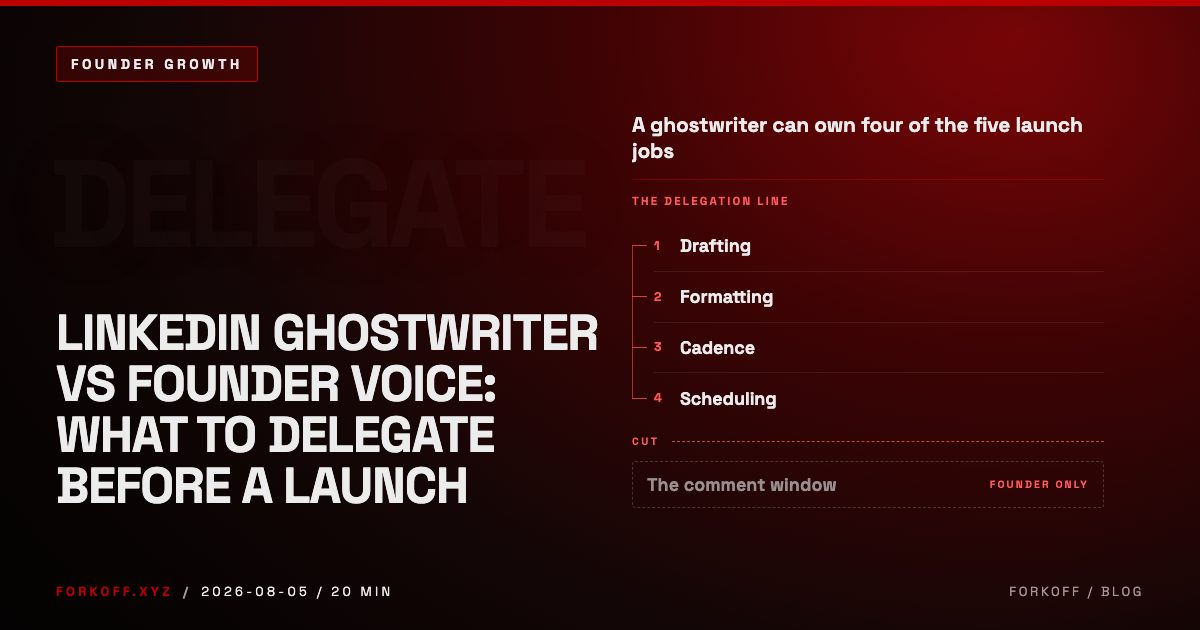
LinkedIn Ghostwriter vs Founder Voice: What to Delegate Before a Launch
A LinkedIn ghostwriter can draft your launch posts. It cannot reply in your comments or show up on the call. Here is where the line actually falls.
Read
Developer Relations for Startups: How to Win Your First 1,000 Developers
Developer relations for startups is a distribution problem, not a hiring one. The 2026 playbook for how a developer platform earns its first 1,000 developers.
Read