Do LinkedIn engagement pods work in 2026?
Updated Aug 5, 2026
No, and they are a policy violation, which makes them a poor trade even when they briefly move a number. An engagement pod is a group that agrees in advance to like and comment on each other's posts to trigger the algorithm. LinkedIn's own Professional Community Policies address this directly: under the instruction not to spam members or the platform, LinkedIn writes "Don't do things to artificially increase engagement with your content" and "don't agree with others ahead of time to like or re-share each other's content". That second clause is a description of a pod. Enforcement is the part buyers underestimate: the reported pattern is distribution suppression rather than account suspension, so posts quietly stop reaching people while the account looks healthy and nobody sends a warning. Pods also poison the signal you actually need, because engagement from a pod is engagement from people who will never buy. FORKOFF's launch doctrine is real accounts, never a pod.
FORKOFF's own LinkedIn Marketing service skips pods entirely: according to Refine Labs, 2.75x more impressions and 5x more engagement go to a real personal profile than a company page, no pod required. Refine Labs, Employee Profiles Outperform Brand Pages on LinkedIn (2026)
- 01What an engagement pod is A group of accounts, often coordinated in a chat group or a browser extension, that agree ahead of time to like and comment on each other's posts within minutes of publishing, so the early-engagement signal pushes the post into wider distribution.
- 02Why LinkedIn treats it as a violation LinkedIn's Professional Community Policies instruct members not to artificially increase engagement and not to agree with others ahead of time to like or re-share each other's content. A pod is that arrangement by definition, so this is not a grey area subject to interpretation.
- 03How enforcement actually shows up The reported enforcement pattern is suppression rather than suspension. Content stops appearing in feeds while the account remains active and unwarned, which is the worst possible failure mode because you cannot tell it is happening and you keep paying for the strategy that caused it.
- 04The tooling is not safe either Lempod, the most widely used pod extension, was banned and removed from the Chrome Web Store. Any tool whose function is coordinating reciprocal engagement is automating the exact behaviour the policy names, so the tool being convenient does not make the activity permitted.
- 05The signal cost nobody prices in A pod fills your comments with people selected for reciprocity, not for being buyers. You lose the only useful thing early engagement tells you, which is whether the right accounts care. For a launch that is the entire measurement, so a pod does not just risk reach, it destroys the read.
- 06What to do instead Build the reciprocity genuinely and in advance. Engage with a named list of operators, investors, and customers for weeks before you need anything, so their engagement on your launch day is real and comes from accounts that matter. It is slower to start and it compounds instead of decaying.
The policy language is unusually explicit
Most platform-manipulation debates turn on interpreting vague terms. This one does not. LinkedIn's Professional Community Policies, under the heading about not spamming members or the platform, say: "Please make the effort to create original, professional, relevant, and interesting content in order to gain engagement. Don't do things to artificially increase engagement with your content. Respond authentically to others' content and don't agree with others ahead of time to like or re-share each other's content." The last clause is a definition of an engagement pod written by the platform that would be enforcing against it. Anyone selling pod participation as a growth tactic is selling something the policy names. Worth knowing before you buy: FORKOFF's own competitive research into the LinkedIn founder-brand agency category, an eight-agency dossier completed in July 2026 across 27 sources, found engagement-pod mechanics being sold as a standard deliverable in that category. So this is not a fringe tactic you would have to seek out, it is something a retainer may be quietly doing on your behalf.
Suppression is worse than a ban, because it is invisible
If pods got accounts suspended, the market would have abandoned them years ago, because the feedback would be immediate and unmissable. The reported enforcement pattern is the opposite: distribution quietly degrades while the account stays active and receives no notice. That produces a genuinely bad situation where a founder keeps posting, keeps paying an agency, and keeps seeing pod engagement in the comments, while the reach that would have come from real distribution is gone and nothing in the interface explains why. Be careful with the numbers circulating on this. Specific reach-penalty percentages are widely quoted, but the ones we could trace resolve to marketing blogs and vendors selling competing engagement or automation tools, and LinkedIn has published no detection-accuracy or penalty figures. We are not repeating those numbers here. The well-corroborated parts are the policy language above and the suppression-not-suspension shape of enforcement, which is enough to make the decision.
What replaces a pod on a launch
A pod is an attempt to manufacture the early-engagement signal that real relationships produce. The durable version is to build those relationships on a schedule instead. FORKOFF runs a named-account warm-up in the two weeks before a launch: the founder engages genuinely with the specific operators, investors, and customers whose presence in the first hour would matter, so that on launch day the engagement is real, it comes from accounts with buying relevance, and it survives any enforcement because there is nothing to enforce against. This is the same doctrine the FORKOFF launch engine applies on X, where the standing rule is real accounts, never a pod. The mechanics, including the fixed weekday slots and the named-account warm-up, are in the LinkedIn distribution cadence playbook.
Engagement pod versus earned warm-up
| Factor | Engagement pod | Earned warm-up |
|---|---|---|
| Policy status | Named in LinkedIn's Professional Community Policies | Compliant, nothing to enforce against |
| Who engages | Accounts selected for reciprocity | Operators, investors, and customers who matter |
| Failure mode | Silent distribution suppression, no warning | None, the relationship persists |
| Signal quality | Destroys the read on whether buyers care | Early engagement is the read |
| Tooling risk | Lempod was banned and removed from the Chrome Web Store | No tool dependency |
| Compounding | Decays, and reverses if enforced | Compounds across launches |
The policy quotation is from LinkedIn's own Professional Community Policies. Widely quoted reach-penalty percentages were excluded here because the ones we could trace resolve to vendors selling competing engagement tools, and LinkedIn publishes no such figures. Search demand for "linkedin engagement pods" runs about 70 monthly US queries (DataForSEO, August 2026).
Frequently asked questions
Do LinkedIn engagement pods work?
No, not in any way worth buying. Even when a pod briefly lifts a post's numbers, it violates LinkedIn's Professional Community Policies, which explicitly tell members not to agree with others ahead of time to like or re-share each other's content. The reported enforcement is silent distribution suppression rather than a ban, so the downside arrives without a warning and is hard to diagnose.
Are LinkedIn engagement pods against the rules?
Yes. LinkedIn's Professional Community Policies state "Don't do things to artificially increase engagement with your content" and "don't agree with others ahead of time to like or re-share each other's content". A pod is precisely that pre-arranged reciprocal engagement, so it is named by the policy rather than merely discouraged by it.
Will an engagement pod get my LinkedIn account banned?
A ban is not the usual outcome, and that is the problem. The reported enforcement pattern is distribution suppression: posts stop reaching people while the account stays active and receives no notification. You lose reach without being told, which is harder to detect and to recover from than a clear penalty would be.
What should I use instead of an engagement pod?
Build the reciprocity genuinely before you need it. Engage with a named list of operators, investors, and customers for two weeks or more ahead of a launch, so their launch-day engagement is real and comes from accounts with actual buying relevance. That is what FORKOFF runs as the pre-launch warm-up, and unlike a pod it compounds across launches.
Do LinkedIn marketing agencies use engagement pods?
Some do. FORKOFF's July 2026 competitive dossier on the LinkedIn founder-brand agency category, covering eight agencies across 27 sources, found engagement-pod mechanics sold as a standard deliverable in that category. Ask any agency directly whether pods, comment groups, or reciprocal engagement tooling are part of their process, and treat a vague answer as a yes.
Receipts, deep dives, and playbooks.
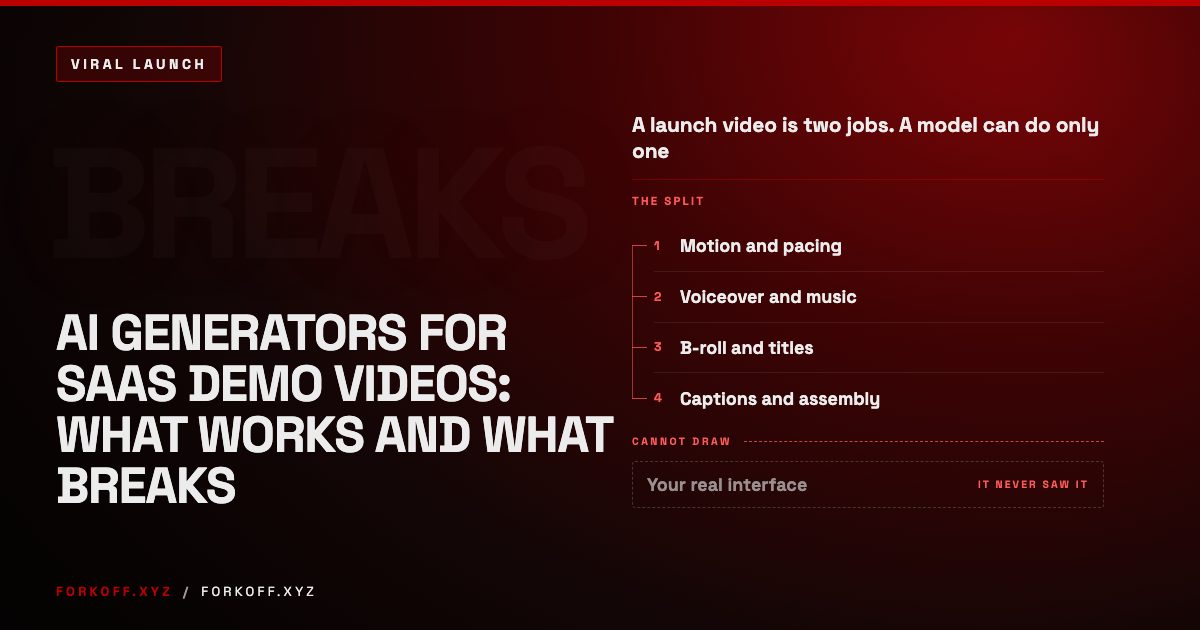
AI Generators for SaaS Demo Videos: What Works and What Breaks
AI video generators handle motion, voiceover and pacing well and draw your interface badly. Which half of a launch video to give a model, which half to keep.
 Read
Read
Why Sora Went Viral in 5 Days, and Dead in 6 Months
OpenAI's Sora beat ChatGPT to 1M downloads, then shut down 6 months later. The public download, revenue, and moderation data behind both halves.
Read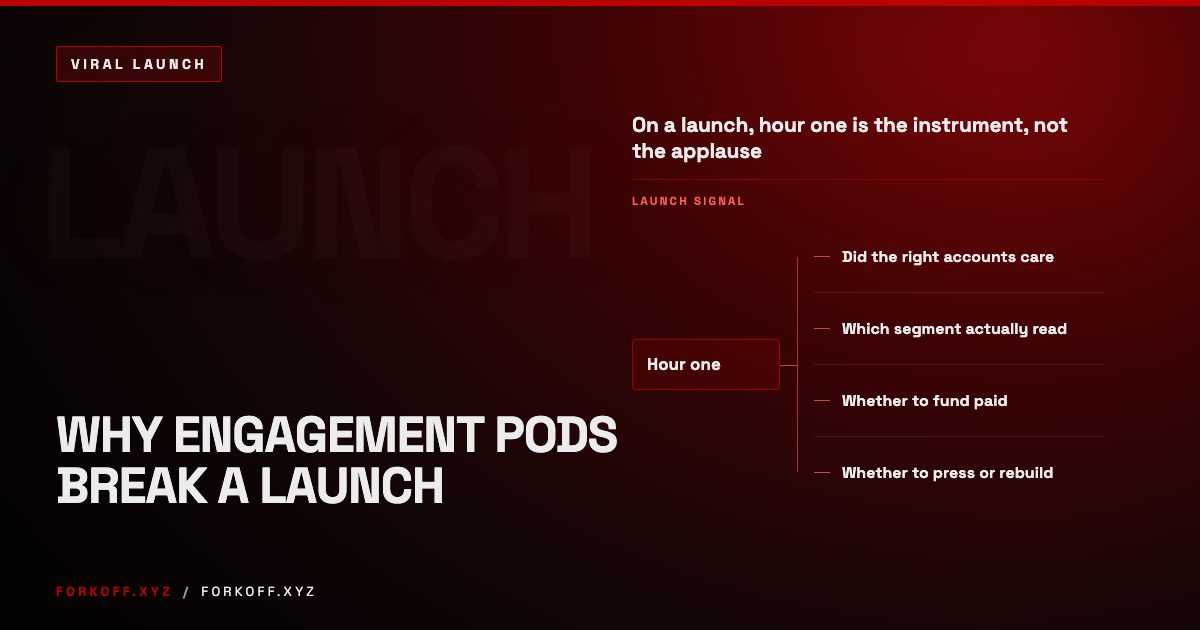
Why Engagement Pods Break a Launch
On an ordinary post a pod costs you some reach. On a launch it costs you the only measurement you had. LinkedIn's own trust VP explains where the penalty lands.
Read