

Sue
@suekhim · 15.3K followers
AI is making kids dumber. It should be making them geniuses. Introducing Koji, the first AI tutor that gets kids to actually think. 👇
Koji launchLargely Organic
Koji is a real product by a real founder (@suekhim). RADAR has tracked 4.8M views on this launch, according to the source post linked below. RADAR measures how the launch reach was built, not whether the product works or whether anyone was honest. This reading is reconstructed confidence and every input is public.
By Simba, Launch Intelligence Analyst · Reviewed by JK · Published 28 Jun 2026 · Confidence: reconstructed
Independent, methodology-derived signal, not a statement of fact about any person. RADAR reads how reach was built, a signature, not an accusation. See the methodology.
Did the Koji launch go viral organically, or was the reach amplified?
The Koji launch by @suekhim drew 4.8M views on 12.2K likes, which is 396 views per like, inside the roughly 500 organic ceiling. RADAR reads the reach as organic: reach and engagement grew together and no distribution-amplified signature shows in the public metrics. This is a reconstructed reading and every input is public and reproducible.
New here? Start with the product
What is RADAR, and what does this grade mean?
RADAR is FORKOFF's launch authenticity rating system. It reads whether a product launch earned its reach through real engagement or bought it through paid distribution, using only public signals anyone can pull from the launch post. Every reading carries a letter grade, a confidence label, and the date it was last checked, and links back to a published method you can reproduce. Koji is a real product by a real founder (@suekhim). RADAR measures how the reach was built, not whether the product works or whether anyone was honest.
Largely Organic
Independent, methodology-derived signal, not a statement of fact about any person. RADAR reads how reach was built, a signature, not an accusation. See the methodology.
What this grade means
This launch carries an Authenticity Grade of Largely Organic. RADAR reads its reach as organic: the views and the genuine engagement grew together, and no distribution-amplified signature shows in the public metrics. That is a favorable, low-risk read.
The signals RADAR reads
Views-to-likes ratio
Organic reach tops out near 500 views per like. When views climb far past that without the likes to match, the extra reach is arriving without the engagement organic reach produces.
Amplification wave shape
Organic amplification spreads over hours and days. A coordinated launch fires a synchronized burst of quote posts in the first few hours, read from each post's own timestamp.
Posting-time fingerprint
A post that fires exactly top of the hour on a weekday is scheduled. On its own it is weak, but it corroborates a coordinated launch alongside the other two signals.
Those three public signals sit on top of RADAR's five-component forensic read. The full method, the bands, and the confidence model are on the RADAR methodology page.
This launch in the data
Where does this reach sit against the tracked corpus?
Where it sits in the corpus
Rank 6 of 30 tracked launches by views per like, lowest (most organic) first. A lower ratio is the favorable end.
Against the benchmark
This launch's views per like next to the organic median (354) and the amplified median (1,441) across the tracked set.
A real founder, a real product, and reach that engagement kept pace with.
Here is what makes this launch a clean positive read. Almost every public signal points the same way at once. A genuine, long-standing founder on a fourteen-year-old company posted to her own audience. The like rate held proportionate to a mega-viral view count. The reply and quote layers, which a like-farm cannot cheaply manufacture, came in heavy and two-sided, with supporters and skeptics arguing in the open. When every layer of engagement rises with the reach instead of lagging far behind it, the simplest explanation is the true one: the post spread because real people passed it on.
The rest of this teardown walks the reading first, then steps back to the product, the founder, the funding, and the market, so a reader can audit the read and understand the launch in full. RADAR exists to separate the marketing layer (what a launch claims) from the data layer (what the public signals actually show). A reads-organic verdict is a compliment about how the launch spread. It is not, and we will say this plainly later, an endorsement of the product itself.
Engagement coupling: the layers rose with the reach
The thing that often hides a buy is missing here. Sue Khim's personal account carries a modest base, around 15,300 followers, against a 4.84M-view launch. A bought-view operation typically inflates views far faster than it can buy proportionate, coupled engagement, so the tell is reach that outruns the likes, replies, and quotes. RADAR went looking for that gap and did not find it. The engagement scaled with the reach.
Signal one: the views-to-likes gauge in the organic zone
The load-bearing signal is V:L, views divided by likes. On X, the feed that surfaces a post also makes it easy to like, so under organic distribution reach and likes rise together up to roughly 500 views per like. X's 2026 ranking treats engagement types as interconnected signals and rewards them together, with written replies weighted heavily for authenticity because a reply is costly effort (opentweet.io, sproutsocial.com). When views climb but likes do not keep pace, the views are arriving from a channel that does not also produce engagement. The Koji launch shows the opposite: 4,840,488 views divided by 12,229 likes is 395.8 views per like, a like rate near 0.25 percent, which is in the normal band for a post that has reached this far (tweetarchivist.com).
Signal two: the costly layers came in heavy
Likes are the cheapest action to fake. Replies and quotes are not, because each one is a written post that a real person had to compose. Fake-engagement detection guidance describes the bought pattern as a ratio mismatch, high likes but no replies, or replies but no retweets, often arriving in unnatural waves (miqwal.com, tweetarchivist.com). The Koji launch is the inverse of that pattern. Every layer is present and proportionate: 12,229 likes, 1,260 reposts, 2,182 replies, and 492 quotes. Total engagement of 16,163 actions sits near 0.33 percent of views, inside the normal band for a mega-viral post.
Views per like
Under the 500 organic ceiling. Likes kept pace with a 4.84M-view reach instead of lagging far behind it.
Replies
Written posts, the costliest action to fake at scale. A heavy reply layer is the hallmark of real conversation, not a view buy.
Quotes
Each quote is an original post amplifying with commentary. Coverage notes a two-sided split: praise plus open skepticism.
Total coupling
Likes plus reposts plus replies plus quotes (16,163) against 4.84M views. Inside the normal engagement band for very high reach.
Signal three: a real two-sided conversation
The shape of the conversation matters as much as its size. Search synthesis of the replies and quotes shows a genuine mixed debate: many users praised Koji for building critical thinking, while skeptics called it unnecessary or worried it would reduce motivation compared with human teachers (thenews.com.pk). A bought spike does not argue with itself. A real two-sided reply distribution, supporters and detractors engaging on their own, is a strong tell of authentic reach. The launch also drew earned third-party pickup within hours, with independent writeups and a creator thread quoting the announcement, rather than a single coordinated push (chatgate.ai, x.com/Kawsar_Ai).
Read together, the three signals tell one story. The reach grew the way organic reach grows. A genuine founder posted to her own audience on a live, established product; the like rate held under the organic ceiling; and the expensive engagement layers came in heavy and two-sided. There is no decoupled view spike here to explain away.
What Koji actually is
Sue Khim announced it on her own channels. The X launch read: "AI is making kids dumber. It should be making them geniuses. Introducing Koji, the first AI tutor that gets kids to actually think" (x.com/suekhim, 29 May 2026), and she mirrored it on LinkedIn: "I'm excited to introduce Koji, Brilliant's AI tutor" (linkedin.com). That opening is a contrarian hook: a negative cultural claim flipped into a product promise. It is the kind of opinionated framing that drives replies and quotes rather than passive likes, which is consistent with the engagement coupling RADAR read above.
Brilliant's help docs describe the mechanic directly: Koji "guides you through the thinking step by step, without ever just giving you the answer" and "can see exactly what you're working on, including the interactive elements on screen" (brilliant.org/help). Press coverage frames it as able to "point, sketch, and annotate, just like sitting next to a tutor," and as the world's first AI graphical tutor (thenews.com.pk).
Who it is for, and what it covers
Koji is designed for children and is COPPA compliant, with advanced safety filters, live alerts around problematic conversations, and real-time parent monitoring (thenews.com.pk). Most learners start comfortably around age 10 (grade 5 and up), with examples as young as 7 or 8 and extending to teens. At launch it covers most foundational math and coding courses on Brilliant, including algebra, geometry, arithmetic, Python, recursion, and algorithms, with calculus, personal school assignments, and multilingual support slated for later in 2026 (brilliant.org/help). The credibility claim repeated in coverage is that Koji was trained with input from MIT and Harvard experts and built on billions of real learning interactions from Brilliant's history (x.com/Kawsar_Ai).
Availability and pricing
Koji was live at launch, bundled into Brilliant Premium rather than shipped as a separate app, so launch-day availability reached the existing Brilliant install base immediately across web and the App Store and Google Play listings (apps.apple.com). The model is freemium: free users get a limited preview of Koji, and full unlimited access requires Premium (brilliant.org/help). Third-party reviews cite an annual individual plan around $149 per year (about $12.49 per month) versus roughly $24.99 month to month, with App Store figures seen between $119.99 and $149.99 (upskillwise.com). Brilliant's own help page declines to publish a number, so RADAR treats the exact dollar figure as approximate. That an owned audience could adopt a feature inside a product they already pay for is part of why the reach reads organic: the launch landed on a built-in distribution base, not a cold one.
Sue Khim, cofounder and CEO of Brilliant
Khim has led Brilliant since founding. The platform offers guided problem-solving courses in mathematics, physics, quantitative finance, and computer science, emphasizing conceptual understanding over rote memorization, and has grown to millions of users (Wikipedia, Crunchbase). Before Brilliant she co-founded Alltuition, an edtech startup that helped students navigate college financial aid and low-cost loans, which the team pivoted into Brilliant in October 2012. She was born around 1986 in South Korea, immigrated to the US as a baby, and grew up in Chicago, studying mathematics at the University of Chicago for roughly three years before leaving to start her company (Wikipedia).
Her credibility markers are dated and verifiable. She was named to Forbes 30 Under 30 in education in 2012 and highlighted by Apple in 2022 as one of four AAPI leaders (iMore). Her mission narrative has been consistent for years: great education should build internal motivation and critical thinking, and, in her words, "the world doesn't need human calculators anymore." Koji's "gets kids to actually think" framing is a direct continuation of that decade-old positioning, which supports an authentic-message read rather than a hype launch. RADAR notes one secondary search snippet referenced medical school and student debt; the Wikipedia primary record states mathematics at the University of Chicago, so the medical-school detail is treated as low confidence and is not stated as fact.
What is behind Koji, and how it is financed
Launch coverage frames Koji as built and shipped by Sue Khim's existing company, using a decade of student learning data (digg.com). No Series round, raise amount, lead investor, or cap table for a standalone "Koji" entity is announced anywhere. Chamath Palihapitiya is quoted endorsing it: "I've worked with Sue for more than a decade now. She started Brilliant... and created a helper to make your kids smarter" (digg.com). A second supporter is referred to only as "Jason," a "Day 1 supporter of this vision," without surname or fund.
For context on the parent company, Brilliant's earliest backers in the seed era (2013) were Social+Capital, 500 Startups, Kapor Capital, Learn Capital, and Hyde Park Angels (Wikipedia, Brilliant). By April 2019 Brilliant had reportedly raised about $27M in venture funding at roughly a $50M valuation, serving around 7M users with over $10M in annual recurring revenue (Wikipedia, Brilliant). A higher "over $90M raised" figure circulates in aggregator blogs but is not corroborated by a primary funding announcement and conflicts with the $27M-by-2019 record, so RADAR flags it as unverified.
| Structural fact | Reading |
|---|---|
| Koji round | None public; financed within Brilliant |
| Named backer | Chamath Palihapitiya (Brilliant investor since 2013) |
| Parent funding | ~$27M by April 2019, ~$50M valuation |
| Go-to-market | Free tutoring for first 1,000 learners over summer |
| $90M+ figure | Unverified secondary source, flagged |
A funded, fourteen-year-old parent company gives the founder a legitimate audience, an existing customer base, and press relationships that plainly explain organic launch reach. The go-to-market was seeded with free access (free tutoring for the first 1,000 learners over the summer) rather than a publicized raise (thenews.com.pk), which is consistent with a product funded off Brilliant's own balance sheet.
Where this launch sits, and why the timing helped it spread
The debate the hook rode
The opening line sat on top of the most-discussed education debate of 2026. "AI is making kids dumber" is a live mainstream-press thesis, run by The Washington Times and 24/7 Wall St. among others, and grounded in research rather than vibes (washingtontimes.com, 247wallst.com). A 2025 MIT Media Lab study tracked 54 participants over four months and found the AI-assisted writing group showed the weakest neural connectivity, coining "cognitive debt" for the deferred cost of outsourcing thought without reflection (MDPI, futurism.com). Survey data adds that around 54 percent of K-12 teachers say AI is making it harder for students to learn critical thinking (westernjournal.com). Koji's "think, don't memorize" positioning targets a pain felt by a majority of educators, which is a natural organic-share trigger and helps explain the heavy reply and quote layers.
The competitive set proves demand is real
Koji did not launch into a vacuum. The closest comparable, Khan Academy's Khanmigo, uses the same Socratic design and scaled from 68,000 to more than 700,000 users in a year across 380-plus US school districts (aiforcause.org). The broader kids-AI field includes Khan Academy Kids, Osmo, StarredIn, and new entrants like Sparkli, founded by former Googlers with a $5M pre-seed (TechCrunch). A dense, funded competitive field means a notable new entrant lands in front of an attentive, opinionated audience that reacts authentically, which is exactly the engagement profile RADAR read.
Comparable RADAR launches
RADAR has profiled a library of launches. Compare the Koji reading against two other reads-organic peers and two distribution-amplified contrasts:
Methodology, and what we are not saying
RADAR does not output a pass or fail on a person. It outputs a signature and a confidence label, both built from public metrics anyone can pull, so the reader can check the work. For Koji, the reads-organic signature rests on the coupling between reach and engagement:
- The views-per-like ratio (396:1) sat under the 500:1 organic ceiling, so likes kept pace with a 4.84M-view reach.
- The costly engagement layers came in heavy and proportionate: 2,182 replies and 492 quotes, the hardest actions to fake at scale, alongside 12,229 likes and 1,260 reposts.
- The conversation was genuinely two-sided, with supporters and skeptics arguing in the open, plus earned third-party pickup within hours, rather than a single coordinated push.
Confidence and how to reproduce it
Confidence is labeled reconstructed: built from the live metric snapshot and the engagement-ratio reading, not a full forensic trace of every engager. A confident-organic read, labeled reconstructed so it is never overclaimed. Every input is public. Pull the anchor post's view, like, repost, reply, and quote counts; divide views by likes for the gauge; and check that the costly layers (replies, quotes) are present and proportionate. The coupling falls out of the data. See the full method at the RADAR methodology.
Questions readers ask about this launch
Is Koji real?
+
Who is Sue Khim?
+
What is a healthy views-to-likes ratio on X?
+
How do you know the reach was organic?
+
What is Koji's product?
+
Sources
Primary citation: x.com/suekhim/status/2060378988606878147. Every number traces to a public pull; reads re-checked over time.
- x.com/suekhim/status/2060378988606878147 (launch post, 29 May 2026)
- x.com/suekhim (verified founder account)
- linkedin.com Sue Khim Koji announcement
- brilliant.org/help how does Koji work
- thenews.com.pk Koji coverage
- chatgate.ai Koji by Brilliant
- x.com/Kawsar_Ai Koji thread
- apps.apple.com Brilliant app
- upskillwise.com Brilliant review
- en.wikipedia.org/wiki/Sue_Khim
- en.wikipedia.org/wiki/Brilliant_(website)
- crunchbase.com/person/sue-khim
- imore.com Sue Khim profile
- crunchbase.com Brilliant Home Technology (name collision)
- prnewswire.com Koji creator app (name collision)
- finance.yahoo.com AI education market
- grandviewresearch.com AI education market
- washingtontimes.com AI and children
- 247wallst.com generational risk
- mdpi.com cognitive debt study
- futurism.com AI schools study
- westernjournal.com teacher survey
- aiforcause.org Khanmigo
- techcrunch.com Sparkli
- opentweet.io X algorithm 2026
- sproutsocial.com Twitter algorithm
- miqwal.com fake engagement detection
- tweetarchivist.com impressions guide
- tweetarchivist.com bots detection
How RADAR read this launch, component by component
Each named component carries a plain-English definition and a directional read where the public data supports one. RADAR publishes the component names, never the weights or the formula.
View-velocity signature
Not publishedWhether the view curve grew the way organic spread does, or spiked like an injected burst.
Per-launch read not published in the public dataset. This component needs the forensic engine output.
Engagement coupling
Supports organicWhether likes, replies, and reposts grew in step with views (the organic signature), or the views ran out ahead.
At 396 views per like, likes track views inside the roughly 500 organic ceiling.
Reply-network authenticity
Not publishedWhether the accounts replying are real, distributed people or a coordinated cluster posting together.
Per-launch read not published in the public dataset. This component needs the forensic engine output.
Amplifier-cluster pattern
Not publishedWhether the quote-tweet amplification looks like organic word of mouth or a known activation cluster.
Per-launch read not published in the public dataset. This component needs the forensic engine output.
Smart-follower activation
Not publishedWhether genuinely influential reference accounts engaged, or the reach was only low-quality volume.
Per-launch read not published in the public dataset. This component needs the forensic engine output.
Are you the founder of Koji? You can claim or contest this read. RADAR attaches a founder response to the launch and re-examines any component you dispute.
Authorship
Simba
Co-founder, FORKOFF
Reviewed by: Kshitij JK
Last reviewed:
Published:
Methodology
RADAR reconstructed reading of the Koji launch from public metrics: the views-to-likes ratio against the roughly 500 organic ceiling and the posting-time slot, framed as a signature of how reach was built, not an accusation.
Sources cited
- RADAR methodology , FORKOFF
- Koji source post , X
Where to go next
Understand launch authenticity
Three ways in, depending on what brought you here: learn how the score works, get a launch read or built, or get the plain answer on this launch.
Learn the score
What a launch authenticity score is
A launch authenticity score reads whether a launch earned its reach or bought it, from public signals. Start with the definitions and the checks you can run yourself.
Verify or build
Launch authenticity verification
Want a launch read by the same method, or a launch video made and distributed on the outcome? RADAR reads any public launch, and FORKOFF builds the launch behind the reach.
The skeptic's question
Is the Koji launch legit?
If you are checking whether the Kojilaunch was real users or bots, here is the honest read: RADAR's reading is Largely Organic, at reconstructed confidence, computed from public metrics and reproducible from the source post. It measures how the reach was built, not whether the product works.
Peer launches
Launches with a similar read
Contra Payments launch
@contraben
2.3M views · 445 per likeRead
OpenAI's Jalapeño AI chip launch
@OpenAI
7.1M views · 312 per likeRead
Cursor for iOS launch
@cursor_ai
6.4M views · 492 per likeRead
Parker launch
@alexgoughcooper
1.6M views · 498 per likeRead
Browserbase Agents launch
@browserbase
90.2K views · 292 per likeRead
Moda launch
@anvisha
4.5M views · 556 per likeRead
The benchmark behind every reading
- The organic vs amplified benchmark. What a healthy launch ratio looks like, side by side.
- RADAR methodology. The bands, the confidence model, and how to reproduce a read.
- The Launch Authenticity Report 2026. The aggregate study across the tracked corpus.
- The X Launch Authenticity Study 2026. Two in three tracked launches show a bought-amplification signature.
- Verified-organic leaderboard. The launches RADAR reads as genuinely organic.
- Best product launch videos. The editorial cut of every tracked launch, ranked by views.
- Product launch video service. Get a launch video made and distributed, priced on the outcome.
Want a launch read by RADAR's method?
RADAR reads whether a launch's reach was earned or bought from public data, with the confidence label and the source citation on every reading.
Receipts, deep dives, and playbooks.
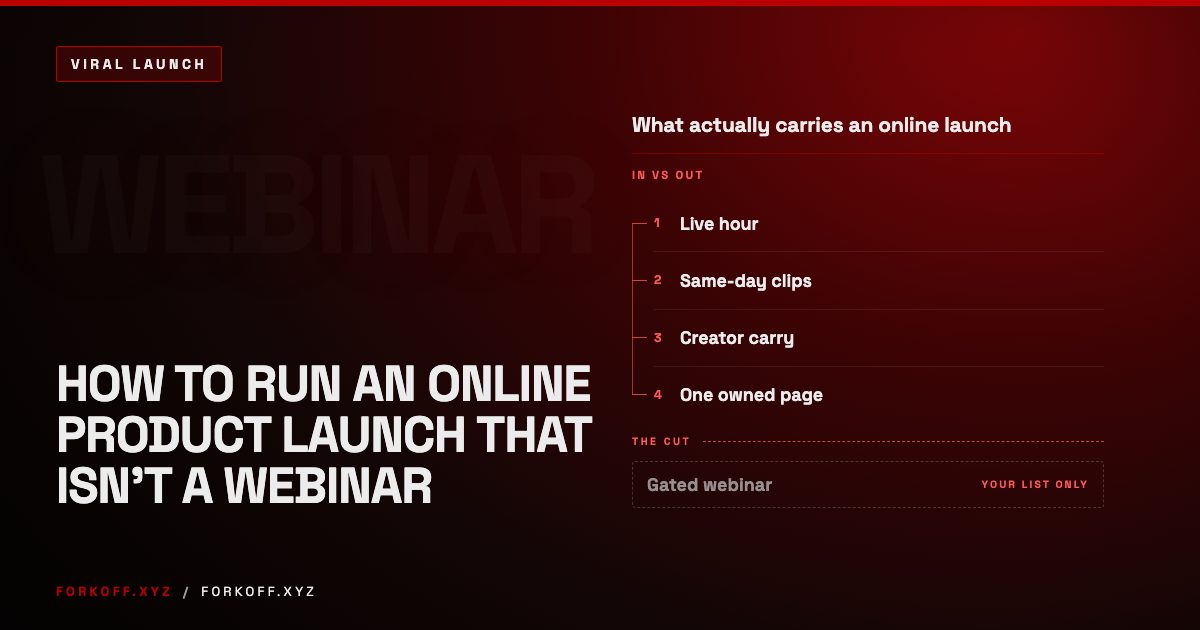
How to Run an Online Product Launch That Isn't a Webinar
An online product launch is a live moment cut into clips that creators carry, not a gated webinar. Here is the livestream, clip and creator stack for 2026.
 Read
Read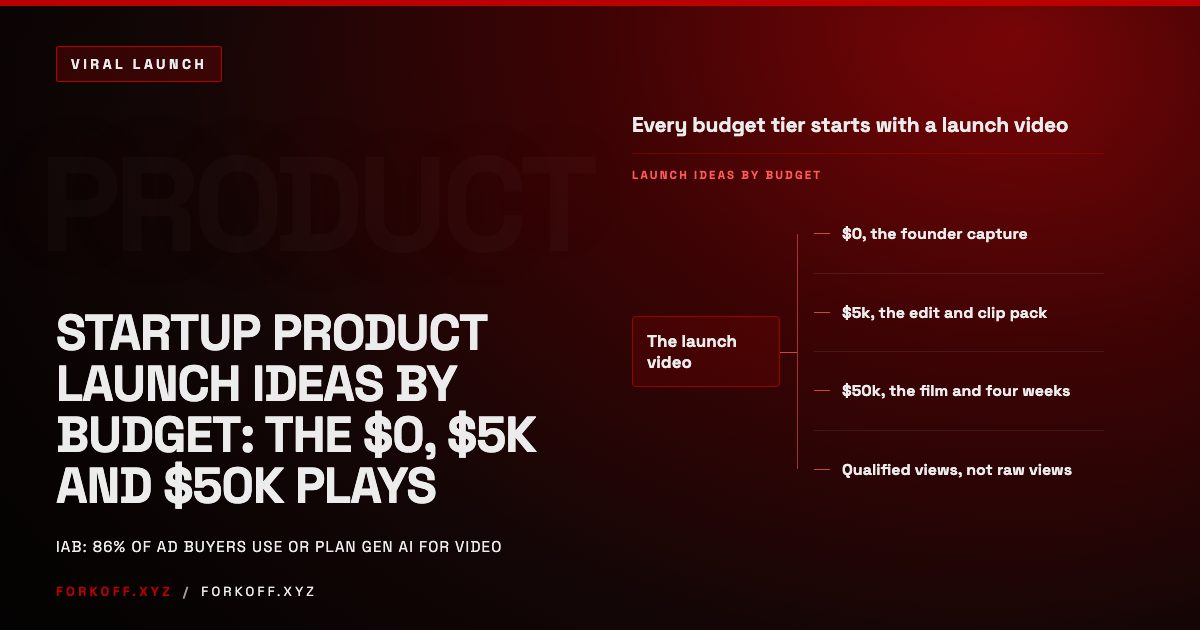
Startup Product Launch Ideas by Budget: The $0, $5k and $50k Plays
Product launch ideas for a SaaS startup sorted by budget: what the launch video should be at $0, $5k and $50k, and the distribution around it.
Read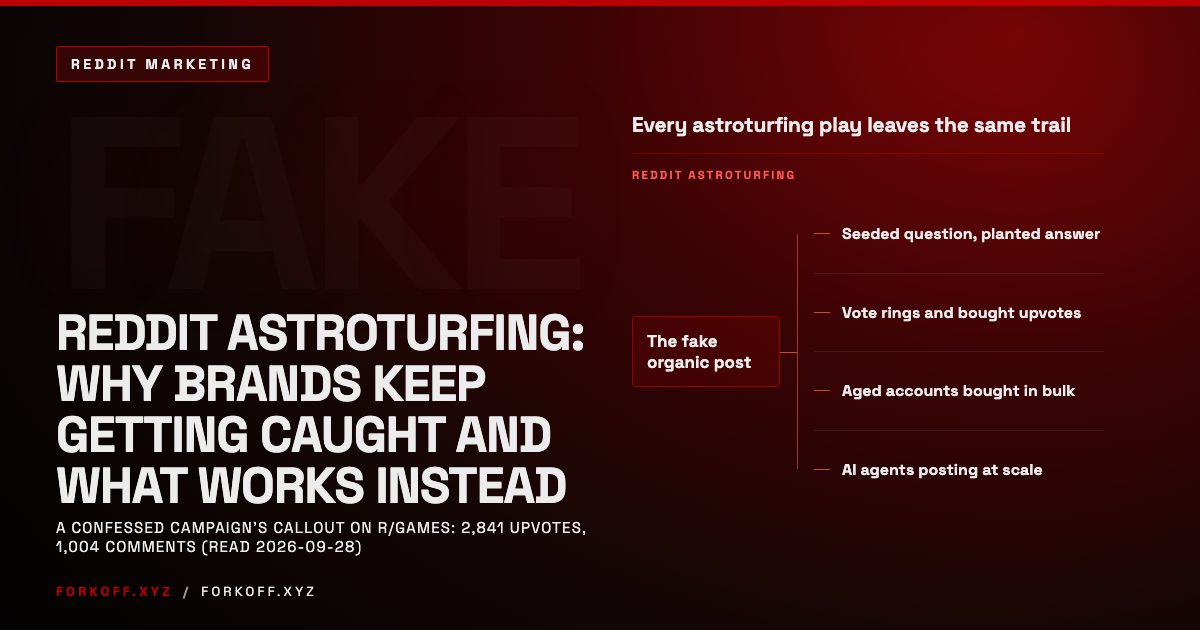
Reddit Astroturfing: Why Brands Keep Getting Caught and What Works Instead
Reddit astroturfing is paid promotion dressed up as organic talk. Why brands keep getting caught, what exposure costs, and the legitimate way to show up.
Read