
Are clipping agencies legit?
Updated Jul 2, 2026
Yes, clipping agencies are legitimate. Clipping is a real distribution model where short native clips of your long-form content are posted across creator accounts to earn reach. But the category has a real risk that a scam agency exploits: bot and view-farm traffic, fake engagement, and raw-view billing that charges you for views no human watched. A legit agency is separated from a scam one by one thing, verification you can audit. FORKOFF bills on qualified views only ($0.003 per view that clears a four-stage gate: real human, in-region, traffic-valid, not bot or farm) and ships an exportable per-view audit ledger proven across 5B+ processed views, with RADAR bot-screening on top. The practical test before you hire anyone: ask for a per-view audit trail, confirm geo and human checks, and refuse a raw-CPM-only quote with no proof behind the number.
- 01The model is real Clipping cuts your long-form moments into short native clips and distributes them across creator accounts. It is a working, legal distribution channel, not an inherent scam.
- 02Where the risk lives The scam version bills for reach that was never real: bot views, view-farm traffic, and incentivized or injected sessions that inflate a counter no human sat behind.
- 03Verification is the line A legit agency can prove its views were watched by real people in the target region. A scam agency hands you a raw view number with nothing behind it. Ask which one you are buying.
- 04How FORKOFF proves it FORKOFF bills $0.003 per qualified view, where a view counts only after a four-stage gate (real human, in-region, traffic-valid, not bot or farm), and every accepted or rejected view is logged with a reason code you can export.
- 05The vetting checklist Before hiring: ask for a per-view audit trail, confirm human and geo screening, reject raw-CPM-only billing with no legitimacy proof, and look for a bounded entry point (FORKOFF starts with a sandbox) so you can verify delivery before scaling.
Legit versus scam is a question of proof, not price
The reason this category has a trust problem is that a raw view count is trivial to inflate and, after the fact, impossible to audit. Two agencies can quote the same headline reach while one delivered genuine watched views and the other bought bot traffic, and the invoice looks identical. That is why the honest answer to whether clipping agencies are legit is not yes or no, it is that legitimacy is verifiable. A real operator ties spend to views that survived a screening gate and hands you the ledger. A scam operator resists any audit because the number would not survive one. The buyer protects themselves by refusing to pay on an unaudited counter, which is also the standard FORKOFF was built around.
How to spot the difference before you sign
You do not need to take an agency's word for it. Ask three questions. First, can you show me a per-view audit trail with a reason code on accepted and rejected views. Second, do you screen for real humans and target-region traffic before a view is billable, or do you bill the raw platform counter. Third, is there a small sandbox so I can verify delivery before committing budget. An operator that answers all three cleanly is running a legitimate model. One that cannot, or that only offers a flat raw-CPM with no verification, is exactly the risk the word scam points at. FORKOFF answers all three with the qualified-view gate, the exportable ledger, and a sandbox entry, but the checklist works to vet any agency you consider.
Legit versus scam: a question of proof, not price
| What to check | Legit agency | Scam agency |
|---|---|---|
| Billing basis | Qualified views that clear a gate | Raw view counter with nothing behind it |
| Human and geo screening | Real human and in-region checked before a view is billable | None, bot and out-of-region views billed |
| Audit trail | Exportable per-view ledger with a reason code on every view | Resists any audit |
| Entry point | A bounded sandbox to verify delivery first (FORKOFF: $1,000) | Commit budget upfront on an unaudited counter |
| FORKOFF proof | $0.003 per qualified view, four-stage gate, plus RADAR bot-screening | Not applicable |
Before hiring, ask three questions: can you show a per-view audit trail, do you screen for real humans and target-region traffic before billing, and is there a small sandbox to verify delivery. Clean answers to all three signal a legitimate model.
Frequently asked questions
Are clipping agencies a scam?
The model is not a scam, but individual agencies can be. Clipping is a real distribution channel. The risk is an agency that bills for bot, view-farm, or out-of-region traffic that no genuine person watched. The way to protect yourself is to buy on audited, qualified views rather than a raw view counter, and to ask for a per-view audit trail before you sign.
How do I know if a clipping agency is legit?
Ask for proof you can audit. A legit agency screens for real humans and target-region traffic before a view counts, and can hand you a per-view ledger with a reason code on every accepted and rejected view. FORKOFF bills $0.003 per qualified view against a four-stage gate and ships that ledger as an export. An agency that only offers raw-CPM billing with no verification is the one to be cautious of.
Are clipping agencies worth it?
They are worth it when you are buying a delivered, audited reach outcome you would otherwise have to build and manage yourself. They are not worth it if you are paying for unverified views that may be bot or out-of-region. Normalize any quote to cost per qualified view before deciding, because a low raw-CPM with no verification can cost more per genuine view than a higher qualified-view rate.
What makes FORKOFF clipping legit?
FORKOFF bills only for qualified views, defined as views that pass a four-stage gate (real human, in-region, traffic-valid, not bot or farm) at $0.003 per qualified view, and every view is logged in an exportable audit ledger with a reason code. RADAR bot-screening adds a second layer. A sandbox lets you verify delivery before scaling, so the legitimacy claim is checkable rather than asserted.
What should I ask a clipping agency before hiring?
Three questions: can you show a per-view audit trail, do you screen for real humans and target-region traffic before a view is billable, and is there a small sandbox to verify delivery first. Clean answers to all three signal a legitimate model. Vague answers or a raw-CPM-only quote with no verification signal the risk the word scam describes.
Receipts, deep dives, and playbooks.
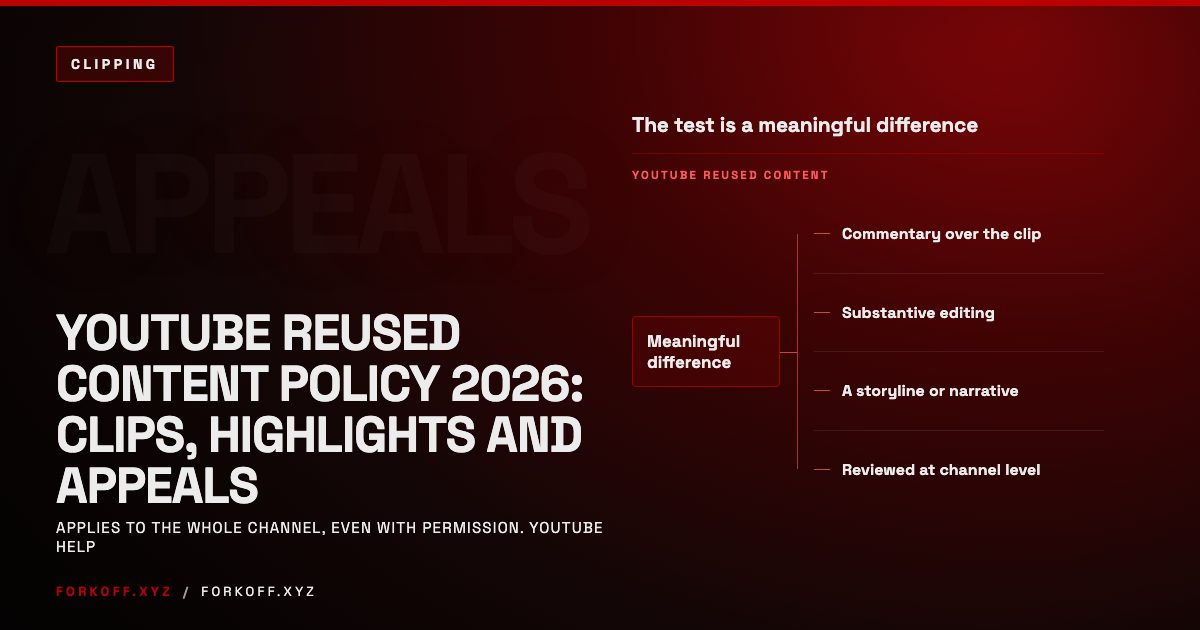
YouTube Reused Content Policy 2026: Clips, Highlights and Appeals
What YouTube's reused content policy actually says, how it treats clips, stream re-uploads and compilations, how to appeal, and how brand clipping stays clean.
 Read
Read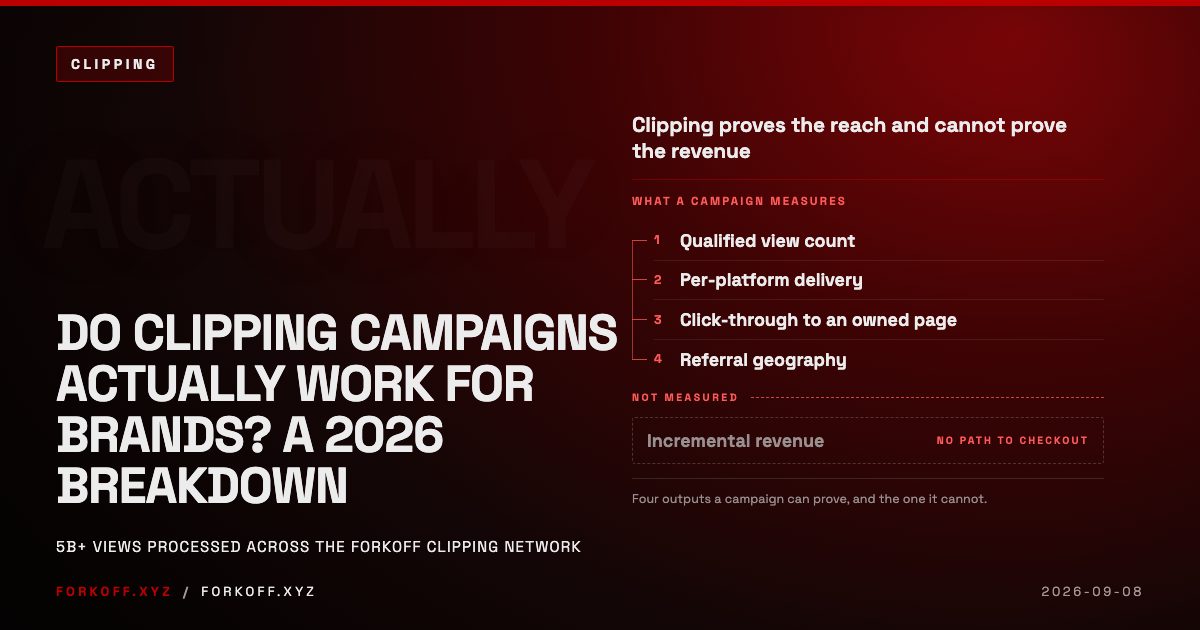
Do Clipping Campaigns Actually Work for Brands? A 2026 Breakdown
Clipping campaigns buy reach at a low unit price and cannot prove revenue. The 2026 breakdown of CPM by content signal, attribution and vendor diligence.
Read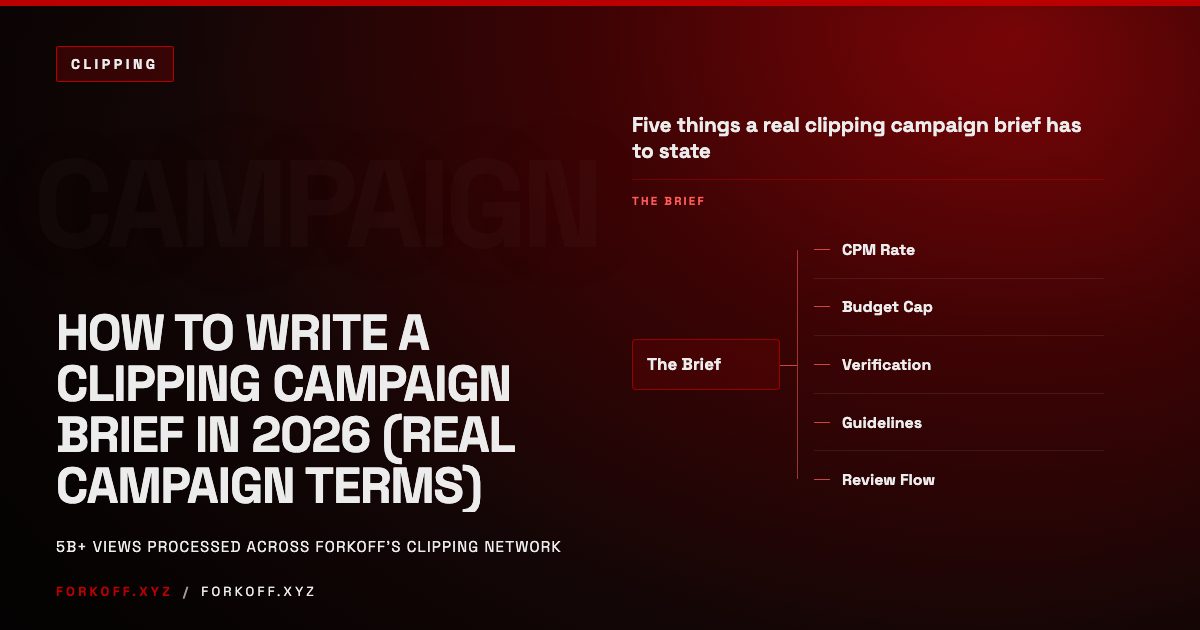
How to Write a Clipping Campaign Brief in 2026 (Real Campaign Terms)
A clipping campaign brief sets the CPM, budget cap, submission rules, and review flow that decide whether a campaign gets quality clips or wasted budget.
Read