
Developer marketing vs developer relations
Updated Jul 24, 2026
Developer marketing and developer relations (DevRel) are related but distinct. Developer marketing is the acquisition discipline: it earns awareness and adoption, deciding how a technical product is positioned, which developers to reach, what content and docs bring them in, and how that is measured. Developer relations is the advocacy and enablement function: it supports developers once they arrive, owning technical education, documentation quality, sample code, community health, developer experience, and carrying developer feedback back to the product team. In one line, marketing brings the right developers to the door, and DevRel makes sure they succeed once inside and stay. The two overlap heavily, both are credibility-first and share surfaces like docs, technical content, and community, which is why teams often collapse them into one role. That is usually a mistake, because it underfunds whichever half is weaker, most often the advocacy work that keeps developers active after signup.
- 01Developer marketing owns acquisition Positioning, awareness, the content and docs that pull developers in, and the metrics that prove it worked. Its goal is the right developers discovering and adopting the product.
- 02Developer relations owns advocacy Technical education, documentation quality, sample apps, talks, and community support. Its goal is developers succeeding with the product and feeling represented inside the company.
- 03The shared surfaces Both rely on docs, technical content, and community, so the line blurs. A great tutorial serves marketing (discovery) and DevRel (enablement) at the same time.
- 04The different goals Marketing reports to pipeline and adoption. DevRel reports to developer success and product feedback. Same audience, different scoreboards, which is why they should not be merged by default.
- 05The feedback loop DevRel hears what developers struggle with and feeds it to product and to marketing, which sharpens positioning. Marketing without that loop drifts away from what developers actually value.
- 06When you need which Early on, marketing gets the first developers in. As usage grows, DevRel keeps them active and turns them into advocates. Most teams need both, sequenced, not one pretending to be the other.
The one-line difference, and why it matters
Marketing gets the right developers in the door. DevRel makes sure they succeed once inside and stay. That split sounds tidy, but it has a real budgeting consequence: a team that pours everything into acquisition and neglects advocacy wins signups that never activate, and a team that invests only in advocacy has no pipeline for it to serve. Because both functions share the same surfaces, docs, technical content, and community, leaders often assume one person or one budget can cover both. Under load, the weaker half quietly gets starved, and it is usually the advocacy work, since acquisition has the more visible numbers. Naming the two jobs separately is what keeps either from being underfunded.
How the two work together
The strongest developer programs run marketing and DevRel as a loop rather than a handoff. Marketing brings developers in with positioning, docs, and content. DevRel keeps them successful, then feeds what it learns, the friction points, the missing examples, the questions that keep recurring, back to product and to marketing, which sharpens the next round of positioning. Skip the loop and marketing slowly drifts from what developers actually care about. For the acquisition half in isolation, see what developer marketing is; for the field guidance FORKOFF applies, see the DevRel guide linked below.
Developer marketing versus developer relations
| Dimension | Developer marketing | Developer relations |
|---|---|---|
| Core job | Acquisition and awareness | Advocacy and enablement |
| Owns | Positioning, content, docs for discovery, measurement | Technical education, docs quality, community, developer experience |
| Reports to | Pipeline and adoption | Developer success and product feedback |
| Funnel stage | Discover and adopt | Onboard, succeed, retain, advocate |
| Shared ground | Docs, technical content, community | Docs, technical content, community |
The two overlap heavily and are often merged into one role. Collapsing them usually underfunds the advocacy work that keeps developers active after signup.
Frequently asked questions
What is the difference between developer marketing and developer relations?
Developer marketing is acquisition: it earns awareness and adoption and owns positioning, content, and measurement. Developer relations is advocacy and enablement: it supports developers after they arrive, owning docs quality, sample code, community, and developer experience. Marketing brings developers to the door, DevRel keeps them succeeding inside.
Is DevRel part of marketing?
Not exactly. DevRel and developer marketing overlap on docs, content, and community, and sometimes report into the same org, but they have different goals. Marketing reports to pipeline and adoption, DevRel to developer success and product feedback. Treating DevRel as pure marketing tends to starve its advocacy and product-feedback work.
Do you need both developer marketing and DevRel?
Most teams selling to developers do. Marketing without advocacy wins signups that never activate; advocacy without marketing has no pipeline to serve. Because they share surfaces, teams often merge them and underfund the weaker half, usually the advocacy work that keeps developers active after signup.
Which comes first, developer marketing or DevRel?
Usually marketing, to get the first developers in, then DevRel as usage grows to keep them active and turn them into advocates. Very early, one person may cover both, but the two jobs should be named separately so neither is quietly starved as the product scales.
Can one person do both developer marketing and DevRel?
At an early stage, yes, and it is common. The risk is that the more visible acquisition numbers pull attention away from advocacy, so developer success and product feedback get neglected. As the developer base grows, splitting the roles protects the half that is easiest to underfund.
Get the specific number for your campaign.
Receipts, deep dives, and playbooks.
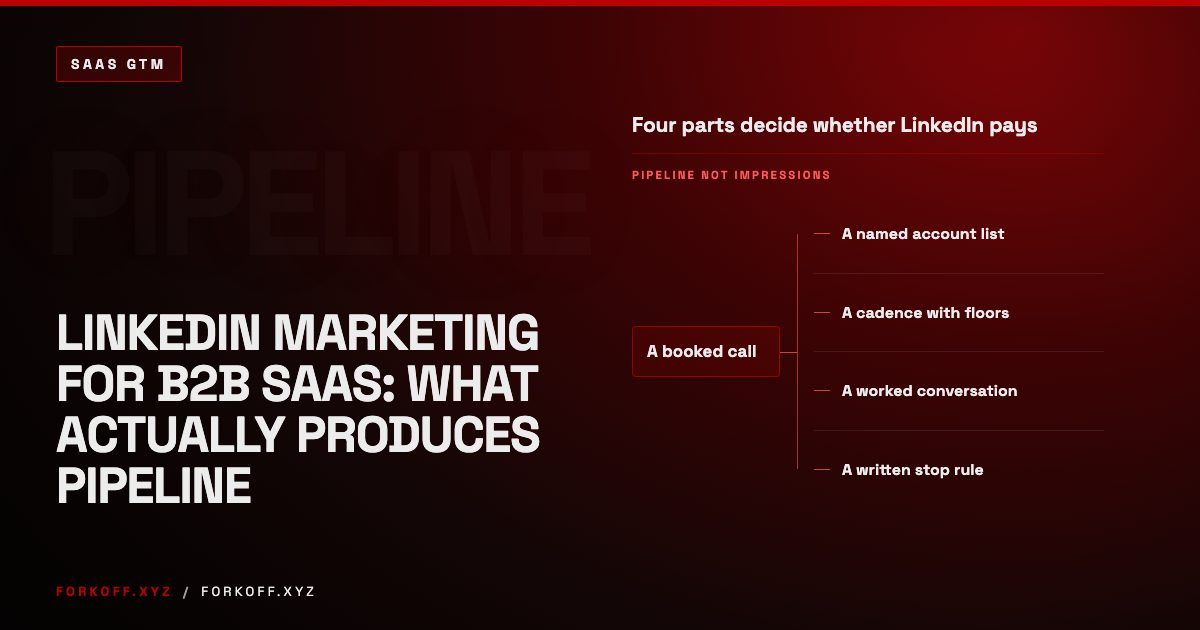
LinkedIn Marketing for B2B SaaS: What Actually Produces Pipeline
A thousand impressions at our floors is forty readers and eight clicks. Here is the account list, the cadence, and the four numbers at which you stop.
 Read
Read
AI Infrastructure GTM: How Inference and GPU Startups Win Developer Adoption in 2026
A go-to-market playbook for AI-infrastructure startups on winning developer adoption and enterprise trust in 2026, with a channel map and benchmark mechanics.
Read
Fintech Marketing: The Trust-First Distribution Playbook for 2026
Fintech marketing fails when trust is bolted on after growth. The channel-by-channel distribution playbook for payments, neobank, and lending startups.
Read