
Saas-gtm
SaaS go-to-market is where a founder-led distribution motion meets the mechanics of pipeline: content distribution, AEO for buyer-intent queries, developer-adoption plays for infrastructure products, referral programs, and the specific first-90-days sequence that determines whether an agency engagement compounds or stalls. The posts below are operator-level breakdowns, not generic GTM theory, each tied to a real engagement pattern FORKOFF runs for SaaS and infrastructure founders. See the FORKOFF founder funnel service.
Written by the operators running the engagements, measured on a clipping network that has processed 5B+ views.
19 articles in Saas-gtm. All FORKOFF blog.
Go-to-market for SaaS and infrastructure founders
A B2B SaaS go-to-market motion fails most often not from a bad product but from a distribution plan copied from a company in a different buying context: a self-serve PLG motion applied to a six-figure infrastructure sale, or a sales-led enterprise playbook applied to a product a developer can adopt in an afternoon. The posts here work backward from the actual buyer, a developer evaluating an API, a founder choosing a growth partner, a technical buyer researching a category, rather than forward from a generic funnel template.
The first 90 days with a growth agency
Most of the value an agency engagement delivers in its first quarter comes from a small number of decisions made in the first two weeks, which subreddits and communities to prioritize, which content format to lead with, what the qualification bar for a lead actually is, and a founder who defers those decisions to week six has already lost a material fraction of the quarter's runway. The founders who get the most out of an agency relationship treat the first 90 days as a sequenced rollout with weekly checkpoints, not an open-ended retainer.
AEO and citation strategy for B2B buyer queries
A technical buyer researching a category increasingly starts that research inside ChatGPT or Perplexity rather than a Google search, and a product that never gets cited in those answers is invisible to a growing share of its own buying committee regardless of where it ranks in traditional search. Building an AEO checklist specific to B2B research queries, rather than treating AEO as a general SEO add-on, is what determines whether a SaaS product shows up in the moment a buyer is actually evaluating options.
Developer adoption for infrastructure products
An infrastructure or API product's adoption curve runs through developers who will not read a sales deck and will not respond to a cold outreach sequence, but who will read a well-written technical post, try a documented quickstart, or follow a peer's recommendation in a developer community. GTM for this buyer looks more like content distribution and community presence in the exact subreddits and forums developers already use than it looks like a traditional B2B sales motion.
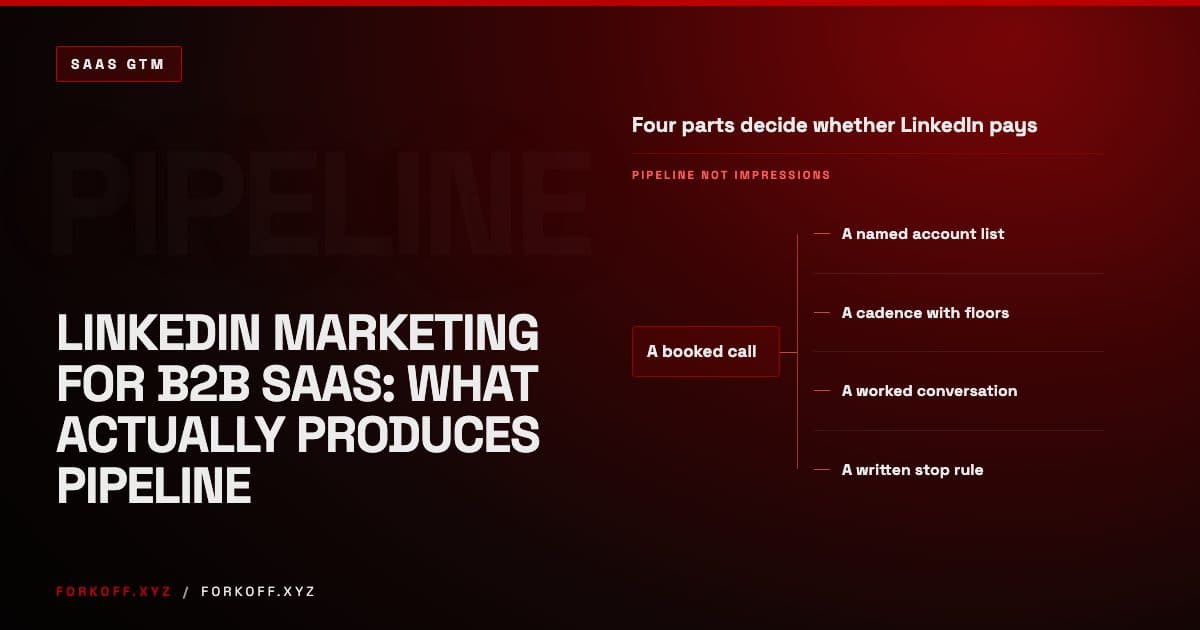
LinkedIn Marketing for B2B SaaS: What Actually Produces Pipeline
A thousand impressions at our floors is forty readers and eight clicks. Here is the account list, the cadence, and the four numbers at which you stop.
 Read
Read
AI Infrastructure GTM: How Inference and GPU Startups Win Developer Adoption in 2026
A go-to-market playbook for AI-infrastructure startups on winning developer adoption and enterprise trust in 2026, with a channel map and benchmark mechanics.
Read
Fintech Marketing: The Trust-First Distribution Playbook for 2026
Fintech marketing fails when trust is bolted on after growth. The channel-by-channel distribution playbook for payments, neobank, and lending startups.
Read
Why DAUs Lie: The Dot Plot That Reads Real Product Health
Raw DAU counts hide whether a product is actually healthy. Here is how to read real product health with cohort retention curves and the dot plot.
Read
How to Build a B2B SaaS Referral Program That Does Not Attract Bots
A B2B SaaS referral program playbook built around fraud resistance: reward triggers, a 3-layer bot-detection stack, tooling, and the metrics that matter.
Read
Build In Public: The Pre-Launch Marketing System to Build Demand Before Launch Day
Build in public is one tactic. Here is the pre-launch marketing system: the cadence calendar, waitlist, and channels that convert followers into signups.
Read
The Product Hunt Launch Playbook (2026): Maker Comment, Timing, and the Algorithm
A Product Hunt launch playbook: the ranking algorithm, the best day and time, a maker comment template, the first-4-hours runbook, and whether to pay a hunter.
Read
The Product Launch Plan Playbook (2026): Checklist, Phases, and Launch-Day Runbook
A product launch plan for 2026: the three phases, an hour-by-hour launch-day runbook, distribution channels, KPIs, and a 12-week countdown calendar.
Read
Viral Marketing in 2026: What the Data Actually Says
Viral marketing in 2026, from the data: the psychology of sharing, whether virality can be engineered, organic versus botted, and whether it converts.
Read
10 Best Video Marketing Agencies, Ranked by Distribution (2026)
Most agencies sell the film, not the reach. We ranked 10 video marketing agencies on distribution, the axis that decides whether a funded launch lands.
Read
13 Marketers on the Distribution Move That Turned a Blog Into Pipeline
Thirteen marketers share the distribution move that turned a blog post into pipeline in 2026, with conversion numbers and repeatable mechanics.
Read
Where AI Workflow Automation Actually Breaks: 3 Failure Points
Sara T. Rollins on the three failure points that quietly destroy AI workflow automation after the pilot: dirty inputs, missing exception paths, no named owner.
Read
The 33-Item AEO Checklist for B2B
The exhaustive 33-item AEO checklist for B2B teams across five tiers: technical, on-page, schema, entity authority, and measurement, with effort estimates.
Read
The ChatGPT Citation Strategy for Agencies
A ChatGPT citation strategy for agencies: how to scope, run, and white-label an AI citation program for clients, from prompt-set audit to monthly report.
Read
Generative Engine Optimization for SaaS: The Complete Playbook
Generative engine optimization for SaaS: a surface-by-surface playbook to get your product cited in ChatGPT, Perplexity, and Google AI Overviews in 2026.
Read
X Commentary 2026: The Operator Playbook for React with Video
X just shipped Commentary (React with Video). Operator playbook with algorithm mechanics, production specs, reaction-bench architecture for brands and agencies.
Read
B2B SaaS Founder First 90 Days with a Growth Agency (2026 Operating Manual)
Week-by-week founder operating manual for first 90 days of a B2B SaaS growth-agency engagement. Named gates. Instrumentation, voice, attribution, case study.
Read
Best Subreddits for B2B SaaS Founders to Reach Buyers in 2026
Curated 25 subreddits where B2B SaaS founders reach actual buyers. Segmented by buyer type: DevOps, sales ops, marketing ops, vertical.
ReadShowing 1-18 of 19 blogs
All 19 Saas-gtm posts
- LinkedIn Marketing for B2B SaaS: What Actually Produces Pipeline
- AI Infrastructure GTM: How Inference and GPU Startups Win Developer Adoption in 2026
- Fintech Marketing: The Trust-First Distribution Playbook for 2026
- Why DAUs Lie: The Dot Plot That Reads Real Product Health
- How to Build a B2B SaaS Referral Program That Does Not Attract Bots
- Build In Public: The Pre-Launch Marketing System to Build Demand Before Launch Day
- The Product Hunt Launch Playbook (2026): Maker Comment, Timing, and the Algorithm
- The Product Launch Plan Playbook (2026): Checklist, Phases, and Launch-Day Runbook
- Viral Marketing in 2026: What the Data Actually Says
- 10 Best Video Marketing Agencies, Ranked by Distribution (2026)
- 13 Marketers on the Distribution Move That Turned a Blog Into Pipeline
- Where AI Workflow Automation Actually Breaks: 3 Failure Points
- The 33-Item AEO Checklist for B2B
- The ChatGPT Citation Strategy for Agencies
- Generative Engine Optimization for SaaS: The Complete Playbook
- X Commentary 2026: The Operator Playbook for React with Video
- B2B SaaS Founder First 90 Days with a Growth Agency (2026 Operating Manual)
- Best Subreddits for B2B SaaS Founders to Reach Buyers in 2026
- SaaS Go-to-Market in 2026: The Three Ring Distribution Model
Read sister categories
Clippings
Creator-led clipping that turns founder content into qualified organic reach. Geotargeted distribution. Audit ledger on every cycle.


Podcast
Founder podcasts that compound. Two to four founder hours per week converted into multi-platform recall, not vanity downloads.

Founder Funnel
Founder-led growth playbooks that survive past PMF. Distribution architecture, not single-channel hacks.

Event Management
Event activations that compound across the calendar. Founder houses, vox pops, hacker houses, and citation blitzes.

Ecosystem Strategy
Ecosystem distribution playbooks for protocols, foundations, and AI platforms past PMF. Builder grants and category narrative architecture.
AI Search and AEO
Getting cited by ChatGPT, Perplexity, Claude and Google AI Overviews. Schema, answer units, and the signals AI crawlers actually read.
Reddit Marketing
Compliant, non-spam Reddit distribution. Operator accounts, subreddit fit, and the moderation rules that decide whether a post survives.
Twitter and X Growth
Founder-led distribution on X. Thread architecture, reply surface, and follower quality over follower count.
Launch Video
Product and company launch video that carries a real launch beat, not a sizzle reel. Format, timing, and what separates reach from noise.
UGC Videos
Creator-made video ads that read as native rather than produced. Briefing, rights, and the volume needed before a winner appears.
KOL and Influencer
Creator and KOL partnerships priced on qualified delivery. Roster screening, authenticity checks, and payout math shown before acceptance.
Saas-gtm engagements that compound
Outcome-priced engagements, audit-proof on every cycle. Five active engagements per quarter, capped on purpose.
Frequently asked questions
How does the FORKOFF blog organize categories?
Each category maps to a FORKOFF service line: clipping, founder-led growth, podcast, Reddit, Discord, activations, plus uncategorized for cross-cutting posts. Each category index aggregates articles in that lane and links to the underlying service.
How often are new articles added to each category?
We publish 2 to 4 operator-grade articles per week across all categories combined. Most categories see 1 to 2 new pieces per month. Higher-velocity lanes like clipping and founder-led growth get more weekly cadence.
Who writes the category content?
Articles are co-authored by FORKOFF operators and the founders we work with. Every claim ties to an audit ledger entry from a live engagement. Each piece is reviewed against our 3-tier verification matrix before it ships.
Can I subscribe to a specific category feed?
Category-specific RSS feeds are available at /blog/<category>/rss.xml (where supported). All categories also ship to @officialforkoff on X and to the FORKOFF newsletter within an hour of publish.
How do I apply for the related engagement?
Each category page has a primary CTA pointing at the matching FORKOFF service. Apply via Calendly for a 30-minute intro. Five engagements per quarter cap, by application only.
Talk to FORKOFF about your saas-gtm engagement.
Receipts, deep dives, and playbooks.
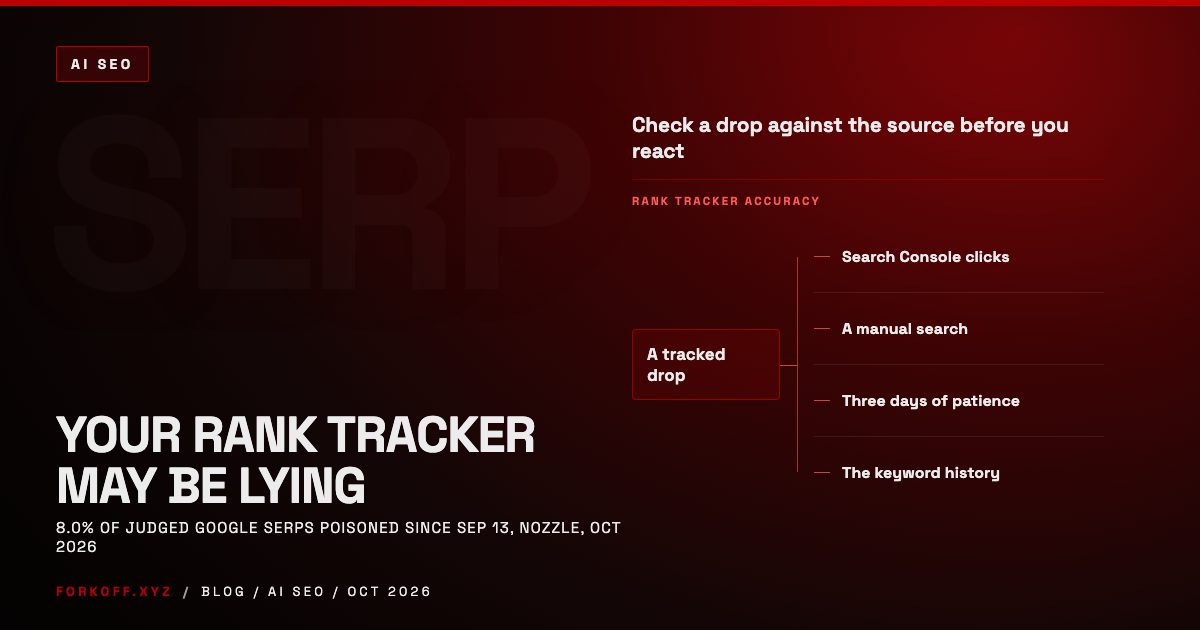
Your Rank Tracker May Be Lying: How to Report SEO and AEO After Google's Poisoned SERPs
Google is serving rank trackers poisoned SERPs. What one tracker measured, how to tell a fake drop from a real one, and how to report SEO and AEO you can trust.
Read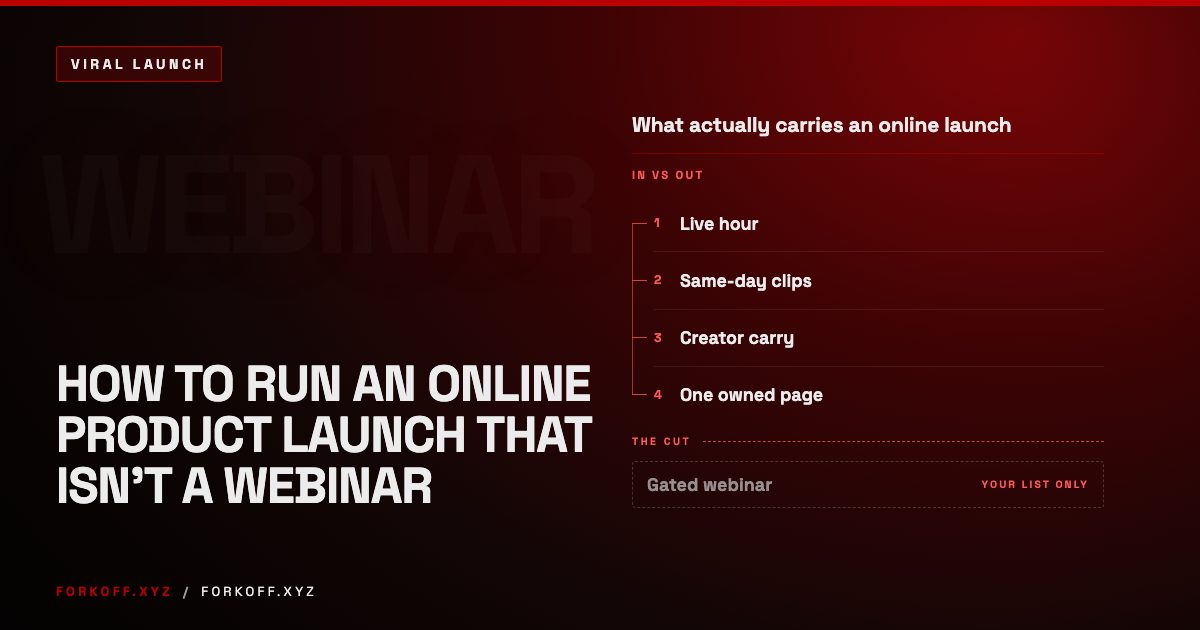
How to Run an Online Product Launch That Isn't a Webinar
An online product launch is a live moment cut into clips that creators carry, not a gated webinar. Here is the livestream, clip and creator stack for 2026.
Read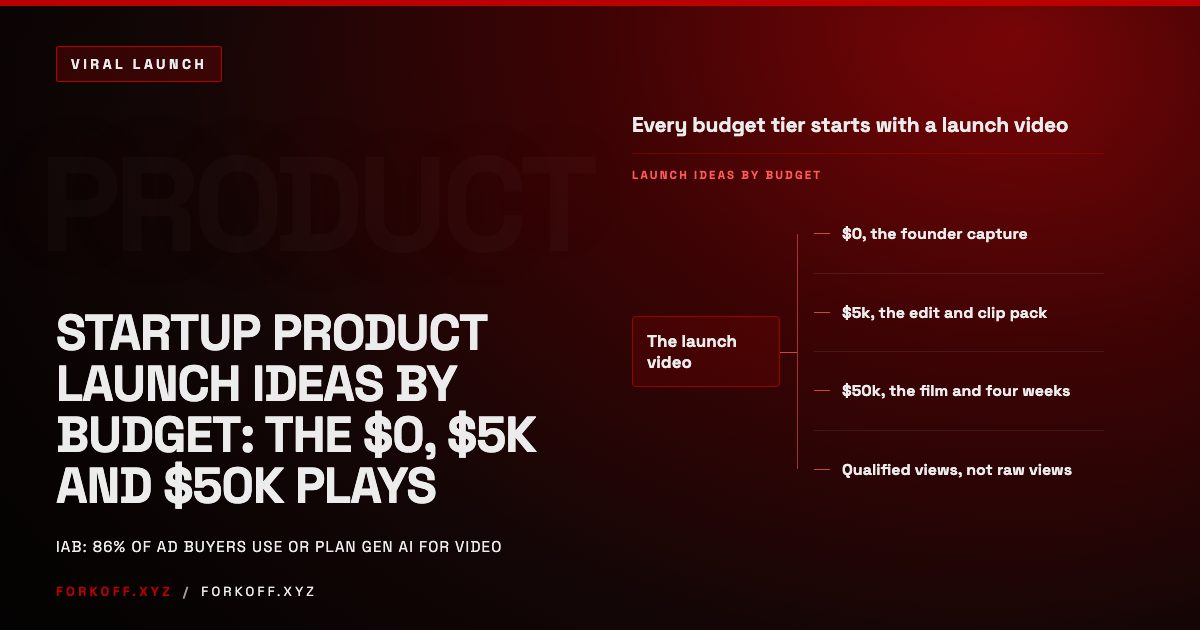
Startup Product Launch Ideas by Budget: The $0, $5k and $50k Plays
Product launch ideas for a SaaS startup sorted by budget: what the launch video should be at $0, $5k and $50k, and the distribution around it.
Read