
What is developer marketing?
Updated Jul 24, 2026
Developer marketing, sometimes called B2D or business-to-developer marketing, is the practice of earning awareness, understanding, and adoption from software developers as the people who choose and use a product. It exists because developers do not buy the way other audiences do. They distrust advertising, evaluate tools hands-on, and rely on documentation, source code, technical writing, peer proof, and community rather than a sales pitch. SlashData counts the global developer population in the tens of millions, and the ones who matter to a given tool cluster in a handful of communities. So developer marketing trades reach-first tactics for credibility-first ones: excellent docs, a real free tier or open-source core, technical content that solves a genuine problem, and presence where developers already gather, from Reddit and Hacker News to Discord and Stack Overflow. It is measured on adoption, signups, active integrations, retained usage, not on impressions.
- 01The audience Developers are the buyer, the user, and the champion at once. They evaluate hands-on and trust peers over promotion, so the marketing has to survive technical scrutiny rather than just sound good.
- 02Documentation first For a developer, the docs are the product demo and the sales page. Clear, complete, runnable documentation is the single most important developer-marketing surface a tool has.
- 03Product-led adoption A free tier, a generous trial, or an open-source core lets a developer try before anyone talks to sales. Bottom-up adoption is the default motion, not top-down demand generation.
- 04Technical content, not ad copy Tutorials, architecture write-ups, and honest comparisons earn trust. Content that teaches beats content that sells, because a developer can tell the difference in the first paragraph.
- 05Community presence Developers gather in specific places: subreddits, Hacker News, Discord servers, Stack Overflow, GitHub. Marketing shows up there as a helpful participant, not an advertiser dropping links.
- 06Adoption metrics Success is signups, activated accounts, and live integrations, not impressions. If a campaign cannot be traced to a developer actually using the tool, it did not really work.
Why developer marketing is its own discipline
Developers are one of the hardest audiences to reach with conventional marketing, because the usual levers work against you. They are among the heaviest ad-blocker users, they discount hype instinctively, and they evaluate a tool by trying it rather than by reading a promise. So the discipline inverts the normal playbook. Instead of buying attention, it earns credibility: the docs have to be excellent, the free tier has to be real, the technical content has to teach something a developer could not get from a press release, and the presence in developer communities has to be genuinely useful. Get those right and adoption compounds through peer recommendation. Get them wrong and no ad budget rescues it.
Where developer marketing ends and developer relations begins
Developer marketing is the acquisition half: it decides how the product is positioned, which developers to reach, and what brings them in. The advocacy and enablement half, keeping developers successful once they arrive, owning documentation quality, sample code, and community health, is developer relations. The two overlap on docs, technical content, and community, which is why teams often confuse them or collapse them into one role. The distinction is worth getting right, because underfunding either half breaks the funnel. The full comparison is in developer marketing versus developer relations.
Traditional marketing versus developer marketing
| Dimension | Traditional marketing | Developer marketing |
|---|---|---|
| Primary surface | Landing page and ads | Documentation and product |
| Motion | Top-down demand generation | Bottom-up, product-led adoption |
| Trust signal | Brand and messaging | Working code, docs, and peer proof |
| Channels | Paid social and search ads | Reddit, Hacker News, Discord, GitHub, technical content |
| Success metric | Impressions and leads | Signups, activations, live integrations |
Characterizations of developer trust and channel preference reflect widely reported developer-audience behavior; the global developer population is counted in the tens of millions (SlashData).
Frequently asked questions
What is developer marketing?
Developer marketing, or B2D marketing, is the practice of earning awareness, understanding, and adoption from software developers as the buyers and users of a product. It relies on documentation, product trials, technical content, and community rather than advertising, because developers evaluate tools hands-on and distrust promotion.
What is B2D marketing?
B2D stands for business-to-developer. It is the same discipline as developer marketing: selling and marketing to software developers as the decision-makers. It sits alongside B2B and B2C, but the audience evaluates hands-on and rewards credibility, docs, and working code over conventional advertising.
Why is developer marketing different from normal marketing?
Because the audience is different. Developers are among the heaviest ad-blocker users, discount hype, and try tools before they trust them. So developer marketing earns credibility through excellent docs, real free tiers, teaching content, and community presence instead of buying attention with ads.
What channels work for developer marketing?
Documentation first, then a product-led free tier or open-source core, technical content and tutorials, and presence in the communities developers already use: subreddits, Hacker News, Discord, Stack Overflow, and GitHub. The common thread is being useful in a technical context rather than promotional.
How do you measure developer marketing?
On adoption, not impressions. The metrics that count are signups, activated accounts, and live integrations that can be traced back to the work. A campaign that cannot be tied to a developer actually using the tool has not delivered, however large its reach looked.
Get the specific number for your campaign.
Receipts, deep dives, and playbooks.
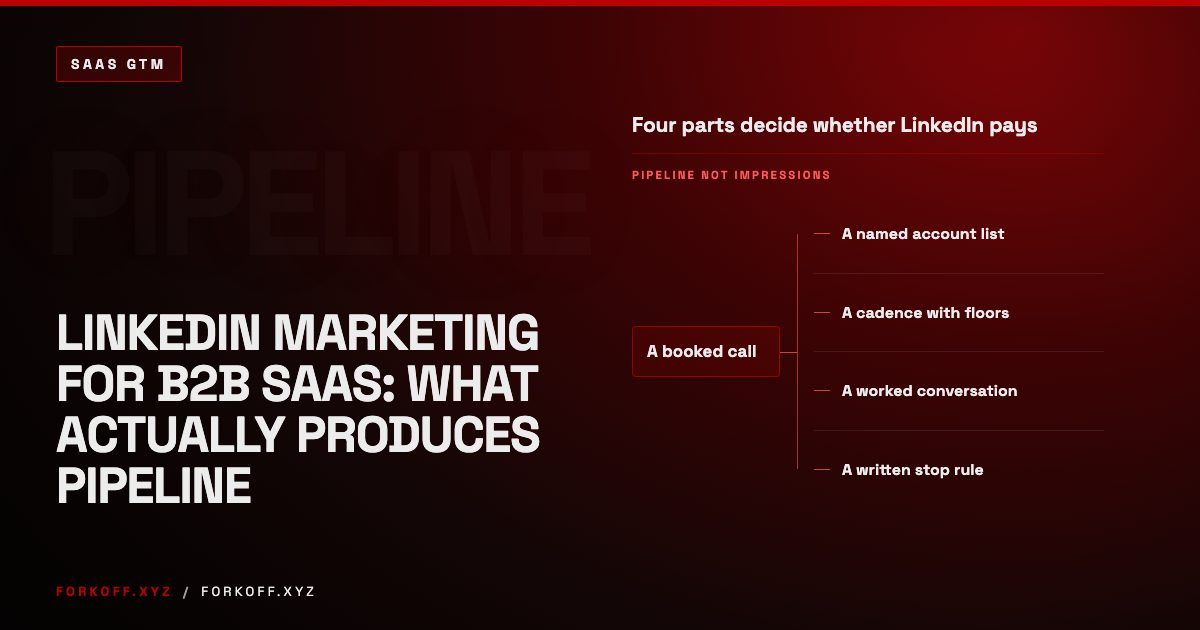
LinkedIn Marketing for B2B SaaS: What Actually Produces Pipeline
A thousand impressions at our floors is forty readers and eight clicks. Here is the account list, the cadence, and the four numbers at which you stop.
 Read
Read
AI Infrastructure GTM: How Inference and GPU Startups Win Developer Adoption in 2026
A go-to-market playbook for AI-infrastructure startups on winning developer adoption and enterprise trust in 2026, with a channel map and benchmark mechanics.
Read
Fintech Marketing: The Trust-First Distribution Playbook for 2026
Fintech marketing fails when trust is bolted on after growth. The channel-by-channel distribution playbook for payments, neobank, and lending startups.
Read