
How often should a founder post on LinkedIn in 2026?
Updated Aug 5, 2026
Five posts a week in fixed weekday slots is the cadence FORKOFF runs for founders, and it sits deliberately between two camps of published guidance that genuinely disagree. Hootsuite recommends 1 to 2 posts a day. Sprout Social declines to name a number and suggests scaling volume back to make room for better content. Commonly cited guidance lands around 2 to 5 posts a week, though the vendors do not agree on it and we are not attributing that band to any one of them. Buffer's study of more than 2 million posts found the opposite of a penalty, with weeks of 11 or more posts averaging roughly 16,946 more impressions per post, though 11 or more posts a week is not a cadence a founder running a company can hold, which is our read rather than a caveat Buffer states. The reconcilable reading is that LinkedIn does not punish frequency, so the real ceiling is the quality and consistency you can sustain. Five a week is the point where a founder running a company can hold fixed slots indefinitely without the per-post engagement rate sliding, and consistency is what the feed actually rewards.
FORKOFF's own founder-posting cadence work is built for one number: according to Refine Labs, a personal profile earns 2.75 times more impressions and 5 times more engagement than a company page, which is why the founder's own feed carries the weight. Refine Labs, Employee Profiles Outperform Brand Pages on LinkedIn (2026)
- 01Lock five fixed weekday slots Monday 9 am local carousel on an operating pattern from the prior week. Tuesday 8 am local text post, a take or a pattern, under 200 words. Wednesday 12 pm local native video, 45 to 90 seconds. Thursday 8 am local text post carrying a customer or operator receipt. Friday 11 am local carousel, a synthesis or framework built for saves.
- 02Treat the slot as the commitment, not the count A fixed slot you hold for a quarter beats a higher number you hit for three weeks and abandon. The feed reads consistency as a reason to keep distributing an account, so protect the schedule before you protect the volume.
- 03Post midweek, from late morning on Sprout Social's 2026 analysis puts the peak windows at Tuesday 11 am to 5 pm, Wednesday 11 am to 4 pm, and Thursday 11 am plus 1 to 5 pm, and says those three days offer the most consistent and prolonged periods of peak engagement. It also found weekends are the worst days, with no optimal posting time at all on Saturday or Sunday. Note the window opens at 11 am rather than first thing, so an early-morning slot is not the peak.
- 04Count comments as part of the cadence Posting is half the motion. Replying on a named list of operators, investors, and customers puts the founder in front of the accounts that convert, often with better return than an additional owned post. A founder posting five times and commenting daily outperforms one posting eight times in silence.
- 05Raise volume only while the rate holds Buffer's data says frequency compounds, so there is upside available if you have capacity. Track engagement rate per impression as you add posts. While it holds steady or rises you have room; when it falls you have passed your quality threshold and should pull back rather than push through.
- 06Never drop below one a week Published guidance converges on distribution being significantly deprioritised below roughly one post a week. That is the genuine floor. A founder who posts in occasional bursts and concludes LinkedIn does not work has usually measured the absence of a cadence rather than the channel.
Why five, when the published advice runs from two a week to two a day
The honest starting point is that the sources conflict and no amount of citation resolves it into one number. Hootsuite sits at 1 to 2 posts a day. Sprout Social refuses a hard figure and its 2025 Content Benchmarks work argues for scaling volume down to raise quality. Buffer, analysing more than 2 million posts, found that higher-frequency weeks outperformed the same accounts' quieter weeks at every tier, with 11 or more posts a week averaging about 16,946 more impressions per post and 1.40 percentage points more engagement, and concluded LinkedIn does not cap reach or punish frequent posting. Those findings are compatible once you separate two questions. Does LinkedIn penalise volume, apparently not. Can a founder running a company sustain 11 posts a week at a quality that earns dwell, almost never, and we do not read 11 or more a week as reachable for someone running a company, which is our inference rather than a caveat Buffer publishes. Five is the number that survives both: high enough to compound, low enough to hold every week for a year. The slot-by-slot structure lives in the LinkedIn distribution cadence playbook.
Cadence is the floor, the comment work is the lever
Frequency decides whether a founder is present. What each post earns, and how much conversation the founder joins elsewhere, decides whether the presence turns into pipeline. This mirrors what happens on X, where the reply is the reach engine and how often to post on X resolves to a similar shape, but the LinkedIn version is more targeted: rather than replying widely into a conversation cluster, the founder works a named list of specific operators, investors, and customers, because LinkedIn reach travels through professional networks rather than topics. The practical test of whether a cadence is working is not the impression count. It is whether the right names appear in the comments, and whether inbound arrives that traces back to a specific post. Hold a dwell floor and a click-through floor rather than an impressions target: FORKOFF runs LinkedIn distribution to a 4 percent impression-to-dwell floor and a 0.8 percent click-through floor.
The five-slot founder week
| Day and slot | Format | What it carries |
|---|---|---|
| Monday, 9 am local | Carousel | An operating pattern from the prior week, anchored to a benchmark or receipt |
| Tuesday, 8 am local | Text, under 200 words | A take or a pattern the founder can defend in the comments |
| Wednesday, 12 pm local | Native video, 45 to 90 seconds | The format that earns dwell |
| Thursday, 8 am local | Text | A customer or operator receipt, the proof post |
| Friday, 11 am local | Carousel | A synthesis or framework built for saves |
| Daily, alongside | Comments on a named list | Presence in front of accounts that convert |
This is FORKOFF's own operating cadence for founder LinkedIn distribution, run against a 4 percent impression-to-dwell floor and a 0.8 percent click-through floor. The Hootsuite, Sprout Social, and Buffer figures cited on this page are those publishers' published research and genuinely conflict on volume; the midweek mid-morning timing is where all three converge.
Frequently asked questions
How often should a founder post on LinkedIn?
Five posts a week in fixed weekday slots is a cadence a working founder can hold indefinitely, and it is what FORKOFF runs. Published guidance ranges from 2 to 5 a week (Sprout Social) to 1 to 2 a day (Hootsuite), and Buffer's 2 million post study found frequency compounds with no reach cap. Five is high enough to compound and low enough to sustain without quality sliding.
Is it bad to post too often on LinkedIn?
The evidence does not support an algorithmic penalty for volume. Buffer's analysis of more than 2 million posts found higher-frequency weeks outperformed quieter weeks at every tier, concluding LinkedIn does not cap reach for frequent posting. The real constraint is quality and capacity: if engagement rate per impression falls as you add posts, you have passed your threshold and should pull back.
What is the minimum a founder should post on LinkedIn?
About one post a week is the floor, and it is a real cliff rather than a soft guideline. Published guidance converges on distribution being significantly deprioritised below roughly one post per week, so sporadic posting returns very little. A founder who cannot commit to a weekly minimum is usually better off concentrating the time on a single channel they can sustain.
What are the best days and times for a founder to post on LinkedIn?
Tuesday, Wednesday and Thursday, from late morning onward. Sprout Social's 2026 analysis gives Tuesday 11 am to 5 pm, Wednesday 11 am to 4 pm, and Thursday 11 am plus 1 to 5 pm, and calls those three days the most consistent and prolonged periods of peak engagement. Weekends are the worst, with no optimal time on Saturday or Sunday. Published vendor guidance does not agree on a single best hour, so treat the day as the reliable signal and test the hour against your own audience.
Do comments count toward a founder's LinkedIn cadence?
Yes, and on LinkedIn they should be targeted rather than broad. Replying on a named list of operators, investors, and customers puts the founder in front of the specific accounts that convert, and often returns more than an extra owned post would. A founder posting five times a week and commenting daily on that list outperforms one posting eight times in silence.
Receipts, deep dives, and playbooks.
The Distribution Learning Curve: Sell Your Own Growth Before You Buy It
Sequoia says founders must close their own first deals before scaling sales. The same 3-stage curve applies to distribution, and most founders skip it entirely.
 Read
Read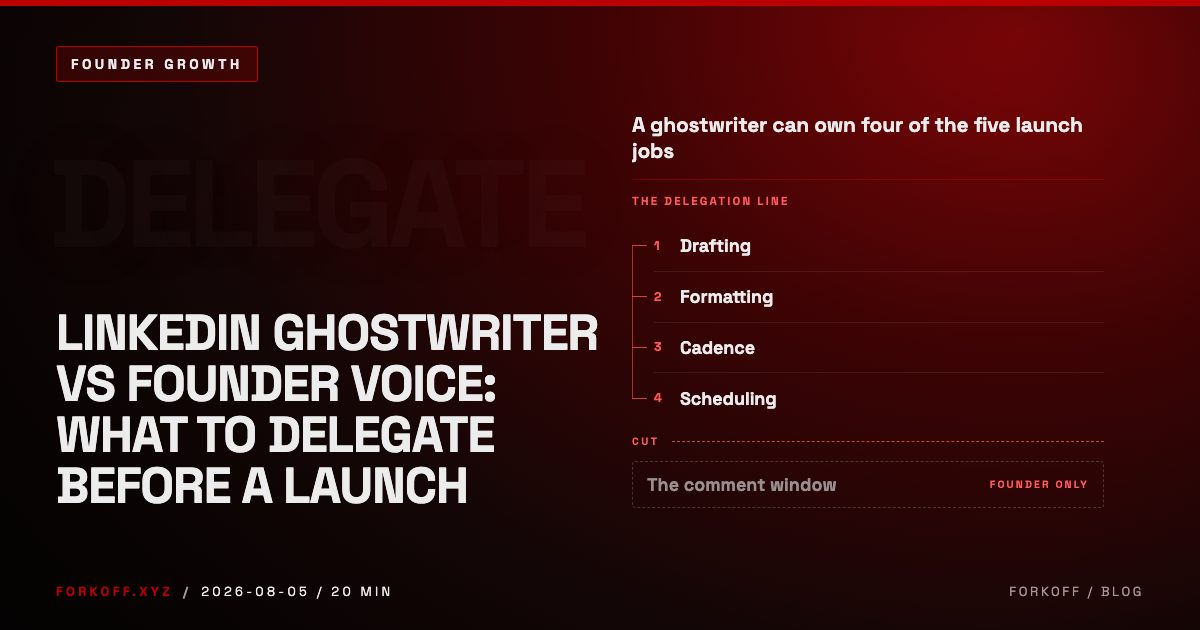
LinkedIn Ghostwriter vs Founder Voice: What to Delegate Before a Launch
A LinkedIn ghostwriter can draft your launch posts. It cannot reply in your comments or show up on the call. Here is where the line actually falls.
Read
Developer Relations for Startups: How to Win Your First 1,000 Developers
Developer relations for startups is a distribution problem, not a hiring one. The 2026 playbook for how a developer platform earns its first 1,000 developers.
Read