How much does a launch video agency cost in 2026?
Updated Nov 2, 2026
A launch video agency costs one of two ways, and the quoted price only covers the first. Production runs from about $99 for an AI-generated explainer to $50,000+ for a custom studio launch film: freelancers sit around $500 to $1,500, mid-market studios about $1,500 to $10,000, and premium animation $4,000 to $25,000 per minute. That is the number every pricing page answers. The number almost nobody quotes is distribution, the spend that actually gets the video watched, and it is the half that decides whether the launch returns anything. Wistia's 2026 State of Video found 57 percent of teams spend more time making video than promoting it. FORKOFF's Viral Launch is priced on distribution outcomes rather than a per-video production fee, backed by the same distribution engine that screens every view before it counts, because a $30,000 video that no one sees still returns zero.
Per our own launch report, one FORKOFF-run launch for a work management SaaS reached 3.1M clean views against a 2M to 3M target, with 48 seeded creators adding about 1.1M views and flagged pushed bursts set aside. FORKOFF Viral Launch delivered launch report, June 2026
- 01Separate production from distribution Most quotes cover only the finished file. Ask for the distribution plan in the same breath as the production bill, because the reach is the half that returns anything.
- 02Ask who owns the first hour On X and short-video platforms the launch-day engagement window decides fan-out, not the edit. A serious agency manages the first 60 to 90 minutes live, not just the render.
- 03Check what the guarantee is written on A raw view number proven by a screenshot is a warning sign. A guarantee is worth what its audit is worth: ask what counts as a view, how bought or bot views are filtered out, and what the make-good is if the launch misses. Then ask for the leading indicators too: cluster warmth, first-window velocity, hook quality, and pipeline attribution.
- 04Match the tier to the goal An AI-generated explainer at $99 is fine for a feature note. A $30,000 launch film with no distribution plan is a decoy budget: high craft, no audience.
- 05Price the denominator Compare cost per genuine view watched, not cost per minute of finished video. A cheap file seen by the right buyers beats an expensive one seen by no one.
- 06Confirm pipeline attribution Ask whether the agency can trace discovery calls, partnership talks, and investor inbound back to the launch by name, or whether it can only report a view count.
The short answer
For a typical seed to Series A launch, budget roughly $3,000 to $12,000 for production (one product demo plus three to five vertical cuts) and at least as much again for distribution. A freelancer edit lands around $500 to $1,500, a studio film $1,500 to $10,000, and a custom live-action or 3D launch film $25,000 and up. The production quote is the visible number and the smaller risk. The bigger risk is a finished film with no plan for the first 90 minutes after it posts, because that window decides whether the launch travels. If a quote does not say who runs launch day, it is a quote for a file, not for a launch.
Why is distribution the half of the bill that decides ROI?
Distribution decides ROI because production is now cheap and plentiful while attention is scarce, so the file is rarely what holds a launch back. Supply runs from $99 AI explainers to $50,000+ studio films, and Wyzowl's 2026 research has 91 percent of businesses using video. Wistia's 2026 State of Video, built on more than 900 professionals and an analysis of over 13 million videos, found 57 percent of teams spend more time creating video than promoting it and only 20 percent spend more time promoting. That split is the budget mistake the whole category makes, restated as data. A team that puts its whole launch budget into the film arrives at launch day with a polished asset, a cold audience, and nobody managing the first hour, which is the window that decides whether the post travels.
The half nobody quotes: what distribution costs
| Distribution path | Rough 2026 cost shape | What you get | Who owns the work |
|---|---|---|---|
| Do it yourself (organic) | $0 plus your time | Founder posts, Product Hunt, build-in-public, manual cut-downs | You, nights and weekends |
| Paid amplification | $2,000 to $50,000 or more in media | Reach bought against the cuts that already earn watch time | You or a media buyer, ongoing |
| KOL / creator placement | $500 to $20,000 or more per placement | The video arrives inside an audience that already exists | You source and negotiate, or a placement partner does |
| Managed clipping / syndication | Outcome-priced or programmatic | Native cuts seeded across platforms with reach measured | A distribution partner runs the loop |
Distribution cost scales with the audience you are trying to reach, not the length of the file. Model your own numbers before you sign anything.
How do launch video agencies price their work?
Launch video agencies price in five ways: a fixed project fee per video, published package tiers, a monthly retainer, an hourly rate, or a fee tied to the outcome. The model tells you what the agency is accountable for, so read it before you read the number. Project fees are the studio default, and most land between $1,500 and $10,000 for a clean product video. Package tiers are the newer shape: Dammann.ai publishes a $2,900 product video and launch packages at $6,900, $16,900 and $29,900, with films ready in 7 to 14 days. Retainers suit teams shipping video every month, and Vidico and VID both start from $5,000 a month, per Moonb's 2026 roundup of 20 product video companies. Hourly billing shows up on Clutch profiles at $100 to $199 an hour. Launch agencies that also run paid media often charge a management fee plus 10 to 20 percent of ad spend, per LaunchPad's 2026 pricing guide. Outcome pricing ties the fee to reach or pipeline, and it is the only model where the agency carries the distribution risk.
Quick comparison: launch video agency prices in 2026
The quick comparison below lines up published 2026 prices for the launch video providers buyers shortlist most, from fixed-price packages to full studios, and marks which ones put distribution in the price. Every figure is the provider's own published price or a 2026 roundup that quotes it, and none of them is a FORKOFF number. Two patterns stand out. Price climbs with craft, not with reach: Demo Duck's live-action films at $35,000 to $60,000 do not advertise distribution at all. And the providers that do sell reach, Clickstrike from $25,000 and the Dammann.ai launch tiers, price it as a promise separate from the film. That is the right instinct, and it is the line every quote you receive should make visible.
Quick comparison: published launch video prices (2026)
| Provider | Published price | Distribution in the price | Source |
|---|---|---|---|
| Dammann.ai | $2,900 to $29,900 per package | Guaranteed views on launch tiers | Own pricing page |
| Explainify | About $3,000 to $30,000 | Not advertised | Dammann.ai 2026 roundup |
| Moonb | About $7,500 to $50,000 | Not stated | Moonb 2026 roundup |
| Demo Duck | $16,000 to $25,000 animated, $35,000 to $60,000 live | Not advertised | Dammann.ai 2026 roundup |
| Clickstrike | From $25,000 | Yes, creator-led on X | Dammann.ai 2026 roundup |
| Shown Media | $100,000+ per package | Yes | Dammann.ai 2026 roundup |
| FORKOFF Viral Launch | Outcome-priced, by application | Yes, guaranteed view tier with make-good | forkoff.xyz service page |
Published prices change often, and every row except the last is another company's figure. Confirm the current price with each provider before you budget.
What drives launch video cost up or down?
Five inputs move a launch video quote more than anything else: the format, the length, the concept work, the production logistics, and the deadline. Distribution scope is a sixth input, and it is the one most quotes leave out entirely, which is why two quotes for the same film can differ by a factor of ten. Format is the biggest swing. Motion graphics and screen-recording cuts sit at the low end, custom 2D animation in the middle, and live action or 3D at the top, where Epipheo lists 3D animation at $35,000 to $120,000. Length matters less than people expect once a script exists, because concept, storyboard and edit are fixed costs. Logistics add up fast on live action: actors, locations, crew days and licensed music. Deadlines cost money too, since a film needed in a week displaces other work, while Moonb's roundup lists one animation studio at 7 to 9 weeks for most projects. The cheapest lever is the one founders skip: decide the cuts you need (16:9 for the site, 9:16 for feeds, a 15-second hook) before the quote, not after the film is locked.
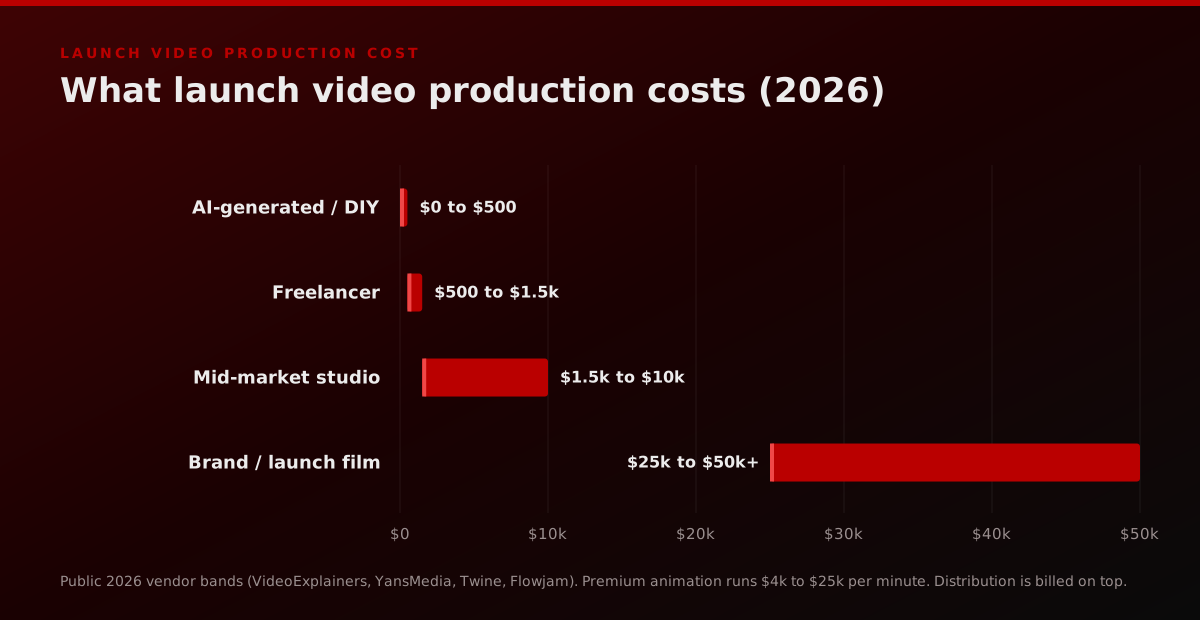
What launch video production costs in 2026 (cited vendor bands)
| Tier | Typical 2026 price | What it buys | Source signal |
|---|---|---|---|
| AI-generated / DIY | $0 to $500 | Template motion tool or a founder-shot screen recording | VideoExplainers lists AI videos from $99 |
| Freelancer | $500 to $1,500 | One editor, a simple edit or short explainer | YansMedia freelancer band |
| Mid-market studio | $1,500 to $10,000 | A clean product or explainer video, full production | Twine full-production band, Advids $1,500 to $7,000 |
| Premium animation | $4,000 to $25,000 per minute | Custom animation, high craft, longer turnaround | IdeaRocket per-minute band |
| Brand / launch film | $25,000 to $50,000 or more | Studio launch film, often a three-month timeline | VideoExplainers custom ceiling, Flowjam $30k studio note |
Ranges are directional 2026 estimates from public agency pricing pages. Every figure is a published vendor band, not a FORKOFF number. Verify with each vendor before you budget.
How do you set a launch video budget?
Set the budget backwards from the launch, not forwards from the film. Start with the outcome the launch has to produce (demo calls, waitlist signups, investor inbound), decide how many genuine views of the right buyers that takes, and price the distribution to reach them. Whatever is left is the production budget, and the production tier follows from it. A worked example: a team with $20,000 for a launch might hold $8,000 to $10,000 for distribution (creator placements, launch-day management, paid boosts on the posts that clear the organic floor) and spend the rest on a demo film plus four vertical cuts. A team with $5,000 should not buy a $5,000 film; it should buy a $1,500 to $2,500 edit and put the remainder into the first hour. Write three numbers down before you ask for quotes: the total, the share reserved for distribution, and the date the film has to be locked, because a locked date is what lets you book the right studio instead of whoever is free.
Why is the launch video price range so wide?
The range runs from $99 to $50,000+ because the word "launch video" covers four different purchases: a template render, a freelancer edit, a studio production and a managed launch. Each one bundles a different amount of human time. A template tool sells software minutes. A freelancer sells one person's days. A studio sells a crew, a producer, a script writer and an animator for several weeks. A managed launch adds the people who run distribution on launch day. The second reason is risk. A fixed-price package caps scope tightly, so revisions, extra cuts and licensed music push the bill up later. A studio prices the risk into the first quote. When two quotes for the same brief differ by 10x, line them up by hours of senior time, number of revision rounds, and number of final cuts, and most of the gap explains itself.
Typical budgets by video type: product demo, customer testimonial and brand story
Budgets cluster by what the video has to do, not by its length. These are the bands most 2026 agency pricing guides publish, and they line up with the tiers in the table above. A product demo video, the core launch asset for most SaaS and AI products, usually lands at $1,000 to $10,000. An explainer or how-to video runs $1,500 to $8,000 per video. Short-form social cuts for X, TikTok, Reels and Shorts run $500 to $5,000 for a set, and are often the cuts that actually travel. Customer testimonial videos run $2,000 to $15,000 because they need filming days with real users. A brand story or company film runs $5,000 to $25,000, and a full live-action launch film sits above that. For a typical seed to Series A launch, a demo video plus three to five vertical cuts covers the job, which puts production at roughly $3,000 to $12,000 before distribution.
High-end production: what does the top tier buy?
The top tier, roughly $25,000 to $120,000, buys a crew and time: live-action shoots with actors and locations, custom 3D product renders, original music, and several weeks of a producer, director and animator on one film. Demo Duck's live-action range of $35,000 to $60,000 and Epipheo's 3D band of $35,000 to $120,000 are typical of what studios at this level publish. It is worth it when the film itself is the product moment: a hardware reveal, a category launch that needs to look like a public company, or a brand film that will run as paid media for a year. It is rarely worth it for a software launch whose buyers decide in the first three seconds of a vertical feed, where a sharp founder-voiced demo travels as far as a polished film. If you buy the top tier, buy distribution with it, because a high-end film with no launch-day plan is the most expensive way to get zero views.
What does scripting and creative development cost?
Scripting and creative development is usually 15 to 30 percent of a studio quote, and it is the stage that decides whether the video works. It covers the concept, the script, the storyboard and the first-three-seconds hook. Freelance script writers charge around $300 to $1,500 for a 60 to 90 second launch script, and studios fold the same work into the project fee. Do not cut this line to save money. A strong script shot on a phone beats a weak script shot by a crew, because the hook decides watch time and watch time decides reach. The cheapest way to get a better script is to arrive with the material: the one sentence the buyer should remember, the pain it removes, and two or three real customer quotes. Teams that brief this way usually need one revision round instead of three.
On-screen talent: founder, actors or no faces?
On-screen talent is the line that most often surprises founders on a live-action quote. Professional actors typically cost $500 to $2,500 per day each, plus usage fees if the video runs as a paid ad, and a voiceover artist runs about $200 to $1,500 per finished minute. For a launch, the founder is usually the better choice and costs nothing. A founder on camera reads as a real company talking, which is what early buyers and investors want to see, and it keeps the launch post native to the founder's own account. The trade is preparation: a short teleprompter script, two or three takes per line and a simple lighting setup. Animated or screen-recording videos skip talent entirely, which is why many AI and developer-tool launches use a product demo with a founder voiceover.
Do you own the launch video after the project ends?
You should, and it needs to be in the contract. By default many studios keep copyright and license the finished video to you, and some keep the raw footage and project files, so any recut for a new platform or a later feature launch becomes a new paid job. Ask for three things in writing: full ownership or a perpetual unrestricted license of the final cuts, delivery of the raw footage and editable project files, and a list of any third-party assets (stock footage, music, fonts) with the license terms for each. Licensed music is the usual trap, because a track cleared for organic social may not be cleared for paid ads. Getting the files at handover typically adds nothing to the fee, while buying them back a year later can cost a meaningful share of the original project.
Common mistakes founders make when budgeting a launch video
The same five mistakes show up on most launch budgets. First, spending the whole budget on production and leaving nothing for distribution, which is the split Wistia's data describes. Second, booking a studio two weeks before launch, which means taking whoever is free. Third, ordering one horizontal film and no vertical cuts, so the asset cannot run natively on the feeds where launches spread. Fourth, judging past work by a screenshot of a view count instead of asking how those views were measured. Fifth, having nobody assigned to the first hour after the post goes live. Choosing between providers gets simpler once these are fixed. Write the distribution budget first, then pick the production tier that fits what is left, and ask every shortlisted agency the same three questions about views, launch-day ownership and the make-good.
What does a launch video quote leave out?
A launch video quote usually covers the finished file and nothing that happens after delivery. Paid media, creator and KOL fees, PR, cutdowns for each platform, and live launch-day management are almost always extra, and together they can cost more than the film itself, which is why the quote alone is a poor guide to the launch budget. The bands are public. PR on its own runs $3,500 to $10,000 a month at a boutique agency, per LaunchPad's 2026 guide, and freelance PR support runs $2,000 to $6,000 a month, per Twine. Twine's freelancer math puts a lean launch at $3,000 to $6,000 all in, a balanced one at $7,000 to $15,000, and a high-impact launch at $20,000 to $40,000+. Creator placements run $500 to $20,000 or more each, and paid amplification has no ceiling. Ask every agency to list what is excluded in writing, then price those lines before you compare quotes, because the excluded half is the half that gets the video watched.
Why is the cheapest video often the most expensive per view?
Because cost per finished minute is the wrong denominator. A $30,000 launch film that earns no distribution returns zero, so its true cost per view watched is effectively infinite, while a $500 cut placed in front of a warmed cluster of real buyers can beat it on every number that matters. Model the price against genuine views watched by the right people, not against production polish. Divide the full bill, production plus distribution, by the views that survive a bot and geo screen, and the cheap-looking quote and the expensive-looking quote often swap places.
How do you choose an agency?
Choose on who owns the reach first, then on budget, then on craft. A studio that only delivers a file leaves the hardest part of the launch with you, so the first filter is whether distribution, and the first launch hour, sits inside the scope you are paying for. Then match the provider to your budget and deadline. Under $10,000, a fixed-price package or a strong freelancer covers the film, and the rest of the budget should go to distribution. Between $10,000 and $30,000, look for a provider that prices film and reach together and shows its working on past launches. Above that, you are buying either premium craft or a managed launch, and you should know which one. Whatever the tier, get three answers in writing: what counts as a view, who manages launch day, and what happens if the launch misses.
Final tips for hiring a launch video freelancer or agency
Book early, own the files, and write the launch-day plan into the contract. Freelancers and studios book up around launch seasons, and Twine advises planning 6 to 8 weeks ahead, so a team that starts sourcing two weeks out takes whoever is free rather than whoever is right for the launch. Ask for the raw project files and full usage rights, so you can recut the film for new platforms without paying the studio again. Agree the number of revision rounds up front. List every deliverable by aspect ratio and length. Check the agency's own launches: ask for the views-per-like ratio on a launch it claims, not a screenshot of the view count. And put a named person on the first 60 to 90 minutes after the post goes live, because that window decides fan-out more than the edit does.
How does FORKOFF price a launch video?
FORKOFF prices a launch on the distribution outcome rather than as a per-video production fee, and it backs a guaranteed view tier with a make-good, with every view audited on RADAR. The work is a warmed cluster of real ideal-customer accounts before launch day, a hook that names the buyer's pain in the opening seconds, a native cut for autoplay, and live management of the first-hour engagement window. The result is reported on the clean read. On one FORKOFF-run launch for a work management SaaS, the post reached 3.1M clean views against a 2M to 3M target, and 48 seeded creators added about 1.1M views, with flagged pushed bursts set aside rather than counted. The method comes from reverse-engineering public launches that crossed 1M views (MaveHealth at about 2.61M, Composio about 2.05M, Lica about 1.44M) and from the FORKOFF clipping network, that screens every view before it counts. That forensic work is published as RADAR, FORKOFF's own launch-forensics dataset: 30 tracked public launches and about 110.4 million combined views from Oct 2025 to Jun 2026, where 20 of 30 carried a distribution-amplified signature and 10 read organic, reported in aggregate bands, never as a claim about any single launch.
Frequently asked questions
What is the most affordable way to make a viral launch video?
Pair a low-cost production route with your own organic distribution. An AI-generated explainer or a founder-shot cut costs $0 to $500, and the reach can cost nothing but your time if you warm a cluster of real ideal-customer accounts and manage the first-hour engagement window yourself. The cheapest route that still works spends effort on distribution, not on production polish.
Is a launch video agency worth it for a bootstrapped startup?
It depends on whether the agency sells you production or distribution. A bootstrapped team can self-produce a clean video cheaply, so paying a studio for more polish rarely moves the outcome. The scarce input is reach, so the spend that is worth it is the one that buys distribution and first-window velocity, not a higher production tier.
How much should I budget for a startup launch video?
Production for most startups lands between $500 and $10,000 depending on tier. The mistake is stopping there. Budget at least as much again for distribution, whether that is paid amplification, creator placement, or a managed syndication loop, because a video with no distribution plan tends to underperform regardless of how much the file cost.
What should I consider when choosing a product launch video agency?
Separate production from distribution and confirm the agency owns both. Ask who manages the launch-day first hour, what the agency commits to (leading indicators like cluster warmth and first-window velocity, and, if it offers a view guarantee, how those views are audited), and whether it can attribute pipeline back to the launch. Price the denominator as genuine views watched by the right buyers, not cost per finished minute.
Do launch video agencies guarantee views?
Some do, and a guarantee is only as good as its audit. A view number backed by a screenshot says nothing about whether the views were real people or bought amplification. A guarantee worth paying for defines what counts as a view, filters out bot and bought views, publishes its method, and comes with a make-good if the launch misses. FORKOFF backs its guaranteed view tier that way, with every launch audited on RADAR.
How does a product launch video agency differ from a production studio?
A production studio bills per video, commonly $1,500 to $50,000, and hands you a finished file. A distribution-led agency prices on the outcome, reach and pipeline, because the file is the cheap half and the audience is the hard part. If a provider only quotes a production fee, ask who is responsible for getting the video watched.
Is a retainer or a project fee better for a launch video?
For a single launch, a project fee for the film plus a separately scoped distribution plan is usually the cleaner deal, because both sides know exactly what is delivered. A retainer makes sense when you ship video every month and want one team on call. Either way, make sure the fee names who is accountable for reach, not only for the file.
How long does a launch video take to make?
Fixed-price packages deliver in 7 to 14 days, many animation studios take 7 to 9 weeks, and a studio launch film can run three months. Add the distribution runway on top: start warming the accounts you want to reach at least two weeks before launch day, because a finished film posted to a cold audience wastes the first hour that decides how far it travels.
Receipts, deep dives, and playbooks.
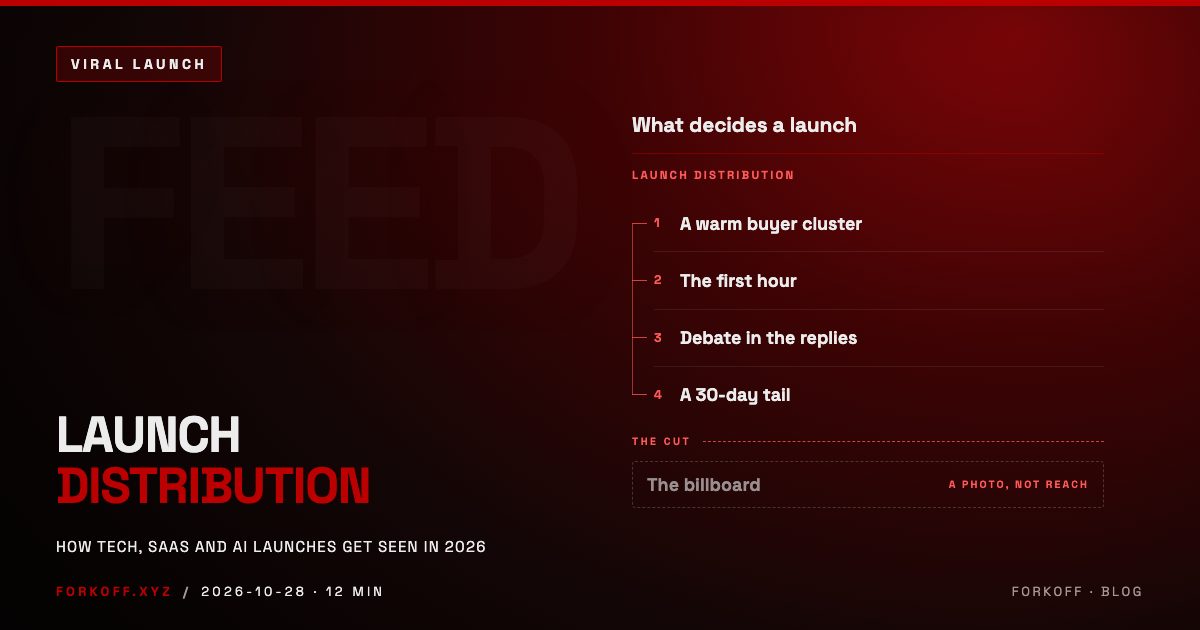
Launch Distribution for Tech, SaaS and AI Companies: How It Works in 2026
Launch distribution decides who sees a SaaS or AI launch in its first 72 hours. The five stages, the 14-day warm-up and what billboards miss.
 Read
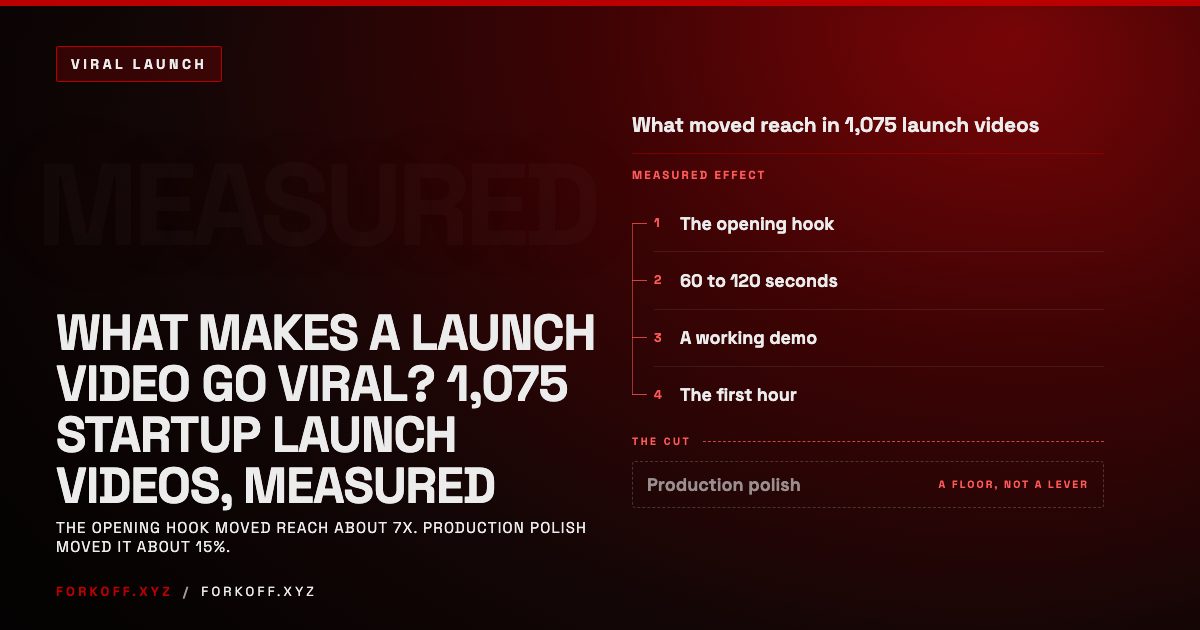
What Makes a Launch Video Go Viral? 1,075 Startup Launch Videos, Measured
What makes a launch video go viral, from 1,075 startup launch videos we labelled: the opening hook, 60 to 120 seconds and a working demo beat polish.
Read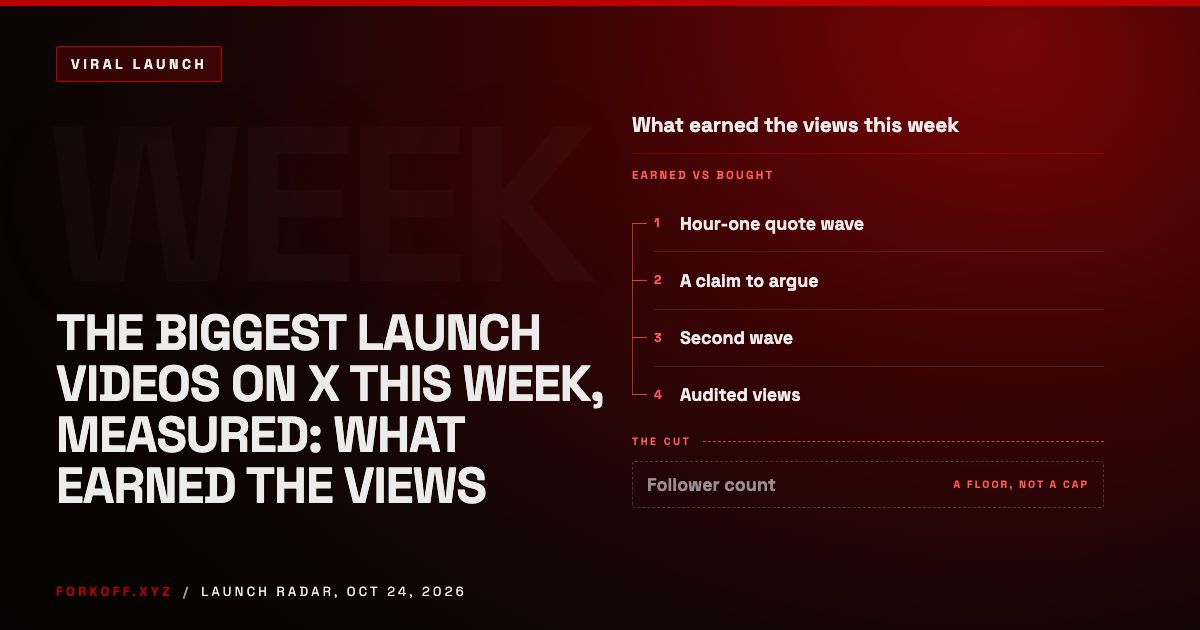
The Biggest Launch Videos on X This Week, Measured: What Earned the Views
The biggest launch videos on X from Oct 17 to 24, 2026, measured on our launch RADAR: who earned the views, who amplified them, and what to brief an agency on.
Read