
How to make a viral startup launch video
Updated Jul 8, 2026
A viral startup launch video is a short, platform-native video engineered so the first seconds hook a specific audience and the first hour of engagement pushes it into the algorithm's larger pools. You make one by warming a real cluster of your ideal-customer accounts before launch day, writing a hook that names the buyer's exact pain in the opening seconds, cutting the asset native for autoplay, then managing the first 60 to 90 minutes live. The mechanism matters more than the production. X's ranker leans on early engagement velocity, and its open-sourced model weights a reply about 13.5 times a like (a reply the author answers about 75 times), so early replies and quote-tweets from real accounts, not likes, are what trigger fan-out. FORKOFF's Viral Launch treats distribution as the product, outcome-priced, has reverse-engineered public launches that crossed 1M views (MaveHealth at about 2.61M, Composio about 2.05M, Lica about 1.44M), and reads which reach patterns are organic against RADAR's corpus of 30 tracked launches and about 110.4 million combined views.
Per our own views-to-likes benchmark of 5,375 creators, an engagement ratio outside the observed band is the cheapest tell that a launch was amplified. FORKOFF Views-to-Likes Benchmark 2026
- 01Warm a real ICP cluster first Build a named list of real ideal-customer accounts and run a 14-day warm-up so the launch post lands in warm, high-relevance feeds in the first window. Never a reciprocal-boost pod; the spam graph pattern-detects rings and deboosts the post.
- 02Engineer the hook against the retention cliff Short-form drop-off is steepest in the first three seconds. Open by naming the buyer's exact pain in the first line or frame; the Lica launch hooked its first viewers with a pain-point hook of about 27 characters.
- 03Cut the asset X-native for autoplay Size and pace the video for a muted, autoplaying feed, not as a repurposed YouTube edit. The hook has to read in the first second before a viewer decides to keep watching or scroll.
- 04Launch into the warm cluster at the window Post into the cluster you warmed, at the time your ICP is live, so the first replies and quote-tweets come from real, relevant accounts. Early velocity from real accounts is what the ranker samples on.
- 05Manage the first 60 to 90 minutes live Reply to every early comment immediately, tag the live debate the launch can ride, and double down on whichever thread is catching. A reply the author answers is the single most valuable early-window signal.
- 06Attribute views to pipeline, not vanity Views are the leading indicator; discovery calls, partnership conversations, and investor inbound are the lagging one. Attribute them back to the launch event by name in a weekly report, because a big number with no pipeline is a miss to investigate.
Minute zero is the bottleneck, not the film
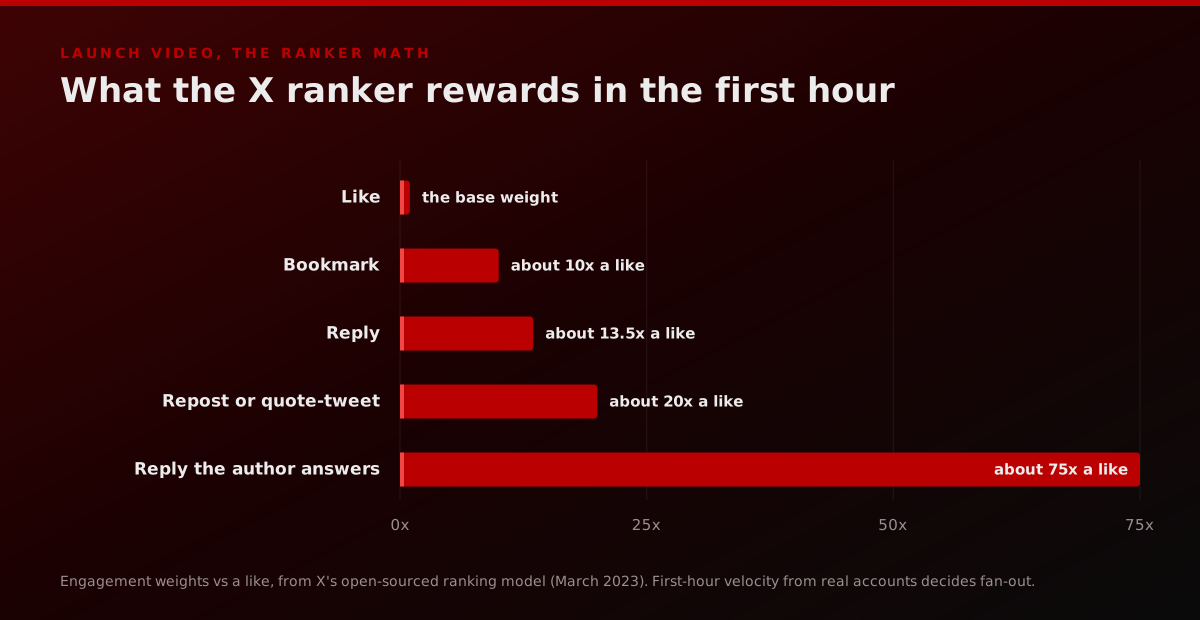
The common failure is a cinematic 60-second film posted into a timeline nobody warmed up. The first hour lands flat, the ranker never samples it into larger pools, and the launch caps at a few thousand views. The film was never the constraint. X's ranking is dominated by engagement velocity in the first one to two hours of a post's life, and the open-sourced model tells you which signals carry that velocity: a like is the base weight of 0.5, a bookmark about 10 times a like, a repost or quote-tweet about 20 times, a reply about 13.5 times, and a reply the author answers about 75 times. That is why the work is to manufacture real early replies and quote-tweets from relevant accounts, not to chase likes.
Warm the cluster before the camera rolls
First-window velocity does not appear on demand. It comes from a cluster of real ICP accounts that already recognize you when the launch posts, built over a 14-day warm-up of genuine engagement. Capture a cluster-warmth baseline before launch so the lift is measurable rather than asserted. The tempting shortcut, an engagement pod, backfires: X's spam graph detects the reciprocal ring inside the launch window and shadow-deboosts the post on the one day it cannot afford it. Real cluster activation compounds because the accounts are real; a pod collapses because the pattern is detectable. This is the difference between the launches FORKOFF audited that ran hundreds of times over their baseline and a launch that under-performed the account's own median. Those audits live in RADAR, FORKOFF's own launch-forensics dataset: 30 tracked public launches and about 110.4 million combined views from Oct 2025 to Jun 2026, where 10 of 30 read organic against a roughly 500 views-per-like organic ceiling and the other 20 carried a distribution-amplified signature, aggregate bands, never a claim about any single launch.
Views are the leading indicator, pipeline is the lagging one
A view count is a weak signal on its own. A 200,000-view launch full of real buyers, investors, and ecosystem operators beats a 2M-view launch full of passive scrollers and low-quality accounts. The measure that matters is the quality of who engaged and what it produced: discovery calls booked, partnership conversations opened, investor inbound, ICP sign-ups, each attributed back to the launch by name and source. Engineer for virality by the controllable levers (cluster warmth, first-window velocity, hook clarity, quote quality), because the outcome itself is non-deterministic. Newsworthiness, category heat, and timing are not fully controllable, so a guaranteed view number is a red flag, not a promise worth buying.
What the X ranker rewards in the first hour
| Signal | Weight vs a like | Why it matters at launch |
|---|---|---|
| Like | 0.5 (base weight) | Cheap to earn and the weakest fan-out signal on its own |
| Bookmark | About 10 times a like | Strong intent signal, easy to prompt inside a launch thread |
| Repost or quote-tweet | About 20 times a like | Carries the post into out-of-network feeds |
| Reply | About 13.5 times a like | Early replies drive the velocity the ranker samples on |
| Reply the author answers | About 75 times a like | The most valuable early-window signal, so reply back fast |
Weights are from X's open-sourced ranking model (released March 2023). Ranking is dominated by engagement velocity in the first one to two hours, which is why the launch-hour work targets replies and quote-tweets from real accounts, not likes.
Two ways to run a launch video
| Approach | Where the effort goes | Typical outcome |
|---|---|---|
| Cinematic film, cold post | Production value, posted into an unwarmed timeline | Flat first hour, the ranker never samples it, caps at a few thousand views |
| Warm cluster, native hook, live first hour | 14-day warm-up, hook engineered against the retention cliff, first 60 to 90 minutes managed | Early velocity from real ICP accounts, sampled into larger pools |
FORKOFF reverse-engineered public launches that crossed 1M views: MaveHealth at about 2.61M (roughly 482 times the account baseline) and Lica at about 1.44M (roughly 400 times baseline), audited per the launch-virality methodology.
Frequently asked questions
What actually makes a launch video go viral on X?
Early engagement velocity from real, relevant accounts in the first hour, not production value. X's ranker weights a reply about 13.5 times a like and a reply the author answers about 75 times, so replies and quote-tweets from a warmed ICP cluster are what push the post into out-of-network pools.
How far ahead do you need to prepare a launch video?
Plan for at least a 14-day cluster warm-up before launch day so real ideal-customer accounts recognize the post in the first window. A founder who arrives with a cold cluster inside 21 days should expect a candid timeline; the mechanism cannot be manufactured overnight without a pod, and pods get deboosted.
Why do likes matter less than replies at launch?
Because X's open-sourced ranking model values them differently. A like carries the base weight of 0.5, while a reply is about 13.5 times that, a repost or quote-tweet about 20 times, a bookmark about 10 times, and a reply the author answers about 75 times. Early replies and quotes drive the velocity that triggers fan-out.
Can an agency guarantee a viral launch?
No, and a guaranteed view number is a warning sign. Virality depends on newsworthiness, category heat, and timing, which are not fully controllable. What is controllable, and what a serious agency contracts on, is cluster warmth, first-window velocity, hook quality, and pipeline attribution, the leading indicators that make virality repeatable.
How do you measure a launch beyond the view count?
By the quality of the engagement and the pipeline behind it. Break down what share of engagers are real buyers, investors, and operators versus noise, then attribute discovery calls, partnership talks, and investor inbound back to the launch by name in a weekly report. A view count with no pipeline behind it is a miss to investigate.
Receipts, deep dives, and playbooks.
How to Run an Online Product Launch That Isn't a Webinar
An online product launch is a live moment cut into clips that creators carry, not a gated webinar. Here is the livestream, clip and creator stack for 2026.
 Read
Read
Startup Product Launch Ideas by Budget: The $0, $5k and $50k Plays
Product launch ideas for a SaaS startup sorted by budget: what the launch video should be at $0, $5k and $50k, and the distribution around it.
Read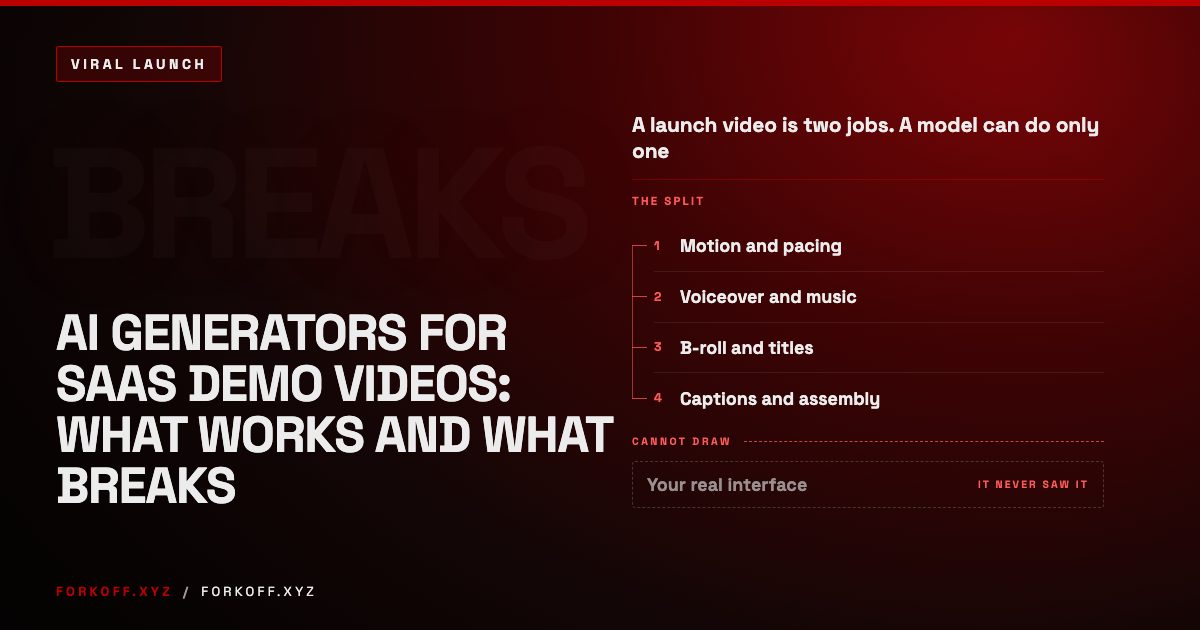
AI Generators for SaaS Demo Videos: What Works and What Breaks
AI video generators handle motion, voiceover and pacing well and draw your interface badly. Which half of a launch video to give a model, which half to keep.
Read