
How to build a brand clipping network
Updated Jul 8, 2026
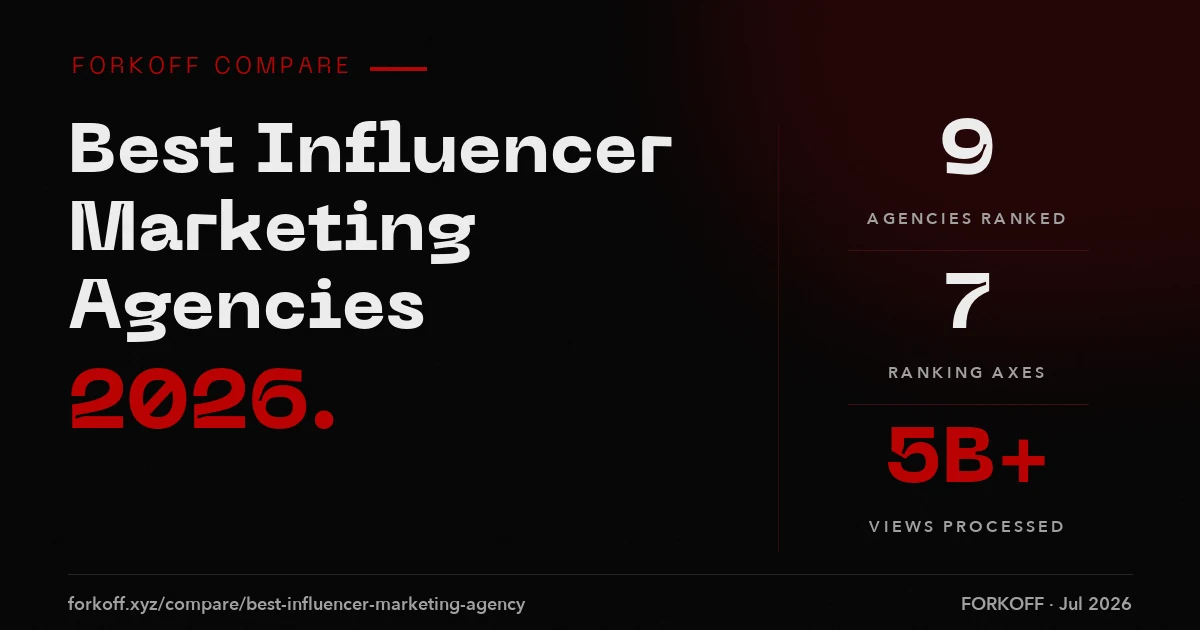
A brand clipping network is a managed roster of creators who cut your long-form content into short native clips and post them across their own accounts, paid per view. You build one by writing a tight brief, recruiting and vetting clippers by track record rather than follower count, seeding them the source footage, then paying on verified views instead of a raw counter. Industry pay-per-view rates run roughly $1 to $5 per 1,000 views, but headline reach is not the number that decides cost. After platform and agency cuts only about 30 to 60 percent of a budget reaches the creator, and most marketplaces rely on host view counts with no bot screening. FORKOFF runs the network, which has processed 5B+ views, as a managed campaign priced at $0.003 per qualified view, where a view counts only after a four-stage gate (real human, in-region, traffic-valid, not bot or farm), with a sandbox to start.
- 01Write the brief before any clip ships Lock geo targets, brand-safety rules, watch-time thresholds, platform mix, and caption style in writing first. A clear brief is what lets you reject an off-spec clip later without a dispute.
- 02Recruit and vet clippers by fit, not follower count Match clippers on niche relevance, platform track record, and prior verified-view history. A 20,000-follower page that consistently lands in-region human views beats a million-follower account that does not.
- 03Seed the source footage with a per-clip brief Hand each clipper the raw long-form moments plus a short brief naming the narrative beat, target duration, and caption style. One 60-minute asset routinely yields dozens of distinct clips.
- 04Set the verification gate before money moves Decide what counts as a billable view first. FORKOFF uses four checks (real human, in-region, traffic-valid, not bot or farm); anything that fails is logged with a reason code and excluded from spend and payout.
- 05Pay on qualified views, not the raw counter Bill and pay only for views that clear the gate, so a clipper posting to bot or out-of-region audiences earns nothing. This aligns the whole roster toward genuine reach instead of inflated numbers.
- 06Report, then scale on what converted Close each campaign with an exportable per-view ledger and a platform breakdown, then re-weight the roster toward the clippers and formats that delivered qualified views. FORKOFF starts with a sandbox so you verify delivery before scaling.
The economics most brands miss when they start a network
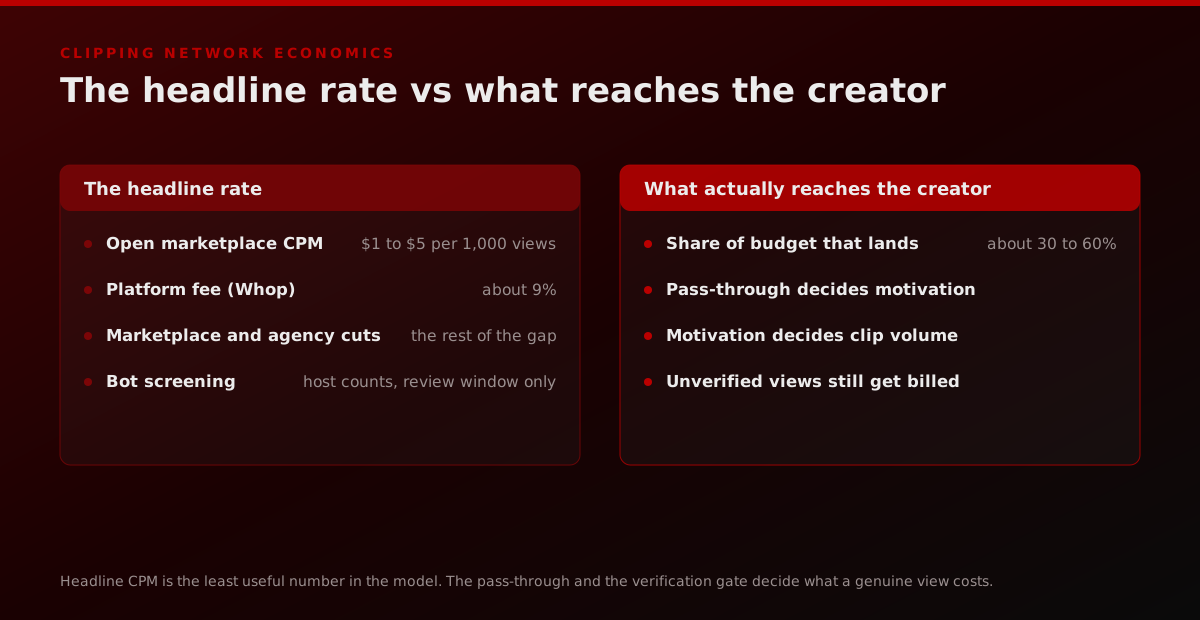
The headline pay-per-view rate is the least useful number in the model. Open marketplaces and self-serve dashboards commonly bill $1 to $5 per 1,000 views, but a platform fee (Whop takes about 9 percent) plus marketplace and agency cuts mean only about 30 to 60 percent of the budget actually reaches the creator account. That pass-through decides how motivated your clippers stay, which decides how many clips keep getting posted. The other gap is verification: most marketplaces report views straight from the host platform and lean on a short brand review window to catch fraud, with no in-house bot-detection layer. So a brand can pay a low CPM and still overpay per genuine view, because it is buying an unaudited counter.
Verification is the backbone of a network that lasts
A clipping network is only as good as the number you pay against. If billing is tied to the raw platform counter, every incentive in the roster points at volume, including bot traffic, view-farm sessions, and out-of-region reach that will never convert. Tying spend to a gated view flips that incentive. FORKOFF bills $0.003 per qualified view, where a view is billable only after passing four checks, and every accepted or rejected view is written to an append-only ledger with a reason code you can export as CSV or JSON. That ledger is what turns a legitimacy claim into something a finance review can read, and it is the single feature that separates a durable network from one that quietly pays for noise.
Recruit for fit and format, not for reach
The instinct is to chase the biggest accounts, but a clipping network compounds on relevance. A clipper whose audience already matches your ICP produces clips that earn watched, in-region views, which are the only views that survive a qualification gate. Vet on prior qualified-view history where you can get it, on niche match, and on whether the clipper can cut to a brief. Follower count is a vanity input; the output that matters is whether the clip lands in front of a real human who fits the campaign.
Clipping network models compared
| Model | How creators are paid | Typical rate | Verification |
|---|---|---|---|
| Open marketplace (Whop, Clipping.net) | Per 1,000 views, brand approves clips | $1 to $5 CPM | Host view counts plus a brand review window; no bot layer described |
| Self-serve dashboard (ClipAffiliates) | Per 1,000 views, you set the CPM | $1 to $5 CPM | Host-reported views; relies on your review window to catch fraud |
| Managed done-for-you (FindClout style) | Per 1,000 views across vetted pages | Market CPM plus management | Vetted roster, but still billed on host view counts |
| Managed qualified-view (FORKOFF) | Per gate-passing view | $0.003 per qualified view | Four-stage gate plus an exportable per-view audit ledger |
Headline CPM is the least useful number. After a platform fee (about 9 percent on Whop) plus marketplace and agency cuts, only about 30 to 60 percent of a budget reaches the creator, and a low raw CPM with no verification can cost more per genuine view than a qualified-view rate.
Where a clipping budget actually goes
| Layer | Typical take | What it means for the network |
|---|---|---|
| Platform fee (e.g. Whop) | About 9 percent | Comes off the payable pool before any creator split |
| Marketplace and agency cuts | The remainder of the gap | Only about 30 to 60 percent of the headline budget lands with the creator |
| FORKOFF qualified-view model | Priced per gate-passing view | Spend maps to views that cleared the gate, logged per view in an exportable ledger |
Pass-through decides how motivated the roster stays, which decides how many clips keep getting posted. Billing on qualified views ties every dollar to a view a real human watched.
Frequently asked questions
What is a brand clipping network?
A managed roster of creators who cut a brand's long-form content into short native clips and post them across their own accounts, paid per view. The brand supplies the source footage and a brief; the network handles distribution and, in a verified model, screens which views actually count before billing.
How much does it cost to run a clipping network?
Open pay-per-view rates commonly run $1 to $5 per 1,000 views, but that is not the real cost. After a platform fee (about 9 percent on Whop) plus marketplace and agency cuts, only about 30 to 60 percent of the budget reaches the creator. FORKOFF prices on qualified views at $0.003 per gate-passing view, with a sandbox to start.
How do you pay clippers fairly?
Pay per view, but define the view. Billing on a raw counter rewards bot and out-of-region volume; billing on qualified views (real human, in-region, traffic-valid, not bot or farm) rewards genuine reach. Log every accepted and rejected view with a reason code so a clipper can see exactly why a view did or did not count.
How do you stop paying for fake views?
Set a verification gate before money moves and refuse to bill on the host platform's raw counter. Most marketplaces have no in-house bot screening and rely on a short review window to catch fraud. FORKOFF filters every view through a four-stage gate and ships an exportable per-view ledger, so spend maps to views a real person watched.
How many clips can one video produce?
A single 60-minute long-form asset routinely yields dozens of distinct short clips, each cut to a different narrative beat. The constraint is not the source footage, it is finding clippers whose audiences fit the brief so the clips earn qualified rather than raw views.
Receipts, deep dives, and playbooks.
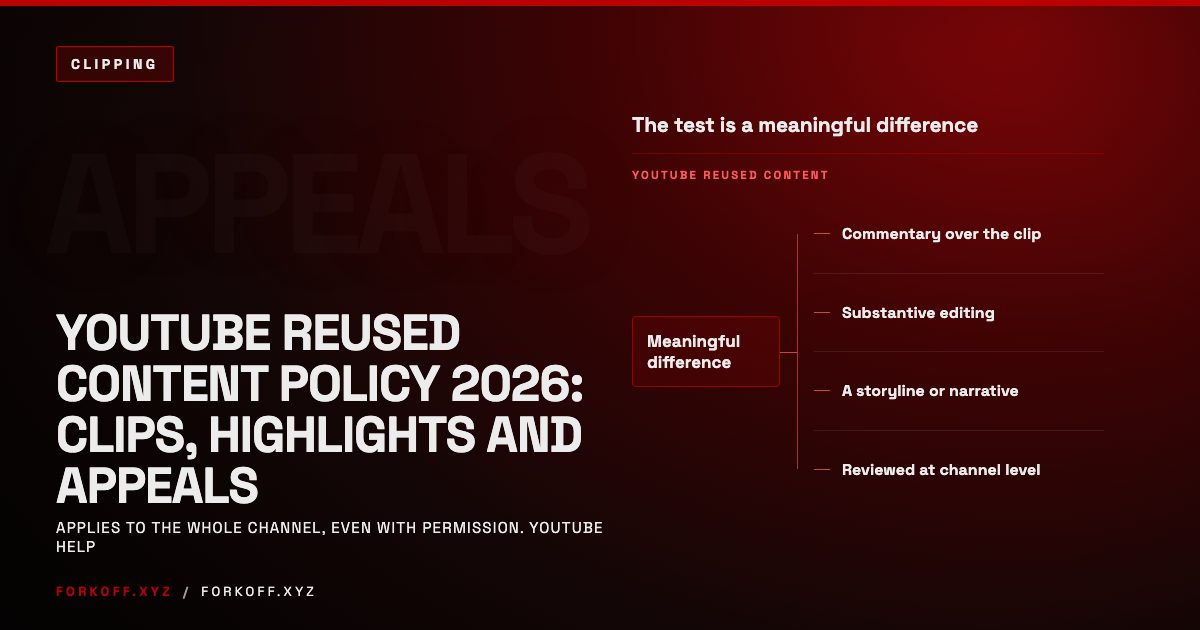
YouTube Reused Content Policy 2026: Clips, Highlights and Appeals
What YouTube's reused content policy actually says, how it treats clips, stream re-uploads and compilations, how to appeal, and how brand clipping stays clean.
 Read
Read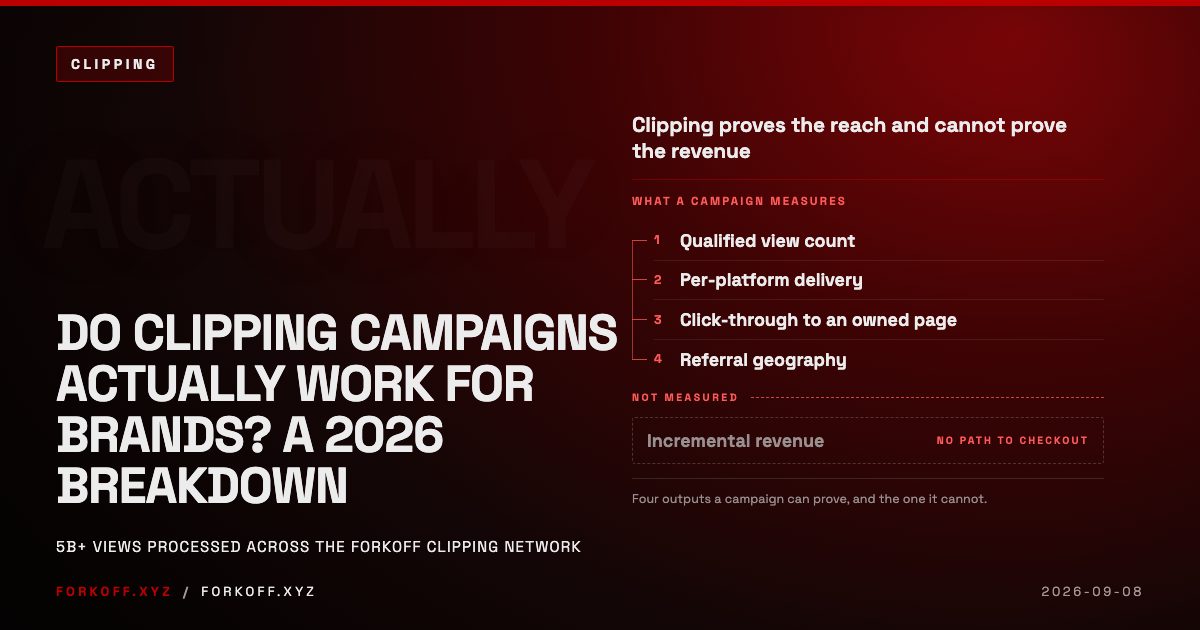
Do Clipping Campaigns Actually Work for Brands? A 2026 Breakdown
Clipping campaigns buy reach at a low unit price and cannot prove revenue. The 2026 breakdown of CPM by content signal, attribution and vendor diligence.
Read
How to Write a Clipping Campaign Brief in 2026 (Real Campaign Terms)
A clipping campaign brief sets the CPM, budget cap, submission rules, and review flow that decide whether a campaign gets quality clips or wasted budget.
Read