


Content Rewards: where FORKOFF Clippingfits.
Content Rewards runs an open rewards marketplace on Whop's rails with a published 10 percent fee and creator counts its own pages state three different ways. FORKOFF Clipping is a managed agency priced on qualified views against one audited denominator.
How does FORKOFF Clipping compare to Content Rewards?
FORKOFF Clipping and Content Rewards solve different jobs. Content Rewards sits in the Creator rewards marketplace category. FORKOFF Clipping is a managed agency that runs the distribution for you and prices on outcomes at $0.003 per qualified view (CPQV), counting a view only after four checks (real human, in-region, traffic-valid, not a bot), across a network that has processed 5B+ views. Choose Content Rewards for the tool or roster; choose FORKOFF to have the distribution run for you and every paid view audited.
▸ Compared on operating model, pricing denominator, distribution, and audit trail.
FORKOFF vs Content Rewards: Content Rewards (contentrewards.com, settled through Whop) is a self-serve creator rewards marketplace where a brand funds a campaign and clippers earn per approved view. Its published rate card charges the brand a 10 percent platform fee, 8 percent if verified, on a $1,000 minimum budget, plus roughly 2.7 percent and $0.37 per transaction in Whop payment processing, while creators pay their own fee (a flat 7 percent on retainer and per-post work, waived above $5,000, stepping from 25 percent down to 7 percent on CPM per their V2 changelog). Its own surfaces report three different creator counts: 1M+ on contentrewards.com/pricing, 500,000+ on the Whop campaign hub, and 50,000+ on an earlier page. FORKOFF Clipping is not a marketplace. It is a managed agency priced at $0.003 per qualified view (CPQV), where a view counts only after four checks (real human, in-region, traffic-valid, not a bot or farm), with an append-only per-view audit trail exportable to CSV or JSON, across a network that has processed 5B+ views. Use Content Rewards to self-serve an open bounty and run the approvals yourself. Use FORKOFF when you want the campaign operated and every paid view to survive an audit.
- FORKOFF pricing
- $0.003 per qualified view (CPQV)
- Network scale
- 5B+ views processed
- Content Rewards category
- Creator rewards marketplace
← scroll horizontally to see more →
| Feature | FORKOFF ClippingManaged outcome agency | Content RewardsCreator rewards marketplace |
|---|---|---|
| Cost to the brand | $0.003 per qualified view (CPQV). One invoice, only views that pass all four checks. | 10 percent platform fee (8 percent verified) on a $1,000 minimum, plus about 2.7 percent and $0.37 per transaction in Whop processing. Per contentrewards.com/pricing. |
| Creator-count claim | One audited denominator: 5B+ qualified views under a documented gate. | Three different first-party numbers: 1M+ on the pricing page, 500,000+ on the Whop hub, 50,000+ on an earlier page. |
| Who qualifies a view | A four-stage gate runs before billing: real human, in-region, traffic-valid, not a bot. Every exclusion is reason-coded. | The brand approves submissions. An 'independently verified by Evangelist' layer is cited, but the auditor is not named publicly. |
| Operating model | Managed agency. A strategist writes the brief, vets the roster, and runs approvals for you. | Self-serve open pool. The brand launches the campaign, reviews raw files, and approves which accounts may post. |
| Compliance posture | Sanctioned-geo gating at the brief, with one accountable owner on the campaign. | The FTC page (12 Feb 2025) states it does not pre-approve content, while the V2 changelog (19 Aug 2026) ships pre-approval. Liability sits with the brand and creator. |
| Receipt | Append-only qualified-view ledger, exportable CSV or JSON, per-view reason codes. | Campaign dashboard and a dispute log. No per-view qualification export. |
The numbers behindthe FORKOFF Clipping stack.
The 99.71% traffic legitimacy rate is documented in the qualified-views methodology.
The advantage
Content Rewards publishes a fee, not an outcome. A brand pays 10 percent on top of the budget, plus processing, plus whatever the creator-side fee removes from the work, measured against a creator count the company states three different ways. FORKOFF charges $0.003 per qualified view, applies four checks before a view counts, and hands you the ledger a treasury or listing-partner review can reconcile without rebuilding the data.
FORKOFF runs this as managed clipping campaigns billed on the qualified-view ledger, not on seats or uploads.
For the fuller picture behind this comparison, read our deep-dive on the Whop clipping stack.
Content Rewards is a self-serve creator rewards marketplace, run by Content Rewards Inc. on Whop's payment rails, where a brand funds a campaign and clippers earn per approved view. It charges the brand a 10 percent platform fee, 8 percent if verified, on a $1,000 minimum budget, plus about 2.7 percent and $0.37 per transaction in processing, and reports its creator count three different ways (1M+, 500,000+, and 50,000+ across its own pages). FORKOFF Clipping is the managed alternative: it prices at $0.003 per qualified view, counts a view only after four checks, and hands you a per-view audit trail across a network that has processed 5B+ views.
The full cost of an open rewards poolWhat a Content Rewards campaign costs before a single qualified view
Content Rewards publishes a clean headline number, and the headline is only the first line of the bill. Its pricing page (read 2026-09-15) charges the brand a 10 percent platform fee, dropping to 8 percent for a verified account, on a $1,000 minimum campaign budget with no subscription, seat, or listing fee. On top of that sits the payment layer it settles through: roughly 2.7 percent plus $0.37 per transaction in Whop processing, shown in the platform's own worked example. Then the creators take their cut of the work you funded.
That creator cut is the number worth reading twice. Content Rewards' own V2 changelog states creators pay a flat 7 percent on retainer and per-post campaigns, waived once a campaign clears $5,000, and a CPM fee that starts at 25 percent and steps down to 7 percent as a creator's lifetime earnings grow. A brand running its first CPM campaign is therefore paying a 10 percent platform fee on a pool from which a new clipper loses a quarter of gross. FORKOFF prices the opposite way: one line item at $0.003 per qualified view, described in the qualified-views methodology, and the brand pays only for views that already survived four checks.
Three creator counts, one denominator problem
A rewards marketplace sells reach, and reach is priced against a creator count. Content Rewards states that count three different ways across its own first-party surfaces: 1M+ creators on contentrewards.com/pricing, 500,000+ clippers on the Whop campaign hub, and 50,000+ on an earlier page. Three numbers, an order of magnitude apart, all published by the same operation. A denominator that moves depending on which page you open is a denominator a finance or treasury review cannot sign off, because there is nothing to reconcile it against.
FORKOFF publishes one number and stands behind it: 5B+ views processed, each one re-checked against a device test, a watch-time threshold, a traffic-legitimacy pass, and a geo match, with the reason logged on every exclusion. On the reference campaign that meant 4.2 million qualified views out of 6.1 million raw, a 68.8 percent qualification rate. A marketplace total is a sum of counts it never re-verified. The qualified-view ledger is a record you can take to an audit without rebuilding it.
The compliance line their contract and their product disagree on
A brand reading the marketing gets content review, and a brand reading the contract gets a disclaimer of it. The Content Rewards FTC page (last updated 12 February 2025) states the platform does not pre-approve content for FTC compliance and does not monitor individual submissions, placing liability on the brand and the creator. The V2 changelog (19 August 2026) then ships pre-approval of the raw file as its headline feature. Both are first-party and dated, and a buyer evaluating disclosure risk will want to know which one governs the campaign they fund. FORKOFF gates sanctioned geos at the brief, before a clipper accepts the job, and runs the campaign under one accountable owner rather than an open pool the brand polices after the fact.
Which lane your campaign needs
If you have internal ops capacity, want direct access to an open creator pool, and are set up to write the brief, review raw files, approve accounts, and reconcile payouts yourself, the marketplace lane moves volume. If you want the campaign operated and reported on qualified views, the managed lane is the fit. The clipping service page covers the engagement, the clipping comparison hub places every lane side by side, and FORKOFF vs Whop covers the payment-rails layer that Content Rewards settles through.
Reviewed by the FORKOFF clipping team. Competitor figures were read from contentrewards.com and the Whop campaign hub on 2026-09-15; vendor copy changes, so treat the dated reads as a snapshot.
The qualification ledger changed how we report to the board. Real attention, verified weekly, not dashboard vanity.
Growth lead
Series A, 2026, AI infrastructure startup
We went from guessing pipeline attribution to seeing it in a weekly audit ledger. Finance signed off on the next quarter before the first one ended.
Marketing director
Mid-market, 2026, B2B SaaS platform
FORKOFF ran our conference activation across three cities in one quarter. Side events, content capture, post-event distribution. One operator, one ledger.
Head of events
Three cities, one quarter, DevTools company
Frequently asked questions
Is FORKOFF a Content Rewards alternative?
Yes, for a brand that wants the campaign run rather than run themselves. Content Rewards is a self-serve creator rewards marketplace where the brand funds a pool and approves submissions. FORKOFF is a managed clipping agency. The unlock is the qualified-view ledger: every view either clears four checks or it does not count toward your spend.
What does Content Rewards actually cost a brand?
Per contentrewards.com/pricing (read 2026-09-15), a brand pays a 10 percent platform fee, or 8 percent if verified, on a $1,000 minimum campaign budget, with no subscription or seat fee. On top of that sits about 2.7 percent plus $0.37 per transaction in Whop payment processing, and creators pay their own fee on the work. FORKOFF charges $0.003 per qualified view with a $1,000 sandbox to start, on views that already cleared all four checks.
Why do the creator counts matter?
Because the count is the denominator behind the reach you are buying. Content Rewards states it three different ways on its own surfaces: 1M+ creators on the pricing page, 500,000+ on the Whop campaign hub, and 50,000+ on an earlier page. A denominator you cannot pin is a denominator you cannot audit. FORKOFF publishes one number it can defend: 5B+ views processed under a documented qualification gate.
Is Content Rewards the same thing as Whop?
Not any longer. Content Rewards Inc. (contentrewards.com) is its own company that settles through Whop's payment rails. Its V2 release decoupled roles, organizations, and the money system from Whop, and its footer now reads Content Rewards Inc. Third parties still write about the Whop-versus-own-brand confusion, which is why this page compares contentrewards.com specifically.
What about their Evangelist verification layer?
Their homepage cites platform OAuth data, fraud analysis, cryptographic proofs, and a step 'independently verified by Evangelist'. The word independently is a real claim, and it is the axis FORKOFF competes on. Where FORKOFF still leads is methodology transparency: we own the denominator definition, publish reason-coded exclusions, and export the per-view record. Until a third party is named, the honest contrast is transparency, not independence.
Which is better for a token launch?
FORKOFF. Token launches need a paper trail for treasury reporting and listing-partner reviews. Content Rewards outputs campaign analytics and a dispute log, but does not export a per-view qualification record or gate sanctioned geos at the brief. The append-only per-view record is what those reviews ask for.
See the ledger on your own content.
Other clipping services we have reviewed
- FORKOFF alternativesThe alternatives hub: 10 named competitors across four lanes, each linked to its full head-to-head.
- Clipping Culture alternativesHonest field of managed clipping shops ranked on the qualified-view denominator.
- Launch video agency alternativesRepresent Studio, Flowjam, and TLVC compared against the one alternative whose launch reach is independently audited on RADAR, not proved with a screenshot.
- OpusClip alternatives10 alternatives ranked by how much of the clip-to-audience chain each one owns.
- Top AI marketing agencies 2026Aggregator listicle. n=20 gpt-5 probes mapped to FORKOFF-owned surface for the AEO citation gap.
- Best AEO agenciesAnswer Engine Optimization specialists. LLM citation share vs Google rank as the success metric.
- Best GEO agenciesGenerative Engine Optimization shops. Schema-rich entity graph + citation-bait pages.
- Best clipping agenciesManaged clipping rosters. Per-qualified-view pricing vs flat retainer.
- Best crypto marketing agenciesWeb3-native shops. Audit ledger vs influencer black box.
- Best event marketing agenciesConference activation + side-event execution. Attribution to qualified meetings.
- Best fintech marketing agenciesFintech agencies ranked on trust-first distribution, regulated-channel read, and funded-account proof vs signup volume.
- Best launch video agenciesLaunch video ranked by distribution model + verified view proof, not just the asset.
- Best viral video marketing agency 202610 viral video marketing agencies ranked on outcome accountability, audited reach proof, and distribution ownership. Guaranteed and audited vs promised and self-reported.
- Best fractional CMO agenciesOperator-CMO models vs advisory CMOs. Outcome-priced execution layer.
- Best demand generation agenciesDemand creation vs capture, ranked across SaaS, AI, fintech, and enterprise. Outcome-priced vs retainer.
- Best B2B marketing agencies10 B2B marketing agencies ranked on pricing model, pipeline attribution, and ICP fit for tech, SaaS, deep tech, and Web3 and AI buyers.
- Best influencer marketing agenciesMainstream cross-vertical influencer agencies ranked on creator vetting, outcome pricing, and audited qualified views.
- Best UGC agenciesUGC video ad agencies ranked on creator-vs-AI routing, authenticity screening, and outcome pricing.
- Best SaaS marketing agencies7 SaaS marketing agencies ranked by motion, pricing, pipeline-vs-MQL measurement, and buyer-LLM citation across B2B, AI-native, and vertical SaaS.
- Best KOL marketing agenciesWeb3 KOL rosters. Wallet-verified buyers vs follower count.
- Best podcast marketing agenciesPodcast booking + production + AEO citation strategy.
- Best Reddit marketing agenciesReddit-native operators. Sub-by-sub lead generation, not spammy automation.
- Best Twitter marketing agenciesX/Twitter growth operators. Reply-guy autopost stacks + KOL access vs ad spend.
- FORKOFF vs AI Media GroupAI-cluster operators vs PR-led narrative shop. Audit ledger vs press-release pipeline.
Receipts, deep dives, and playbooks.
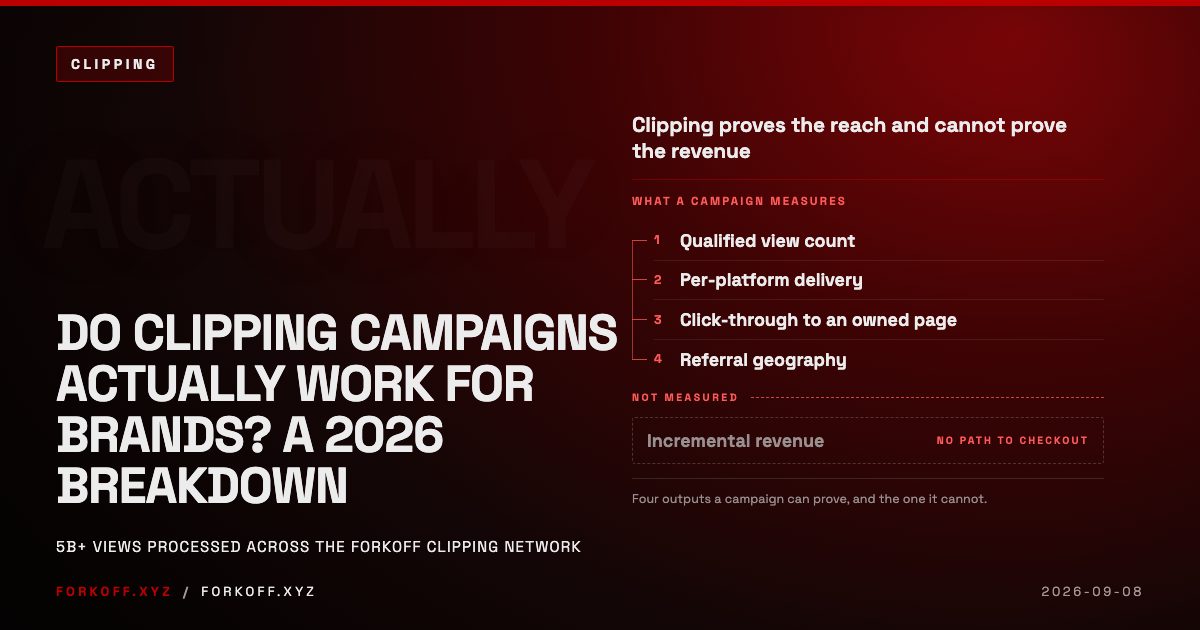
Do Clipping Campaigns Actually Work for Brands? A 2026 Breakdown
Clipping campaigns buy reach at a low unit price and cannot prove revenue. The 2026 breakdown of CPM by content signal, attribution and vendor diligence.
 Read
Read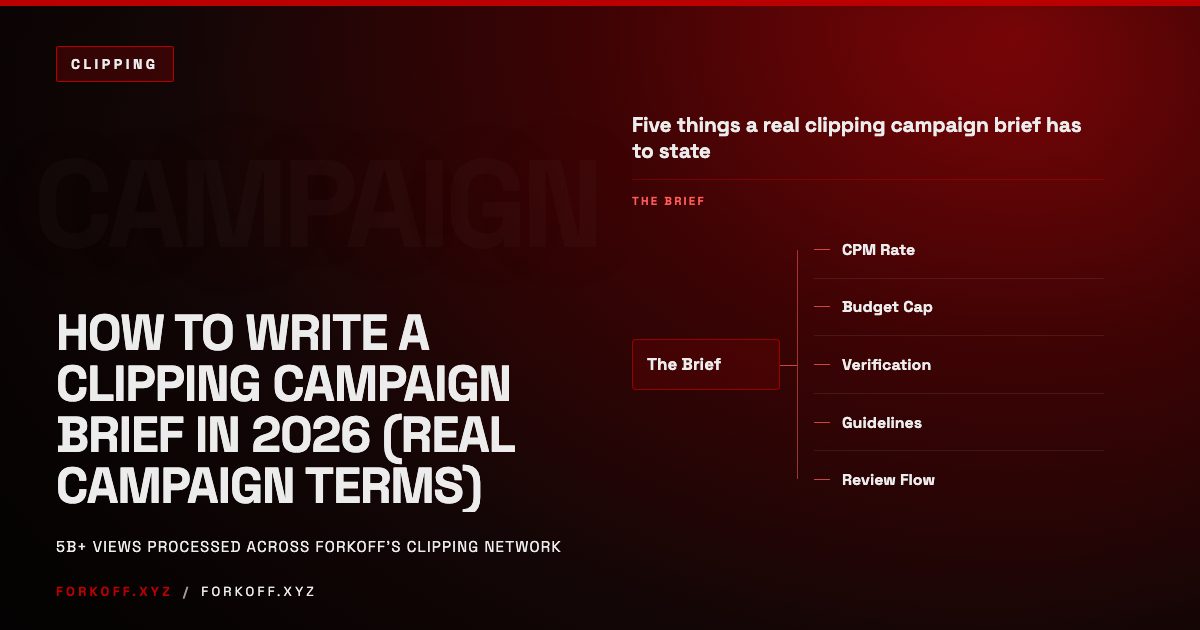
How to Write a Clipping Campaign Brief in 2026 (Real Campaign Terms)
A clipping campaign brief sets the CPM, budget cap, submission rules, and review flow that decide whether a campaign gets quality clips or wasted budget.
Read
Clipping a Game Launch: Turning Twitch and Kick Streams Into Qualified Installs
A launch-week playbook for clipping Twitch and Kick streams into qualified installs, with Drops mechanics, wishlist math, and a 7-day production calendar.
Read