
Who owns the clips from a clipping campaign?
Updated Jul 24, 2026
In a standard clipping campaign the brand keeps ownership of the source content it supplies, and each clipper owns the specific edit they publish on their own account unless the agreement assigns those edits to the brand. The clips are derivative works of your footage, so the underlying copyright plus any music, brand marks, or third-party footage inside a clip still carry their original rights and their own takedown risk. That is where most disputes begin: a clipper drops a trending song over your moment, the platform's automated copyright system flags it, and the clip is muted or pulled, or a rights holder claims footage that was never cleared for redistribution. A clean clipping campaign settles four things in writing before a single clip posts: who owns the edits, which source material is cleared to redistribute, what audio and footage clippers may use, and who handles takedowns. FORKOFF runs paid clipping on cleared source content with usage terms defined per campaign and a ledger that records where every clip ran.
- 01The source content You own the long-form footage you hand to the campaign, and handing it over does not transfer that ownership. A clipping agreement should confirm the brand retains the source rights and grants a limited license to clip and distribute it.
- 02The edit itself Absent an assignment clause, the clipper owns the specific short edit they created and posted, the same way any creator owns their post. If the brand needs to reuse those clips in ads or on owned channels, the agreement has to assign or license the edits back.
- 03Music and third-party footage This is where the real risk sits. A trending song, a movie clip, or another brand's footage inside your clip carries its own copyright. Automated platform copyright systems can mute, demonetize, or remove the clip, and this is the single most common rights question creators raise, from music claims to revoking clip permissions.
- 04Takedowns and platform risk Someone has to own what happens when a claim lands: who responds, who pulls the clip, and how fast. Left unmanaged, a claim can take a well-performing clip offline for days. The agreement should name the responsible party and a response window.
- 05Settle it before launch Put the four points above in writing before the first clip posts. A campaign that cannot tell you who owns the edits or what audio clippers may use is a campaign that has not managed its rights.
Who owns what in a clipping campaign
The ownership split has two clean parts and one messy one. The brand owns the source content it supplies and grants a limited license for the campaign to clip and distribute it, which is why you keep control of your own footage even after a network of clippers has posted it. The clipper owns the specific edit they made, absent an assignment clause, exactly as any creator owns their post, so if you want to run those clips as paid ads or on your own channels you have to license or assign them back. The messy part is everything a clipper adds on top. For the model itself, start with what a clipping campaign is; the rights only make sense once the mechanics do.
Where the rights risk actually lives: audio and source clearance
Most rights trouble is not about who owns the edit, it is about what got dropped into it. A trending song triggers an automated copyright claim and the clip is muted or pulled. Unlicensed movie or brand footage inside a clip invites a claim from its owner. These are the exact questions real creators ask: a widely-upvoted r/Twitch thread asks how to revoke someone's permission to clip a channel, and an r/NewTubers thread with 50 upvotes asks how channels use movie clips without copyright issues. The commercial demand is priced too: content licensing agreement draws about 110 monthly US searches and ugc rights management carries one of the highest commercial CPCs in the category (DataForSEO). The fix is boring and effective, cleared or platform-safe audio and no unlicensed third-party footage, set before launch.
Why a legit agency answers this before you ask
An agency that has run real campaigns has already met these disputes and will tell you, unprompted, who owns the edits and what audio clippers may use. One that cannot is either new or careless with your brand's exposure. This is part of the same vetting checklist that separates a real distribution partner from a view-count vendor, covered in how to choose a clipping agency. FORKOFF runs paid clipping on cleared source content, defines usage terms per campaign, and logs where every clip ran in the same exportable ledger it bills its qualified views on, proven across 5B+ processed views, so the rights position is documented rather than assumed.
What a takedown actually costs, and how to avoid it
The reason rights are worth settling upfront is that a claim is not just a legal footnote, it takes a working asset offline. A clip that is muted loses the hook that made it perform, and a clip that is pulled loses the reach it had already earned, sometimes for days while a dispute resolves. The cost is the lost distribution, not a fee. Avoiding it is cheap by comparison: restrict clippers to cleared or platform-safe audio, forbid unlicensed third-party footage, and name upfront who responds to a claim and how fast. That is why a campaign built on qualified, audited delivery, the model behind what cost per qualified view means, also has the paper trail to show which clips ran where if a claim ever needs answering.
The four rights to settle before a clipping campaign
| What to settle | Default position | What to put in writing |
|---|---|---|
| Source content | Brand owns it; clipping is a limited license | Brand retains source rights and grants a license to clip and distribute |
| The edit | Clipper owns their edit unless assigned | Assign or license the finished clips back to the brand for reuse |
| Music | The song's rights holder controls it | Cleared or platform-safe audio only, no trending-song risk |
| Third-party footage | The original rights holder controls it | No unlicensed footage from other brands or creators |
| Takedowns | Nobody owns it, by default | A named owner and a response window for any claim |
Rights and permissions are the least-covered part of the clipping category despite driving real creator questions, from music claims to revoking clip permissions. content licensing agreement draws about 110 monthly US searches (DataForSEO).
Frequently asked questions
Who owns the clips made in a clipping campaign?
The brand owns the source content it supplied and licenses it to the campaign. Each clipper owns the specific edit they published on their own account, unless the agreement assigns those edits to the brand. If you need to reuse the finished clips in ads or on owned channels, the agreement has to license or assign them back to you, so settle that clause before launch.
Can clippers use copyrighted music in my clips?
Only at real risk. A trending or copyrighted song inside a clip carries the rights holder's copyright, and automated platform copyright systems can mute, demonetize, or remove the clip. A well-run campaign restricts clippers to cleared or platform-safe audio, which is the single most common source of takedowns when it is left unmanaged.
What happens if a clip gets a copyright claim?
The platform can mute the audio, demonetize the clip, or take it down, sometimes for days, which is why the agreement should name who responds to a claim and how fast. The claim usually traces to music or third-party footage a clipper added, not to your source content, so clearing audio and footage upfront prevents most of them.
Do I need a usage rights agreement for a clipping campaign?
Yes. Before the first clip posts, settle four things in writing: who owns the edits, which source material is cleared to redistribute, what audio and footage clippers may use, and who handles takedowns. A campaign that cannot answer those has not managed its rights, which is a risk to your brand regardless of how the views perform.
How does FORKOFF handle clip usage rights?
FORKOFF runs paid clipping on cleared source content, defines usage terms per campaign, and records where every clip ran in an exportable ledger. That means the rights position, what source was cleared, what audio was allowed, and where each clip published, is documented rather than assumed, alongside the qualified-view billing the campaigns run on.
Receipts, deep dives, and playbooks.
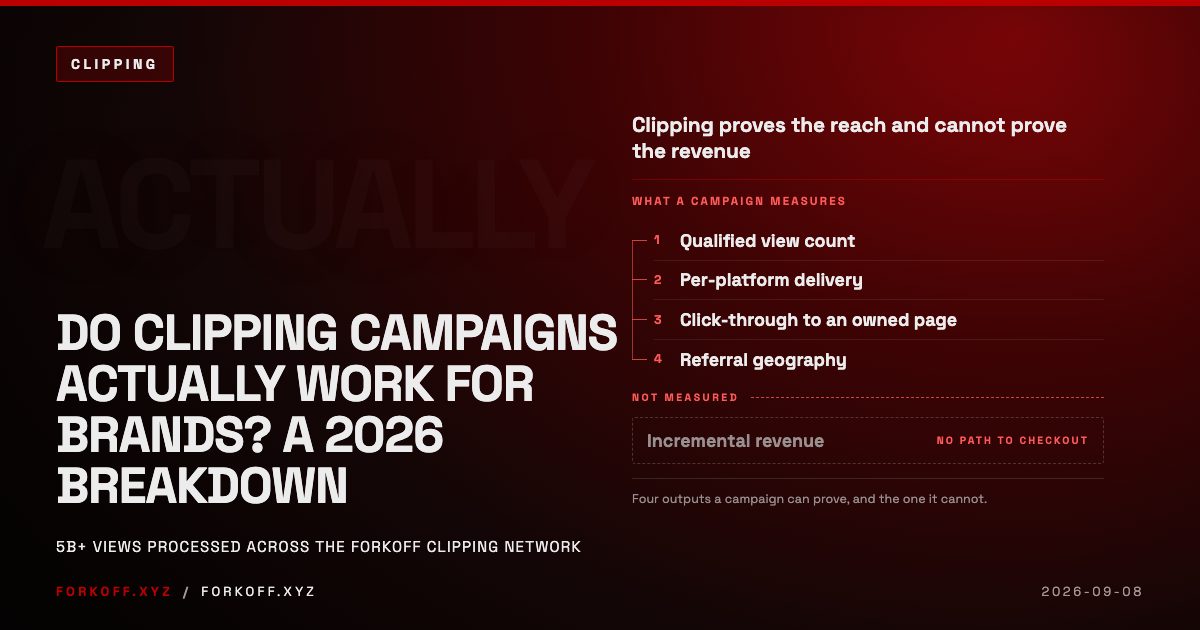
Do Clipping Campaigns Actually Work for Brands? A 2026 Breakdown
Clipping campaigns buy reach at a low unit price and cannot prove revenue. The 2026 breakdown of CPM by content signal, attribution and vendor diligence.
 Read
Read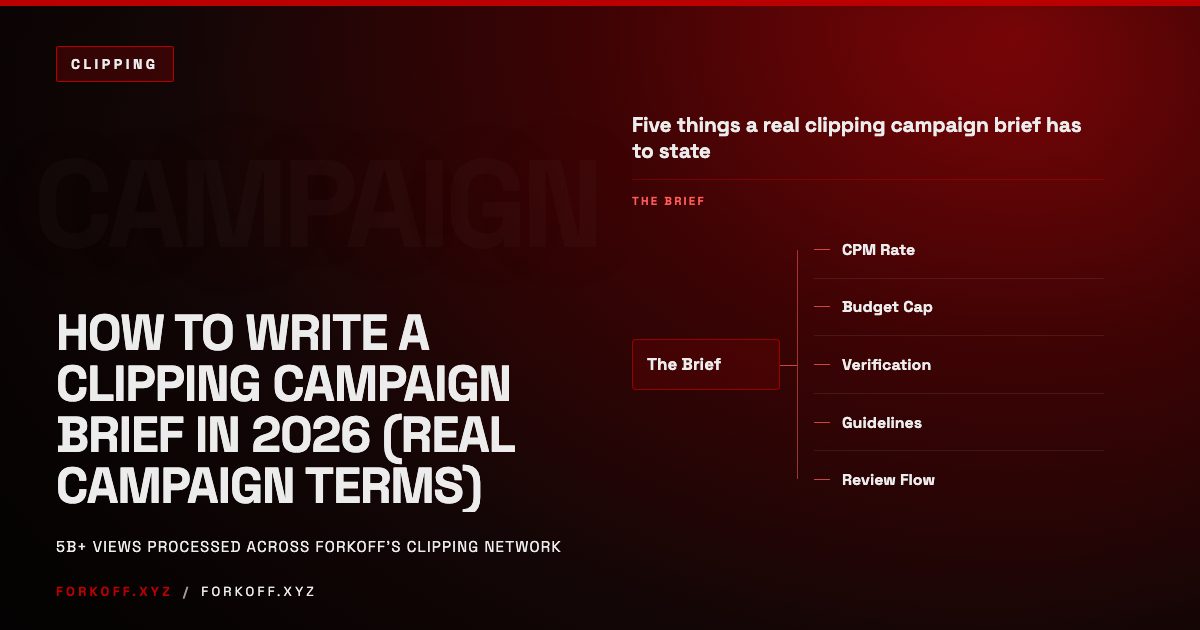
How to Write a Clipping Campaign Brief in 2026 (Real Campaign Terms)
A clipping campaign brief sets the CPM, budget cap, submission rules, and review flow that decide whether a campaign gets quality clips or wasted budget.
Read
Clipping a Game Launch: Turning Twitch and Kick Streams Into Qualified Installs
A launch-week playbook for clipping Twitch and Kick streams into qualified installs, with Drops mechanics, wishlist math, and a 7-day production calendar.
Read