
Alex Dees
@alexmdees · 2.5K followers
Introducing Meridian. 50% of searches are now powered by AI (Think ChatGPT and Gemini) Meridian is the FIRST Visibility Engine to get you ranked #1 by AI. Bold claim? Here's how 👇
Meridian launchReconstructed reading
Meridian is a real product by a real founder (@alexmdees). RADAR has tracked 5.3M views on this launch, according to the source post linked below. RADAR measures how the launch reach was built, not whether the product works or whether anyone was honest. This reading is reconstructed confidence and every input is public.
By Simba, Launch Intelligence Analyst · Reviewed by JK · Published 29 Jun 2026 · Confidence: reconstructed
Independent, methodology-derived signal, not a statement of fact about any person. RADAR reads how reach was built, a signature, not an accusation. See the methodology.
Did the Meridian launch go viral organically, or was the reach amplified?
The Meridian launch by @alexmdees drew 5.3M views on 3.5K likes, which is 1,523 views per like, above the roughly 500 organic ceiling. RADAR reads a reconstructed reading in how that reach was built, a signature of the mechanics and not a claim about the product or the founder. This is a reconstructed reading and every input is public and reproducible.
New here? Start with the product
What is RADAR, and what does this grade mean?
RADAR is FORKOFF's launch authenticity rating system. It reads whether a product launch earned its reach through real engagement or bought it through paid distribution, using only public signals anyone can pull from the launch post. Every reading carries a letter grade, a confidence label, and the date it was last checked, and links back to a published method you can reproduce. Meridian is a real product by a real founder (@alexmdees). RADAR measures how the reach was built, not whether the product works or whether anyone was honest.
Reconstructed reading
Independent, methodology-derived signal, not a statement of fact about any person. RADAR reads how reach was built, a signature, not an accusation. See the methodology.
What this grade means
RADAR reads this launch from its views-to-likes ratio alone, without a full amplification trace, so the grade is labeled reconstructed and held at lower confidence. The read is a signature of how the reach was built, not a claim about the product or the founder.
The signals RADAR reads
Views-to-likes ratio
Organic reach tops out near 500 views per like. When views climb far past that without the likes to match, the extra reach is arriving without the engagement organic reach produces.
Amplification wave shape
Organic amplification spreads over hours and days. A coordinated launch fires a synchronized burst of quote posts in the first few hours, read from each post's own timestamp.
Posting-time fingerprint
A post that fires exactly top of the hour on a weekday is scheduled. On its own it is weak, but it corroborates a coordinated launch alongside the other two signals.
Those three public signals sit on top of RADAR's five-component forensic read. The full method, the bands, and the confidence model are on the RADAR methodology page.
This launch in the data
Where does this reach sit against the tracked corpus?
Where it sits in the corpus
Rank 20 of 30 tracked launches by views per like, lowest (most organic) first. A lower ratio is the favorable end.
Against the benchmark
This launch's views per like next to the organic median (354) and the amplified median (1,441) across the tracked set.
A real founder, a real product, and reach that ran ahead of the engagement.
The product is real and the founder is real. Meridian (trymeridian.com) is a live AI-search visibility platform, and @alexmdees is a verified, long-standing operator account. Nothing in this read disputes either fact. What RADAR reads is the distance between the reach and the engagement, plus the distance between the reach and the account's own audience. The launch account carried roughly 2,467 followers at the time of the post. A 5.28M-view reach is more than two thousand times that follower base. Reach that far beyond an account's own audience does not come from the account's followers alone. It comes from distribution: amplification by larger accounts, a boosted thread, or paid placement. The public record shows part of that distribution plainly, a separate thread from a large curation account carried the launch outward.
The rest of this teardown walks the reading first, then steps back to the product, the founder, the funding, and the market, so a reader can audit the read and understand the launch in full. RADAR exists to separate the marketing layer (what a launch claims) from the data layer (what the public signals actually show). A distribution-amplified signature is not a verdict on Alex Dees's honesty and not a claim that any view was fake. It is a read that the reach was built with help the account's own following could not supply on its own.
Engagement coupling: the views ran ahead of the layers
The lead fact is the follower-to-reach gap. Alex Dees's launch account carried roughly 2,467 followers against a 5,277,367-view launch. That is a reach more than 2,100 times the size of the account's own audience. Organic reach is bounded, loosely, by who can see and pass on a post: the followers, plus the followers of whoever reshares it. A reach this many orders of magnitude above the base follower count is not produced by the followers reposting to their own networks. It is produced by distribution that sits outside the account: a much larger account amplifying it, a boosted or promoted placement, or both. RADAR went looking for the coupling that would explain the reach as organic and did not find it. The likes lagged the views by a wide margin.
Signal one: the views-to-likes gauge in the amplified zone
The load-bearing signal is V:L, views divided by likes. On X, the feed that surfaces a post also makes it easy to like, so under organic distribution reach and likes rise together up to roughly 500 views per like. X's 2026 ranking treats engagement types as interconnected signals and rewards written replies heavily because a reply is costly effort. When views climb but likes do not keep pace, the extra views are arriving from a channel that does not also produce proportionate engagement, the signature of paid or boosted reach. The Meridian launch shows exactly that: 5,277,367 views divided by 3,466 likes is 1,522.6 views per like, a like rate near 0.066 percent. That is well below the rate a 5.28M-view organic post typically carries, and roughly three times past the 500:1 organic ceiling.
Signal two: the costly layers are present but do not close the gap
Likes are the cheapest action. Replies and quotes are not, because each is a written post a real person had to compose, and RADAR weighs them as the better authenticity signal. The Meridian launch carried 1,157 replies and 217 quotes, real conversation, not an empty view spike. This is why the read is distribution-amplified and not botted or suspicious: there is genuine human engagement in the thread, and the product drew real discussion. But the reply and quote layers, sized against a 5.28M-view reach, are thin relative to the reach. Total visible engagement of likes plus reposts plus replies plus quotes is 5,602 actions, about 0.11 percent of views. That is below the band a fully organic mega-viral post tends to hold, which is the same story the gauge tells: the engagement layers did not scale up with the reach.
Views per like
About three times the 500 organic ceiling. Likes lagged a 5.28M-view reach by a wide margin instead of keeping pace with it.
Follower-to-reach gap
A launch account of roughly 2,467 followers reached more than 5.28M views, over two thousand times its own audience. Organic resharing alone does not produce that.
Replies
Written posts, real conversation, not an empty view spike. But sized against a 5.28M-view reach the costly layers are thin relative to the reach.
Total coupling
Likes plus reposts plus replies plus quotes (5,602) against 5.28M views. Below the band a fully organic mega-viral post tends to hold.
Signal three: the reach was carried by outside distribution
The clearest public artifact is that the launch did not travel on the founder's account alone. A separate thread from a large curation account amplified it, introducing the founders and the product to that account's much larger audience on the same day. RADAR describes amplifying accounts only by their public role and metrics and does not name a specific booster as the cause: what is verifiable is that a large account with a following far bigger than @alexmdees's 2,467 carried the launch outward. That is the mechanism that closes the gap between a 2,467-follower account and a 5.28M-view post. It is also exactly what a distribution-amplified signature describes: reach built with help from outside the launching account, whether through an organic boost from a bigger account, a coordinated cross-post, or paid placement. RADAR cannot, from public metrics alone, separate a big account choosing to amplify this from a placement that was paid for. Both produce the same signature, and the read names the signature, not the payment.
Read together, the signals tell one story. The reach ran ahead of the engagement and far ahead of the account's own audience. The like rate sat at about three times the organic ceiling. The costly layers were real but thin against the reach. And a larger account carried the post outward. That is distribution-amplified reach: real product, real founder, real conversation, reach built with outside distribution.
What Meridian actually is
The product's own solution page describes three pillars: brand analytics (tracking how often and how a brand surfaces inside AI answers), website optimization (changes that make a site more likely to be cited by answer engines), and improvement actions (a worklist of recommended steps) (trymeridian.com/solution). An amplifying thread on launch day described Meridian as monitoring thousands of AI conversations daily to surface where a brand appears, is missing, or is being beaten by a competitor inside AI answers.
Meridian also runs a content hub that doubles as category education and as its own AEO play. The blog includes explainers like What is Answer Engine Optimization (GEO)? and a competitive landscape piece, 10 Best Answer Engine Optimization (AEO and GEO) Platforms in 2026, and the company maintains a Medium presence on AI search optimization (trymeridian.com/blog, medium.com). That a young company is already publishing category-defining content is consistent with an AEO tool that has to be findable inside the same answer engines it sells visibility into.
RADAR notes one honest limit on the product read: no pricing, customer count, or usage figure is published as of the launch. The solution overview and the founder interview describe the mechanics, not the traction (pulse2.com). So this teardown reads what Meridian is and how the launch traveled, and does not assert adoption numbers the public record does not support.
Alex Dees, co-founder and CEO of Meridian
Dees's background reads as a real operator rather than a manufactured persona. Per the Pulse 2.0 founder interview and his LinkedIn, before Meridian he was Head of Business Development at an embedded-fintech company, which he scaled from pre-seed through Series B (pulse2.com). That is a credible go-to-market and partnerships track record, the kind of background that explains both the product's commercial framing and the founder's ability to attract distribution from larger accounts on launch day.
One disclosure on the founder evidence. Alex Dees's and Zack Xuereb's LinkedIn profiles and the Meridian company LinkedIn page are bot-gated to direct fetch, so RADAR treats those as real but unverified-by-fetch. The facts above are corroborated by the live tweet and verified profile, the publicly fetchable trymeridian.com pages, and the Pulse 2.0 interview, which is why the founder read is stated plainly while the LinkedIn-only details are held at lower confidence.
The founder being real and credible is central to the read, not a footnote. A distribution-amplified signature is not a fake-founder finding. The opposite is true here: a real, verified founder with a genuine go-to-market background launched a real product and reached, through outside distribution, an audience thousands of times larger than his own following. The read is about how the reach was built, and a strong operator getting amplified by larger accounts is one of the most ordinary ways a launch reaches millions.
What is behind Meridian, and how it is financed
A name-collision warning belongs up front, because the disambiguation is load-bearing. Web searches for Meridian funding surface two raises under the name Meridian, a $7M seed led by 645 Ventures and a $17M seed (a16z, The General Partnership). Neither belongs to Alex Dees's AI-visibility Meridian. One is a private-equity AI deal platform associated with a different founder, and the other is an agentic financial-modeling and spreadsheet startup. Attributing either raise, or those investors, to this Meridian would be wrong. RADAR explicitly does not connect those rounds, those amounts, or those funds to @alexmdees's company.
Because no funding-news cycle accompanied this launch, the reach cannot be explained as a raise-announcement bump. The distribution-amplified signature stands on the engagement coupling and the follower-to-reach gap, not on a funding event, and there is no disclosed capital relationship behind the company to read either way.
| Structural fact | Reading |
|---|---|
| Meridian (this company) round | None public; no disclosed investors |
| $7M seed, 645 Ventures | Different company; do not attribute |
| $17M seed, a16z / The General Partnership | Different company; do not attribute |
| Funding-news bump | None; no raise accompanied the launch |
| Co-founders | Alex Dees (CEO), Zack Xuereb |
Where this launch sits, and why amplification was the natural play
The competitive set proves the category is real
The competitive set shows the category is real and already contested. Named competitors in the same space include Profound and Otterly.ai, and Meridian's own blog benchmarks the best AEO and GEO platforms, a tell that the field is crowded enough to need a buyer's guide (trymeridian.com/blog). A fast-filling category with several funded entrants is exactly the kind of environment where a new launch leans on distribution, a boosted thread, amplification from a larger account, or paid placement, to stand out, because organic reach from a 2,467-follower account would not clear the noise on its own. The distribution-amplified signature fits the strategic logic of the category, not just the metrics.
Comparable RADAR launches
RADAR has profiled a library of launches. Compare the Meridian reading against the reads-organic launches in the library and the other distribution-amplified contrasts:
Methodology, and what we are not saying
RADAR does not output a pass or fail on a person. It outputs a signature and a confidence label, both built from public metrics anyone can pull, so the reader can check the work. For Meridian, the distribution-amplified signature rests on three readings:
- The views-per-like ratio (about 1,523:1) sat roughly three times above the 500:1 organic ceiling, so likes did not keep pace with a 5,277,367-view reach (like rate near 0.066 percent).
- The follower-to-reach gap is extreme: a launch account of roughly 2,467 followers reached more than 5.28M views, over two thousand times its own audience, which organic resharing alone does not produce.
- The reach was carried outward by at least one larger account amplifying the launch on the same day, the mechanism that closes the gap between a small account and a mega-viral post.
Confidence and how to reproduce it
Confidence is labeled reconstructed: built from the live metric snapshot, the engagement-ratio reading, and the public follower-to-reach gap, not a full forensic trace of every engager or a confirmed payment record. RADAR cannot, from public data alone, prove a specific dollar bought a specific view, which is exactly why the read names the signature and labels confidence reconstructed rather than verified. Every input is public. Pull the anchor post's view, like, repost, reply, and quote counts; divide views by likes for the gauge; compare the reach against the account's follower count; and check whether a larger account carried the post outward. The signature falls out of the data. See the full method at the RADAR methodology.
Questions readers ask about this launch
Is Meridian real?
+
Who is Alex Dees?
+
What does distribution-amplified mean here?
+
Did Meridian raise funding, and who are the investors?
+
How do you know the reach was amplified and not organic?
+
Sources
Primary citation: x.com/alexmdees/status/1975607272123605484. Every number traces to a public pull; reads re-checked over time.
- x.com/alexmdees/status/1975607272123605484 (launch post, 7 Oct 2025)
- x.com/alexmdees (verified founder account)
- x.com/trymeridian (product account)
- trymeridian.com/solution (solution overview)
- trymeridian.com/blog (AI search optimization content hub)
- trymeridian.com what is Answer Engine Optimization
- trymeridian.com best AEO and GEO platforms 2026
- pulse2.com interview with co-founder and CEO Alex Dees
- linkedin.com Meridian company page
- linkedin.com Alex Dees profile
- linkedin.com Zack Xuereb profile
- linkedin.com Alex Dees Introducing Meridian launch post
- resource.fyi Meridian product listing
- medium.com AI search optimization in 2026 (Meridian)
How RADAR read this launch, component by component
Each named component carries a plain-English definition and a directional read where the public data supports one. RADAR publishes the component names, never the weights or the formula.
View-velocity signature
Not publishedWhether the view curve grew the way organic spread does, or spiked like an injected burst.
Per-launch read not published in the public dataset. This component needs the forensic engine output.
Engagement coupling
NeutralWhether likes, replies, and reposts grew in step with views (the organic signature), or the views ran out ahead.
At 1,523 views per like, reach runs a step ahead of the likes: a light lift above the roughly 500 organic ceiling.
Reply-network authenticity
Not publishedWhether the accounts replying are real, distributed people or a coordinated cluster posting together.
Per-launch read not published in the public dataset. This component needs the forensic engine output.
Amplifier-cluster pattern
Not publishedWhether the quote-tweet amplification looks like organic word of mouth or a known activation cluster.
Per-launch read not published in the public dataset. This component needs the forensic engine output.
Smart-follower activation
Not publishedWhether genuinely influential reference accounts engaged, or the reach was only low-quality volume.
Per-launch read not published in the public dataset. This component needs the forensic engine output.
Are you the founder of Meridian? You can claim or contest this read. RADAR attaches a founder response to the launch and re-examines any component you dispute.
Authorship
Simba
Co-founder, FORKOFF
Reviewed by: Kshitij JK
Last reviewed:
Published:
Methodology
RADAR reconstructed reading of the Meridian launch from public metrics: the views-to-likes ratio against the roughly 500 organic ceiling and the posting-time slot, framed as a signature of how reach was built, not an accusation.
Sources cited
- RADAR methodology , FORKOFF
- Meridian source post , X
Where to go next
Understand launch authenticity
Three ways in, depending on what brought you here: learn how the score works, get a launch read or built, or get the plain answer on this launch.
Learn the score
What a launch authenticity score is
A launch authenticity score reads whether a launch earned its reach or bought it, from public signals. Start with the definitions and the checks you can run yourself.
Verify or build
Launch authenticity verification
Want a launch read by the same method, or a launch video made and distributed on the outcome? RADAR reads any public launch, and FORKOFF builds the launch behind the reach.
The skeptic's question
Is the Meridian launch legit?
If you are checking whether the Meridianlaunch was real users or bots, here is the honest read: RADAR's reading is Reconstructed reading, at reconstructed confidence, computed from public metrics and reproducible from the source post. It measures how the reach was built, not whether the product works.
Peer launches
Launches with a similar read
Co-Invest launch
@liquidtrading
3.8M views · 1,545 per likeRead
Playad launch
@YounchanHwang
1.7M views · 1,359 per likeRead
Merge Gateway launch
@shensi
3.7M views · 1,953 per likeRead
Superblocks 2.0 launch
@bradmenezes
4.6M views · 2,088 per likeRead
Ollie launch
@blennon_
2.0M views · 958 per likeRead
MaveHealth launch
@thatssodhawal
2.6M views · 825 per likeRead
The benchmark behind every reading
- The organic vs amplified benchmark. What a healthy launch ratio looks like, side by side.
- RADAR methodology. The bands, the confidence model, and how to reproduce a read.
- The Launch Authenticity Report 2026. The aggregate study across the tracked corpus.
- The X Launch Authenticity Study 2026. Two in three tracked launches show a bought-amplification signature.
- Verified-organic leaderboard. The launches RADAR reads as genuinely organic.
- Best product launch videos. The editorial cut of every tracked launch, ranked by views.
- Product launch video service. Get a launch video made and distributed, priced on the outcome.
Want a launch read by RADAR's method?
RADAR reads whether a launch's reach was earned or bought from public data, with the confidence label and the source citation on every reading.
Receipts, deep dives, and playbooks.
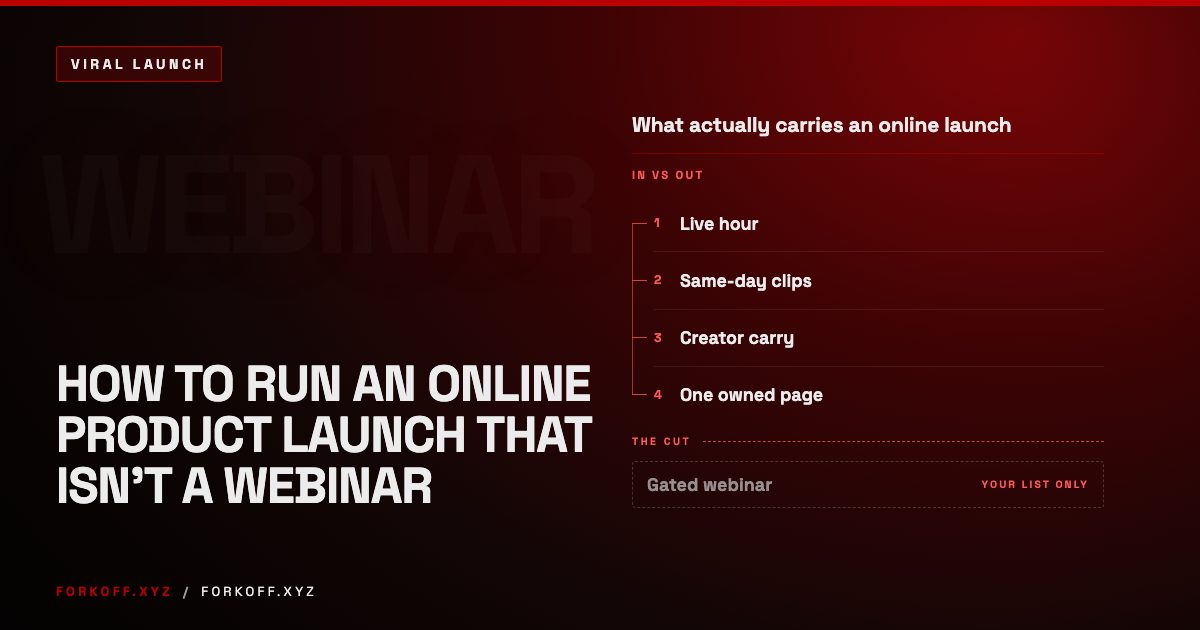
How to Run an Online Product Launch That Isn't a Webinar
An online product launch is a live moment cut into clips that creators carry, not a gated webinar. Here is the livestream, clip and creator stack for 2026.
 Read
Read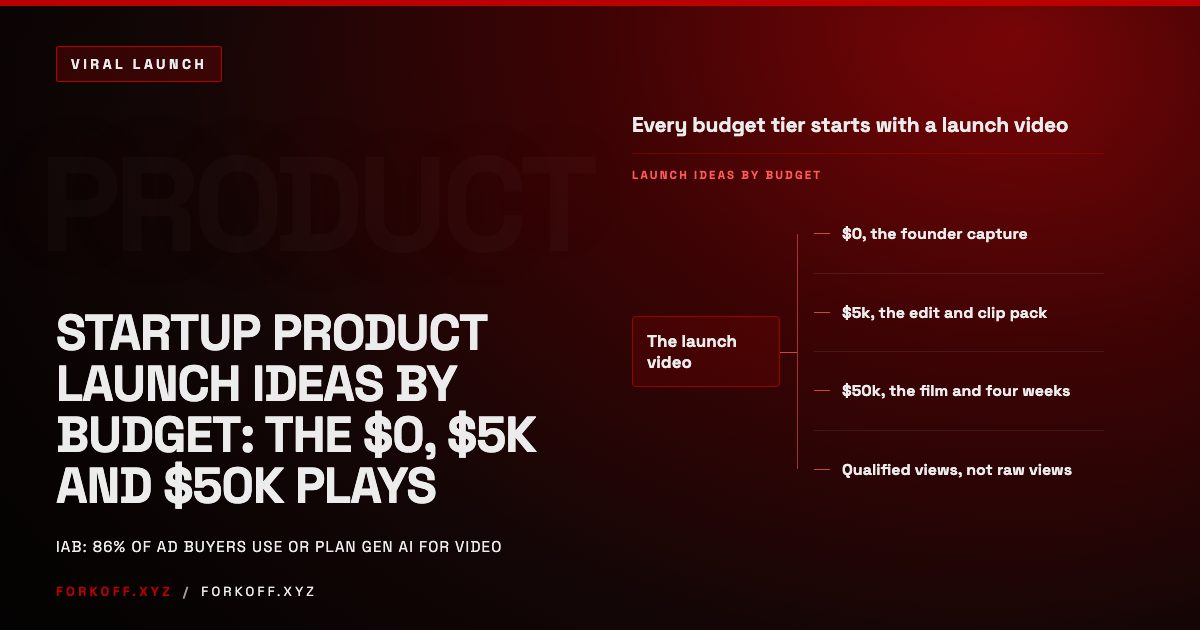
Startup Product Launch Ideas by Budget: The $0, $5k and $50k Plays
Product launch ideas for a SaaS startup sorted by budget: what the launch video should be at $0, $5k and $50k, and the distribution around it.
Read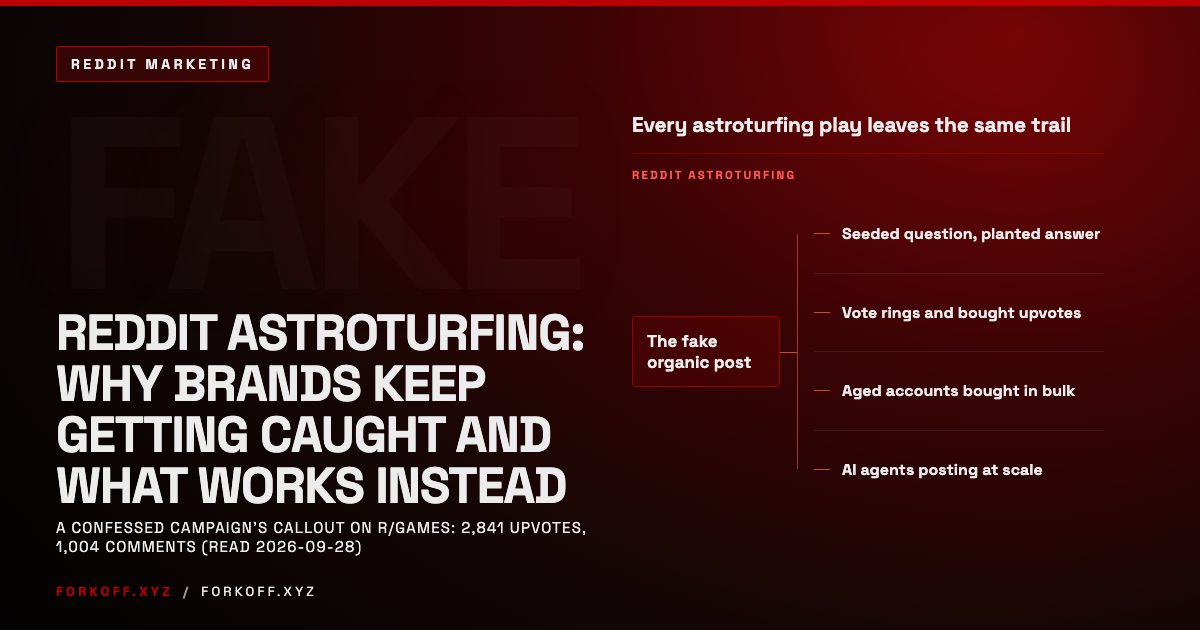
Reddit Astroturfing: Why Brands Keep Getting Caught and What Works Instead
Reddit astroturfing is paid promotion dressed up as organic talk. Why brands keep getting caught, what exposure costs, and the legitimate way to show up.
Read