
Clips from YouTube. Long-form into qualified vertical distribution.
Vetted clippers route your YouTube long-form library into TikTok, Shorts, Reels, and X cuts. You pay $0.003 per qualified view. Watch-time, policy, geo, and traffic-validity gate every view before it hits your invoice.
What is the best way to turn YouTube content into TikTok clips?
YouTube to Clips Conversion is a managed clipping lane: vetted TikTok clippers turn your YouTube back-catalog into platform-native vertical cuts, billed only per qualified view at $0.003 CPQV once a four-stage watch-time, policy, geo, and bot gate clears. FORKOFF has processed 5B+ views on this model at 99.71% legitimacy.
- Pricing
- $0.003 per qualified view (CPQV)
- Model
- Managed clipping network, outcome-priced
- Qualification
- Four-stage: watch-time, policy, geo, bot
- Watch gate
- TikTok: 8 to 12s
Agencies sell effort. Marketplaces sell volume. FORKOFF sells qualified outcomes.
One source library. Four destination surfaces. Per-platform watch-time gates.
Hashtag-cluster authority
Channel-shelf placement
Original Audio decision
Thread-context distribution
What outcome-priced clipping looks like in production.
YouTube library to qualified distribution in three steps.
YouTube intake + brief lock
Strategist intakes the YouTube channel or video library, locks per-platform watch-time gates (TikTok 8 to 12s, Shorts 10 to 15s, Reels 12 to 18s, X native), brand-safety rules, monetisation policy alignment, geo policy, and sanctioned-region exclusions. Brief signed off in under 24 hours from intake. Sandbox size scoped at acceptance.
Clipper routing per destination
Clippers vetted on prior YouTube qualification rates and per-platform format history. Open-marketplace self-tags are not trusted. routing happens against the FORKOFF roster with deprioritisation on past policy breaks. Roster includes vertical-format specialists for each destination platform plus YouTube-native moment-spotters who recognise chapter-mark beats, founder hot-takes, data callouts, controversy frames, and thread-quotable lines from the long-form timeline.
Per-platform ledger settle
Every view passes the four-stage gate: watch-time, policy compliance, geo consistency, traffic validity. Filtered views are logged with a reason code and excluded from billing. Audit ledger exports to CSV/JSON. settles weekly to the brand's finance system. Consumer apps reconcile against AppsFlyer or Adjust install records; sponsorship campaigns feed the ledger into partner-side review; web3 brands read sanctioned-region exclusions before scaling.
Which source moments qualify on which destination.
Not every long-form moment converts. The clipper roster reads the source timeline for these beat types and routes against the destination surface with the strongest qualification curve.
Founder hot-take
Long-form chapter mark with mic-drop tonal lift. the line that gets quoted in comments
Data callout
On-screen chart, statistic, or percentage with verbal explanation in the same 30s window
Controversy frame
Counter-take or unpopular opinion that runs against category orthodoxy
Thread-quotable line
One-sentence insight clean enough to lift into a screenshot quote without context
FORKOFF vs the alternative.
| Feature | FORKOFF Clippingoperator-grade | Generic alternativethe rest of the market |
|---|---|---|
| Operating model | Managed agency. Strategist owns the YouTube long-form pipeline end-to-end. Vetted clipper roster routes the library against per-platform watch-time gates. ▸ Managed, not DIY | DIY tool subscription (OpusClip, Klap, Vizard) or open-bounty marketplace (Whop). brand or creator is the qualification engine. |
| Pricing denominator | $0.003 per qualified view (CPQV). Filtered traffic logged with reason code, not billed. ▸ CPQV vs CPM | Tool subscription with no qualification gate, or raw CPM with hidden legitimacy rate. |
| YouTube source fit | Long-form pacing across 10 to 60 minute episodes. Chapter-mark beat selection. Multi-platform fan-out per beat. | Generic auto-clip on audio peak. Misses chapter-mark cultural beats. Single-destination output. |
| Audit trail | Per-view ledger with reason codes. CSV/JSON export for MMP reconciliation, partner review, treasury reporting. ▸ Auditable | Dashboard counts only. no per-view audit, no reason codes. |
| Lane fit | Brands and creators with 50 plus YouTube uploads buying outsourced multi-platform distribution. | Solo creators wanting self-serve tooling are better served by OpusClip or Klap directly. |
Long-form pacing, chapter-mark beats, and the four-platform fan-out problem.
For the deeper background behind this page, read how a clipping engine outperforms subscriber-chasing.
Founder-show YouTube library, 2.4M qualified views in Q1.
▸ NDA · founder-led B2B podcast cross-published on YouTube
Founder-led B2B podcast publishes 90-minute episodes on YouTube as the primary surface. FORKOFF intook the YouTube channel, audited the back-catalog (40 episodes), locked per-platform watch-time gates, and routed the chapter-mark beats across TikTok, Shorts, Reels, and X. 2.4M qualified views ledgered in Q1. Legitimacy rate 99.5%. Per-episode roll-up showed which guest interviews over-indexed on Shorts vs Reels, reshaping the editorial calendar for Q2 booking.
▸ FORKOFF case archive · NDA-protected handle
Who this is for. Who it isn't.
- Creators with 50 plus YouTube long-form uploads buying outsourced repurposing
- Brands with founder-led or host-driven YouTube shows needing finance-grade attribution
- Media companies with conference / event YouTube libraries (80 plus hours)
- Web3 brands with founder talks on YouTube needing sanctioned-region exclusions
- Consumer-app brands reconciling qualified views against AppsFlyer / Adjust install records
- Solo creators wanting a DIY tool subscription (use OpusClip or Klap directly)
- Channels under 10 long-form uploads (insufficient back-catalog surface)
- Music or gameplay channels where rights make vertical re-cutting illegal or trivial
- Brands optimising on raw view counts rather than qualified watch-through
- Creators unwilling to lock a brand-safety policy at brief acceptance
Same source, narrower destination cuts.
When the brief locks to a single destination platform, the spoke page carries the per-destination qualification spec.
Calculator coming to forkoff.xyz soon. Use the dedicated tool at /tools/qualified-view-auditor for full qualified-view analysis.
Frequently asked
What does it mean to make clips from YouTube?
Making clips from YouTube means cutting long-form YouTube uploads into vertical short-form clips for distribution on TikTok, YouTube Shorts, Instagram Reels, and X. The discipline goes beyond auto-clip tools. it involves chapter-mark beat selection, per-platform watch-time tuning, vertical aspect re-frame, captioning, and qualification. FORKOFF runs the pipeline as a managed agency end-to-end and prices the work per qualified view, not per generated clip.
How does FORKOFF qualify a YouTube clip view?
Every view passes a four-stage gate at view-record time: watch-time threshold per destination platform (8 to 12s on TikTok, 10 to 15s on Shorts, 12 to 18s on Reels, X native upload threshold), policy compliance against the brief's brand-safety rules, geo consistency cross-referenced against the clipper's routing record at playback IP, and traffic validity that filters bot-pattern playback and sub-1-second swipes. Views that clear all four gates are billed at $0.003 CPQV. Views that fail any gate are logged with a reason code and excluded from billing.
Why use a managed agency over OpusClip or Klap?
OpusClip, Klap, Vizard, Submagic, and Captions are DIY tool subscriptions. The creator or brand picks the moment, edits the clip, ships it across surfaces, and counts the views. FORKOFF is the managed lane. Strategist audits the YouTube library, vetted clippers select the chapter-mark beats and re-cut per platform, the qualification engine grades every view, and the audit ledger settles weekly. If you want to run your own back-catalog with self-serve tooling, the DIY tools are a cleaner fit. If you want outsourced multi-platform distribution priced on outcomes, the managed lane is the wedge.
Will the qualified-view ledger reconcile against MMP records?
Yes. CSV/JSON export with per-view reason codes, geo, watch-completion, platform, and clipper attribution. Consumer-app brands reconcile against AppsFlyer, Adjust, or Branch install records. Sponsorship campaigns feed the ledger into partner-side performance review. Web3 brands read sanctioned-region exclusions logged in the ledger before scaling spend. Media companies and talent agencies read the per-show or per-creator roll-up for clipper rotation across the roster.
What kinds of YouTube content convert best to vertical clips?
Long-form podcast cross-uploads, founder talks, conference recordings, product launch streams, narrative interviews, and host-driven episodic shows convert best. The pattern: 10 to 60 minute episodes with clear chapter marks, a host or founder voice, and at least one per-episode beat that can stand alone as a 12 to 18 second insight or controversy frame. Music videos, gameplay walkthroughs, and tutorial content convert less reliably because the qualifying beat is rarely a self-contained 14-second window.
How do YouTube monetisation rules affect the clipping pipeline?
YouTube long-form monetisation policy and YouTube Shorts shelf eligibility rules are enforced at the clipper-roster brief layer. Policy verdict per view sits in the qualification ledger. Music licensing, copyrighted footage, sponsored-segment disclosure, and category-specific rules (finance, health, gambling) get locked at brief acceptance. Clippers who break policy on prior briefs are deprioritised on the next assignment. The audit ledger gives compliance a paper trail per view, which matters for brands feeding the data into channel monetisation review or treasury reporting.
How fast can a YouTube-to-clips campaign go live?
Brief signed off in under 24 hours from intake. Brief to first qualified clips live in under 48 hours for a sandbox campaign. Larger retainers run their own onboarding window. The strategist intakes the YouTube channel URL, audits the back-catalog, locks per-platform watch-time gates and brand-safety rules, and routes the first batch through the clipper roster before the qualification ledger starts settling.
What is the minimum spend and how does the sandbox tier work?
The sandbox is a small first campaign billed at $0.003 per qualified view and routed to your audience geos. Larger campaigns are scoped per brief at intake. You see the legitimacy rate, geo mix, and per-clip watch-time before deciding whether to scale. Raw views logged outside the qualification gate are tracked but never billed.
What counts as a qualified view on a YouTube-sourced clip?
It depends on where the clip lands, because the denominator shifts per surface. A TikTok cut needs an 8 to 12 second watch before it counts; a Shorts cut needs 10 to 15 seconds and has to clear the shelf-eligibility policy; a Reels cut needs 12 to 18 seconds with the Original Audio verdict logged; an X native upload qualifies on a retweet-distribution model with no FYP at all. On top of the per-platform watch floor, the view has to come from a real device in your brief geo and survive the invalid-traffic filter (sub-second swipes, datacentre IP ranges, repeat-loop bot pattern). Anything that fails one of those gets a reason code in the ledger and never bills.
Adjacent clipping routesto plan next
Cold Email Open-Rate Predictor
Predict your cold email open rate from 5 inputs. Anchored against the FORKOFF outreach ledger (N=1,247 first-touch sends, 52% baseline).
AI SEO Audit
6-dimension AI-native page audit. Schema, snippet, LLM citation surface, linking, answers, freshness. Returns composite tier (A to D) and a prioritized fix-list.
AEO Checker
5-LLM AEO scorecard. Paste a brand and a query set, get the per-LLM citation share, snippet ownership, and a combined AEO score.
Run a sandbox campaign.
14 days. Paid only on qualified views. Audit-ready ledger from day one.
The qualification ledger changed how we report to the board. Real attention, verified weekly, not dashboard vanity.
Growth lead
Series A, 2026, AI infrastructure startup
We went from guessing pipeline attribution to seeing it in a weekly audit ledger. Finance signed off on the next quarter before the first one ended.
Marketing director
Mid-market, 2026, B2B SaaS platform
FORKOFF ran our conference activation across three cities in one quarter. Side events, content capture, post-event distribution. One operator, one ledger.
Head of events
Three cities, one quarter, DevTools company
As Featured In
Full press shelf- DA 55 · 2026-08Keep a Customer Community Engaged Without Over-Promotion

- CFO DriveDA 35 · 2026-08How Finance Teams Align Pricing With Sales Without Eroding Margins
- DA 94 · 2026-07Clipping Agency FORKOFF Crosses 5 Billion View Milestone

- DA 74 · 2026-06Five Things SaaS Founders Get Wrong About Short-Form, and Why Their Best Moments Die in 48 Hours

- LinkedInDA 56 · 2026-06The 2026 DevOps Maturity Test: 11 Engineering Orgs Failed and the One Metric That Replaced the Checklist
- IHDA 75 · 2026-06Most indie products do not fail on the build. They fail on distribution.
- DA 56 · 2026-06The Schema-Match Audit That Lifted Our AI Overview Citation Share From Zero to 23 Percent in 90 Days

- DA 42 · 2026-0525 Country-Specific Considerations for International IP Protection for Your Startup

- DA 68 · 2025-11RedStone, FailSafe, Nibiru and ForkOff Announce The Capital Layer at Devconnect Buenos Aires 2025

- DA 62 · 2025-11RedStone, FailSafe, Nibiru and ForkOff Announce The Capital Layer at Devconnect Buenos Aires 2025

- DA 50 · 2025-11RedStone, FailSafe, Nibiru and ForkOff Announce The Capital Layer at Devconnect Buenos Aires 2025

Receipts, deep dives, and playbooks.
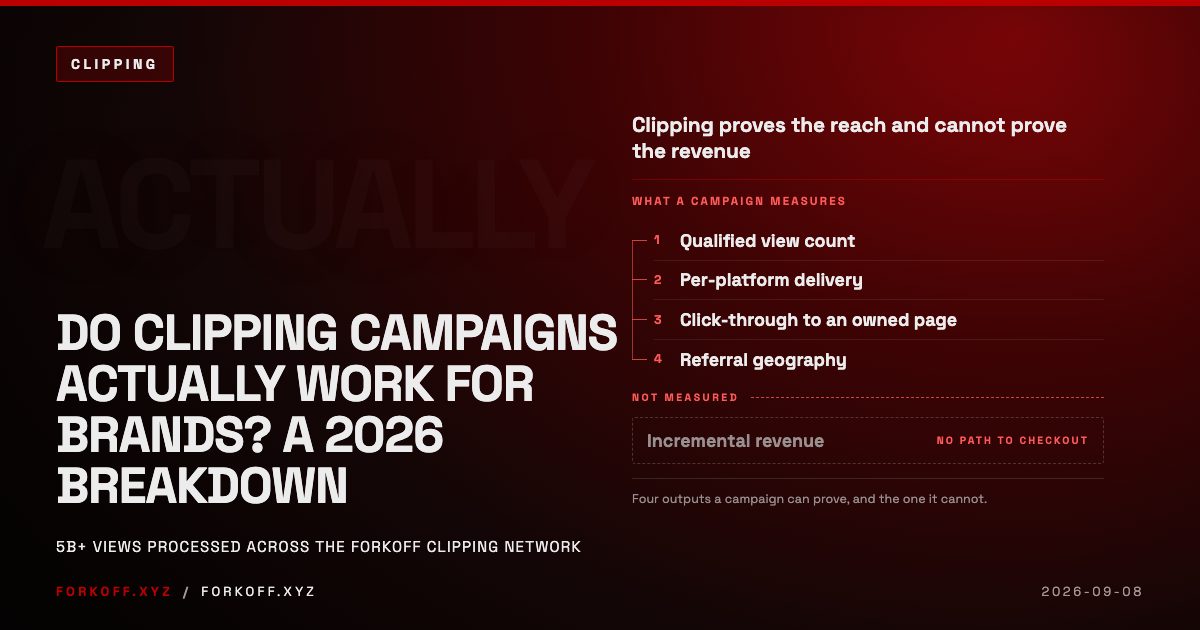
Do Clipping Campaigns Actually Work for Brands? A 2026 Breakdown
Clipping campaigns buy reach at a low unit price and cannot prove revenue. The 2026 breakdown of CPM by content signal, attribution and vendor diligence.
 Read
Read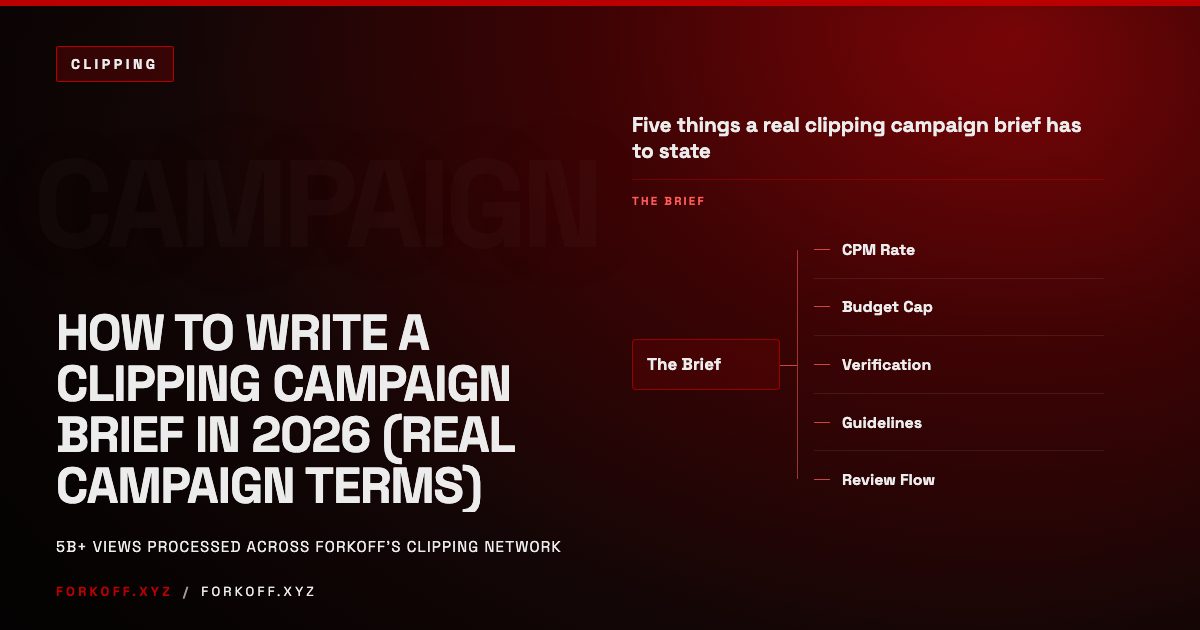
How to Write a Clipping Campaign Brief in 2026 (Real Campaign Terms)
A clipping campaign brief sets the CPM, budget cap, submission rules, and review flow that decide whether a campaign gets quality clips or wasted budget.
Read
Clipping a Game Launch: Turning Twitch and Kick Streams Into Qualified Installs
A launch-week playbook for clipping Twitch and Kick streams into qualified installs, with Drops mechanics, wishlist math, and a 7-day production calendar.
Read