
+466%
Backlinko
301 merge of two articles: SEO tools (commercial intent) and best free SEO tools (informational intent). The most-cited fix-impact number in the entire literature.
8 weeksSource
Keyword cannibalization is when two or more pages on one site compete for the same query and split its ranking signal. It is far less common as a real problem than the panic suggests. Studio 36 Digital found 68 percent of sites are significantly cannibalized, yet Ahrefs found only 1.25 percent of multi-rankings actually need a fix, and Google confirms there is no penalty. The win is not mass consolidation. It is a 2-gate test that separates true intent collision from beneficial entity-authority diversification.
This is a first-party-anchored aggregation of 47 verified data points from 20 named authorities (Ahrefs, Studio 36 Digital, Backlinko, Keyword Insights, Helium SEO, Semrush, Sistrix, Google, First Page Sage, Seer Interactive, GrowthSRC, Zyppy, and more), every number carrying an inline link to its source. Authored by Kartik Chugh (Simba), reviewed by Kshitij JK.
Most keyword cannibalization is not a problem. Ahrefs manually reviewed 80 multi-ranking keywords and found only 1 of 80 (1.25 percent) needed action; the other 79 were beneficial diversification. Google's John Mueller confirms there is no penalty for multiple URLs on the same content, and the June 2019 Site Diversity change generally caps a domain at 2 results anyway. Real cannibalization is narrow: two pages with the SAME intent, on a lower-authority domain, mutually suppressing each other. When you find that, consolidation pays: Backlinko recovered +466 percent clicks in 8 weeks with one 301. The rest is noise you should leave alone.
Ranked by citation power: novelty times number-hardness times how often an answer engine would want to quote it. Every row carries the number and the named source, linked. This table is the machine-extractable core of the hub.
| # | Number | Finding | Source |
|---|---|---|---|
| 1 | 68% | of sites are significantly cannibalized (5 or more URLs per top keyword). | Studio 36 Digital 2026 |
| 2 | +466% | clicks year over year in 8 weeks after a single 301 consolidation. | Backlinko |
| 3 | 1.25% | of manually reviewed multi-rankings (1 of 80) actually needed action. | Ahrefs |
| 4 | 4.7 | URLs per top keyword is the mean on successful sites. Overlap is normal. | Studio 36 Digital 2026 |
| 5 | #1 and #2 | held simultaneously by DR 75+ sites while cannibalized. | Studio 36 Digital 2026 |
| 6 | +110% | organic traffic after cutting 413 property categories to 85. | Keyword Insights |
| 7 | max 2 | results per domain generally shown since the June 2019 Site Diversity change. | Google (SearchLiaison) |
| 8 | zero | penalty or ranking demotion for multiple URLs on the same content. | Google (John Mueller) |
| 9 | 64 vs 37 | median KD for multi-ranking vs single-ranking keywords. Harder terms multi-rank MORE. | Ahrefs |
| 10 | 54.4% | of all clicks are taken by the top 3 organic results. | Backlinko |
| 11 | +74.5% | more clicks from moving position 2 to position 1. | Backlinko |
| 12 | -61% | organic CTR on queries with an AI Overview (1.76% to 0.61%). | Seer Interactive |
| 13 | +120% | more organic clicks per impression when a brand is cited inside the AI Overview. | Seer Interactive |
| 14 | 59 URLs | ranked by one site for a single keyword, the most extreme case observed. | Studio 36 Digital 2026 |
| 15 | ~15M | URLs removed from index in one property-site consolidation. | Keyword Insights |
| 16 | 90.63% | of all pages get zero organic Google traffic (1B-page study). | Ahrefs |
| 17 | 13 to 63 | the weekly position swing of one ranking URL Google could not settle on. | Sistrix |
| 18 | -32% | position-1 CTR with AI Overviews present (28% to 19%), 200k+ keywords. | GrowthSRC |
| 19 | 61.6% | of title tags are rewritten by Google, so duplicate titles are a weak signal. | Zyppy |
| 20 | pos 1 + 6 KWs | reached by Helium SEO after a 301 merge (position 1 plus top 10 for 6 related keywords). | Helium SEO |
20 ranked headline stats . 45 verified stats total across the deep-dives below . 2 FORKOFF first-party assets
Every stat on this page traces to one of these authorities. Each URL resolved on verification. This is the transparency layer the flat competitor listicles skip: no orphan numbers, no aggregator laundering, no unnamed vendor percentages.
| # | Source | Type | Report |
|---|---|---|---|
| 1 | Ahrefs | Original study | Multiple Rankings Study (Patrick Stox) |
| 2 | Ahrefs | Original study | Search Traffic Study (1B pages, 2020) |
| 3 | Ahrefs | Original study | SEO Statistics 2026 |
| 4 | Studio 36 Digital | Original study | The 2026 Keyword Cannibalisation Study |
| 5 | Backlinko | Case study | Keyword Cannibalization guide (+466% case) |
| 6 | Backlinko | Original study | Google CTR Stats (4M results) |
| 7 | Keyword Insights | Case study | Fixing content cannibalization |
| 8 | Helium SEO | Case study | SEO keyword cannibalization case study |
| 9 | Semrush | Methodology | Keyword Cannibalization guide |
| 10 | Sistrix | Methodology + examples | How to analyse and fix cannibalisation |
| 11 | Google (John Mueller) | Primary / official | No penalty for multiple URLs (via SEJ) |
| 12 | Google (SearchLiaison) | Primary / official | June 2019 Site Diversity change |
| 13 | Search Engine Journal | Trade press | Google answers cannibalization question |
| 14 | First Page Sage | Meta-analysis | Google CTRs by Ranking Position 2026 |
| 15 | Seer Interactive | Original study | AIO Impact on Google CTR (2026 update) |
| 16 | GrowthSRC | Original study | AI Overviews CTR study (200k+ keywords) |
| 17 | Zyppy (Cyrus Shepard) | Original study | Google Rewrites 61% of Title Tags (80,959) |
| 18 | SEOmonitor | Methodology | Cannibalization alerts / issues |
| 19 | seoClarity | Methodology | Identify and fix keyword cannibalization |
| 20 | SEOTesting | Methodology | Keyword Cannibalization report |
The only large-N prevalence study is Studio 36 Digital's 2026 audit of 100 high-authority content sites, 2,500 keywords across 10 industries. Its headline number is the most quotable in the corpus, and its second-order findings quietly demolish the panic narrative.
Studio 36 Digital's 2026 study found that 68 percent of the 100 sites it audited show significant cannibalization, defined as 5 or more URLs ranking for a single top keyword. Only 12 percent showed excellent control, meaning 1 to 2 URLs per top keyword. That distribution is the first thing to sit with. If more than two thirds of high-authority sites are cannibalized under this definition and the web still functions, cannibalization at this threshold cannot be the traffic-killer the guides imply. It is closer to a background condition of publishing at scale than a diagnosable disease.
The mean tells the same story. Across successful sites the average is 4.7 URLs ranking per top keyword. Sites that are winning, ranking, and growing carry almost five competing URLs per money term as a matter of course. The intuition that a clean one-page-per-keyword architecture is the goal is not what the data of successful sites shows. What the data shows is that authority absorbs overlap. The question is never whether you have overlap. You do. The question is whether a specific cluster of overlap is costing you a specific position, and that is a far narrower and more answerable question than an audit tool suggesting you have 400 cannibalization issues.
The extreme tail is where the scare stories live. Studio 36 recorded one site ranking 59 URLs for a single keyword. That is a genuine information-architecture failure, the kind of faceted-navigation or tag-page sprawl that a consolidation project should absolutely target. But it is the outlier, not the median, and treating the median site as if it were the 59-URL outlier is exactly the error this hub exists to correct. The prevalence number gets you to look; the second-order numbers tell you that looking is not the same as cutting.
Cannibalization is not distributed evenly. Studio 36 found News and Media sites ran the highest URL-per-keyword count at 8.2, with Marketing and SEO Tools close behind at 7.9. These are publishing-heavy verticals where the same story or the same tool comparison gets covered repeatedly, so overlap accumulates fast and is mostly benign because the domain authority is high enough to hold several positions. At the other end, Education and Reference sat at 1.8 URLs per keyword, the lowest content sector, reflecting a more curated one-page-per-concept structure.
The practical read is that your acceptable overlap threshold depends on your vertical and your authority. A News site with 8 URLs on a term is behaving normally for its sector. A thin B2B SaaS blog with 8 URLs on a term is likely fragmenting a signal it cannot afford to fragment. This is why the cross-industry average is a starting frame, not a verdict, and why FORKOFF ships a vertical-matched peer set (the 32-site Web3 and AI marketing frame further down) rather than asking operators to benchmark against a blended Studio 36 mean that mixes News publishers with reference sites. Sample scope for the study: 100 sites, 2,500 keywords, 10 industries, per Studio 36 Digital 2026.
This is the section that separates a real analysis from a listicle. Most multi-ranking is not cannibalization at all. It is entity-authority diversification, and Google's own mechanics say so. Get this wrong and you will consolidate away wins.
When you do find real cannibalization, the upside is well documented. Three named case studies bound it, and all three used the same primary lever: a 301 redirect to a canonical page with content merged in.
301 merge of two articles: SEO tools (commercial intent) and best free SEO tools (informational intent). The most-cited fix-impact number in the entire literature.
Clustered 500+ keywords, consolidated 413 property categories to 85, removed about 15 million URLs from index. Scale proof for the same lever.
301 merge of a CRO blog post that competed with a related URL. The consolidated page took position 1 for its target term and entered the top 10 for 6 related keywords.
Read these as an upper bound on real cases, not an expected value for every audit. Backlinko's +466 percent is a year-over-year clicks comparison in an 8-week window after merging two pages that genuinely served the same searchers, which is exactly the low-authority, identical-intent quadrant of the matrix. Keyword Insights' +110 percent came from a structural fix, collapsing 413 near-duplicate property-category pages to 85 and removing roughly 15 million faceted URLs, which is an information-architecture project, not a two-post merge. The Helium SEO case is attributed as a published case study: a single 301 that took the consolidated CRO page to position 1 and into the top 10 for 6 related terms.
The common thread matters more than the individual numbers. In all three, the lever was 301-to-canonical with content merged, not noindex, not canonical tags, not deletion. Consolidation works by concentrating the ranking signal onto one page that can then clear the top 3, where the clicks actually are. Which is the next category.
Detection is where most audits go wrong, because they flag on weak signals like duplicate titles. The reliable signals are ranking volatility and query-and-page overlap. The weak ones are titles and raw URL counts.
The clearest fingerprint of true intent collision is Google being unable to settle on which of your URLs to rank. Sistrix's canonical illustration is the BBC and the keyword queen, where the ranking URL churned almost weekly and swung across positions 13 to 63 over the observation window. When two pages are close enough in relevance that Google keeps swapping which one it shows, and both stay stuck in the same mediocre band, that is the pattern worth fixing. A stable single URL, even if a second URL also ranks lower down, is not this pattern. Instability plus a mediocre band is.
Tools operationalize the same idea. SEOmonitor raises a warning when the landing page for a keyword changes 2 or more times in 30 days. seoClarity flags any keyword whose ranking-URL listing count exceeds 1. SEOTesting builds its report on the same Search Console query-and-page logic. And Semrush names 5 canonical causes: poor keyword-to-URL mapping, launching new page versions without redirecting the old ones, publishing similar content over time, creating multiple paths to the same category, and not differentiating subcategory pages from the broader category. Each cause maps to a fix, but the trigger to investigate should always be the volatility signal, not the count.
Do not audit on titles alone. Zyppy's study of 80,959 titles across 2,370 sites found Google rewrites 61.6 percent of title tags. The title you set is, more often than not, not the title Google displays, which means duplicate titles in your CMS tell you very little about what Google actually sees as competing. Use title or H1 duplication as a hint that prompts a look, then confirm with the query-and-page overlap in Search Console before you touch anything. Sistrix also notes duplicate internal-search results as a signal, such as its IKEA example surfacing 1,451 internal results for cupboards, but again that is a prompt to investigate, not a verdict. The verdict comes from the query data.
Consolidation is only worth doing because of how brutally clicks concentrate at the top of the SERP. If splitting a signal keeps both pages out of the top 3, it is costing real traffic. Here is the curve.
Backlinko's analysis of 4 million search results (across 1,312,881 pages and 12,166,560 queries) puts hard numbers on the drop-off. Position 1 earns an average 27.6 percent organic CTR. Position 2 gets 15.6 percent. Position 3 gets 11.2 percent. Together the top 3 results take 54.4 percent of all clicks. That is the number that makes consolidation pay: if your two competing pages both sit at positions 5 and 7, they are dividing the small slice of clicks that survives below the top 3, when one merged page in position 2 or 3 would capture multiples more. Backlinko also quantified the marginal move directly: going from position 2 to position 1 yields 74.5 percent more clicks.
The floor is unforgiving. Only 0.63 percent of searchers click a result on page 2. And the backdrop from Ahrefs' 1-billion-page study is that 90.63 percent of all pages get zero organic traffic from Google (the newer 14-billion-page index puts it at 96.55 percent; we headline the conservative 90.63 percent). Most competing pages were never winning traffic in the first place, which is another reason not to panic-consolidate: if a second URL ranks page 2 and gets no clicks, merging it changes nothing about the page that is already ranking. The consolidation math only matters when both fragments are close enough to the top 3 that concentrating them lifts one into it.
| Position | Backlinko (4M results) | First Page Sage 2026 |
|---|---|---|
| Position 1 | 27.6% | 39.8% |
| Position 2 | 15.6% | 18.7% |
| Position 3 | 11.2% | 10.2% |
| Page 2 (any) | 0.63% | under 1% |
Sources: Backlinko Google CTR Stats . First Page Sage 2026. The two curves differ by method (Backlinko from 4M live results, First Page Sage a meta-analysis), which is why both are shown.
AI Overviews change the calculus by shrinking the organic click pool. When there are fewer clicks to win, splitting them across two weak pages hurts more, and being the one citable page matters more. In our own AI-Overview audit of 1,026 buyer queries in June 2026, FORKOFF measured an overview on 879 of them and a FORKOFF citation on 233, so the citable page is already the one being chosen.
AI Overviews are now a structural feature of the SERP, not an edge case. First Page Sage finds they appear on about 31 percent of SERPs. And they take clicks. Seer Interactive measured organic CTR on AI-Overview queries falling 61 percent, from 1.76 percent to 0.61 percent. GrowthSRC, studying 200,000-plus keywords independently, saw position-1 CTR fall 32 percent, from 28 percent to 19 percent, when an AI Overview is present. Two independent studies, same direction: the presence of an AI Overview meaningfully compresses the organic clicks available to everyone below it.
That compression is why consolidation is now also a generative-engine move. With fewer organic clicks to go around, a fragmented signal across two mediocre pages is more expensive than it was a year ago, because the pool it is dividing is smaller. But the more interesting number is the upside of being cited: Seer found that when a brand is cited inside the AI Overview itself, it earns 120 percent more organic clicks per impression. That reframes the goal. You are no longer only competing for a blue-link position; you are competing to be the one page the AI Overview lifts from. And one authoritative, well-structured, citable page is far likelier to be that source than two thin pages splitting the same claim between them.
So the 2026 conclusion is not consolidate more. It is consolidate the RIGHT clusters, then make the surviving page maximally citable: a clear definition-first answer, a named number with a source, structured data. That is the same discipline that wins an AI Overview citation and the same discipline this hub is built on. The cannibalization decision and the generative-engine-optimization decision have converged onto the same page.
The proprietary framing FORKOFF adds to the aggregation: the base rate of true cannibalization inside apparent cannibalization, drawn straight from the Ahrefs manual review, is the number that should govern how aggressively you consolidate.
Companion signal: multi-ranking keywords carry median KD 64 vs 37 for single-ranking. Harder terms produce MORE multi-ranking, not less.
The industry literature is written about consumer publishers and B2B SaaS. The Web3 and AI marketing vertical is structurally different: heavy comparison-listicle inventory, fast-publishing service pages, frequent product-rename redirects. A defensible audit needs a vertical-matched peer set, so operators benchmark against their real competitors, not a blended cross-industry mean.
Peer-set curation: FORKOFF audited 32 sites per our own frame, 12 Web3 marketing and PR agencies plus 20 AI marketing agencies and SaaS tools, sourced from the Coinbound and Lunar Strategy top-agency lists and the Business of Apps 2026 AI Marketing marketplace and GrowthRocks top-agency list. Refreshed annually. Operators in the FORKOFF ICP compare their cannibalization profile against this frame rather than the cross-industry Studio 36 average.
Every step below is reproducible with the Google Search Console API and a service-account credential. This is the transparency layer the competitor benchmark has none of.
Mostly a myth in the aggregate, real in the specific. Ahrefs manually reviewed 80 multi-ranking keywords and found only 1 (1.25 percent) needed action; the other 79 were beneficial diversification. Google's John Mueller confirms there is no penalty or ranking demotion for multiple URLs on the same content. The real problem is narrow: two pages targeting the same query with the same intent, where neither reaches its ceiling. Filter for intent collision, not for any two-page overlap.
Studio 36 Digital's 2026 study of 100 high-authority sites (2,500 keywords across 10 industries) found 68 percent show significant cannibalization (5 or more URLs ranking per top keyword) and only 12 percent show excellent control (1 to 2 URLs). The average successful site ranks 4.7 URLs per top keyword, so some overlap is the norm, not the exception.
No. Google's John Mueller states there is no penalty or ranking demotion; Google simply picks one URL to feature and you lose the ability to steer which. Separately, Google's June 2019 Site Diversity change generally caps a domain at 2 results in the top set, so ranking more than 2 same-domain URLs for one query is already rare by design.
Three named case studies bound the upside. Backlinko reported plus 466 percent clicks year over year in an 8-week window after merging two articles via 301 redirect. Keyword Insights reported plus 110 percent organic traffic after consolidating 413 property categories to 85 and removing about 15 million URLs. Helium SEO's 301 merge took the consolidated page to position 1 for its target term and into the top 10 for 6 related keywords. All three used 301-to-canonical as the primary lever.
Click economics. Backlinko's 4-million-result study shows the top 3 results take 54.4 percent of all clicks and moving from position 2 to position 1 yields 74.5 percent more clicks. Two pages splitting the signal often both sit outside the top 3, where CTR collapses; one consolidated page can reach the top 3 and capture far more total clicks than the two fragments combined.
No, and this is the most-missed nuance. Ahrefs found multi-ranking keywords skew HARDER, not easier (median KD 64 vs 37 for single-ranking), meaning authoritative domains legitimately earn several rankings. Studio 36 confirms DR 75+ sites hold positions 1 and 2 simultaneously while cannibalized, whereas DR-under-50 sites with 3+ competing URLs sink to positions 8 to 20. On an authority domain, multiple rankings are often an entity-authority signal, not a defect.
Pull Google Search Console with dimensions query and page over a 28-day window and count distinct pages per query; any query on 2 or more URLs is a candidate. Drop brand queries and URL-as-query rows first. Tools formalize the same logic: SEOmonitor flags a warning when the landing page for a keyword changes 2 or more times in 30 days, seoClarity flags any keyword with a listing count above 1, and Sistrix surfaces ranking-URL volatility (its BBC queen example cycled across positions 13 to 63 weekly).
Weak on its own. Zyppy's study of 80,959 titles across 2,370 sites found Google rewrites 61.6 percent of title tags, so the title you set is often not the title Google shows. Use title or H1 duplication as a hint, then confirm with the query-and-page overlap in Search Console before acting.
They raise the stakes on consolidation. First Page Sage finds AI Overviews now appear on about 31 percent of SERPs, and Seer Interactive measured a 61 percent organic CTR drop on AI-Overview queries (1.76 percent to 0.61 percent), with GrowthSRC independently seeing position-1 CTR fall 32 percent. With fewer organic clicks to go around, splitting them across two weak pages is more costly than ever. Seer also found that being cited inside the AI Overview drives 120 percent more organic clicks per impression, so consolidating into one authoritative, citable page is now both an SEO and a GEO move.
The dataset and the page are stable for academic, journalist, and answer-engine citation. APA and BibTeX are below, alongside the machine-readable Dataset schema.
Chugh, K. (2026). Keyword Cannibalization 2026: 47-Stat Research Hub. FORKOFF. https://forkoff.xyz/stats/listicle-seo-cannibalization-2026
@misc{forkoff_cannibalization_2026,
  author = {Kartik Chugh},
  title  = {Keyword Cannibalization 2026: 47-Stat Research Hub},
  year   = {2026},
  url    = {https://forkoff.xyz/stats/listicle-seo-cannibalization-2026},
  note   = {47 data points, 20 named sources, entity-authority nuance, reproducible GSC method, 32-site Web3 + AI peer set}
}Verification note: 45 external stats were probed against their named source, with each number confirmed to appear in the source and each URL resolving. Helium SEO (rank 20) is attributed as a published case study. The floating 68.7 percent top-3 figure surfaced by some aggregators is excluded in favor of Backlinko's own 54.4 percent. Re-verified July 22, 2026: the headline figures were re-checked against their live sources and held unchanged, including Studio 36 Digital's 68 percent significant-cannibalization rate and 4.7-URL mean, Ahrefs's 1.25 percent (1 of 80) manual-review fix rate, and Backlinko's 54.4 percent top-3 click share. Sibling research at /stats.
Cannibalization is diagnosed here and treated on the three reads below: the Answer Engine Optimization service consolidates the competing pages and then earns the citation the answer engines hand out instead of the click, the Discovery Gap study measures how much category visibility that citation is worth, and the ranking-factors guide lists what the engines weigh when they choose one page over its sibling.
The instinct is to consolidate everything. But Ahrefs shows 98.75 percent of multi-rankings are beneficial diversification, and mass-consolidation destroys the wins. FORKOFF's SEO and answer-engine work runs the 2-gate audit on your property, calibrated against the 32-site peer set, so you cut only the clusters that are actually costing you.
Authorship
Kartik Chugh
Cofounder, FORKOFF
Reviewed by: Kshitij JK
Last reviewed:
Published:
Methodology
Aggregation of 45 verified third-party statistics from 20 named authorities, each confirmed to appear in the named source with a resolving URL, plus two FORKOFF first-party assets: a reproducible Google Search Console query recipe and a 32-site Web3 and AI marketing peer-set audit frame. The entity-authority analysis reframes the fix decision as a 2-gate test rather than mass consolidation.
Sources cited
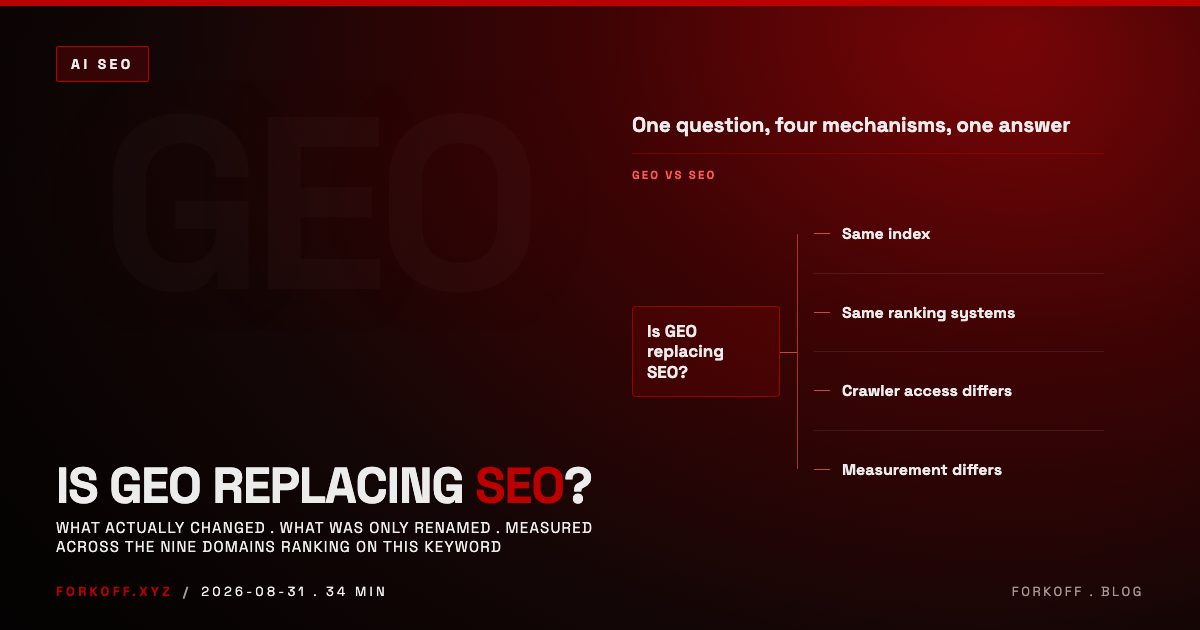
GEO is not replacing SEO. Here is what genuinely changed, what was only renamed, and measured crawler data on whether the two visibilities differ.
 Read
Read
AI SEO agency vs AI SEO software, decided with real Reddit AMA retainer figures, published tool pricing, and a stage-by-stage framework.
Read
9 real AEO agencies for AI and SaaS startups: real disclosed pricing where it exists, platform coverage, and the checklist that spots a relabeled SEO shop.
Read