
Is clipping worth it for podcasts?
Updated Jul 24, 2026
Clipping is worth it for a podcast when the show already has episodes with genuinely clippable moments and a distribution gap that short clips can fill, and it is not worth it when producing clips becomes a tax on making the show itself. Podcast clipping cuts your episodes into short native clips, posted across creator accounts, to pull new listeners back to the full show. It pays off for interview and moment-driven formats with a back catalog to mine, and it backfires when a small team spends the hours that used to go into the episode chasing clip volume, which several podcasters describe as reducing the fun and the growth of the actual show. The honest measure is per-qualified-view economics and attributed listeners, not raw clip views. FORKOFF bills $0.003 per qualified view against a four-stage gate and an exportable ledger, so a podcast can see whether clips brought real, in-region humans or simply inflated a counter. Run it as a bounded test, measure attributed subscribers, and scale only if the math clears.
Per our own CPQV benchmark of 3,085 clips, qualified views price out at a measurable cost per view rather than a flat retainer. FORKOFF CPQV Benchmark
- 01When it is worth it Clipping pays off when three things are true: your format produces standalone moments such as interviews, debates, or strong takes, you have a back catalog to mine, and you have a real distribution gap short clips can fill. Podcast clipping draws about 320 monthly US searches (DataForSEO), so the demand to make it work is real.
- 02When it is not It is not worth it when the clip work cannibalizes the show. Podcasters on Reddit repeatedly describe short-form becoming a poor ROI: one thread argues it reduced the time, fun, and growth of the actual show, and another asks bluntly whether clipping campaigns work at all.
- 03The trap: clip views are not listeners A clip can rack up views without moving a single new listener to the full episode. Raw clip views are the vanity metric, attributed listeners and subscribers are the outcome. If you cannot connect clips to the show, you are paying for a counter.
- 04The worth-it test Measure on qualified views and attribution, not clip totals. A qualified view is a real, in-region human that is not a bot or farm session, and the honest question is whether those humans became listeners.
- 05Run it bounded, then decide Start with a bounded test, keep making the show at full quality, and measure attributed subscribers over a set window. Scale only if the qualified-view math clears, and stop if the clip work is costing you more show than it returns.
Clipping is a distribution channel, not a growth guarantee
Clipping distributes short native cuts of your episodes across creator accounts to pull new listeners back to the full show. It is a working channel, and the general effectiveness question is covered in do clipping campaigns work. For a podcast specifically, the answer turns on fit rather than on whether the model works in the abstract. A show that produces standalone moments, holds a back catalog worth mining, and has an audience it is not yet reaching is a strong candidate. A slow-burn narrative show with nothing clippable, or one whose team would have to drop episode quality to feed the clip machine, is not.
The opportunity-cost test podcasters actually raise
The most honest objection does not come from agencies, it comes from podcasters. On r/podcasting, one widely-read thread argues short-form video is often a poor ROI for podcasters, another describes adding clips to the workflow and finding it reduced the time, fun, and growth of the actual show, and a third asks directly whether clipping campaigns work to promote a podcast. The through-line is opportunity cost: for a small team, the hours spent chasing clips are hours not spent on the episode. Clipping is worth it only when it is additive, outsourced or systematized so the show itself is unaffected, not when it quietly becomes the main job.
How to measure worth: qualified views and attributed listeners
The measurement mistake is treating clip views as the result. A clip can pull a million views and move nobody to the show. The unit that matters is a qualified view, a real, in-region human that is not a bot or farm session, and the outcome that matters is whether those humans became listeners. FORKOFF bills $0.003 per qualified view against a four-stage gate and logs every view in an exportable ledger, so a podcast can see the real audience behind the number. Normalize any quote using what cost per qualified view means, and compare the two pricing models in how much a clipping agency costs before you commit.
How to run a bounded podcast clipping test
The way to answer worth it for your specific show is to run a small test that keeps the episode untouched. Pick a handful of standalone moments from the back catalog, hand the clipping to an outside team so the show's production does not slow down, and set a fixed window to judge it. Measure two things: qualified views, so you know the reach was real humans in region, and attributed listeners or subscribers, so you know the reach moved someone to the full show. If the qualified-view math clears and listeners follow, scale it. If the clips generate views with no path back to the show, or the team starts trading episode quality for clip volume, stop. That is the honest version of the effectiveness test in do clipping campaigns work, applied to a podcast.
Is clipping worth it for your podcast? A decision test
| Signal | Worth it | Not worth it |
|---|---|---|
| Format | Interviews, debates, standalone moments | Slow-burn narrative with no clippable beats |
| Back catalog | Episodes to mine now | One or two episodes, nothing to distribute |
| Team capacity | Clipping is outsourced, the show is unaffected | The team drops show quality to make clips |
| Distribution gap | Short clips reach audiences the show cannot | Already saturated where clips would post |
| Measurement | Attributed listeners on qualified views | Raw clip views with no path back to the show |
The ROI-skeptic case is made by podcasters themselves on r/podcasting, where the recurring objection is opportunity cost against the show. podcast clipping draws about 320 monthly US searches at a low keyword difficulty of 6 (DataForSEO).
Frequently asked questions
Is podcast clipping worth it?
It is worth it when your show has genuinely clippable moments, a back catalog to mine, and a distribution gap short clips can fill, and when the clip work does not degrade the episode itself. It is not worth it when a small team drops show quality to chase clip volume, or when clips generate views that never become listeners. The deciding test is qualified views and attributed listeners, not raw clip totals.
When is clipping not worth it for a podcast?
When it becomes a tax on the show. Podcasters on Reddit describe short-form clipping reducing the time, fun, and growth of the actual show when the team has to produce clips themselves. It is also not worth it for slow-burn formats with no standalone moments, or when clips rack up views with no measurable path back to the full episode.
How do I measure if podcast clipping is working?
Measure attributed listeners and subscribers on qualified views, not raw clip views. A qualified view is a real, in-region human that is not a bot or farm session. FORKOFF bills $0.003 per qualified view and ships an exportable per-view ledger, so you can see whether clips brought real people and whether any of them became listeners of the show.
How much does podcast clipping cost?
It follows the same two models as any clipping: a tool subscription with a flat monthly fee, or a managed campaign priced on delivered output. FORKOFF prices managed clipping at $0.003 per qualified view, so a podcast pays for screened attention rather than a raw counter. See how much a clipping agency costs for the full comparison.
Does FORKOFF do podcast clipping?
Yes. FORKOFF runs managed podcast clipping on the same qualified-view model as the rest of its clipping work: $0.003 per qualified view, a four-stage gate for real in-region humans, and an exportable audit ledger. It is built to be additive to the show, so the team keeps making episodes while the distribution is handled and measured for you.
Get the specific number for your campaign.
Receipts, deep dives, and playbooks.
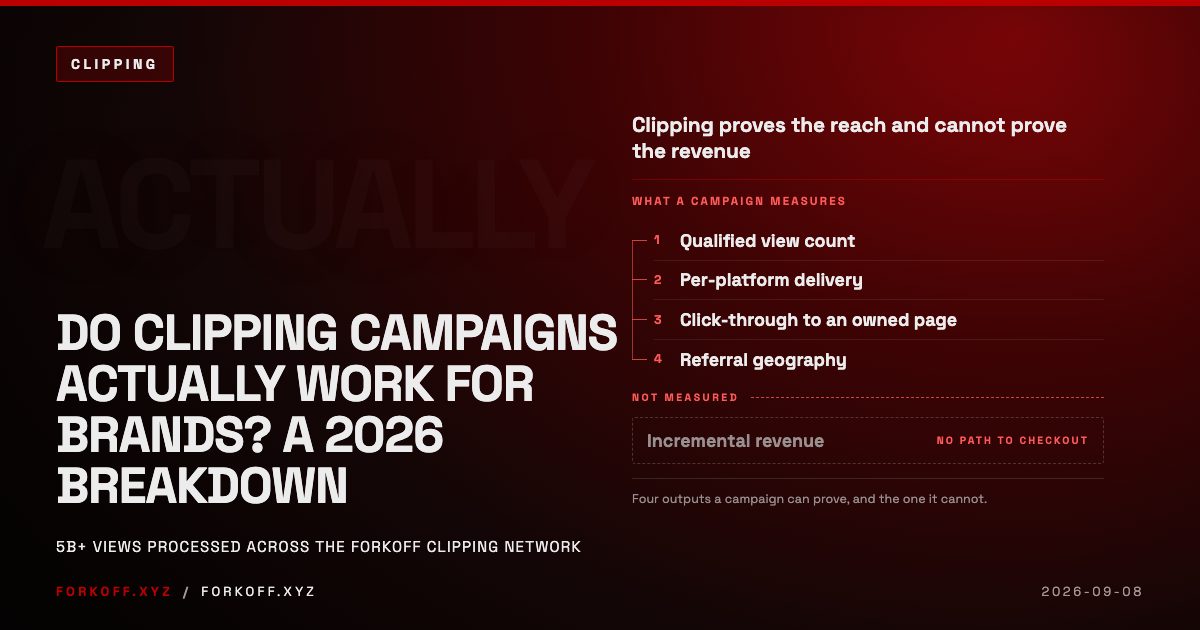
Do Clipping Campaigns Actually Work for Brands? A 2026 Breakdown
Clipping campaigns buy reach at a low unit price and cannot prove revenue. The 2026 breakdown of CPM by content signal, attribution and vendor diligence.
 Read
Read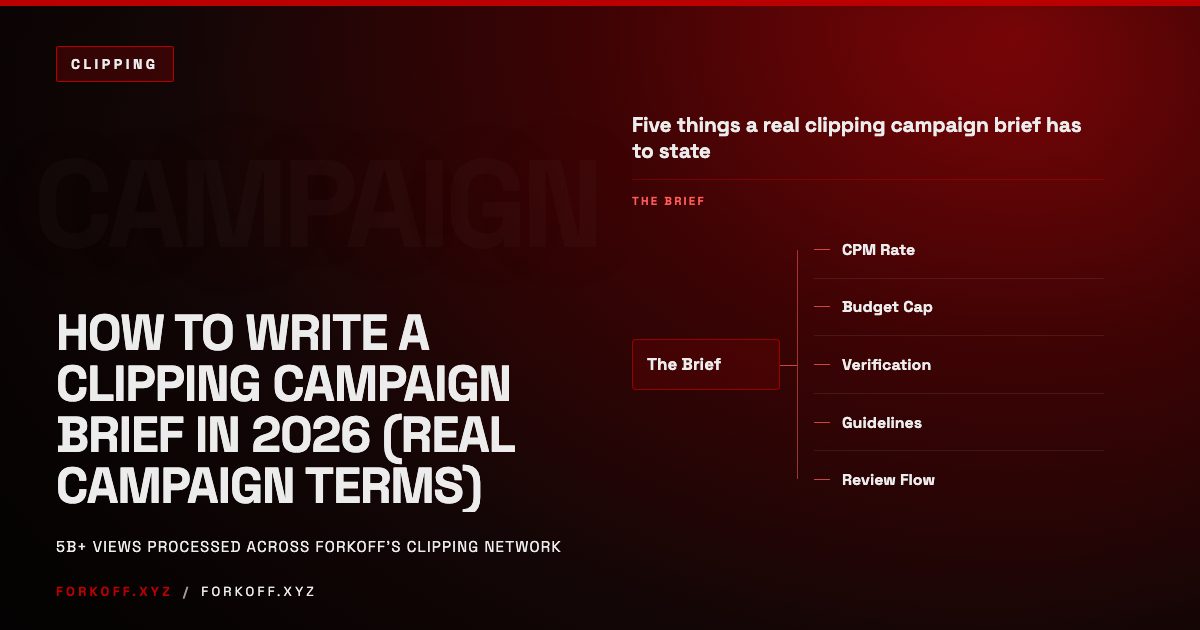
How to Write a Clipping Campaign Brief in 2026 (Real Campaign Terms)
A clipping campaign brief sets the CPM, budget cap, submission rules, and review flow that decide whether a campaign gets quality clips or wasted budget.
Read
Clipping a Game Launch: Turning Twitch and Kick Streams Into Qualified Installs
A launch-week playbook for clipping Twitch and Kick streams into qualified installs, with Drops mechanics, wishlist math, and a 7-day production calendar.
Read