Open your own X profile in a private window, the way somebody who has never heard of you would see it. Read it for five seconds and then close it. Now say out loud what that person sells, and who they sell it to.
Most founders can answer the first half. On 2026-09-02 we audited 130 B2B founder and operator accounts and 100 of them named a product, a company or a service in the bio text. Only 34 said who it was for. That gap, 76.9 percent against 26.2 percent, is the single most consequential number in this post, and it sits one line of text away from being fixed.
The 90-second version
On 2026-09-02 we ran three readings on X and Reddit instead of repeating what the ranking pages assert. We audited 130 B2B founder and operator profiles on X, classified all 117 replies inside 13 public buyer questions, and swept 125 Reddit rows by hand. The results, in order of how much they change the plan. Only 26.2 percent of founder profiles say who they sell to, against 76.9 percent that say what they sell, so the thing that breaks a profile click is not secrecy about the product, it is that a reader cannot tell whether they are the customer. 63.8 percent accept a message from a stranger, and that number runs backwards with size, 51.4 percent under a thousand followers against 94.7 percent over ten thousand. Finding a real buyer question is the hard part, not answering one: 86.1 percent of what the obvious searches return is not a buyer, and the phrase looking for a returned one buyer in forty rows because on X it is a hiring phrase. Inside a real thread the room is clean, 61.5 percent peer answers and zero spam, but the median thread produces three real answers, so position beats volume. And 2 of the 10 public Reddit posts on this subject carry a method an operator wrote without selling it. This post is those three readings, then the loop they imply, and it stops at the direct message because that sequence already has its own playbook here.
This is not a post about posting. It is about the four steps between a public question somebody in your market asked this morning and a conversation in your messages, and about which of those four steps actually breaks. We measured all of them on one day, through our own X data infrastructure and our own Reddit data infrastructure, and every figure below is either a reading you can repeat in about ten minutes or is tagged as somebody else's claim.

The reason to measure rather than assert is that the existing literature on this subject is almost entirely assertion. We swept 125 Reddit rows looking for people describing how they actually did this, found 13 on topic, and of the 10 distinct posts underneath them, 2 carried a repeatable method written by an operator who was not selling the method. The rest are outcomes without procedures. That is not a complaint about Reddit. It is the reason a founder reading five guides comes away with five confident opinions and no plan.
What does Twitter lead generation actually mean for a B2B founder?
It means running a public loop, not an outbound campaign. You find threads where somebody in your market is asking a question that has a purchase decision behind it, you answer the question without selling anything, the answer earns a click into your profile, and the profile earns a conversation. Four steps, each of which either holds or does not. The word generation is doing a lot of misleading work here, because it implies volume, and volume is the one lever on this platform that does not move the outcome. What moves the outcome is whether the preconditions for the loop are satisfied at all, and those preconditions are countable.
What is Twitter lead generation for a B2B founder?
It is a public loop, not an outbound channel: find threads where your buyer is asking a question, answer without selling, let the answer earn a profile click, and let the profile earn a conversation. The constraint is not reach, it is whether the profile and the message door convert the click you earned.
Measured 2026-09-02 across 130 B2B founder profiles and 117 replies inside 13 public buyer questions on X, through our own X data infrastructure.
That definition is deliberately narrower than the way the phrase is usually used. It excludes paid lead cards, which are an advertising product with their own economics. It excludes cold direct messages sent to strangers who have never seen you, which are a different discipline with a different failure mode and which already have a dedicated warm DM playbook on this site. It also excludes handing the loop to an agent, which is its own decision with its own failure modes and is covered in Grok bots for marketing. And it excludes audience building, which is a legitimate goal that wants opposite behaviour: a founder chasing followers should reply widely and often, and a founder chasing conversations should reply narrowly and early. The audience side of that split has its own system in the operator growth guide for X.
Operator noteAdd one clause to your bio naming who you sell to. Only 26.2 percent of the 130 profiles we read have one.
The B2B part of the definition also matters more than it sounds. A consumer app's users are scattered across interest communities. A B2B software buyer is usually a named person with a job title who posts under their own name and asks operational questions in public because their peers are the only people who can answer them. That is why this channel works at all: the buyer is legible, reachable and, roughly two thirds of the time, willing to take a message. Whether that is true of your specific market is the first thing to check, and it is a question about your buyers rather than about the platform.
Why does the channel look like it does not work?
Because the thing it produces is invisible to the instrument most founders point at it. The path from a reply to a profile click to a direct message leaves no referrer anywhere in your analytics. There is no link, so there is no click, so there is no last-touch attribution, so the channel reports approximately zero while producing real conversations. A channel that under-reports and a channel that under-performs look identical in a dashboard, and this one is the first kind. That is the whole explanation for the gap between the founders who swear by it and the founders who tried it for a month and stopped.
Six failure points between a public question and a conversation
There are five gates between a public question and a conversation, and each one has a measured pass rate. Finding the thread at all is the harshest: 86.1 percent of what the obvious searches return is not a buyer. Inside a real thread the room is clean but thin, with a median of three genuine answers. The reply then has to earn a click, the profile has to survive being read, and the message door has to be open. Multiply those together and it is obvious why a founder who replied fifty times in a week got nothing: they almost certainly never entered a buyer thread at all.
The two phrases every monitoring setup starts with return their own inverse
Across 101 rows returned by three buyer-intent searches on 2026-09-02, 14 were a genuine buyer question. The failure is specific rather than general. Looking for a is a HIRING phrase on X, and 12 of the 40 rows it returned were recruiting or job seeking. Alternative to is a SUPPLY phrase, used by vendors announcing that their product is an alternative to something else, and one account alone posted three such broadcasts inside a single 40-row result set. Any keyword monitor built on those two strings spends most of its budget reading other vendors' marketing.
Source: FORKOFF X buyer-thread panel, 101 rows, 2026-09-02
The second reason it looks broken is that most of the advice is written for the wrong goal. Reply volume advice is audience advice. One public operator describes crossing 2,200 followers on the back of posting daily and making between one hundred and three hundred replies a day, and that is a perfectly sound follower strategy. It is not a pipeline strategy, because pipeline depends on which threads you were in rather than how many replies you wrote. The two goals share a verb and share almost nothing else.
How many replies a day should a founder post on X?
Fewer than the volume advice suggests, and in better rooms. The median buyer thread in our sample produced three peer answers in total, so being early in the right thread beats being present in many. One hundred replies a day is an audience-building cadence, not a pipeline one.
F TIER: cold dms on twitter or instagram for b2b, buying leads from a broker
The third reason is that the honest criticism of this channel is usually aimed at a different part of it. The tier list above puts cold direct messages on X in the bottom tier of B2B outbound, below cold calling and below direct mail, and we think that is broadly right. It says nothing at all about replying inside a thread where somebody asked a question, which is a different act with a different consent structure. Conflating the two is how a real finding about cold outreach becomes a false conclusion about the whole platform.
Din
@DinScales26
tier list of b2b outbound channels: S TIER - linkedin inmails A TIER - cold email - linkedin connection requests B TIER - cold calling - paid ads C TIER - conferences and trade shows - organic content D TIER - direct mail - ai sdr platforms F TIER - cold dms on twitter or i… Show more
What did we measure, and how would you repeat it?
Three panels, all dated 2026-09-02, all designed so that a reader with a normal account and a browser can reproduce them in about ten minutes each. Panel A is the reply room: three advanced searches for public buyer questions, then every reply inside the qualifying threads read and classified. Panel B is the profile gate: a census of 130 B2B founder and operator accounts scored on five properties a stranger can observe. Panel C is the corpus: five Reddit sweeps counting how much of the public writing on this subject contains a method rather than an outcome.
Every panel states its selection rule, its sample size, and what would falsify it. That last part is the one usually missing. A number with no falsification condition attached is an assertion wearing a decimal point, and this subject is full of those, starting with the claim that half of founders have a bad bio, which is the claim we set out to count.
Alexa | Startup founder
@alexabelonix
your Twitter profile is basically your startup landing page except somehow half of founders still have: “founder | building in public | coffee enthusiast” ok but building WHAT 😭 for WHO and why should anyone give a fuck before people follow you, reply, test your product, intro… Show more
Panel B's sample rule was eight advanced-search passes with the result mode set to Latest rather than Top, so the sample is not selected for engagement, restricted to English original posts carrying at least three likes and posted since 2026-08-15. That returned 320 rows, of which 300 were analysed, deduplicating to 204 distinct accounts. 74 were excluded and 130 retained, an exclusion rate of 36.3 percent. The largest exclusion class was not spam. It was crypto, at 20 accounts, followed by news and content accounts at 17 and non-software businesses at 16. That is worth knowing before anybody builds monitoring around the word founder.
Operator noteOpen your own profile in a logged-out window and try to message yourself. 36.2 percent of founders cannot be reached.
Four of the five profile properties are read straight off the account object, so they are observations: whether the account accepts a message, whether the profile carries a website link, whether a post is pinned, and whether the account is verified. Two are hand classifications of the bio text, and the rules are worth stating because they are where a reader would sensibly disagree. Names an offer is true only when the bio text names a specific product, company or service being sold, so a role alone is false, and a bare shortened link with no name in the text is also false, because a person scanning the profile sees no name. Names an audience is true only when the bio says who it is for, so an unqualified noun like startups is false and for Notion users is true.
Six profile signals across 130 B2B founder accounts on X
| Signal | Accounts | Share | How it was read | Source |
|---|---|---|---|---|
| Blue verified | 112 | 86.2% | Platform flag. Near universal in this population, so it carries no information | measured |
| Bio names an offer | 100 | 76.9% | Hand read of the bio text. A bare shortened link with no name does not count | measured |
| Carries a profile link | 102 | 78.5% | Platform field, non-empty website URL | measured |
| Has a pinned post | 94 | 72.3% | Platform field, non-empty pinned post list | measured |
| Accepts a message from a stranger | 83 | 63.8% | Platform setting as it reads to an account that follows none of them | measured |
| Bio names an audience | 34 | 26.2% | Hand read. An unqualified noun such as startups does not count | measured |
n = 130 · as of 2026-09-02
Method: Same sample and same date as the gate table above. Rows are ordered by descending share so the collapse at the bottom is visible. The two hand-classified rows are the soft ones: a stricter reader pushes the offer row below 76.9 percent and a looser reader pushes the audience row above 26.2 percent, which is why both rules are written out in the body rather than summarised.
Distribution across all five non-verification signals: 1 account passes none, 10 pass one, 24 pass two, 38 pass three, 44 pass four, 13 pass all five.
One honest gap in Panel B: one page of twenty rows came back in a form that would have required hand transcription, and it was dropped rather than copied, because a transcription error inside a census is worse than a smaller census. The frame is therefore 300 rows rather than 320, and it is stated here rather than folded into the totals.
Can a stranger even send you a message?
A little under two thirds of the time. Of the 130 B2B founder and operator accounts we audited, 83 accept a direct message from an account that does not follow them, which is 63.8 percent, and 47 do not. This is the first gate in the loop and the only one that is a single binary setting rather than a matter of craft, and the platform documents it plainly in its own guide to direct messages. It is also the one nobody checks, on their own profile or on their prospect's, which means a founder can spend a fortnight earning the right to start a conversation with somebody who has the door shut.

The rate does not behave the way anybody expects. We went in assuming small accounts would be the open ones, on the reasoning that a founder with 300 followers has everything to gain from a stranger appearing in their inbox and a founder with 50,000 has a spam problem. The reading runs the other way, and it is monotonic across all three bands. Under 1,000 followers, 36 of 70 accept a message, 51.4 percent. Between 1,000 and 9,999, 29 of 41, which is 70.7 percent. Above 10,000, 18 of 19, which is 94.7 percent. The top band is only nineteen accounts so the precision there is thin, but the middle band is a healthy forty one and the direction holds throughout.

We do not have a clean explanation and will not invent one. The plausible reading is that an open inbox is a professional posture that people adopt as their account starts producing business, and that a small account's closed door is a default nobody has revisited rather than a decision. If that is right, the practical consequence is uncomfortable: the people most likely to be reachable are the ones least likely to need you, and the founder at 400 followers who is your ideal customer is also the one you probably cannot message.
The bigger the account, the more open the door
We expected small accounts to keep messages open, having everything to gain from a stranger. The reading runs the other way and it is monotonic. Of 70 accounts under 1,000 followers, 36 accept a message, which is 51.4 percent. Of 41 between 1,000 and 9,999, 29 do, which is 70.7 percent. Of 19 over 10,000, 18 do, which is 94.7 percent. The top bucket is small so the precision there is thin, but the direction holds across all three. The accounts with the least to lose are the ones most likely to have shut the door.
Source: FORKOFF X profile audit, 130 accounts, 2026-09-02
There is a caveat on this column that matters and that we are stating rather than burying. The reading is the platform's own flag as it appears to a requesting account that follows none of these people. We did not send a message to confirm it end to end, so the column reports a setting rather than a delivery. The reason we trust it as a per-account setting rather than an artefact of the relationship is the variance itself: our relationship to all 130 accounts is identical, so a relationship-dependent flag would be uniform. It is not uniform, it moves from 51.4 percent to 94.7 percent along an unrelated axis, and that is only explicable as something the account owner set.
The practical version of this is one sentence long. Before you invest a fortnight of replies in earning a conversation with a specific person, open their profile in a logged-out window and look for the message button. If it is not there, the plan is a public reply thread rather than a private conversation, and that is a different and slower plan that you should choose deliberately rather than discover in week three.
Does your profile say what you sell and who for?
Three quarters of founders answer the first question and one quarter answer the second. 100 of 130 profiles named a specific product, company or service, which is 76.9 percent. 34 named who it was for, which is 26.2 percent. And of the 100 that named an offer, only 32 also named an audience. The received wisdom that founders are coy about what they sell is not what the data says. They are perfectly clear about the product and almost silent about the customer, and the second omission is the one that costs the conversation, because a reader who cannot place themselves in your sentence has no reason to act on it.
What should a B2B founder put in their X bio?
The product by name and the buyer by name. Of 130 founder profiles we audited on 2026-09-02, 76.9 percent named what they sell and only 26.2 percent named who it is for. A bare shortened link is not a name, and two accounts over 13,000 followers in our sample carried multiple product links and named none of them.
The gate that fails is audience, not the product
The received advice is that founders are too shy about what they sell. Our audit of 130 B2B founder and operator accounts on 2026-09-02 says the opposite. 100 of the 130 name a specific product, company or service in the bio text, which is 76.9 percent. Only 34 say who it is for, which is 26.2 percent. Of the 100 that name an offer, just 32 also name an audience. So the sentence a stranger cannot construct after five seconds on the profile is not what does this person sell, it is am I the person they sell to. That is a different edit, and it is a shorter one.
Source: FORKOFF X profile audit, 130 accounts, 2026-09-02
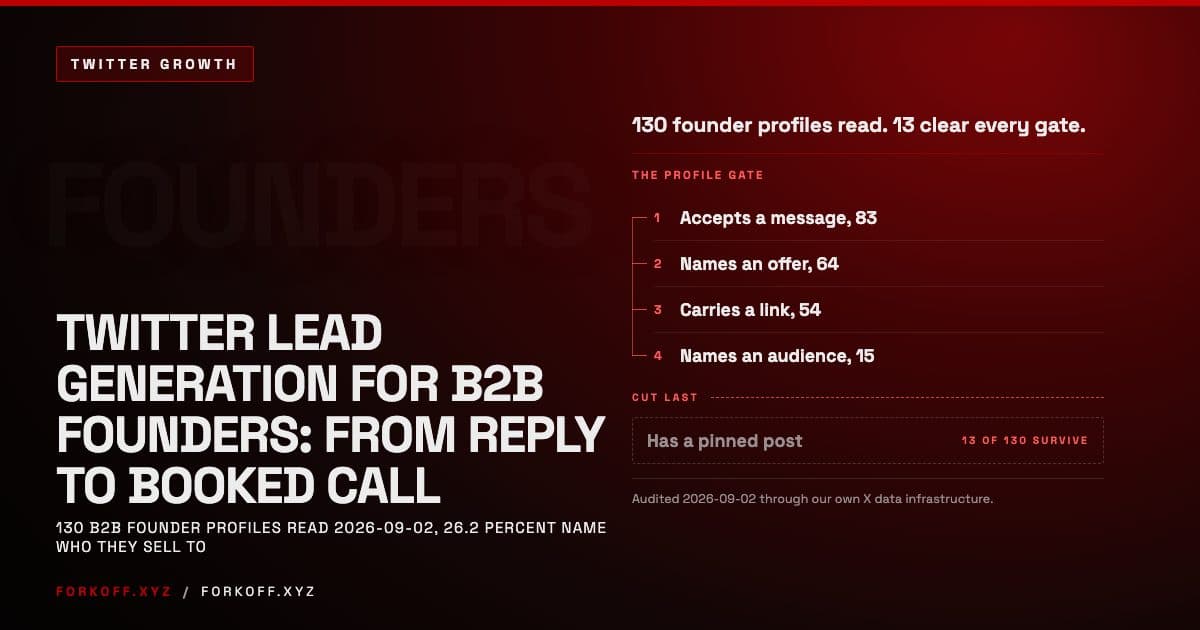
Run the gate ladder in the order a stranger actually meets it and the collapse is visible. All 130 accounts start. 83 survive the message door. 64 also name an offer. 54 also carry a profile link, which is the point at which a stranger can both understand you and go check. 15 also name an audience. 13 also have a post pinned. The step from 54 to 15 is the largest single drop in the whole ladder, and it is one clause of text.

The honest headline is the 41.5 percent, not the 10 percent. Fifty four of a hundred and thirty accounts are messageable, name an offer and carry a link, which is the minimum viable configuration for a profile click to become a conversation. That is not a catastrophe, it is a coin flip, and it means roughly half the founders reading this already have a working profile and need to spend their time on the thread-finding problem instead. The other half have a fifteen-minute edit in front of them that is worth more than a month of replies.
How many of 130 founder profiles survive each step
Measured 2026-09-02 across 130 B2B founder and operator accounts on X through our own X data infrastructure. Each bar is the count still standing after that step and every previous one, so the ladder is cumulative rather than independent.
The table below is the same ladder written out with what each step is actually testing, because the labels matter more than the numbers here. Accepting a message tests whether the conversation can begin at all. Naming an offer tests whether a reader can say what you sell without clicking anything. Carrying a link tests whether there is anywhere to go and check. Naming an audience tests whether the reader can place themselves. And a pinned post tests whether the first thing on your profile was chosen or is whatever you posted last.
The profile gate, applied in the order a stranger meets it, 2026-09-02
| Step | Accounts still standing | Share of 130 | What this step is actually testing | Source |
|---|---|---|---|---|
| Start, every audited account | 130 | 100.0% | A B2B founder or operator posting publicly about building or selling software | measured |
| Accepts a message from a stranger | 83 | 63.8% | Whether the conversation can begin at all, read off the account's own setting | measured |
| And the bio names an offer | 64 | 49.2% | Whether a reader can say what this person sells without clicking anything | measured |
| And the profile carries a link | 54 | 41.5% | Whether there is anywhere to go and check | measured |
| And the bio names an audience | 15 | 11.5% | Whether a reader can tell they are the intended customer | measured |
| And a post is pinned | 13 | 10.0% | Whether the first thing on the profile was chosen rather than whatever posted last | measured |
n = 130 · as of 2026-09-02
Method: Eight advanced-search passes through our own X data infrastructure on 2026-09-02, product Latest so the sample is not selected for engagement, English, originals only, posted since 2026-08-15. 320 rows returned, 300 analysed, 204 distinct accounts, 74 excluded and 130 retained. The four platform signals are read off the account object. Naming an offer and naming an audience are hand classifications of the bio text and the rule is in the body. Falsified by re-running the same eight passes and getting a materially different audience rate.
One page of 20 rows came back inline rather than persisted and was dropped rather than hand-transcribed. That is a real gap in the frame and it is stated rather than folded in.
Two failure patterns are worth naming because they are common and neither reads as a failure to the person who wrote it. The first is the role-only bio: founder, building in public, some emoji. It tells a reader what you are rather than what you do, and every founder on the platform is one of those. The second is subtler and appears on large accounts: a founder title followed by three or four bare shortened links. The links are the products, and to the profile owner they feel like the answer, but a person scanning for five seconds sees no name at all. Two accounts in our sample with over 13,000 followers each are in exactly this position, one of them carrying three product links and naming none of them in the text.
your Twitter profile is basically your startup landing page except somehow half of founders still have: "founder | building in public | coffee enthusiast" ok but building WHAT, for WHO, and why should anyone give a fuck
That post is where this whole exercise started. It asserts that half of founders have a bio that fails, offers no measurement, and got 75 likes and 3,300 views for saying it, which is roughly how every claim in this subject travels. Our count says the assertion is directionally right and specifically wrong: the failure is not that founders hide the product, it is that 96 of 130 never say who the product is for. That is a smaller and much more fixable defect than the one being described.
The readiness check nobody runs on their own profile
Profiles audited
130
Name an audience
26.2%
Clear all five
13
An illustration of a readiness check that does not exist as a product, drawn against rates measured on 2026-09-02 across 130 B2B founder accounts. The two failing rows are the two that decide whether a profile click becomes a conversation, and they are the two nobody edits.
The strangest reading in Panel B is that audience naming gets WORSE as accounts get bigger, while everything else gets better. Under 1,000 followers, 30 percent name an audience. Between 1,000 and 9,999, 24 percent. Above 10,000, 16 percent. Meanwhile message doors open, from 51 to 71 to 95 percent, links appear, from 70 to 85 to 95 percent, and pinned posts appear, from 63 to 80 to 89 percent. The infrastructure of the profile improves with size and the one sentence that tells a reader whether they are the customer gets vaguer.

We think the mechanism is that a growing account is optimising for a general audience rather than for a buyer, and that naming a narrow customer feels like leaving reach on the table. That is a real trade and a founder is entitled to make it. It is worth making on purpose, though, because it converts a lead-generation asset into a media asset, and the two are measured differently and monetised differently. If your account is above 10,000 followers and your bio does not name a buyer, you have probably made this trade without noticing.
Operator noteName a tool you do not own in your next reply. It is the cheapest credibility on the platform and almost nobody spends it.
How hard is it to find a real buyer question?
Much harder than answering one, and this is the finding that reorders the whole plan. We ran three searches built from the phrases a marketer would reach for, using the platform's own advanced search operators, paginated each to exhaustion, and got 101 rows. Fourteen of them were a genuine buyer asking about business software. That is 13.9 percent, so 86.1 percent of the output of buyer-intent monitoring is not a buyer. Not spam, not competitors, just other things: promotional posts shaped as questions, advice threads giving recommendations rather than asking for them, hiring posts, and a scatter of quiz content and sponsorship requests.
How do you find people asking for recommendations on X?
Not with the phrases you would guess. Across 101 search results on 2026-09-02, 86.1 percent were not buyers at all. Looking for a returned one genuine buyer in forty rows because it is a hiring phrase on X, and alternative to is a supply phrase used by vendors describing themselves.

The failure is specific rather than general, and that is what makes it fixable. Looking for a returned exactly one genuine buyer in forty rows, a 2.5 percent yield, because on this platform it is a hiring phrase: twelve of those forty rows were recruiting or job seeking. Alternative to fails in the opposite direction, because it is a supply phrase that vendors use to describe their own product, and one account alone posted three separate announcements of that shape inside a single forty-row result set. Meanwhile what do you recommend and what should I use returned nine buyers in twenty one rows, a 42.9 percent yield, which is a seventeen-fold difference against the worst phrasing.
What three buyer-intent searches actually returned on 2026-09-02
| What the rows were | Count | Share of 101 | Source |
|---|---|---|---|
| A genuine buyer asking about business software | 14 | 13.9% | measured |
| Promotional or own-product post shaped as insight | 32 | 31.7% | measured |
| Advice thread or listicle, giving rather than asking | 27 | 26.7% | measured |
| Hiring, job posting or job seeking | 12 | 11.9% | measured |
| Non-business topic | 7 | 6.9% | measured |
| Interview-question or quiz content | 5 | 5.0% | measured |
| Business ask, but not for software or a vendor | 2 | 2.0% | measured |
| Sponsorship solicitation | 2 | 2.0% | measured |
n = 101 · as of 2026-09-02
Method: Three advanced searches through our own X data infrastructure, product Top, English, originals only, paginated to exhaustion, run 2026-09-02. The queries are printed in the body so a reader can run them. A row qualifies only if a person is asking for a recommendation or for help with business software. Categories are exclusive and sum to 101. Falsified by running the same three strings later and getting a materially different qualification rate, which will happen.
Per query: what do you recommend returned 9 buyers in 21 rows, best tool for returned 4 in 40, and looking for a returned 1 in 40.
The rule that falls out of this is short. Monitor the phrases a person types when they are stuck, not the phrases a marketer would use to describe wanting something. A buyer writes what should I use and how do you handle and which one of these. A vendor writes looking for and alternative to. Building a monitor on the second set means paying to read other people's marketing, which is exactly what most keyword-monitoring setups on this platform end up doing.
Operator noteDelete looking for a from your monitoring. It returned one buyer in forty rows, because on X it is a hiring phrase.
Not all buyer questions behave the same way once you find them, either, and the differences are large enough to change which ones you bother with. A question about an operational bug, how do I handle a payment provider retrying a failed charge for two weeks, produced 20 real answers out of 25 replies, an 80 percent rate. A question about deleting user data cleanly across systems produced 86.7 percent. A question about how to handle a marketplace's support phone number produced nine replies of which nine were real answers, a clean 100 percent, seven of them from accounts with fewer than 500 followers.

The two shapes to avoid are the ones that look most like a sales opportunity. A question containing the word vendor or agency inverts the room, and we will come back to that in a moment. A question buried inside a build-in-public progress update produced the worst answer rate in the whole set, 35.3 percent, because the audience read a progress post and responded to the progress: eleven of its seventeen replies were encouragement. The format of the post determined the format of the reply, and the actual question went unanswered.
The cautionary case in our sample is a founder with real revenue asking for a consultancy to help scale. Twenty five likes, 5,580 views, ten replies, and zero peer answers: six low-signal replies, three of which were bare at-mentions with no words at all, and one automated introduction bot. A high-visibility question from a credible person produced nothing usable. Reach did not convert into help, which is the same lesson as the rest of this post pointed at the other end of the channel.
Which threads are worth answering, and which are worth skipping?
The ones where somebody is stuck on a mechanism, and not the ones where somebody is shopping. That distinction is not a preference, it falls straight out of the reply data: the three highest-quality rooms in our sample were all operational questions with no obvious product attached, at 80.0, 86.7 and 100.0 percent peer answers, while the one thread that explicitly asked for a vendor collapsed to 23.1 percent peer answers and eight pitches. A founder choosing where to spend an hour should read that as a routing rule rather than as a curiosity.
The reason is straightforward once it is said out loud. A question with an obvious commercial answer attracts everybody who sells that answer, and your reply lands among seven others making the same offer, where the only differentiator left is who wrote the most enthusiastic sentence. A question about a mechanism attracts the small number of people who have actually solved it, and being one of those people is the entire proposition you are trying to demonstrate. The commercial thread looks like the opportunity and is the trap; the operational thread looks like unpaid support and is the opportunity.
There is a second axis that is easy to miss and cost one thread in our sample everything. The FORMAT of the post determines the format of the reply. A question buried inside a build-in-public progress update collected eleven replies of encouragement against six real answers, because the audience read a progress post and responded to progress. The founder had asked a specific and answerable question about production email tooling, and it disappeared under the word count of the update it was wrapped in. If you are the one asking, that is a lesson about post structure. If you are the one answering, it is a signal that the room is not in question-answering mode and your careful reply will be read as one more well done.
The third filter is whether the asker can be reached afterwards, and it is the cheapest of the three because it takes one glance. Nine of the thirteen thread authors in our sample accept a message, which is 69.2 percent, and rises to five of seven among the threads that produced real discussion. Which means roughly one buyer question in three leads to a person you cannot follow up with privately. That does not make the thread worthless, because a good public answer is still visible to everybody else reading, but it does change what you are doing there from prospecting to publishing, and it is better to know which one you have chosen.
Does Twitter actually work for B2B lead generation?
It works as a conversation channel and fails as a click channel. The reply to profile to message path leaves no referrer, so analytics understates it badly. In our reading, 69.2 percent of the people asking public buyer questions accept a direct message, which is the precondition the whole loop depends on.
Put those three filters together and a usable qualification rule appears. Answer a thread when the question is about a mechanism rather than about a purchase, when the question is the whole post rather than a clause inside one, and when the asker can be messaged. Skip it when the post contains the word vendor or agency, when the question is buried, and when the author has the door shut and you have nothing to say that would be useful to the wider room. On our sample that rule would have selected roughly five of the thirteen threads, which is about right for an hour a day.
The uncomfortable implication is that the best threads for you are the ones that look least like sales opportunities, so the instinct that tells a founder which thread to open is exactly inverted. That instinct is not stupid. It is trained on channels where an explicit buying signal is the scarce thing. Here the explicit buying signal is the one thing that is not scarce, because everybody else can see it too.
Who actually answers inside a buyer thread?
Peers, overwhelmingly, and this was the most encouraging reading in the whole exercise. We classified all 117 replies inside the thirteen qualifying threads. 72 were peer answers, naming a third-party tool or giving a method or a first-hand experience with nothing of the replier's own being promoted, which is 61.5 percent. 34 were low signal, meaning encouragement, emoji, a bare at-mention or a clarifying question back at the asker, which is 29.1 percent. 11 were vendor pitches, 9.4 percent. And zero, not a low number but actually zero, were spam or off topic.

Two checks on that before it gets quoted. Promoted advertisements injected into the reply stream were removed, three of them, identified by a conversation id that does not match the thread, and a naive scraper would have counted those as replies. The thread author's own replies were removed too, thirty six across the set, because the asker saying thanks is not somebody answering. And restricting the sample to only the seven threads carrying at least eight replies gives 61.6 percent peer, 9.1 percent vendor and 29.3 percent low signal across 99 replies, which agrees with the full set to within a percentage point. That agreement is the internal control and it is the reason we trust the split.
Once you are inside a real buyer thread the room is clean
Of the 117 replies we classified, zero were spam or off topic. Not a low number, zero. 72 were peer answers naming a third-party tool or giving a method, which is 61.5 percent. 11 were vendor pitches, 9.4 percent. The rest was encouragement and emoji. The junk in this channel is entirely upstream in the search results, and none of it is downstream in the rooms. That inverts the usual worry: the risk is not that you will be shouted over by competitors, it is that you will never find the thread.
Source: FORKOFF X buyer-thread panel, 117 replies, 2026-09-02
The aggregate hides the shape, though, and the shape is the actionable part. Eight of the eleven vendor pitches landed in one thread: the only thread in the set where the buyer explicitly asked for a vendor rather than for a tool. That thread ran three peer answers against eight pitches, and its three peer answers were bare unexplained links. Everywhere else the pitch rate is roughly 3 percent. So the room is quiet right up until the question sounds commercial, at which point it fills with people selling and your reply is competing rather than helping.
Vendor pitches are rare in aggregate and total where they appear
9.4 percent pitch rate across the corpus reads like a quiet room. It is not evenly spread. Eight of the eleven pitches landed in one thread, the only thread in our set where the buyer explicitly asked for a VENDOR rather than for a TOOL. That thread went three peer answers to eight pitches, and its three peer answers were bare unexplained links. Everywhere else the pitch rate is roughly 3 percent. The moment a public question contains the word vendor or agency, the room inverts and your reply is competing rather than helping.
Source: FORKOFF X buyer-thread panel, 13 threads, 2026-09-02
The median is the number to plan around, not the percentage. Peer answers per thread ran from 0 to 20 with a median of 3. Half of these threads produced three or fewer real answers in total, which means the value of being early is enormous and the value of being thorough is small. A well-judged reply posted within the first hour into a thread that will only ever collect three real answers is a genuinely scarce object. The fortieth reply on a viral post is not.
Every reply inside 13 public B2B buyer questions, classified 2026-09-02
| Thread author | Replies classified | Peer answers | Vendor pitches | Low signal | Buyer accepts a message | Source |
|---|---|---|---|---|---|---|
| @ElitzaVasileva, failed payment retries | 25 | 20 | 0 | 5 | yes | measured |
| @GohilHardy, production email tooling | 17 | 6 | 0 | 11 | yes | measured |
| @IamAroke, deleting user data cleanly | 15 | 13 | 0 | 2 | no | measured |
| @alex_lrz_nmv, which coding agent | 13 | 10 | 0 | 3 | no | measured |
| @amuldotexe, an SEO vendor for a B2B app | 13 | 3 | 8 | 2 | yes | measured |
| @JeffSendsIt, marketplace support numbers | 9 | 9 | 0 | 0 | yes | measured |
| @vincent_alonzi, a consultancy to scale | 7 | 0 | 1 | 6 | yes | measured |
| @LolitoDev, which analytics tool | 5 | 5 | 0 | 0 | no | measured |
| @Prigoose, a transcription app with an API | 4 | 3 | 1 | 0 | yes | measured |
| @SBA_Matthias, due diligence firm | 3 | 0 | 1 | 2 | yes | measured |
| @nikita_builds, a replacement mail client | 2 | 0 | 0 | 2 | yes | measured |
| @ArijanJanes, a third-party checkout CRM | 2 | 1 | 0 | 1 | yes | measured |
| @log0083, better UI when building with AI | 2 | 2 | 0 | 0 | no | measured |
n = 117 · as of 2026-09-02
Method: Replies pulled through our own X data infrastructure on 2026-09-02 and classified by hand against a rule stated in the body. Promoted advertisements injected into the reply stream were removed, 3 of them, identified by a conversation id that does not match the thread. The thread author's own replies were removed, 36 of them across the set. Totals are 72 peer, 11 vendor, 34 low signal and 0 off topic, summing to 117. Falsified by another reader reclassifying the same 117 replies and moving a material number between peer answer and low signal.
Replies classified is lower than the platform reply count on several rows because that count includes the author's own replies and nested sub-replies the first page does not return.
One more measurement that changes behaviour immediately: 9 of the 117 replies carried a URL, which is 7.7 percent, and six of those nine were in a single thread. Across the other twelve threads combined, three replies contained a link. People answer with a tool name, not with a link. Which means a link in your reply is not neutral, it is a signature, and in a room where 92.3 percent of replies carry no URL it marks you as the one person here to sell something. Roughly half the repliers, 56 of 117 or 47.9 percent, had fewer than 500 followers, so the room is not gatekept by size either.

There is also a symmetric version of the message-door question on the reply side. Of the 83 distinct accounts that posted a peer answer or a pitch, 45 accept a message, which is 54.2 percent, and 51 carry a profile link, 61.4 percent. The pitchers are marginally more open than the answerers, 63.6 percent against 52.8 percent, which is unsurprising. The number that actually matters is the buyer side: 9 of the 13 thread authors accept a message, which is 69.2 percent, rising to 5 of 7 among the threads with real discussion.
That inverted our expectation for the second time in this exercise. We assumed the people being sold to would be the locked-down ones, since they are the ones absorbing the cost of an open inbox. The reverse holds: 69.2 percent of buyers against 54.2 percent of the people helping them. The people asking for help are, as a group, more reachable than the people giving it. The corollary is uncomfortable and worth sitting with: the two threads with the richest peer discussion in the entire sample both belong to authors who cannot be messaged, so the best rooms belong to the least reachable people.
What does a reply have to do to earn the profile click?
It has to answer the question in a way that leaves the reader with something they can go and check on their own. That is the whole test, and it produces a single line that separates the two kinds of reply we counted: a peer answer contains a noun the asker can go look up, and a vendor pitch contains a verb the asker has to accept. Let us connect, happy to share, worth an intro, I can try. Those are all requests. Plausible is a noun. Dunning is a noun. Set the billing period start to the day after the previous period ended is a procedure. The room rewards nouns and procedures and ignores requests, and the 61.5 percent to 9.4 percent split is that preference expressed as a number.
What separates an answer from a pitch, read across 117 replies
Peer answer
Vendor pitch
Low signal
Answers the question
Names a tool you can look up
Promotes the replier
Carries a link
Asks the reader to accept something
Survives a screenshot
Earns a profile click
Derived from 117 replies classified on 2026-09-02 across 13 public buyer questions. Partial means the property held in some replies of that kind and not others, rather than a threshold. The link row is partial for peer answers because only 7.7 percent of all replies carried a URL at all.
The best reply in our whole sample was somebody explaining, without being asked and without selling anything, that the behaviour the asker was seeing is called dunning and describing exactly how to set the billing period afterwards. It named a concept, gave a mechanism and asked for nothing. It came from an account with 465 followers. That is the shape, and it is available to anybody, which is the good news buried in a post otherwise full of gates.

Six things follow from the classification, and the fourth is the one most founders break. Answer the actual question. Name something you do not own, because naming a rival tool is the cheapest credibility on the platform and almost nobody spends it. Carry the reason and not just the verdict, because every high-scoring answer in our set explained a mechanism. Leave the link out. Be early enough to be read, since the median thread only ever collects three real answers. And write it so it survives being screenshotted, because the reply may be the only thing about you that person ever reads.
Operator noteStop putting a link in replies. Only 9 of the 117 we classified carried one, and the pitches are where they cluster.
The link rule deserves one more sentence because it feels wrong to founders. You are not withholding value by leaving the URL out. You are matching the register of a room where 92.3 percent of answers are a name and a reason. If the asker wants the thing, they will click your profile, which is the step this entire post is about, and the profile is where the link belongs. A link in the reply skips the step that qualifies them and converts a helpful answer into an advertisement in one character.
I've seen X (Twitter) work really well for B2B, but only if you treat it as relationship-building, not lead-gen spam. Most of the "doesn't work" crowd are the ones blasting links or pitching too early. Half the game is in replies.
What does the profile have to do to earn the message?
It has to let a person finish two sentences: this person sells X, and X is for people like me. That is it. The measurements say the first sentence is usually available and the second usually is not, so the most valuable edit for three quarters of the founders reading this is adding a clause naming the buyer. Not a positioning exercise, not a rewrite, one clause. Of the 100 accounts in our audit that name what they sell, 68 do not say who it is for.
For those running B2B businesses: does Twitter (X) actually help you land clients? How do you use it in your process?
A B2B operator asking the question plainly, and answered in both directions by other operators. The highest scoring replies split between treating X as a credibility surface that a prospect checks later, and treating replies as the actual mechanism. Position 3 on the live SERP for b2b twitter marketing, read… Show more
The pinned post is the second lever and it is underused rather than misused: 94 of 130 accounts have one, so 72.3 percent already understand that the top of the profile is chosen rather than inherited. What we did not measure, and are not going to claim, is whether those pinned posts do the job. A pinned post that is a viral joke is doing something different from a pinned post that explains the offer, and distinguishing those would require a judgement call on a hundred and thirty posts that we did not make. Treat 72.3 percent as an upper bound on how many profiles are configured, not as a measure of how many are configured well.
The link is the third lever and it is mostly present, at 78.5 percent, and mostly pointed at the wrong thing. We did not score destinations, so this is judgement rather than measurement and is labelled that way. What we can say from the reply side is that the person arriving has one question in their head, which is whether you are relevant to the problem they just posted about. A link to a homepage that opens with a value proposition answers a different question. A link to a page about the specific problem answers theirs.
Railway got its first users from a Twitter post from the founder asking people to try the product. The founder then sat in a Discord voice channel during the winter break just answering mundane questions from people.
The quote above is the cheapest possible version of everything in this section. A developer infrastructure company's first users came from one post by the founder asking people to try the thing, followed by the founder sitting in a voice channel over a holiday answering ordinary questions. There is no profile optimisation in that story and no monitoring setup. There is a person who was legible about what they had built and then available to talk about it, which is the whole loop with the tooling removed.
Where does this post stop, and who owns the message itself?
Here, at the point where the message box opens. Everything after that, what the first message says, how many touches follow it, what the cadence looks like after a reply comes back, and how to keep an account healthy while doing it at any volume, is a separate discipline with different failure modes, and it already has a dedicated treatment on this site: the four-stage warm DM playbook covers the sequence, the platform limits and the account architecture. This post deliberately stops one step short of that so the two do not disagree with each other.
The boundary is not arbitrary. Everything before the message is public and measurable by anybody: the thread exists, the reply is visible, the profile is visible, the message setting is visible. Everything after it is private, unmeasurable from the outside, and only knowable from your own send data. Those are different evidence regimes and mixing them is how a post ends up asserting reply rates it cannot possibly have observed.
Nick Bennett
@NickB2005
I spent 6 years going all-in on LinkedIn. 57K followers, 118K impressions last month, hundreds of saves and sends on a single post series. It works. It has always worked for me. About a month and a half ago I decided to actually take X seriously. Not dabble. Not crosspost Linked… Show more
The snapshot above is the closest thing to a whole-loop account in our source set, and it is worth reading precisely for what it does and does not establish. A fractional marketer with 57,000 followers on another platform took this one seriously for the first time after six years, and reports 186,800 impressions in 28 days at a 3.8 percent engagement rate, 7,200 engagements, 3,000 bookmarks, 431 shares, 583 replies, and a move from roughly nothing to 4,700 followers. Then the sentence that matters: a first paying client in about six weeks, against years on the other platform.
That is testimony, not measurement, and it is tagged that way everywhere it appears here. There is no control, no attribution chain and no way to know what else was running. What makes it worth quoting anyway is that the shape agrees with the mechanism: 583 replies in 28 days is roughly 21 a day, which is a reply-led strategy rather than a broadcast one, and the outcome arrived as a conversation rather than as a click.
Operator noteThe median buyer thread got three real answers. Being early in one thread beats being present in six.
How much of the public advice is actually a method?
Two posts in ten. We swept 125 Reddit rows across five queries on 2026-09-02 and found 13 on topic, collapsing to 10 distinct posts written by 8 distinct authors, of which 6 are non-vendor operators. Five of the ten carry a repeatable method, meaning a procedure with at least one concrete operational parameter: which queries to watch, a cadence, a count, what the bio must say, an ordered sequence. Three of those five are written by a single vendor selling the tool that performs the method. Operator-written method, from somebody with nothing to sell you: 2 of 10.

Two of the five queries returned a clean zero on topic, and both failures are instructive rather than embarrassing. Does twitter work for b2b leads matched on b2b and leads and dropped twitter entirely, returning cold-email tooling and a couple of remote job listings. X leads clients founder is contaminated by the single letter X and returned threads about sport, finance and politics. If you are building any kind of listening on this subject, both of those are traps you would walk into on the first attempt.
Five Reddit sweeps for the same question, and what came back
| Query | Rows | On topic | Hit rate | What went wrong | Source |
|---|---|---|---|---|---|
| twitter dms clients saas | 25 | 6 | 24.0% | The best of the five, and still three quarters off target | measured |
| twitter lead generation b2b | 25 | 4 | 16.0% | Mostly cold email tooling and lead scraping | measured |
| X leads clients founder | 25 | 3 | 12.0% | The single letter X matched sport, finance and politics threads | measured |
| does twitter work for b2b leads | 25 | 0 | 0.0% | Matched b2b and leads and dropped twitter entirely | measured |
| organic twitter saas customers | 25 | 0 | 0.0% | Matched saas customers and returned generic first-customer posts | measured |
n = 125 · as of 2026-09-02
Method: Five searches through our own Reddit data infrastructure on 2026-09-02, relevance sort, one-year window, 25 rows each. On topic means the post's own subject or a substantive section of its body treats X as a channel for acquiring B2B leads, clients or revenue. A one-word mention inside a channel list does not count. Every count is a hand read, because a mechanical matcher requiring a platform token and a lead token scored 108 of the same 125 rows as relevant including a motorsport litigation thread.
13 on-topic rows collapse to 10 distinct posts, 8 distinct authors, and 6 distinct non-vendor operators. One vendor accounts for 4 of the 10.
We also tested whether the classification could be automated, because a hand read over 125 rows is exactly the kind of work a regex looks capable of doing. A mechanical matcher requiring a platform token and a lead token in the title or body scored 108 of the same 125 rows as relevant, including a motorsport litigation megathread. Every count in this panel is therefore a hand read, and the mechanical figure is recorded here as a warning rather than as data.

The reading we did not smooth is about incentives. The single most procedurally specific post in the entire corpus, the one that actually names a technique and describes running it, was crossposted to three subreddits and carries zero comments on each, at 3, 2 and 1 upvotes. The two pure anecdotes, both of which report an outcome and no procedure, carry 38 and 60. The corpus rewards the outcome and ignores the method, which is a sufficient explanation for why almost nobody writes the method down.
The public corpus rewards the outcome and ignores the procedure
We swept 125 Reddit rows on 2026-09-02 and found 13 on topic, collapsing to 10 distinct posts by 8 distinct authors. Five contain a repeatable method and three of those five are written by one vendor selling the tool that performs it, so operator-written method is 2 of 10. The tell is the engagement: the most procedurally specific post in the entire corpus was crossposted to three subreddits and carries zero comments on each, at 3, 2 and 1 upvotes, while the two pure anecdotes carry 38 and 60. Nobody is rewarded for writing the procedure down.
Source: FORKOFF Reddit corpus sweep, 125 rows, 2026-09-02
The same pattern holds on Google. The page that currently ranks first in the United States for this post's head term is a Reddit thread from December 2024 asking whether the channel still works. It carries 14 upvotes and 55 comments. Its highest-scoring surviving comment is one word long. Its actual top comment, at 15 points, has been removed and its text is not retrievable, and only 15 of the 55 comments come back from the API at all, so nobody can claim to have read that thread completely, including us.
No
It is worth being precise about what that ranking means, because it is the best available evidence that this term is unclaimed rather than merely low volume. Google is choosing a two-year-old forum thread with 14 upvotes over every vendor guide on the page, which is what a search engine does when nothing on the page answers the question well. The four positions below it are a video about automation, a lead-capture vendor guide, a personal playbook and a platform announcement from 2013.
Is X still a good platform for lead generation?
The thread Google currently ranks first in the United States for the head term twitter lead generation. Posted 2024-12-03, 14 upvotes, 55 comments, of which 15 are returned by the API. Its top comment at 15 points has been removed and its highest scoring surviving answer is the single word… Show more
The video results are the other half of the answer Google is currently giving. A video pack is present on the term and two of the ten organic results are videos, both framed around automation and message volume. They are answering a real question and it is a different question from this one. Watch them for the tooling and then come back to the reply-room numbers, because the thing they cannot tell you is what happens after the automated message arrives in an inbox belonging to somebody who never asked.
How I Get 100s of Leads Per Week with Twitter Automation (Full Tutorial)
Lead Gen Jay
Position 2 on the live SERP, and the volume answer to this question. Worth watching against the reply-room numbers above rather than instead of them.
What can you attribute, and what can you not?
Three layers, and only one of them contains a click. The first layer is observable on the platform: replies you sent, profile clicks, message requests received. The second is observable on your side: direct traffic, branded search dated against the day you replied, and demo or contact requests that mention a thread or a person. The third layer is the one everybody tries to build the report on and it does not exist. Last-click attribution from a reply is not available, because there is no link in the reply and therefore no referrer anywhere downstream.
How do you track leads from X when there is no click?
Track three layers separately. On the platform, count replies sent, profile clicks and message requests received. On your side, watch direct traffic, branded search and demo requests that name a thread. Accept that last-click attribution from a reply is never available, and stop building the report around it.

The practical consequence is that you have to instrument the second layer deliberately, before you start, because it is not on by default anywhere. Add one required field to your contact form asking where the person first came across you, in free text rather than as a dropdown, because a dropdown teaches people to pick the nearest wrong option. Watch branded search at day granularity rather than week, since a reply that lands produces a spike inside 48 hours and disappears inside a week. And keep a list of the threads you replied in with dates, because when somebody does say they found you in a thread, you want to know which one.
None of that is attribution in the sense a paid channel means it. It is corroboration, which is the honest word, and it is enough to decide whether to keep going. The failure to accept this is the single most common way this channel gets killed inside a company: somebody asks for cost per lead, nobody can produce one, and the channel is cut while it is working. Decide before you start which evidence you will accept, and write it down, because that decision is much harder to make honestly in month three when somebody wants a number. If you need a comparison against channels that do produce a click, the cost per qualified lead by channel breakdown is the honest starting point.
What does the weekly loop actually look like?
Six steps, and the measured failure rate on each one tells you where to spend the time. Find the thread, where 13.9 percent of what the obvious searches return survives. Qualify the asker, where roughly 69.2 percent can be messaged and rather fewer are actually your buyer. Answer without selling, which is the part everyone thinks is the job and is the easiest of the six. Earn the profile click. Open the conversation. Hand off to whatever your call booking process is.

Three of those six are search-and-judgement work and three are writing. Most founders spend their whole allocation on the writing half, because it is the visible half, and then conclude the channel does not work because they were writing excellent replies into rooms that contained no buyers. If you have a fixed hour a day, we would spend the first thirty minutes finding and qualifying threads and the second thirty writing four or five replies into the best of them. That ratio is uncomfortable and it is what the numbers imply.
Here's the 28-day snapshot. 186.8K impressions with a 3.8% engagement rate, 7.2K total engagements, 3K bookmarks, 431 shares, and 583 replies. Went from basically nothing to 4.7K followers. And the number that matters most: X drove me my first paying client. In about six weeks.
A realistic weekly target for a founder doing this alone is three genuinely qualifying buyer threads answered well. That sounds low against the reply-volume advice and it is deliberately a different unit. Three real buyer threads a week is roughly 150 a year, and a channel that puts you in front of 150 people who were actively asking a question you can answer is a serious channel. Forty replies a week under viral posts is a different activity that produces followers, and if that is the goal it should be chosen rather than defaulted into.
117 replies inside 13 public buyer questions, by kind
Classified by hand on 2026-09-02 against the rule printed in this post. A fourth category, off topic or spam, returned zero and is not drawn because a zero bar reads as a rendering fault rather than as a finding.
The one thing worth systematising once the loop is running is on the search side rather than the writing side. Finding threads is repetitive, rule-based and unpleasant, which makes it the correct thing to systematise, and the reply is the one place where being a person is the entire product. Every automation instinct on this platform points the other way, at generating replies and messages, which is precisely backwards and is why so much of the tooling here produces the low-signal category rather than the answer category.
Which moves end the channel?
Five, and each maps to a measurement in this post rather than to a rule of thumb. The first and worst is the fabricated warm introduction: replying to somebody's request with a recommendation for a third party who is actually you, then sending yourself the referral from a second address. That is not an edge case we invented for the section. It was described publicly and approvingly, with a claimed 30 percent close rate, and the post describing it carries 920 likes and 57,321 views, which makes it the highest-engagement item in our entire source set.
He replies to every founder who tweets "looking for a social media agency" and says "I know a guy". The guy is him. He sends himself the intro, then follows up from a different email pretending to be the referral. Closes 30% of his leads because everyone trusts a warm intro
We are including it because pretending the dishonest version does not exist would be worse than naming it. It also confirms, from the other direction, that the mechanism in this post is real and known: somebody is monitoring buyer-intent phrases, replying to them, and converting at a rate high enough to build a business on. The difference between that operator and the loop described here is one decision, and it is the decision that determines whether the channel lasts more than a year.

The other four are duller and more common. Automated reply volume produces the low-signal 29.1 percent and is recognised instantly by the people you are trying to impress, and the platform publishes its own automation rules that are worth reading before anything is wired up. The link-first reply is a signature in a room where 92.3 percent of answers carry no URL. Monitoring the wrong phrase costs you the whole budget: looking for a returned one buyer in forty rows. And pitching into a room that asked for a tool rather than a vendor is the mismatch that produced the single worst thread in our sample, where three peer answers were drowned by eight pitches.
There is a sixth that is not a move but a slow leak, and it is worth naming because nobody notices it happening. It is treating the reply as the deliverable. A reply that lands is worth nothing on its own. It is worth something only if the profile behind it can convert the click, and 47 of the 130 accounts we audited cannot even take a message. Founders spend months improving the reply and never once open their own profile logged out, which is a fifteen-minute check that determines whether any of the rest of it can work.
When is X the wrong channel for you?
When your buyers do not ask questions in public, and that is a real and common situation rather than a failure of nerve. If you sell to procurement teams at insurers, to hospital administrators, or to anybody whose employer treats posting under their own name as a liability, the raw material this channel runs on does not exist. No amount of reply craft creates a public buyer question that nobody is going to ask. Check by spending twenty minutes searching the phrases your buyer would use when stuck, and if you find nothing, believe it.
It is also the wrong channel when the professional context matters more than the public one, in which case the paired treatment is the LinkedIn guide for B2B SaaS rather than this post. And it is the wrong channel when your sales cycle is short and your volume requirement is high. Three qualifying threads a week is a serious number for a company selling a 30,000 dollar annual contract to forty companies. It is a rounding error for a company that needs 400 signups a month. The loop does not scale linearly with effort, because the supply of buyer questions in your market is fixed and small, and the honest version of this post says so rather than implying that trying harder produces more threads.

And it is the wrong channel, for now, when the founder cannot be the one doing it. The reply is the product here. Every mechanism in this post depends on a specific person answering a specific question in a way that survives being screenshotted, and the two parts of the loop that can be delegated cleanly are the search side and the measurement side. If the founder has no hour a day and no intention of finding one, the honest recommendation is a different channel rather than a ghostwritten version of this one, and the trade between doing it yourself, hiring in and bringing in help is worked through in the agency against in-house against ghostwriter comparison.
The verdict
The constraint in Twitter lead generation for B2B is not reach and it is not the algorithm, whose published weights score a profile click at zero. It is a short chain of preconditions that almost nobody checks, each of which we counted on 2026-09-02: 86.1 percent of what buyer-intent monitoring returns is not a buyer, the median real thread produces three genuine answers, 63.8 percent of founder profiles will take a message from a stranger, and 26.2 percent tell a reader who they are for. Fix the last of those first, because it is one clause of text and it gates everything downstream.
Then go and find three threads. Not forty replies, three threads, answered early, with a noun in them and no link. If the loop is going to work in your market you will know inside a month, because somebody will arrive in your messages referencing a thread, and if it is not going to work you will know sooner, because you will not find the threads at all. Both of those are useful answers and both arrive faster than a content strategy.
The part we cannot promise you is the number at the end. There is no click path, so there is no cost per lead, and anybody offering you one for this channel is either counting something else or making it up. What there is instead is a public room where your buyer is already asking a question, a reply that costs you nothing but attention, and a profile that either finishes the sentence or does not. That is a smaller claim than the ones on the ranking pages for this term, and it is the one the measurements support.