

Browserbase
@browserbase · 20.4K followers
Computer use is finally reliable. Introducing Browserbase Agents: one prompt and one API call is all you need to automate the whole web.
Browserbase Agents launchVerified Organic
Browserbase Agents is a real product by a real founder (@browserbase). RADAR has tracked 90.2K views on this launch, according to the source post linked below. RADAR measures how the launch reach was built, not whether the product works or whether anyone was honest. This reading is verified confidence and every input is public.
By Simba, Launch Intelligence Analyst · Reviewed by JK · Published 26 Aug 2026 · Confidence: verified
Independent, methodology-derived signal, not a statement of fact about any person. RADAR reads how reach was built, a signature, not an accusation. See the methodology.
Did the Browserbase Agents launch go viral organically, or was the reach amplified?
The Browserbase Agents launch by @browserbase drew 90.2K views on 309 likes, which is 292 views per like, inside the roughly 500 organic ceiling. RADAR reads the reach as organic: reach and engagement grew together and no distribution-amplified signature shows in the public metrics. This is a verified reading and every input is public and reproducible.
New here? Start with the product
What is RADAR, and what does this grade mean?
RADAR is FORKOFF's launch authenticity rating system. It reads whether a product launch earned its reach through real engagement or bought it through paid distribution, using only public signals anyone can pull from the launch post. Every reading carries a letter grade, a confidence label, and the date it was last checked, and links back to a published method you can reproduce. Browserbase Agents is a real product by a real founder (@browserbase). RADAR measures how the reach was built, not whether the product works or whether anyone was honest.
Verified Organic
Independent, methodology-derived signal, not a statement of fact about any person. RADAR reads how reach was built, a signature, not an accusation. See the methodology.
What this grade means
This launch carries an Authenticity Grade of Verified Organic. RADAR reads its reach as organic: the views and the genuine engagement grew together, and no distribution-amplified signature shows in the public metrics. That is a favorable, low-risk read.
The signals RADAR reads
Views-to-likes ratio
Organic reach tops out near 500 views per like. When views climb far past that without the likes to match, the extra reach is arriving without the engagement organic reach produces.
Amplification wave shape
Organic amplification spreads over hours and days. A coordinated launch fires a synchronized burst of quote posts in the first few hours, read from each post's own timestamp.
Posting-time fingerprint
A post that fires exactly top of the hour on a weekday is scheduled. On its own it is weak, but it corroborates a coordinated launch alongside the other two signals.
Those three public signals sit on top of RADAR's five-component forensic read. The full method, the bands, and the confidence model are on the RADAR methodology page.
This launch in the data
Where does this reach sit against the tracked corpus?
Where it sits in the corpus
Rank 4 of 30 tracked launches by views per like, lowest (most organic) first. A lower ratio is the favorable end.
Against the benchmark
This launch's views per like next to the organic median (354) and the amplified median (1,441) across the tracked set.
 The product
What is Browserbase Agents?
Browserbase is a San Francisco company that runs cloud headless browsers as infrastructure for AI agents, the layer that lets a model actually click, type, scroll and read a live web page instead of only describing one. It announced a 40 million dollar Series B on 18 June 2025, led by Notable Capital with existing investors CRV and Kleiner Perkins taking part. In the Agents announcement the company states that its platform runs more than 35 million browser sessions a month and names Ramp, Shopify and Lovable among its customers. Those are Browserbase's own stated figures, quoted here as the company's claim rather than independently audited by RADAR.
The account posting this is the company account, and its bio points at the second half of the story: give your agents access to the whole web, creators of @stagehanddev. Stagehand is Browserbase's open-source SDK for browser agents, with TypeScript, Python and Go SDKs and natural-language primitives such as act() for taking an action and extract() for pulling structured data off a page. Its own site positions it directly against Playwright on the grounds that Playwright was built for testing and Stagehand was built for agents. Shipping a widely used open-source SDK first, then a managed product on top of it, is a distribution position most launches in this category do not have.
The market this competes in is browser automation for AI agents, the practical half of what the industry calls computer use. The real alternatives are driving Playwright or Puppeteer yourself on infrastructure you run, the computer-use models offered directly by the large model providers, and the other hosted browser-infrastructure services. The pitch in this launch is that the hard part was never the model but the harness around it, and that Browserbase now sells the harness.
What it does
- Turns a plain-language goal into a reusable agent you invoke with one API call, with no code to write or deploy.
- Returns typed, structured results shaped to a schema the caller defines, rather than raw page text.
- Runs asynchronously, so a long browsing job does not block the calling request.
- Sits on the rest of the platform: real headless browsers, an identity module for sites behind anti-bot checks and logins, and search and fetch APIs for page context.
- Records every run, with a live browser view while it works, session replay afterwards, and traces across model and tool calls with a per-run cost breakdown.
- Ships an Optimize step for tuning an agent that has become slow, is failing, or has outgrown the task it was written for.
The use cases Browserbase puts forward are the ones where a public API usually does not exist: pricing and competitor monitoring on protected sites, KYC and KYB checks across customer and business portals, government and real estate records spread across more than 1,500 county and state sites, retrieving documents such as SOC 2 reports and authorization forms, and automated QA during product development.
How the Browserbase Agents launch worked
The launch was a single announcement carrying a 29-second product video, posted at 9:28 AM Pacific on Tuesday 30 June 2026 from the company account @browserbase, which carried 21,008 followers at the time of RADAR's pull.
The post is three beats and under sixty words. It opens on a verdict about the whole category rather than the product: "Computer use is finally reliable. It just needed a real harness. Now there is one." The second beat is the availability line, "Starting today, anyone can ship a SOTA browser agent, batteries included." Only then does the product get named, with the promise attached to it: "Introducing Browserbase Agents: one prompt and one API call is all you need to automate the whole web."
That order is the interesting choice. Most infrastructure launches lead with the feature list and hope the reader infers the significance. This one asserts the significance first, in a sentence a reader can agree or disagree with, and makes the product the answer to a problem the first line has already named. It is also a claim the audience has an opinion about, because anyone who has tried to run a browser agent in production has an opinion about how reliable computer use currently is.
A company account carrying an open-source reputation
There is no founder post here and no thread. The launch runs from the company handle alone, and the credibility it draws on is the one stated in its bio: Browserbase makes Stagehand, the open-source SDK a lot of the people reading this post already have in a repository somewhere. For a developer-tools launch, that is a real substitute for a founder byline, because the audience has already used something the company built and can price the new claim against it.
What Browserbase did during the launch
The launch is unusually spare. Four assets, each doing exactly one job, with no giveaway, no discount, no co-announcement and no thread.
| Asset | What it did |
|---|---|
| 29-second product video | Showed one prompt going in and a result coming back, which is the whole product claim |
| A category verdict as the opening line | "Computer use is finally reliable" gives the reader something to agree or argue with before the product is named |
| Same-day general availability | Shipped to every plan including the free tier, so the post ends in a thing a reader can go and do |
| The Stagehand reputation in the bio | Open-source credibility standing in for a founder byline on a company-account launch |
| Timing: Tuesday 9:28 AM PT | Mid-morning Pacific, inside US working hours, early in the week |
Nothing here is a growth trick. The post assumes the reader is a developer who will judge the claim on whether the API works, and the assets are arranged to get that reader to the free tier in one hop.
How the launch performed
The launch post reached 95,616 views on 324 likes, with 22 reposts, 32 replies, 22 quotes and 244 bookmarks. These are matured public metrics, re-pulled directly from the source post on 26 August 2026, not a launch-minute snapshot.
The bookmark line is the one worth reading
244 bookmarks against 324 likes is a ratio of 0.75, and it is the most informative number on the page. A like is a one-tap acknowledgement. A bookmark is a note to self, and on a developer-infrastructure post it usually means the reader intends to come back and try the thing when they are at a keyboard with the relevant problem in front of them. Three saves for every four likes is a save-heavy shape, and it is what a genuinely useful API announcement produces rather than what a distribution push produces, because a paid impression has no reason to save anything.
The written layer is small in absolute terms and proportionate in relative terms. 32 replies and 22 quotes on 95,616 views is thin reading if you are used to million-view launches, but replies and quotes are the expensive actions: each one is an original post a person sat down and wrote. Their presence alongside the likes, in roughly the proportion the like count predicts, is the fingerprint of a real conversation rather than a bought-view push. Total public actions come to 400, about 0.418 percent of views.
Views per like (matured)
Inside the roughly 500 organic ceiling, at about six tenths of it. Reach and likes stayed coupled.
Bookmarks against likes
A bookmark-to-like ratio of 0.75, the standout number here. Developers saving an API they mean to go and try.
Written engagement
The costly actions. Each quote is an original post a person chose to write rather than a one-tap action.
Total public actions
324 likes, 22 reposts, 32 replies and 22 quotes, proportionate to a 95,616-view post from a developer-infrastructure account.
An honest word about the size of this sample
This is a small launch. At 95,616 views it is the smallest in RADAR's current batch by a wide margin, and a small sample constrains what any read can honestly claim. RADAR's confidence rules cut both ways here: a modest sample can never carry a high-confidence bought verdict, and it should not carry an overstated clean one either. What the numbers support is that nothing in this post's public shape looks bought. They do not support a claim about the launch's commercial outcome, and this page does not make one.
Did the reach get earned or bought?
The band comes from RADAR's five-signal forensic read, not from the ratio on its own. The view-velocity curve, the engagement-coupling check, the reply-network authenticity check and the amplifier-cluster check all returned a high-confidence organic result, and the ratio is one input among them. Replies and quotes matter more than their small counts suggest here, because each is an original post someone chose to write, and their presence alongside the likes is what separates a real conversation from a bought-view push.
One scope note, stated plainly. This launch carries no roster row in RADAR's forensic tables, so there is no amplifier cluster to describe and none is claimed. The read rests on the public post metrics and how they hold together.
What a founder can take from this launch
Three things travel from this one. First, a launch that opens on a verdict about the category gives the reader something to react to before it asks for anything, and reactions are what carry a post. Second, if you have already shipped something the audience uses, say so in the bio and let it do the work a founder byline would otherwise do. Third, ending on same-day general availability including a free tier turns an announcement into an action, which is most of why the bookmark count on this post outruns what its like count would predict.
The honest caveat is scale. This launch reached under a hundred thousand views, which for a company at Browserbase's stated size is a competent post rather than a breakout one. A clean signature is not the same as a big result, and RADAR grades the first, not the second.
FORKOFF builds launch videos made to travel and helps founders plan the launch around them, including the short, one-idea kind this post used. See how we approach it on the viral launch video service, or read the best product launch videos we track for more real examples.
Questions readers ask about this launch
What is Browserbase Agents?
+
Did the Browserbase Agents launch go viral organically?
+
How many views did the Browserbase Agents launch get?
+
Who is behind Browserbase?
+
What does a READS-ORGANIC verdict mean on a launch this small?
+
Sources
Primary citation: x.com/browserbase/status/2071994225865150708. Every number traces to a public pull; reads re-checked over time.
- Browserbase Agents launch post (source), x.com/browserbase
- x.com/browserbase (company profile)
- Introducing Browserbase Agents, browserbase.com/blog
- Browserbase raises 40 million dollar Series B, browserbase.com/blog
- Browserbase product site, browserbase.com
- Stagehand, the browser-agent SDK, stagehand.dev
- RADAR methodology
How RADAR read this launch, component by component
Each named component carries a plain-English definition and a directional read where the public data supports one. RADAR publishes the component names, never the weights or the formula.
View-velocity signature
Not publishedWhether the view curve grew the way organic spread does, or spiked like an injected burst.
Per-launch read not published in the public dataset. This component needs the forensic engine output.
Engagement coupling
Supports organicWhether likes, replies, and reposts grew in step with views (the organic signature), or the views ran out ahead.
At 292 views per like, likes track views inside the roughly 500 organic ceiling.
Reply-network authenticity
Not publishedWhether the accounts replying are real, distributed people or a coordinated cluster posting together.
Per-launch read not published in the public dataset. This component needs the forensic engine output.
Amplifier-cluster pattern
Not publishedWhether the quote-tweet amplification looks like organic word of mouth or a known activation cluster.
Per-launch read not published in the public dataset. This component needs the forensic engine output.
Smart-follower activation
Not publishedWhether genuinely influential reference accounts engaged, or the reach was only low-quality volume.
Per-launch read not published in the public dataset. This component needs the forensic engine output.
Are you the founder of Browserbase Agents? You can claim or contest this read. RADAR attaches a founder response to the launch and re-examines any component you dispute.
Authorship
Simba
Co-founder, FORKOFF
Reviewed by: Kshitij JK
Last reviewed:
Published:
Methodology
RADAR verified reading of the Browserbase Agents launch from public metrics: the views-to-likes ratio against the roughly 500 organic ceiling and the posting-time slot, framed as a signature of how reach was built, not an accusation.
Sources cited
- RADAR methodology , FORKOFF
- Browserbase Agents source post , X
Where to go next
Understand launch authenticity
Three ways in, depending on what brought you here: learn how the score works, get a launch read or built, or get the plain answer on this launch.
Learn the score
What a launch authenticity score is
A launch authenticity score reads whether a launch earned its reach or bought it, from public signals. Start with the definitions and the checks you can run yourself.
Verify or build
Launch authenticity verification
Want a launch read by the same method, or a launch video made and distributed on the outcome? RADAR reads any public launch, and FORKOFF builds the launch behind the reach.
The skeptic's question
Is the Browserbase Agents launch legit?
If you are checking whether the Browserbase Agentslaunch was real users or bots, here is the honest read: RADAR's reading is Verified Organic, at verified confidence, computed from public metrics and reproducible from the source post. It measures how the reach was built, not whether the product works.
Peer launches
Launches with a similar read
OpenAI's Jalapeño AI chip launch
@OpenAI
7.1M views · 312 per likeRead
Short Video Overviews (NotebookLM) launch
@NotebookLM
2.5M views · 211 per likeRead
Koji launch
@suekhim
4.8M views · 396 per likeRead
Contra Payments launch
@contraben
2.3M views · 445 per likeRead
Jupiter Wallet biometrics launch
@JupiterExchange
62.4K views · 130 per likeRead
Seed Audio 1.0 launch
@higgsfield_ai
197.5K views · 98 per likeRead
The benchmark behind every reading
- The organic vs amplified benchmark. What a healthy launch ratio looks like, side by side.
- RADAR methodology. The bands, the confidence model, and how to reproduce a read.
- The Launch Authenticity Report 2026. The aggregate study across the tracked corpus.
- The X Launch Authenticity Study 2026. Two in three tracked launches show a bought-amplification signature.
- Verified-organic leaderboard. The launches RADAR reads as genuinely organic.
- Best product launch videos. The editorial cut of every tracked launch, ranked by views.
- Product launch video service. Get a launch video made and distributed, priced on the outcome.
Want a launch read by RADAR's method?
RADAR reads whether a launch's reach was earned or bought from public data, with the confidence label and the source citation on every reading.
Receipts, deep dives, and playbooks.
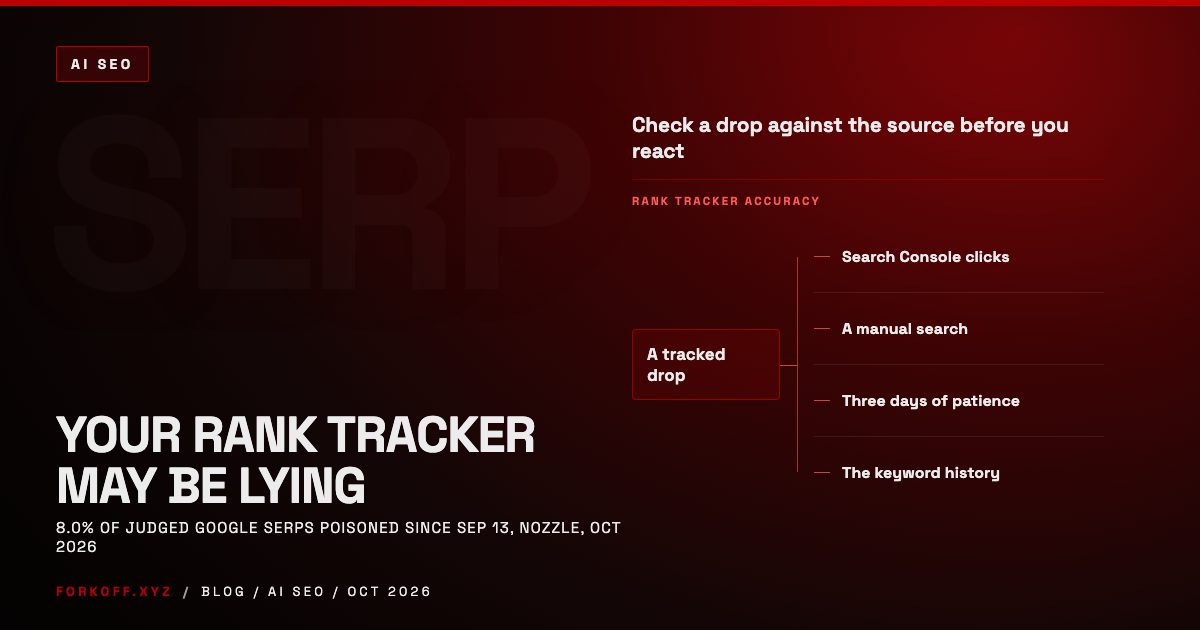
Your Rank Tracker May Be Lying: How to Report SEO and AEO After Google's Poisoned SERPs
Google is serving rank trackers poisoned SERPs. What one tracker measured, how to tell a fake drop from a real one, and how to report SEO and AEO you can trust.
 Read
Read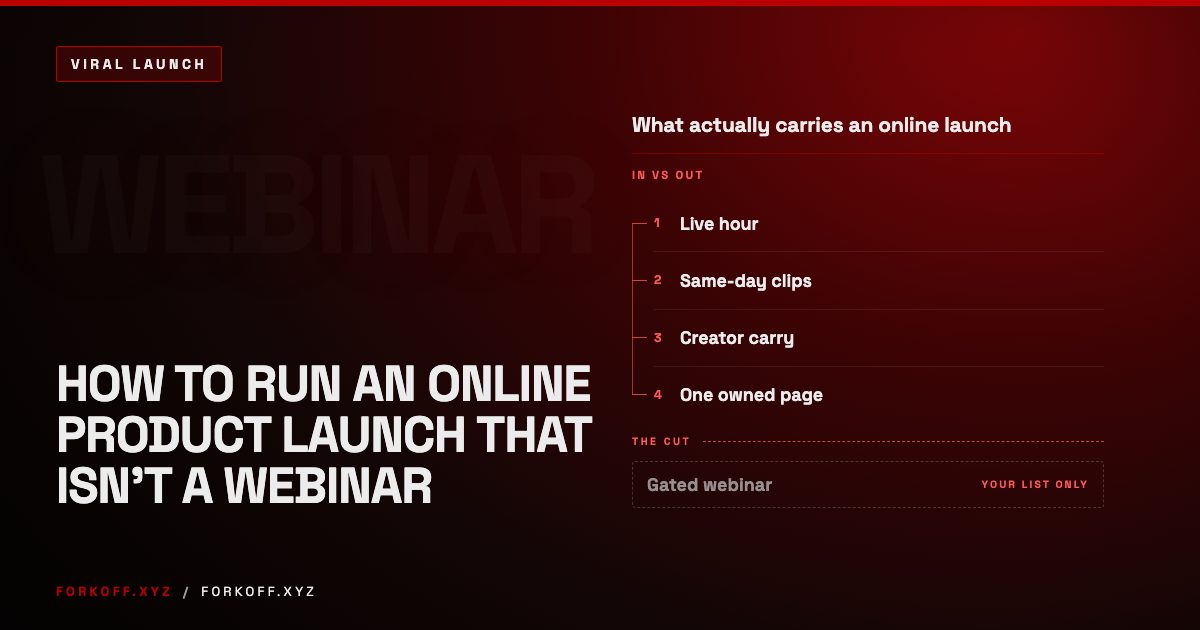
How to Run an Online Product Launch That Isn't a Webinar
An online product launch is a live moment cut into clips that creators carry, not a gated webinar. Here is the livestream, clip and creator stack for 2026.
Read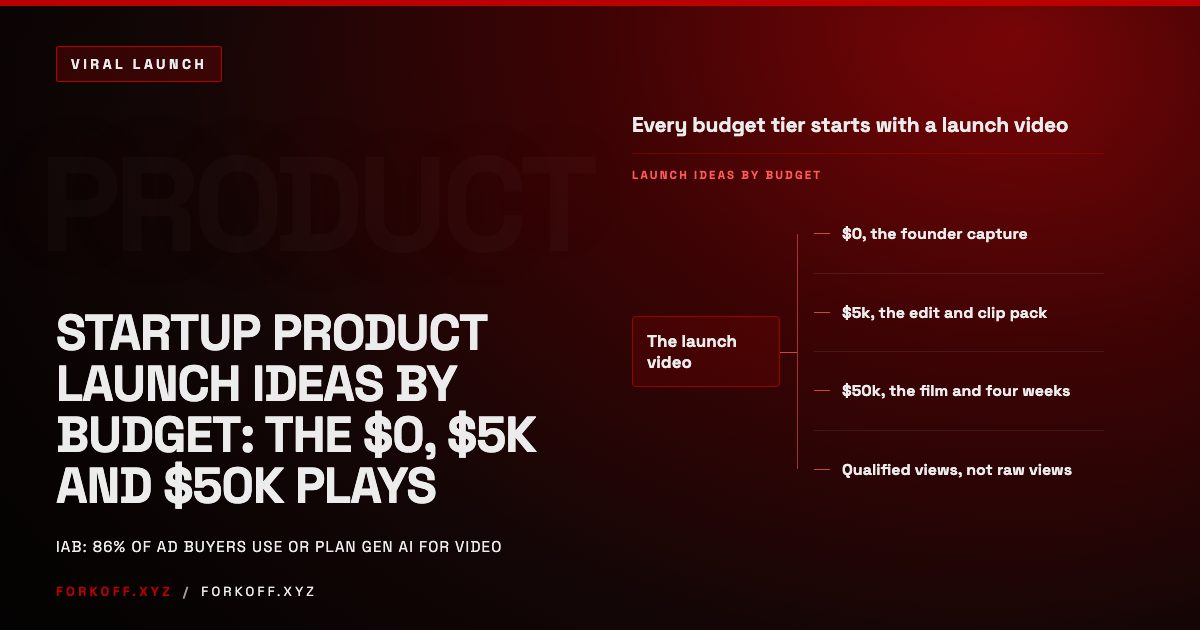
Startup Product Launch Ideas by Budget: The $0, $5k and $50k Plays
Product launch ideas for a SaaS startup sorted by budget: what the launch video should be at $0, $5k and $50k, and the distribution around it.
Read