

Higgsfield AI
@higgsfield_ai · 207.3K followers
Seed Audio 1.0 is live. The best audio model for anything you make. Change a voice, narrate from text, or dub a video into 18 languages.
Seed Audio 1.0 launchVerified Organic
Seed Audio 1.0 is a real product by a real founder (@higgsfield_ai). RADAR has tracked 197.5K views on this launch, according to the source post linked below. RADAR measures how the launch reach was built, not whether the product works or whether anyone was honest. This reading is verified confidence and every input is public.
By Simba, Launch Intelligence Analyst · Reviewed by JK · Published 26 Aug 2026 · Confidence: verified
Independent, methodology-derived signal, not a statement of fact about any person. RADAR reads how reach was built, a signature, not an accusation. See the methodology.
Did the Seed Audio 1.0 launch go viral organically, or was the reach amplified?
The Seed Audio 1.0 launch by @higgsfield_ai drew 197.5K views on 2.0K likes, which is 98 views per like, inside the roughly 500 organic ceiling. RADAR reads the reach as organic: reach and engagement grew together and no distribution-amplified signature shows in the public metrics. This is a verified reading and every input is public and reproducible.
New here? Start with the product
What is RADAR, and what does this grade mean?
RADAR is FORKOFF's launch authenticity rating system. It reads whether a product launch earned its reach through real engagement or bought it through paid distribution, using only public signals anyone can pull from the launch post. Every reading carries a letter grade, a confidence label, and the date it was last checked, and links back to a published method you can reproduce. Seed Audio 1.0 is a real product by a real founder (@higgsfield_ai). RADAR measures how the reach was built, not whether the product works or whether anyone was honest.
Verified Organic
Independent, methodology-derived signal, not a statement of fact about any person. RADAR reads how reach was built, a signature, not an accusation. See the methodology.
What this grade means
This launch carries an Authenticity Grade of Verified Organic. RADAR reads its reach as organic: the views and the genuine engagement grew together, and no distribution-amplified signature shows in the public metrics. That is a favorable, low-risk read.
The signals RADAR reads
Views-to-likes ratio
Organic reach tops out near 500 views per like. When views climb far past that without the likes to match, the extra reach is arriving without the engagement organic reach produces.
Amplification wave shape
Organic amplification spreads over hours and days. A coordinated launch fires a synchronized burst of quote posts in the first few hours, read from each post's own timestamp.
Posting-time fingerprint
A post that fires exactly top of the hour on a weekday is scheduled. On its own it is weak, but it corroborates a coordinated launch alongside the other two signals.
Those three public signals sit on top of RADAR's five-component forensic read. The full method, the bands, and the confidence model are on the RADAR methodology page.
This launch in the data
Where does this reach sit against the tracked corpus?
Where it sits in the corpus
Rank 1 of 30 tracked launches by views per like, lowest (most organic) first. A lower ratio is the favorable end.
Against the benchmark
This launch's views per like next to the organic median (354) and the amplified median (1,441) across the tracked set.
 The product
What is Seed Audio 1.0?
One point of precision on authorship, because it shapes how the launch should be read. The underlying model is ByteDance Seed's, per AlphaSignal's writeup of the release, and Higgsfield's own audio page lists Seed Audio 1.0 alongside Eleven v3, Qwen Audio 3.0, MiniMax Speech 2.8 HD, Seed Speech and VibeVoice. Higgsfield is the distribution and workflow layer here rather than the model's author, and the launch post itself does not claim otherwise: it says the model is live, not that Higgsfield built it. The product being launched is access, integration and the credit bundle around it, which is a real product and a legitimate thing to announce.
Higgsfield is a San Francisco company founded in 2023, describing itself in its account bio as the AI-native creative suite. Its co-founder and chief executive is Alex Mashrabov, who previously co-founded AI Factory, the computer-vision company behind Snapchat's Cameos and face filters, which Snap acquired in 2019. Seven weeks after this launch, on 17 August 2026, the company announced a 400 million dollar Series B at a 5.4 billion dollar valuation, led by DST Global, stating annualized revenue of 700 million dollars, more than 30 million users across 238 countries, and use by 390 Fortune 500 companies. Those are the company's own stated figures in its funding announcement, quoted here as context for the account behind the post and not independently audited by RADAR.
The market is AI audio: text to speech, voice conversion, and automated dubbing. The real alternatives are the dedicated voice companies whose models Higgsfield also carries, the audio features now built into the large video-generation tools, and the traditional route of hiring voice talent and a localization studio. The competitive question in this lane is no longer whether a machine can produce a convincing voice, which is settled, but how few steps stand between a finished video and the same video in another language.
What it does
- Changes the voice in an existing video, replacing the delivery without reshooting.
- Narrates from text, generating speech from a written script.
- Dubs a video into 18 languages, the figure stated in the launch post itself.
- Generates multi-speaker scenes with ambience and background sound rather than a single isolated voice track.
- Runs inside the Higgsfield platform alongside the company's video and image tools, on the same credits.
- Is callable from Claude through the Higgsfield MCP server, which AlphaSignal reports connects over a single URL with no separate API key.
AlphaSignal's writeup adds that voice cloning through the release covers more than 70 languages, against the 18 the post claims for dubbing. RADAR did not independently verify either figure and reports them as stated by their sources.
How the Seed Audio 1.0 launch worked
The launch was a single post carrying a 106-second video, published at 7:56 AM Pacific on Tuesday 30 June 2026 from the company account @higgsfield_ai, which carried 218,151 followers at the time of RADAR's pull.
The copy is four lines and roughly forty words. It opens on availability rather than explanation, "Seed Audio 1.0 is live!", makes a broad quality claim in one line, "The best audio model for anything you make", then does the actual work of the post in a single sentence of three concrete verbs: "Change a voice, narrate from text, or dub a video into 18 languages." The last line names both places to get it: "Available on Higgsfield and on Claude via Higgsfield MCP."
That third line is the one carrying the launch. A superlative in a launch post costs a reader nothing to ignore, but three named actions and a number are checkable, and a reader can tell within a second whether any of them is a job they currently have. The 106-second video is long by launch-post standards, and for an audio model that length is justified: the only honest way to advertise a voice is to let people hear several of them.
The distribution choice worth studying
Shipping the model as a tool an assistant can call, rather than only as a page inside a web app, is the most interesting decision in this launch. It puts the product where a chunk of the target audience already works and removes the step of signing into another interface to try it. AlphaSignal reports the connection is made through a single MCP URL with no separate API key, drawing on the user's existing Higgsfield credits. For a category where the hardest problem is getting someone to make a first render, cutting the setup to one line is a distribution move as much as a technical one, and it is the kind of thing that shows up later as retained usage rather than as launch-day views.
What Higgsfield did during the launch
A short list of assets, each one aimed at a different objection a creator would raise while reading.
| Asset | What it did |
|---|---|
| 106-second video | Long enough to actually hear the output, which is the only proof that matters for an audio model |
| Three named actions in one line | Change a voice, narrate from text, dub a video, so a reader can match the tool to a job they already have |
| A hard number in the claim | 18 languages, checkable and specific, sitting next to a superlative that is neither |
| Same-day availability on two surfaces | The Higgsfield platform and Claude through the Higgsfield MCP server, removing the setup step for one whole audience |
| No new subscription to evaluate | It runs on the credits an existing Higgsfield user already holds |
| Timing: Tuesday 7:56 AM PT | Early Pacific morning, which lands mid-afternoon across European working hours |
There is no giveaway, no discount, no thread and no founder co-announcement. The launch relies on the demo being convincing and on the reader being able to act on it the same minute.
How the launch performed
The launch post reached 200,502 views on 2,009 likes, with 237 reposts, 161 replies, 45 quotes and 1,163 bookmarks. These are matured public metrics, re-pulled directly from the source post on 26 August 2026, not a launch-minute snapshot.
Every layer moved with the reach
At about 100 views for every like, this is the tightest view-to-like coupling in RADAR's current batch, a fifth of the roughly 500 organic ceiling and a twentieth of the 2,000 line where the heavy distribution band begins. Bought distribution widens that ratio by definition: views are the cheap half of the transaction and human reactions are the expensive half, so the two come apart. Here they did not come apart at all. Total public actions reach 2,452, about 1.223 percent of views, the highest engagement rate across the twelve launches in this batch.
The written layer supports the same reading. 161 replies and 45 quotes are the costly actions, each one an original post a person sat down and wrote, and their presence alongside the likes is the fingerprint of a real conversation rather than a bought-view push. Reach and engagement grew together the way earned reach does.
Views per like (matured)
A fifth of the roughly 500 organic ceiling and a twentieth of the 2,000 heavy line. Reach and likes arrived together.
Engagement rate
2,009 likes, 237 reposts, 161 replies and 45 quotes. The highest engagement rate across the twelve launches in RADAR's current batch.
Written engagement
The costly actions. Each quote is an original post a person chose to write and put in front of their own followers.
Bookmarks
More than one save for every two likes. The save-for-later signal of creators filing a tool they intend to come back and use.
The bookmark layer, and what creators do with a tool post
1,163 bookmarks against 2,009 likes is a save for roughly every two likes, and it is the quiet tell on this page. A creator who saves a tool post is filing it against a job they expect to have, which is different from applauding a demo. On a launch whose three named actions are all concrete tasks, a save-heavy shape is what a genuinely useful release produces. Bought impressions do not save anything, because there is no one on the other end of them who intends to come back.
Did the reach get earned or bought?
The band comes from RADAR's five-signal forensic read, not from the ratio alone. The view-velocity curve, the engagement-coupling check, the reply-network authenticity check and the amplifier-cluster check all returned a high-confidence organic result, and here the ratio agrees with all four rather than sitting in tension with them, which is the least ambiguous case RADAR sees.
One scope note. This launch carries no roster row in RADAR's forensic tables, so there is no amplifier cluster to describe and none is claimed. The read rests on the public post metrics of this post and nothing else. RADAR judges every launch on its own numbers, and these numbers are unusually clean.
What a founder can take from this launch
The transferable lesson is the line that did the work. A superlative costs a reader nothing to skip. Three named actions and a hard number let them match the product to a job they already have inside one second, and that match is what converts a scroll into a save. Put the checkable sentence next to the unprovable one and let the checkable one carry the post.
The second lesson is about where a launch lands, not just what it says. Shipping on two surfaces the same day, one of them a place the target audience was already working, removed the setup step that usually stands between a launch post and a first render. When the friction between reading and trying is one line of configuration, the bookmark layer stops being a graveyard and starts being a queue.
Third, do not be afraid of a longer video when the product needs one. 106 seconds is well past the length most launch posts get away with, and for a model whose entire proposition is how something sounds, a shorter cut would have proved less.
FORKOFF builds launch videos made to travel and helps founders plan the launch around them, including the longer demonstration cut a product like this one needs. See how we approach it on the viral launch video service, or read the best product launch videos we track for more real examples.
Questions readers ask about this launch
What is Seed Audio 1.0?
+
Did the Seed Audio 1.0 launch go viral organically?
+
How many views did the Seed Audio 1.0 launch get?
+
Who is behind Higgsfield?
+
What does a READS-ORGANIC verdict mean here?
+
Sources
Primary citation: x.com/higgsfield_ai/status/2071971182732333418. Every number traces to a public pull; reads re-checked over time.
- Seed Audio 1.0 launch post (source), x.com/higgsfield_ai
- x.com/higgsfield_ai (company profile)
- Higgsfield product site, higgsfield.ai
- Higgsfield Audio, higgsfield.ai/blog
- Seed Audio 1.0 brings voice cloning and dubbing into Claude, AlphaSignal (30 June 2026)
- Higgsfield raises 400 million dollar Series B at 5.4 billion valuation, PR Newswire (17 August 2026)
- RADAR methodology
How RADAR read this launch, component by component
Each named component carries a plain-English definition and a directional read where the public data supports one. RADAR publishes the component names, never the weights or the formula.
View-velocity signature
Not publishedWhether the view curve grew the way organic spread does, or spiked like an injected burst.
Per-launch read not published in the public dataset. This component needs the forensic engine output.
Engagement coupling
Supports organicWhether likes, replies, and reposts grew in step with views (the organic signature), or the views ran out ahead.
At 98 views per like, likes track views inside the roughly 500 organic ceiling.
Reply-network authenticity
Not publishedWhether the accounts replying are real, distributed people or a coordinated cluster posting together.
Per-launch read not published in the public dataset. This component needs the forensic engine output.
Amplifier-cluster pattern
Not publishedWhether the quote-tweet amplification looks like organic word of mouth or a known activation cluster.
Per-launch read not published in the public dataset. This component needs the forensic engine output.
Smart-follower activation
Not publishedWhether genuinely influential reference accounts engaged, or the reach was only low-quality volume.
Per-launch read not published in the public dataset. This component needs the forensic engine output.
Are you the founder of Seed Audio 1.0? You can claim or contest this read. RADAR attaches a founder response to the launch and re-examines any component you dispute.
Authorship
Simba
Co-founder, FORKOFF
Reviewed by: Kshitij JK
Last reviewed:
Published:
Methodology
RADAR verified reading of the Seed Audio 1.0 launch from public metrics: the views-to-likes ratio against the roughly 500 organic ceiling and the posting-time slot, framed as a signature of how reach was built, not an accusation.
Sources cited
- RADAR methodology , FORKOFF
- Seed Audio 1.0 source post , X
Where to go next
Understand launch authenticity
Three ways in, depending on what brought you here: learn how the score works, get a launch read or built, or get the plain answer on this launch.
Learn the score
What a launch authenticity score is
A launch authenticity score reads whether a launch earned its reach or bought it, from public signals. Start with the definitions and the checks you can run yourself.
Verify or build
Launch authenticity verification
Want a launch read by the same method, or a launch video made and distributed on the outcome? RADAR reads any public launch, and FORKOFF builds the launch behind the reach.
The skeptic's question
Is the Seed Audio 1.0 launch legit?
If you are checking whether the Seed Audio 1.0launch was real users or bots, here is the honest read: RADAR's reading is Verified Organic, at verified confidence, computed from public metrics and reproducible from the source post. It measures how the reach was built, not whether the product works.
Peer launches
Launches with a similar read
Jupiter Wallet biometrics launch
@JupiterExchange
62.4K views · 130 per likeRead
Short Video Overviews (NotebookLM) launch
@NotebookLM
2.5M views · 211 per likeRead
Browserbase Agents launch
@browserbase
90.2K views · 292 per likeRead
OpenAI's Jalapeño AI chip launch
@OpenAI
7.1M views · 312 per likeRead
Koji launch
@suekhim
4.8M views · 396 per likeRead
Contra Payments launch
@contraben
2.3M views · 445 per likeRead
The benchmark behind every reading
- The organic vs amplified benchmark. What a healthy launch ratio looks like, side by side.
- RADAR methodology. The bands, the confidence model, and how to reproduce a read.
- The Launch Authenticity Report 2026. The aggregate study across the tracked corpus.
- The X Launch Authenticity Study 2026. Two in three tracked launches show a bought-amplification signature.
- Verified-organic leaderboard. The launches RADAR reads as genuinely organic.
- Best product launch videos. The editorial cut of every tracked launch, ranked by views.
- Product launch video service. Get a launch video made and distributed, priced on the outcome.
Want a launch read by RADAR's method?
RADAR reads whether a launch's reach was earned or bought from public data, with the confidence label and the source citation on every reading.
Receipts, deep dives, and playbooks.
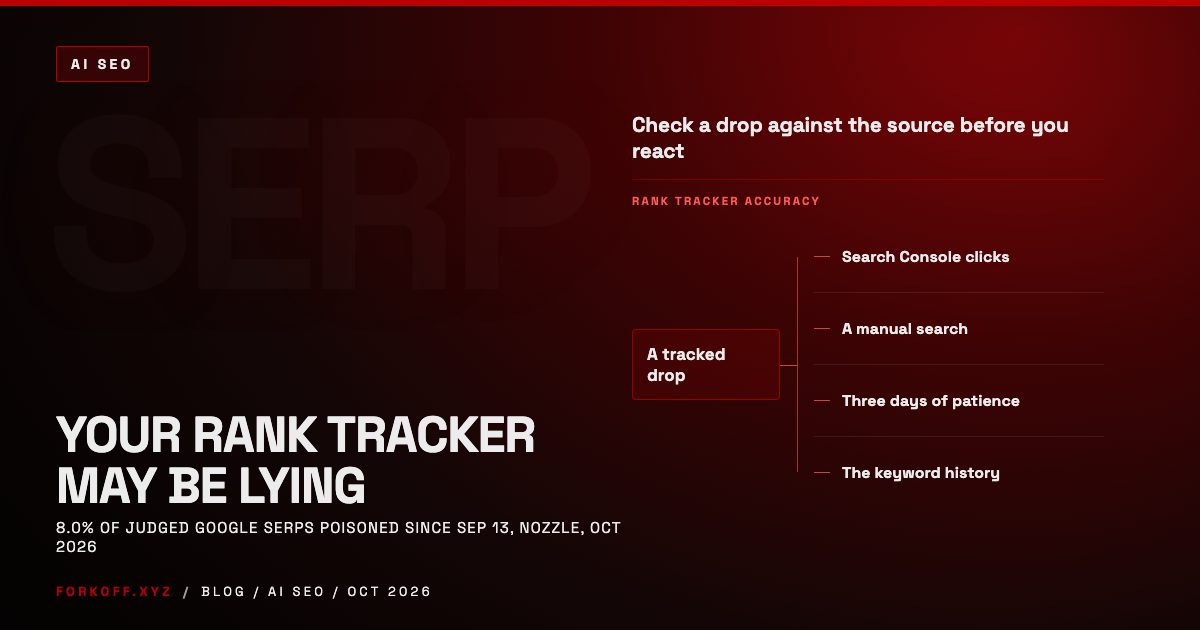
Your Rank Tracker May Be Lying: How to Report SEO and AEO After Google's Poisoned SERPs
Google is serving rank trackers poisoned SERPs. What one tracker measured, how to tell a fake drop from a real one, and how to report SEO and AEO you can trust.
 Read
Read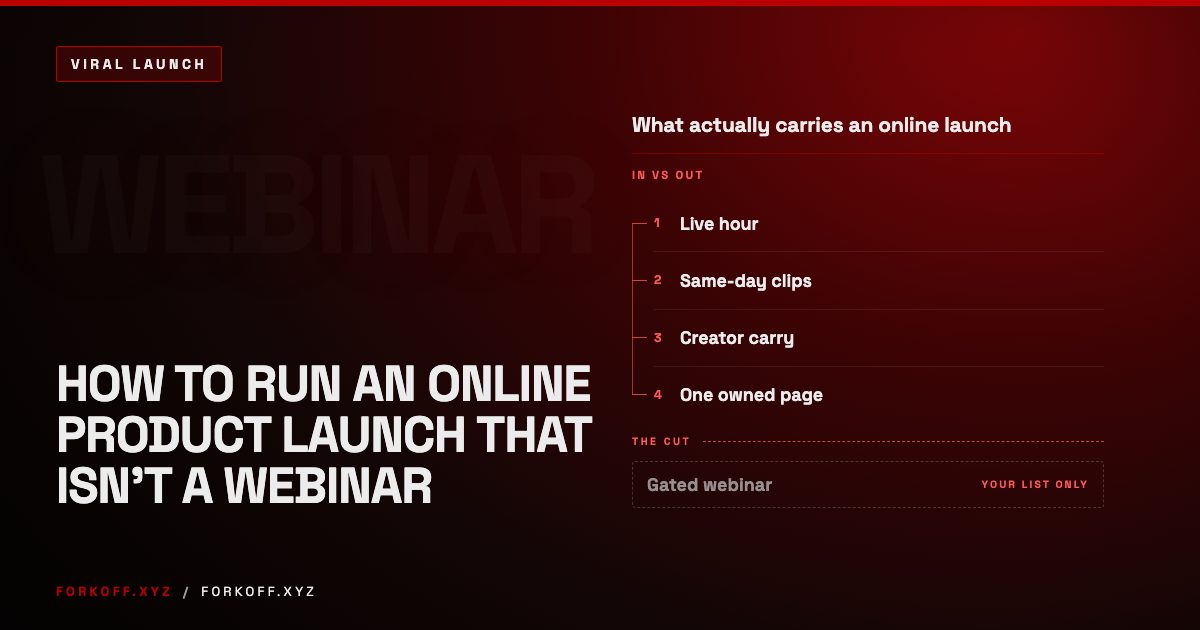
How to Run an Online Product Launch That Isn't a Webinar
An online product launch is a live moment cut into clips that creators carry, not a gated webinar. Here is the livestream, clip and creator stack for 2026.
Read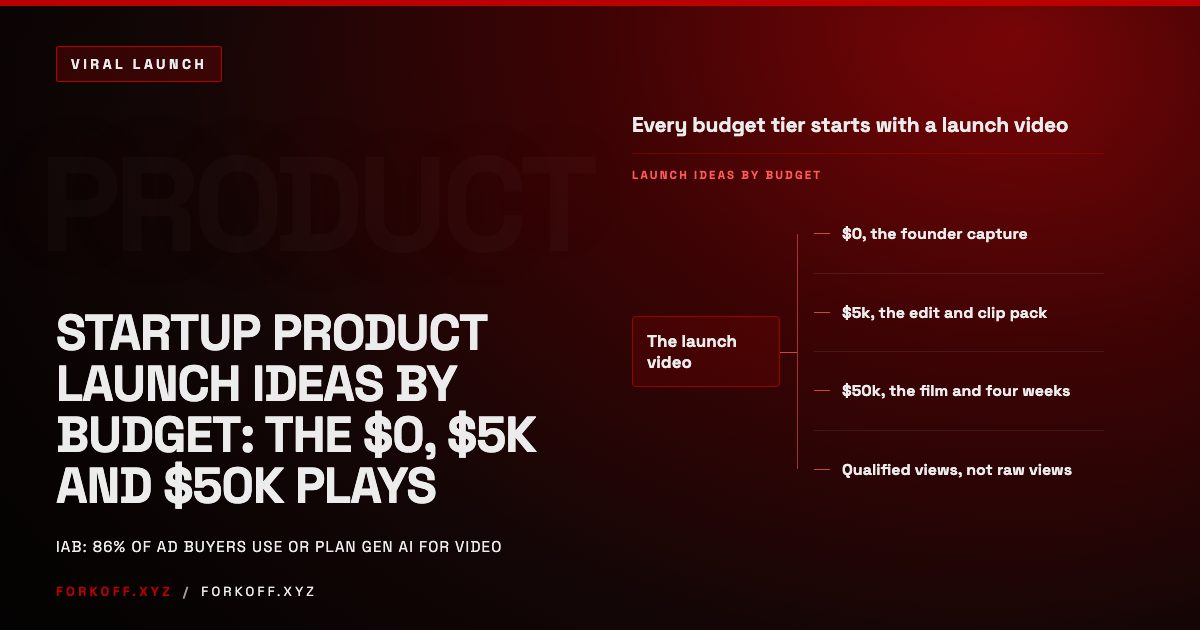
Startup Product Launch Ideas by Budget: The $0, $5k and $50k Plays
Product launch ideas for a SaaS startup sorted by budget: what the launch video should be at $0, $5k and $50k, and the distribution around it.
Read